Love & Protest in Taiwan: LFM Reviews Girlfriend Boyfriend—GF BF

From "Girlfriend Boyfriend: GF-BF."

By Joe Bendel. In the 1980’s, student protesters across Taiwan started demanding a more democratic form of government. By 1997, the country functioned much like our own duly elected but media-driven dysfunctional system. While historic events unfold on a macro level, three classmates struggle with their own messily intertwined lives and loves in Yang Ya-che’s Girlfriend Boyfriend—GF BF (trailer here), which opens today in New York.

High school magazine editor Aaron is passionate about Mabel and the democracy movement. She likes him well enough and supports the cause, to an extent, but she really has eyes for Liam. Though he has affection for her too, it is definitely of the “just friends” variety. He pines for Aaron instead, but realizes that simply is not to be. Eventually, Aaron wins Mabel over, at least temporarily, but the three keep in close contact for the next decade or so, which leads to considerable pain and complications for them all. Meanwhile, they watch from the student barricades as political reform sweeps across Taiwan.

Granted, GF BF’s premise certainly lends itself to melodrama, but Yang’s approach to the material is unexpectedly restrained. Frankly, he passes up several golden opportunities for tearjerking. Similarly, he consistently eschews didacticism when depicting the student movement. In fact, the orderly, matter-of-fact manner the film portrays Taiwan’s revolutionary liberalization is rather surprising (and telling).

Nonetheless, GF BF has a wistful air of innocence lost that leaves quite an impression. Cinematographer Jake Pollock’s early candle-lit night scenes are particularly evocative. There is a real sense of time passing in the film, even though its ridiculously attractive cast never seems to age a crow’s foot over a dozen or so trying years.

From "Girlfriend Boyfriend: GF-BF."

Who would want to see Gwei Lun Mei age anyway? As Mabel, she vividly projects earnest sensitivity, without degenerating into an emotional basket case. It is a perfect starring vehicle for her. Likewise, Joseph Chang is also a pretty effective tortured slow burner as Liam. However, Rhydian Vaughan never really gets inside Aaron, leaving viewers with the impression of a rather shallow opportunist.

It is hard not to favorably compare the response to the Wild Lily Student Movement with the Tiananmen Square protests just one year earlier, but that is hardly GF BF’s central point. It is sort of like a Taiwanese Jules & Jim, intensified by tumultuous social change and the closeted homosexual dynamic added to their mismatched love story.

Like the lives it presents, GF BF can be a bit unwieldy, but it is consistently engaging viewing and also fascinating as a reflection of current Taiwanese socio-political attitudes. Recommended for those who enjoy a love triangle with a very definite sense of time and place, Girlfriend Boyfriend opens today (8/3) in New York at the AMC Empire and Village 7, as well as in San Francisco at the AMC Metreon and Cupertino Square, courtesy of China Lion Entertainment.

LFM GRADE: B

Posted on August 3rd, 2012 at 11:35am.

Women’s Rights & Islam: LFM Reviews Invoking Justice @ The Asian American International Film Festival

By Joe Bendel. They are called Jamaats. In Muslim areas of Southern India, these neighborhood old boys’ networks supposedly apply sharia law. However, in practice, they regularly provide cover for abusive and even homicidal husbands. At least, such appears to be the case based on the evidence presented to the upstart women’s Jamaats. Deepa Dhanraj documents the efforts of the women’s Jamaat leaders to redress gender based injustices in Invoking Justice, which screens during this year’s Asian American International Film Festival in New York.

As per Indian custom, Islamic law officially supersedes secular law in the provincial south. It is a nice set-up if you are a man, particularly if you and your cronies are on the community Jamaat. If you are a woman, though, the system is literally rigged against you. However, a small but growing number of Muslim women have challenged the institutionalized misogyny by forming alternative women’s Jamaats. While their legal standing is rather iffy, especially by the local standards, the civilian police force has to deal with them. This often means the men’s Jamaats must as well, albeit rather grudgingly.

From "Invoking Justice."The kinds of cases women’s Jamaat activists investigate are frankly shocking, including several cases of spousal murder and one abused wife and mother desperately trying to divorce her pedophile husband. The women’s Jamaat founder Sharifa Khanam clearly knows the Koran and uses it to shame their male counterparts. Yet, on a fundamental level, they still acknowledge the primacy of Islamic law over civilian authority. Indeed, this begs an obvious question Dhanraj does her level best to ignore: is religious-based law compatible with any meaningful notion of justice? Indeed, viewers might well wonder if non-Muslims living in Tamil Nadu have any recourse for legal redress, whatsoever.

To be fair, Dhanraj largely adopts the observational approach, only sparingly mixing in traditional on-camera interview sequences. We see the Jamaat case-workers do the leg work and build the trust of families seeking their assistance. Tellingly, it is not just women who petition the women’s Jamaats for help, but often the male relatives of women who have been battered and even killed.

Invoking is certainly eye-opening stuff. However, if ever there was a film that could have benefited from a little confrontational showboating, it would have been this one. Ultimately, viewers will feel justice is not being served in Tamil Nadu and may well suspect the situation is even worse than it appears in Dhanraj’s documentary. Still, capturing courage on-screen is always a worthy endeavor. Earning a moderate recommendation for those concerned about the state of women’s affairs in the Islamic world, Invoking Justice screens this coming Saturday (8/4) at the Chelsea Clearview, as part of the 2012 AAIFF.

LFM GRADE: B-/C+

Posted on August 3rd, 2012 at 11:35am.
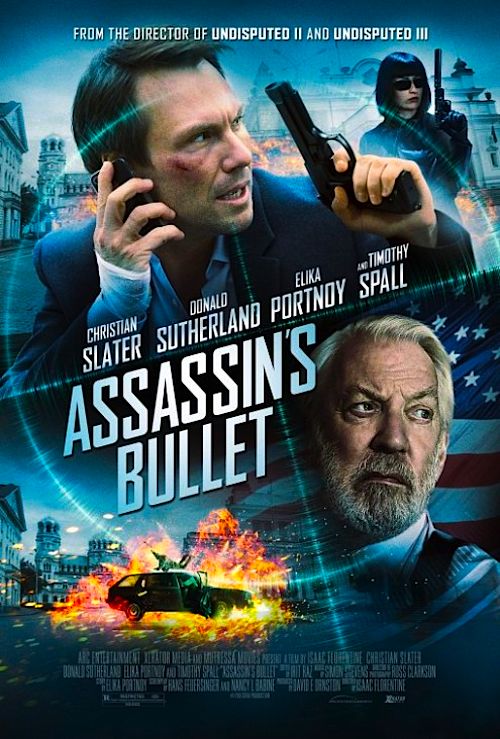
La Femme Sofia: LFM Reviews Assassin’s Bullet

By Joe Bendel. Someone is killing Europe’s top Islamist terrorists. This is a problem for American intelligence bureaucrats, because it makes them look bad. The vigilante has taken out priority targets they could not even find – and therefore must be stopped, post-haste. That assignment falls to a former FBI agent assigned to America’s Bulgarian embassy in Isaac Florentine’s Assassin’s Bullet, which opens this Friday in New York.

Still wracked with guilt over his wife’s death, Robert Diggs is taking a timeout from life in Bulgaria. Happy overseeing on in-country educational initiatives, Diggs is reluctant to get back into investigative work. However, Ambassador Ashdown is a political appointee very aware he is in over his head and in need of Diggs’ services. Reluctantly Diggs starts tracking the vigilante, who is obviously also the English teacher at the Embassy-sponsored high school, as well as the belly dancer who has been come-hither dancing for Diggs at his favorite night club.

The good news about Bullet is that it has no tears for the vigilante’s prey. Her motivation is clear: terrorists murdered her family. Had they lived, her targets would have only spread more death and misery. It even unambiguously associates the keffiyeh scarf with terrorism, which makes it a pretty dumb choice of accessory for Diggs during the climatic third act. The bad news is a spoiler that will not be much of a surprise: there is some shadowy villainy going on at the highest levels of the American diplomatic-intelligence services.

So Bullet isn’t really a great movie, but it is sort of a shame you can hardly see serviceable B-movies like this in the theaters very much anymore. Back in the day, this totally would have been worth a trip to the drive-in or the bargain cinema. In fact, on a technical level, Bullet is a surprisingly polished production. Florentine stage-manages a couple of nifty little fight scenes. Of course, that is his specialty, having previously helmed the Scott Adkins Undisputed series and the Power Rangers, for both the big and small screens (don’t scoff at that gig; they don’t entrust important franchises like that to hacks). Shot on location, Florentine made the most of the exotic Sofia sites and cinematographer Ross W. Clarkson gives it all a moody, mysterious sheen.

The real mixed bag here is the cast. Christian Slater is more or less okay as the earnest Diggs and co-scenarist Elika Portnoy is sort of/kind of okay as the mystery woman. At least Donald Sutherland does not disappoint doing his stately roguish thing as the Ambassador. Yet, the high point might be Timothy Spall, clearly enjoying the ambiguity of the friendly but inscrutable Dr. Kahn, a part that would have had Donald Pleasance’s name all over it in years past.

As it happens, Bullet’s DVD release is already scheduled to follow hard on the heels of its New York opening. Make of that what you will. Frankly, it ought to find an audience through more affordable means of distribution. It is not classic, but some considerable filmmaking talent went into it (most definitely including the contributions of Florentine, Clarkson, and Spall). Eventually recommended for B-movie lovers at B-movies prices, Assassin’s Bullet opens this Friday (8/3) in New York at the Cinema Village.

LFM GRADE: C+

Posted on July 30th, 2012 at 12:44pm.

LFM Reviews I Am a Ghost @ The 2012 Asian American International Film Festival

Anna Ishida in "I Am a Ghost."

By Joe Bendel. Just because you’re a ghost, doesn’t mean you can’t be haunted too. For Emily, “haunted” is not exactly the right term. Her situation is rather more complicated and creepy as all get-out in H.P. Mendoza’s I Am a Ghost (trailer here), which screens during the 2012 Asian American International Film Festival in New York.

Emily’s existence is one of strictly regimented routine. Unfortunately, this also includes regular instances of self-abuse. The audience knows this because we see her repeat the same day over and over. It might sound laborious in an indulgent, experimental kind of way – but stick with it. When deviations from the pattern start to emerge, they are significant and jarring.

Emily is a ghost, endlessly repeating the tragic memories she imprinted on the spooky old Victorian house, or at least that is what the disembodied voice tells her. Understandably, that is not something she wants to hear. Yet, Ghost is just getting started. Emily has some rather wicked revelations in store for her.

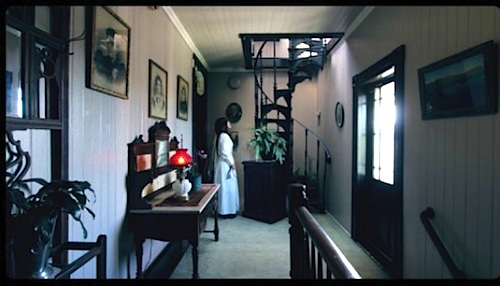
From "I Am a Ghost."

With Ghost, Mendoza might actually break new ground in the field of horror films. It is really nothing like his previous films, Colma and Fruit Fly, since it is not a musical—not even remotely. Frankly, Mendoza risks trying viewers’ patience, but he pays off their tolerance with some of the most disconcerting scenes of supernatural dread to hit screens in years. In fact, the scares in Ghost are so unusually deep, because they are more metaphysical in nature. Mere violence is small potatoes here. However, it is difficult to explain how novel and challenging the twists and turns truly are, without getting spoilery.

It is safe to say Ghost is a very cool example of how a chillingly effective genre film can be produced with hardly any special effects. Aside from maybe one sequence, Ghost relies solely on its lead performance and the moody atmosphere of the fateful house, overstuffed with evocative curios, masterfully rendered by art director-prop designer (and producer) Mark Del Lima.

Still, it is Anna Ishida carrying the picture more or less alone as Emily. It is quite an extraordinary performance, covering the entire dark side of the emotional spectrum, with only an off-screen voice for support.

Ghost definitely has the stuff of a cult classic, and ought to be a breakout film for both Ishida and Mendoza. It is smart, original, and unsettling. Highly recommended for fans of ambitious horror films, I Am a Ghost screens this Friday (8/3) at the Chelsea Clearview Cinemas, as part of this year’s AAIFF.

LFM GRADE: A

Posted on July 30th, 2012 at 12:42pm.

LFM Reviews Easton’s Article @ The 2012 Fantasia Festival

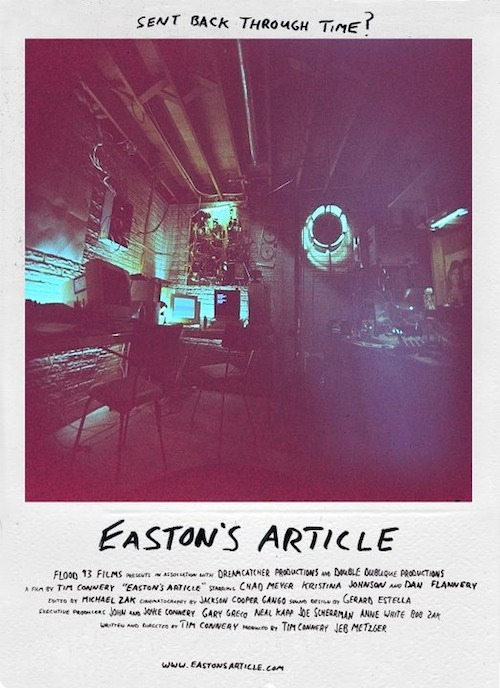
By Joe Bendel. It is 1997. The internet bubble has yet to burst and dial-up is still commonplace. Easton Denning is an internet expert who has seen the future. Unfortunately, he is not a part of it. Time will bend as the computer wonk challenges fate head on in Tim Connery’s high concept, low-gloss science fiction drama Easton’s Article, which screens at the 2012 Fantasia Festival.

After high school, Easton left Iowa and never looked back, until now. He had his reasons, which will be revealed as he deals with his current crisis. One night, his internet spiders retrieved a massive data dump. Most of it was just corrupted files and the like, but there was one document that spooked Denning: his future obituary.

Along with his death notice, the scanned file includes hand written notes instructing him to be at certain places at certain times. He will know why when he gets there. Obediently, Denning returns home, duly encountering the father and girlfriend of his close high school friend, who died under murky circumstances their senior year. Somehow, karma appears to be using the internet to do its thing.

Frankly, the time travel elements in Article are basically hocus pocus, likening a digital information deluge to a flood of water, effectively spilling over into the past. However, the characterizations and the overriding vibe of tragically unfinished business are strong enough to overwhelm logical pedantry. Perhaps the closest comparison film would be John Weiner & Danny Kuchuck’s clever Cryptic, which deserved more attention when it played the festival circuit.

Indeed, Article represents the road not taken often enough in the science fiction genre, telling an intimate yet speculative story, with little or no special effects required. Connery’s completely linear script fits together the pieces without any distracting seams, while fully immersing viewers in his characters’ lives and Midwestern environment.

Looking like everyday regular people, the small ensemble is smart and engaging throughout Article. Given the anti-social protagonist’s myriad flaws, Chad Meyer has a somewhat tough road to hoe, but he portrays Easton as a haunted, fully dimensional human figure. Likewise, Kristina Johnson brings substance and sensitivity to Hayley Reed, Easton’s potential love interest. A more sharply drawn role than typically expected in low budget genre fare, Reed is a refreshingly active participant here and not simply stuck on the sidelines wringing her hands.

Easton’s Article might just be the definitive Iowan science fiction film. Moody and thoughtful, it is definitely for the high end of science fiction fandom’s bell curve, but by the same token it is also quite accessible to non-genre audiences. Recommended accordingly, Easton’s Article screens this coming Wednesday (8/1) at this year’s Fantasia Festival up north.

LFM GRADE: B+

Posted on July 30th, 2012 at 12:41pm.

IFC Midnight: LFM Reviews Rites of Spring

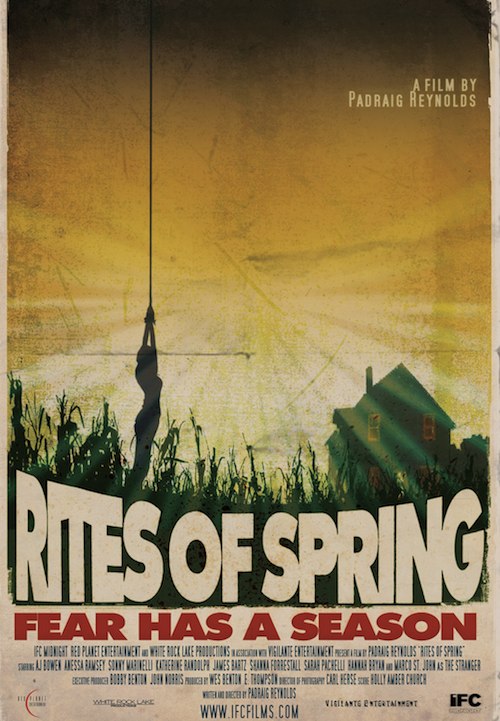
By Joe Bendel. It’s time to spring forward into Spring—although not the way you might prefer. There is a reason a small rural Mississippi county always has perfect weather for their crops. Initially, a ruthless band of kidnappers couldn’t care less about agriculture when they abduct a young girl for ransom, but they soon will in Padraig Reynolds’ Rites of Spring (trailer here), which began a run of midnight screenings Friday night in New York at the IFC Center and will also be available nationally on VOD.

Rachel Adams is drowning her guilt at a local tavern. Thanks to a mistake she made, the office doormat got canned. Unfortunately, it is also the first day of spring. That means an old farmer has to find five sacrifices to the “it” living under the trap door in his barn to maintain the supernaturally good local weather. Adams and her friend Alyssa Miller are about to see the inside of his psycho-stalker van.

Ben Geringer is the dumb jerk from Adams’ office. Somewhat disappointed by recent events, Geringer agrees to a dodgy plot to kidnap the daughter of his now former boss. However, Paul Nolan, the ostensive mastermind, seems to nurse an even deeper grudge against their well-heeled target. Naturally, Geringer and company hole-up in a shuttered high school not far from the old coot’s farm, so when Adams manages to escape, she blunders into their abduction drama. Of course, the ravenous beast also follows.

This will probably disappoint many potential viewers, but they should know there is no Stravinsky on Spring’s soundtrack. And as a genre hybrid, the film is somewhat uneven. However, it is surprisingly effective as a rather dark and nasty crime drama, at least for a while. Sonny Marinelli makes a particularly entertaining villain as the all kinds of bad news Nolan. As Geringer and his Lady Macbethish girlfriend, indie genre vets A.J. Bowen and Katherine Randolph also fare quite respectably in the straight crime scenes.

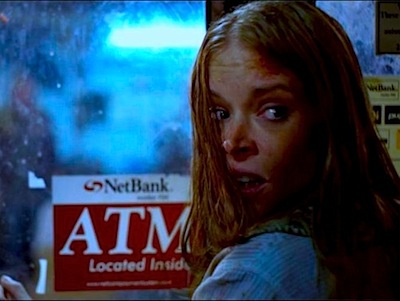
Anessa Ramsey in "Rites of Spring."

Conversely, the supernatural-slasher side of the coin is often pretty silly. It is hard to believe the old farmer still has enough gas in his tank to lug about full grown adults, while the what-ever-it-is monster just looks like a dude with gauze tied around his head.

Reynolds team scouted some good locations, most notably the big spooky industrial-looking school building. He also builds some nice claustrophobic tension, only to let it deflate as soon as the action shifts to the evil farmhouse. The rather abrupt ending does not help much nor does the brief but befuddling stinger. Frankly, the film has its moments, but it just doesn’t pan out. That’s life. A serviceable midnight movie candidate, but highly flawed when judged on its merits, Rites of Spring screens round midnight at the IFC Center.

Posted on July 30th, 2012 at 12:40pm.