Colin Farrell: The Restoration

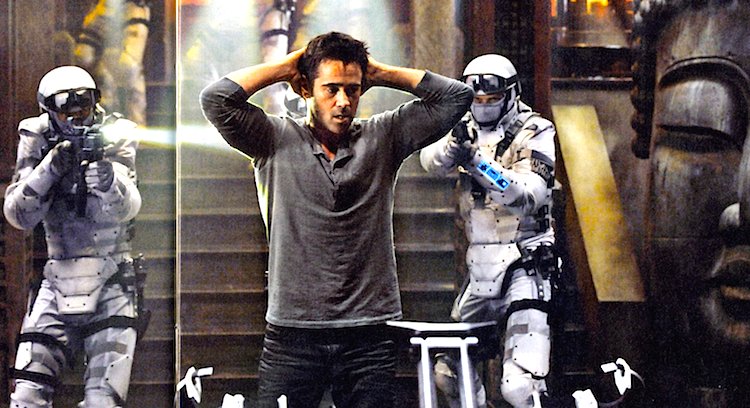
Colin Farrell in the new "Total Recall."

By Patricia Ducey. Now that the trailer for the remake of Total Recall is out, I thought about Colin Farrell and the trajectory of his career – how the actor once more famous for his partying than his acting climbed his way back to blockbuster status again, now reprising Arnold Schwarzenegger’s iconic role. How did he get from Alexander to Quaid? [See Colin Farrell discuss the new Total Recall here.]

Farrell’s international career ignited when he, a Dublin native and actor in both Ireland and on the BBC, was cast by Joel Schumacher in Tigerland (2000) as Bozz, an edgy Texan army recruit. His smoldering good looks and credible Texas twang in the film made Hollywood sit up and take notice. With his Irish charm, his reputation for four letter words, and rebelliousness — plus his nudity in Tigerland — Farrell soon became known as much for his off-screen antics as for his roles, and for a while he was the enfant terrible of the film world. A blur of big roles followed Tigerland: he co-starred opposite Bruce Willis in Hart’s War, played Jesse James in American Outlaws, and worked with Steven Spielberg on Minority Report. He shot to the top of the acting world, and landed the cover of Vanity Fair — all before he was 25.
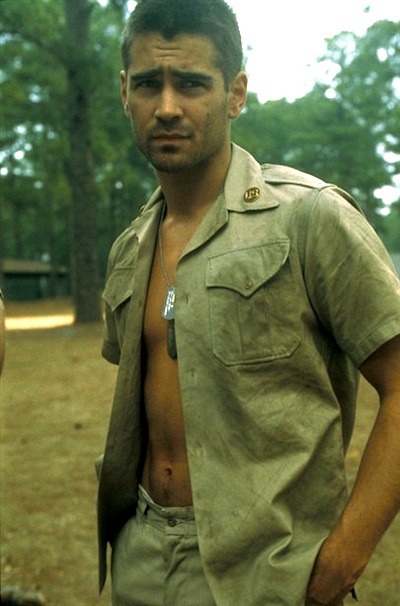
Colin Farrell in "Tigerland."

Then Farrell donned that platinum blond wig (but kept his Irish accent) for the title role in Oliver Stone’s unfortunate Alexander in 2004. Nominated for six Razzies, the movie was rejected by critics and moviegoers alike. He quickly went to work on a remake of Miami Vice, then collapsed at the wrap party and checked into rehab. Miami Vice collapsed, too.

Farrell had offended the lords of fame and cinema: his movies bombed, and his x–rated exploits felt, well, exploitative. He didn’t work much. And although many Hollywood notables who burn the flame at both ends never make it back (like Stone himself, still wandering in the desert after Alexander), Farrell did. In a series of small but memorable roles over the past five to six years, Farrell worked steadily and garnered attention for all the right reasons. By honing his affecting acting skills and leaving the bad-boy persona behind, he moved forward.

In four roles, especially — John Smith in The New World, Ray in In Bruges, Valka in The Way Back, and as Bobby Pellitt in Horrible Bosses — Farrell played against his good looks and roguish charm (and his much ballyhooed craic-loving ways) to create indelible characters instead.

When he read the script to In Bruges, for instance, he loved it. But he warned Martin McDonagh, the director, “I don’t think you should hire me. I come with a certain amount of baggage that has been well earned through the years and this piece is so pure, I would love the audience to not have too much of a relationship with any of the actors.” Luckily, McDonagh disagreed and hired him. The result is the character of Ray, a hit man who violates his own moral code by killing an innocent and who spends the rest of the film trying to expiate his guilt. Strangely, and thanks to Farrell’s portrayal, we root for him to do just that.

After Bruges Farrell played Valka, a Russian gangster in The Way Back (a film often written about here at Libertas, see here and here), another “minor” character with a believable, multifaceted identity. Valka admires toughness and demands it of others. With a tattoo of Stalin on his chest to honor one of Russia’s “tough men,” he eschews self-pity — “grateful is for dogs” — and doesn’t quit until he reaches the border. Turns out he is not so tough after all, though. At the border he realizes he can’t leave Russia, his beloved homeland –  and as for freedom, he “wouldn’t know what to do with it.” Another deftly created character with just the right touch of saint and sinner.
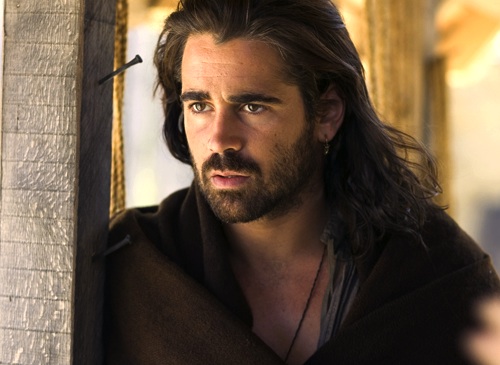
Farrell in "The New World."

On the comedic side, in Horrible Bosses Farrell undergoes a complete physical transformation as Bobby Pellitt, the obnoxious son of the boss. Vanity be damned, Farrell morphs into one of the most comically unlikable characters ever, yet the fierceness of Bobby’s lust for power (plus an almost heroically bad comb-over) earn our admiration.

But the first I saw of Farrell after his burnout was his role as Captain John Smith in Terrence Malick’s The New World. I was frankly surprised by the seriousness of his work – and his willingness to subsume himself into Malick’s ensemble – instead of dominating the screen. This was definitely not a star turn. In New World Farrell captures us without speaking — dialogue is always sparse in a Malick film — first as the rebel explorer, and then as Smith the man in love. I sought out Farrell’s films after that, and the string of memorable portrayals continued.

I’ve enjoyed him so much in these “supporting” roles that I almost hate to see him in the lead – of a blockbuster, no less – once again. Almost. By now he’s tucked the baggage away and earned his standing as a leading man. In the new trailer we can guess that his Total Recall is going to be different, with a vulnerability and emotional depth as evident as in his previous work. There’s a soul, not a cyborg, behind those eyes — and somehow I don’t think the stardust will blind him this time.

Posted on April 3rd, 2012 at 2:26pm.
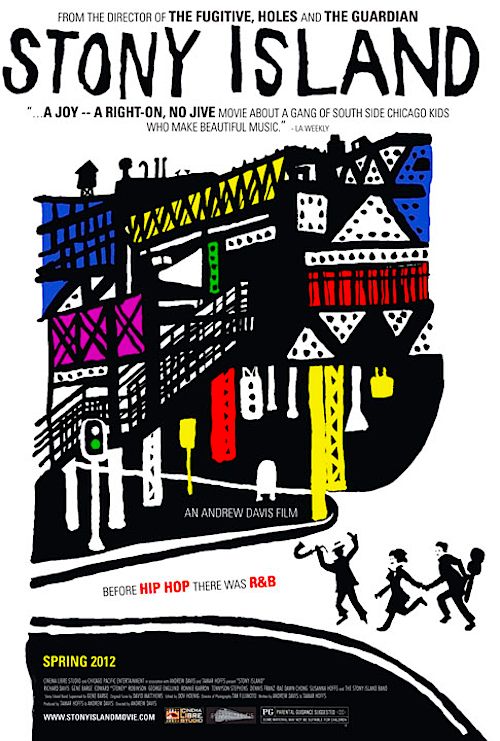
At Last: LFM Reviews Stony Island

By Joe Bendel. Some things never change. In the late 1970’s, Chicago was home to musicians who played the blues and crooked politicians who gave them, just as it is now. For his feature directorial debut, future Fugitive helmer Andrew Davis captured the vibe of his hometown in the hip musical drama Stony Island (a.k.a. My Main Man from Stony Island). Despite the talent involved in the production, it has been nearly unseen for decades, known mostly to diehard record collectors familiar with the smoking hot soundtrack LP. Happily, this will soon change. Stony Island screens this Wednesday and Thursday at Chicago’s Gene Siskel Film Center, in advance of it April 24th DVD release from Cinema Libre.

Guileless guitarist Richie Bloom has come to Chicago with a dream. He wants to start a band, so he does with the help of his vocalist Stony Island neighbor Edward “Stoney” Robinson and Percy Price, a beloved tenor sax veteran of the Chicago music scene. Slowly, they piece together a grooving big-funk band, but just as it all starts to click, Price, their spiritual leader, tragically dies. With their first big gig on the horizon, the Stony Island Band must pull together to find a way to give the destitute Price a proper send-off.

Comprised largely of tunes arranged and composed by David Matthews (the CTI Records house arranger), the Stony Island soundtrack should have been more sought after by vinyl hounds. Though ostensibly R&B, the Stony Island Band often plays more in a greasy soul jazz bag, which is very cool. A lot of great musicians’ musicians appear in the film, such as Chess Records mainstay Gene Barge, making a strong impression as Price. Those heard but not seen include studio warriors like alto saxophonist David Sanborn (during his groovy CTI, pre-smooth days), guitarist Hiram Bullock, and bassist Mark Egan.

Some of Island’s musician-actors are a bit awkward on-screen, but they always mean well. In contrast Barge gives a fantastically soulful and assured performance as Price, the Obi-Wan Kenobi of funk. Likewise, Ronnie Barron, a onetime sideman to just about everyone from New Orleans, brings the film a fresh jolt of energy as keyboard player Ronnie Roosevelt. His NOLA arrangement of “Just a Closer Walk with Thee” is also one of the film’s highlights.

Viewers should keep an eye out for jazz vocalist Oscar Brown, Jr. in a nonmusical role as the corrupt Alderman Waller. Ironically, a young Rae Dong Chong has a mostly musical rather than dramatic part, appearing as Janetta, a back-up vocalist. Likewise, Susanna Hoffs, the future Bangle and daughter of co-writer-co-producer Tamar Hoffs, never sings a note as Bloom’s girlfriend Lucie.

Even more than his crime dramas like Code of Silence, Davis vividly conveys to viewers of Island a sense of Chicago, soaking up its distinctive sights and sounds. He even uses Daley Sr’s real life funeral as a surreal backdrop. Considering the future big name stars appearing here early in their careers (Dennis Franz as a sleazy hustler? You bet) and the highly regarded (if not exactly world famous) musical talent heard throughout, it seems downright bizarre the film was not reissued far earlier. Cheers to Cinema Libre for getting it.

Granted, the let’s-get-a-band-together story is a bit predictable, but its earnest enthusiasm is endearing. Sentimental in the right way, Island feels like the last gasp of big city innocence. Featuring a swinging, funk-drenched soundtrack and a wonderfully humane supporting turn from Barge, Island is a criminally neglected movie musical gem. Highly recommended for blues-funk-R&B-soul jazz fans, Davis will personally present both screenings at the Siskel Center this Wednesday (4/4) and Thursday (4/5), with the mother and daughter Hoffses set to attend both nights and the great Barge also scheduled to appear at the first screening. For those outside Chicago, it releases nationwide on DVD and screens at Los Angeles’ American Cinematheque on April 24th.

Posted on April 3rd, 2012 at 2:25pm.

Smokeless Romance: LFM Reviews Love in the Buff

By Joe Bendel. It was smoking that brought together Cherie Yu and Jimmy Cheung, but it might be everything else in life that splits them apart. They met during cigarette breaks soon after Hong Kong workplaces went smoke-free in Pang Ho-cheung’s Love in a Puff. Unfortunately, work and time undermine their romance in Pang’s completely stand-alone sequel Love in the Buff, which opened this Friday in New York.

It seems the couple has quit smoking to judge from Buff, but that might be the only responsible thing Cheung has done in his personal life. He has gotten serious about his career, but at the cost of his relationship with Yu. She is something of his mirror image, ready to make a commitment to him, but sleepwalking through her days working retail for Sephora. Eventually, they break-up, with a shrug rather than a bang. That lack of definitive closure will become an issue for them both when they later cross paths again in Beijing.

Transferred by their companies (for very different reasons), the ex-lovers planned to start fresh on the Mainland. Each will find a significant other who would seem much better suited to their respective temperaments. Yet before long, they have reverted to form, sneaking around with each other behind their partners’ backs.

From "Love in the Buff."

Do not get the wrong idea. The “Buff” in the title is only really there because it rhymes with “Puff.” In truth, Buff is about as risqué as an average episode of Friends, perhaps even less so. Yet it is definitely a film for adult sensibilities (in the best sense of the term). In fact, Pang’s treatment of their relationship issues and dynamics is brutally honest and at times rather caustic.

As a result, viewers will feel acute sympathy for the deceived lovers. Indeed, the earnestness of the beautiful Shang You-you and Sam, the gentlemanly divorcee, will make viewers want to see them get together instead. However, Buff is too sincere for such “change partners” gimmicks (though there are a number of novelty cameos from Chinese/HK celebrities that will be largely lost on American audiences).

Instead of trying to be compulsively likable, Miriam Yeung and Shawn Yue are consistently maddening in a very realistic, down-to-earth way as Yu and Cheung, respectively. They really convey a sense of flawed chemistry that is central to the film. Not simply set decoration, Mimi (Mi) Yang projects a tangible, needy vulnerability that should have quite the effect on audiences. As for Xu Zheng’s Sam, well okay, he is rather likable.

At times Buff approaches the edge of melodrama, yet always pulls back at the last minute, just in the way people do in real life every day. Altogether it is a well-written look at the pitfalls of romance with a highly attractive cast and an appealingly swinging soundtrack. Recommended for movie-goers looking for something smart but not too heavy, Love in the Buff opened this past Friday in New York at the AMC Empire and AMC Village 7 as well as in San Francisco at the AMC Metreon, courtesy of China Lion Entertainment.

Posted on April 2nd, 2012 at 2:45pm.

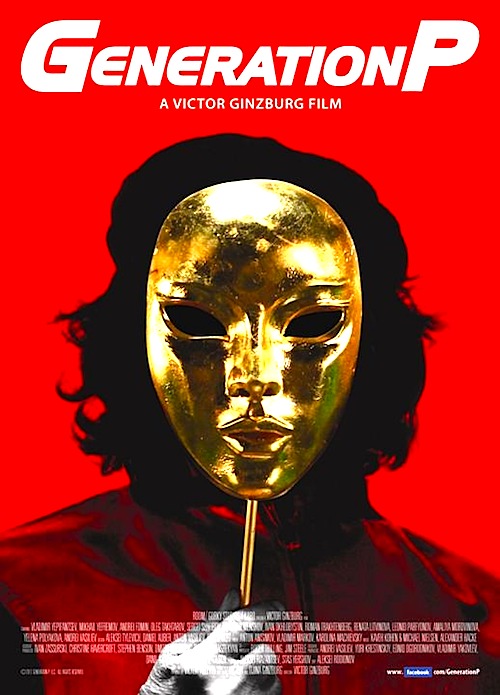
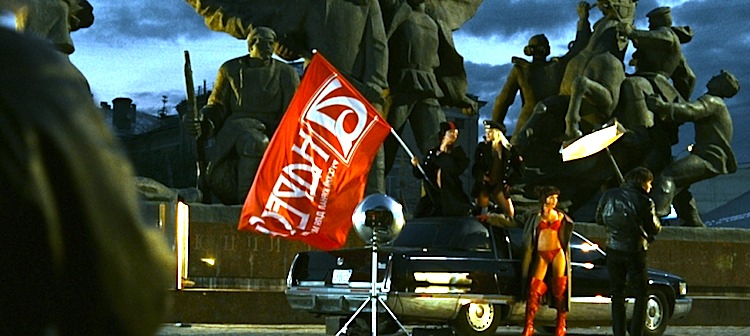
Welcome to the New Russia: LFM Reviews Generation P

By Joe Bendel. Only a bold film would invoke the name “Ishtar,” but Victor Ginzburg is clearly a bold filmmaker. The context is much different here, of course, but Elaine May’s notorious box office dud might have been quite popular in the old USSR, since it co-starred Reds helmer Warren Beatty. As it happens, Soviet era nostalgia plays a significant role in Generation P, Ginzburg’s adaptation of Viktor Pelevin’s Illuminatus!-esque novel of late Yeltsin-era Russia, which screens this week as part of the 2012 New Directors/New Films.

Eventually viewers learn that the Babylonian goddess Ishtar has a special relationship with Russia and its secret history. Though previously oblivious to the byzantine machinations of the behind-the-scenes power players, Babylen Tatarsky has always felt a kinship to all things Mesopotamian because of his name, originally conceived as a hybrid of Yevtushenko’s poem Babi Yar and Lenin. A failed poet working in a kiosk owned by the Chechen mob, Tatarsky falls backwards into a “creative” gig at one of the upstart Russian advertising agencies catering to Russia’s nouveau riche industrial class.

Tatarsky specializes in calibrating campaigns to appeal to Soviet nostalgia. He does not believe in it himself, though, because he does not believe in anything. That ideological flexibility allows him to advance to larger, more connected firms. However, he has a spiritual advisor in the person of Gireyev, a Buddhist mystic and expert harvester of psychedelic mushrooms.

The “P” in Generation P is an ironic reference to Pepsi, the cola of Glasnost. Though it never outright glamorizes terrorism, P is not that far removed from V for Vendetta, exhibiting similar anarchistic inclinations. However, the closest comparison might be Fear and Loathing in Las Vegas, giving viewers a hallucinogenic tour of Russia worthy of Hunter S. Thompson.

P arguably peaks halfway through. At its most inventive, it mixes Mesopotamian and Soviet imagery to evocatively hint at ancient mystic secrets. However, once Tatarsky reaches the inner circle, the film gets bogged down in rather standard, dog-wagging conspiracy rigmarole.

Beyond its heavy-handed critique of consumerism, it is hard to get a bead on P’s exact ideology. While Tatarsky’s cynical nostalgia campaigns are clearly intended to be problematically simplistic, the only real reference to Russia’s Communist past are the fondly remembered Pioneer Days, which are presented with a Norman Rockwell-like patina of lost innocence. The film also has little love for Yeltsin, but plot developments ironically absolve him of much of his buffoonery. Likewise, there is constant white noise equating all capitalists with oligarchs, but they constantly wind up assassinated for running afoul the mob or the government.

Yet, the similarities between a blunt-talking nationalist “reformer” (literally created on a hard-drive) and the current Russian president – who refuses to relinquish his grip on power – are difficult to miss.

A relentlessly satirical look at the new Russia.

Amidst the maelstrom of satire and metaphysics, Vladimir Epifantsev somehow creates a memorable, multidimensional portrait of Tatarsky, the everyman turned insider. Ginzburg also keeps viewers’ feet solidly on the ground, giving them plenty of narrative handles to guide them through the complicated and surreal storyline. It is a very accomplished work, but it is not clear what it all adds up to, particularly for those coming from what the film somewhat mockingly refers to as a “Soviet mentality.” A strange, sometimes dazzling film certainly worth attempting to decode – but in no way to be considered the final word on the immediate post-Soviet years – Generation P screens this Friday (3/30) at the Walter Reade Theater and Sunday (4/1) at MoMA, as this year’s ND/NF concludes in New York.

Posted on March 28th, 2012 at 5:00pm.

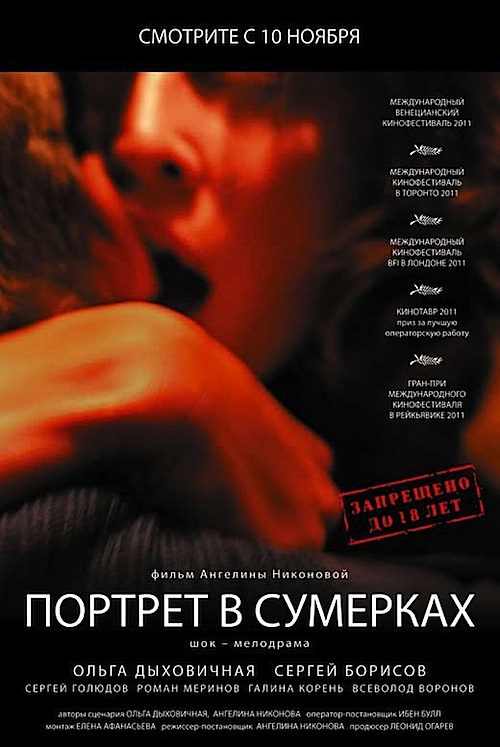
Malaise in Moscow: LFM Reviews Twilight Portrait

By Joe Bendel. In Moscow, you can never find a cop when you need one—if you’re lucky, that is. While ostensibly nonpolitical, a scathing picture of the Putin era’s petty corruption, casual cruelty, and moral malaise emerges in Angelina Nikonova’s Twilight Portrait (see a clip here), which screens this week during the 2012 edition of New Directors/New Films.

Initially, Marina appears to be a woman who has it all: a career she is ambivalent about, a husband she cannot respect, and a lover she despises. Unfortunately, after another unsatisfying tryst, the wheels come off Marina’s life. A stolen handbag, a broken heel, and a bit of dishevelment later, the cops pick up Marina on the assumption she is a prostitute and therefore fair game. The details are kept deliberately obscure from the audience, but we know some combination of the three officers rapes her in their patrol car.

Twilight’s second act might be the most realistic, bluntly unvarnished portrayal of the aftermath of such trauma yet rendered on film. Marina’s depression and anger manifest themselves in ways that are sometimes understandable, but often perplexing and off-putting. However, Twilight is just getting started. When Marina takes up with Andrei, one of the cops from that fateful night (who apparently does not recognize her in a different context), the film gets even darker. Is this part of an elaborate plan for revenge or compulsive self-debasement? Perhaps it is both or neither. Indeed, part of her seems drawn to Andrei’s unapologetic masculinity in much the same way Russia collectively submits to an authoritarian strongman like Putin. Twilight keeps its cards close to its vest, but it is safe to surmise their relationship is deeply twisted.

Olga Dihovichnaya as Marina in Angelina Nikonova's "Twilight Portrait."

At this point, it might be helpful to point out Twilight was co-written by Nikonova and her lead actress, Olga Dihovichnaya. Nonetheless, some might find the film’s sexual dynamics, as described above, considerably troubling – which is perfectly reasonable.  This is not a film for everyone, just like Bad Lieutenant is not a film for the masses. However, like Ferrara’s arguable masterwork, there is always a point to the degradation. Frankly, Twilight is not very explicit in terms of what it shows on-screen, but the implications of the character’s words and actions are undeniably disturbing.

Beyond visceral, Dihovichnaya gives a phenomenal performance that will make viewers squirm in discomfort. Film patrons will not see better work on-screen this year, but it is so brutally honest and tightly controlled, Dihovichnaya is unlikely to get the accolades she deserves, at least around these parts. (We’ll probably just shower our awards on Meryl Streep’s next schticky impersonation.)

Nikonova masterfully controls what the audience sees and what it thinks it perceives, keeping them off-balance and edgy throughout the film. It is not an easy film to watch, but it has some real arsenic to it. Recommended for those who fully understand what they are getting into, Twilight screens this Friday (3/30) at MoMA and Saturday (3/31) at the Walter Reade Theater, as the 2012 ND/NF wraps up a particularly strong year.

Posted on March 28th, 2012 at 4:55pm.

LFM’s Govindini Murty in The Atlantic: Decoding the Influences in Hunger Games, From ‘Spartacus’ to ‘Survivor’

[Editor’s Note: The article below and its accompanying slideshow appears in its entirety today at The Atlantic.]

A guide to the cultural touchstones alluded to in the new sci-fi smash

By Govindini Murty. The Hunger Games enjoyed the biggest-ever box office opening for a non-sequel film this past weekend, and it’s likely to keep captivating audiences in coming weeks with its edgy action and potent critique of today’s celebrity-worshiping culture.

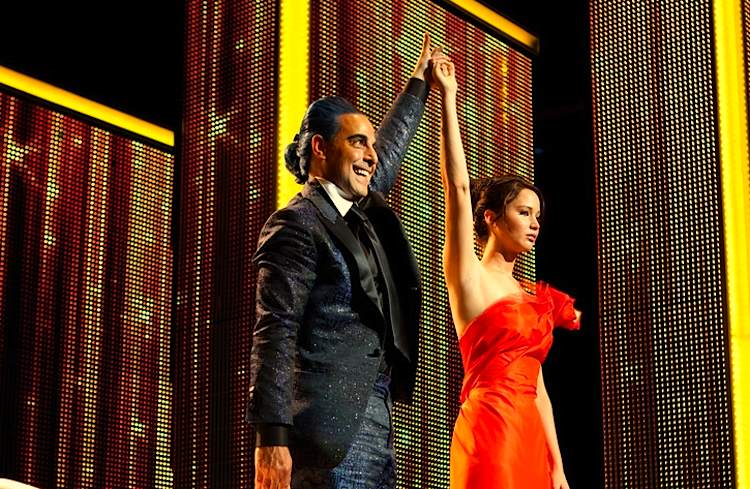
Decoding the influences on a blockbuster.

The film depicts a totalitarian future in which the all-powerful government of Panem (in what was once the United States) demands an annual “tribute” of two youths from each of its 12 districts to fight to the death in a televised event known as the Hunger Games. Sixteen-year old Katniss Everdeen (Jennifer Lawrence) of the dirt-poor District 12 volunteers to take her younger sister Primrose’s place in the Games. But when she reaches the Capitol of Panem, she realizes that in order to succeed, her physical abilities are not enough. She must also create a convincing (if false) public narrative that she and fellow tribute Peeta Mellark (Josh Hutcherson) are “star-crossed lovers” in order to win the allegiance of the audience and outwit the “gamemakers.” This crafting of her own media narrative eventually turns Katniss into a popular heroine with the power to change the future of Panem itself.

Author Suzanne Collins has said that her inspirations for The Hunger Games came from a variety of sources, including the ancient Greek myth of Theseus, Roman gladiatorial games, contemporary TV, her father’s experiences in the Vietnam War, and news footage of the Iraq War. However, the movie adaptation of The Hunger Games contains a number of other cultural and historical references as well. Here’s a mini-guide to the cinematic, literary, and historical allusions in The Hunger Games.

The Goddess Diana

The Goddess Diana.

An early scene in The Hunger Games depicts Katniss sneaking into the forest to hunt for food. She retrieves her bow and arrows from a tree, and spotting a deer, attempts to shoot it—before her friend Gale interrupts her. The imagery of Katniss with her bow and arrow—central to The Hunger Games—evokes the imagery of Diana, the Roman Goddess of the Hunt, who was frequently associated with deer hunting. In one famous story from Ovid’s Metamorphoses, when the hunter Actaeon accidentally sees Diana bathing nude in a forest pool, she turns him into a stag and sets his own hounds to chase him down and tear him apart. One can see allusions to these hounds in The Hunger Games when the gamemakers send monstrous dogs into the forest to hunt down Katniss and Peeta. In addition, Diana was a chaste goddess, and Katniss’s reluctance to engage in a romance with Peeta reflects this warrior-woman ethos of independence from men. Early in the film, Katniss even tells Gale that she will never have children. Peeta himself, in his somewhat subservient position to Katniss, resembles male acolytes of the Goddess Diana, from Hyppolytus to the Priest-Kings of Nemi—who themselves participated in a famous ritual of fighting to the death, as described in Frazer’s The Golden Bough.

[For the rest of the article and the accompanying slideshow, please visit The Atlantic.]

Posted on March 26th, 2012 at 1:58pm.