Dreamworks "Megamind" poster to the left, Olivia Wilde ACLU ad to the right.
By Jason Apuzzo. Obama adulation in Hollywood has apparently not yet waned completely. Some are still apparently holding out hope … trying to resuscitate the dream, as its embers fade in the cold wind of Obama’s own narcissism. Note above-left the new Dreamworks Shepard Fairey-inspired poster for Megamind, with the villain depicted as an opponent of Obama-style hopefulness.
Perhaps more depressingly, since such partisan nonsense is to be expected from Dreamworks, is Tron’s Olivia Wilde (above-right) in a new Shepard Fairey-inspired ad for the ACLU. Is this the kind of activism we can expect from Ms. Wilde when Tron debuts in December, with what may be some subtle political messaging already embedded in that film?
I think it’s the smugness of these posters that bothers me most, their basic triteness, beside the fact that they feel like they’re about two years behind the times. Who is actually persuaded by this nonsense anymore – other than the young, poorly educated and easily impressionable … oh, right, that’s quite a lot of people these days. [Sigh.]
By Jason Apuzzo. As we’ve been reporting a great deal to you recently, many new filmmakers are emerging in the indie filmmaking scene who are challenging the reigning Hollywood narrative by which the Islamic world is depicted simplistically as a supine victim of American imperialism – rather than as a complex society, struggling to emerge out of punishing religious intolerance into a Westernized, middle class future. [See the Living with the Infidels web series below as an example.] A interesting example of this new wave appears to be London filmmaker Hammad Khan’s Slackistan, which Variety reports just got picked up for distribution in the UK, and which will be opening the forthcoming Raindance Film Festival.
Slacker babe from Hammad Khan's "Slackistan."
Since we obviously have a lot of new UK readers here at Libertas, we encourage you to go see the film when it’s released later this year, and come back to us with reviews. The film reminds me somewhat of a film coming out later this year here in the States called The Taqwacores, which showed at Sundance and which we’ve talked about previously here at Libertas. [Another film that comes to mind: No One Knows About Persian Cats, which showed at Cannes and which we reviewed here.] From a cultural standpoint, if you’re looking for signs of hope in the Islamic world, these films would seem to be it – although this ‘hope,’ of course, comes wrapped within the irony that young Islamic youth are becoming more like us in the West every day.
Are we happy about that? Is Fast Times at Islamabad High just around the corner? I can hardly tell whether this film is set in Pakistan or Encino.
PLEASE NOTE: Living with the Infidels Episode 3, “The Honey Trap,” features adult situations. If that might offend you, please don’t watch the webisode. Otherwise, enjoy.
Here is Episode 3 of Living with the Infidels. We hope you enjoy the series.
By David Ross. Constructing literature courses is relatively easy, because literary history is so coherent and clearly marked – its nodes are so inarguable. You can no more bypass Austen or Dickens in a course on the British novel than you can bypass London on a trip to the UK.
Film, which I will teach for the first time in the Spring, is different. Unlike poetry or even the novel, film is a living form. It continues to unfold and redefine itself, and it forces one constantly to reconsider what seemed fixed. Bergman, for example, may be the greatest director of all time, but his kind of filmmaking – let’s call it filmed theater – seems everyday less relevant, while Godard, who cannot compare as a directorial talent or philosopher, seems to have put his finger on the future. Whom to prefer? Did Mssrs. Lucas and Spielberg reinvent American mythmaking (Mr. Apuzzo’s view, if I’ve understood him correctly these twenty years), or did they infantilize our popular entertainment (my view)?
And what of those beloved heirlooms of Hollywood’s golden age that are neither entirely art nor merely entertainment, and that, in any case, nobody younger than fifty has particularly bothered to see? Are they historical artifacts, national treasures, charming baubles, or inadvertent masterpieces? In teaching them, do we chronicle the American Spirit or do we dumb down the curriculum? In general, is film high art or popular art – a belated expression of the old Renaissance aspiration, or a symptom of capitalist energy and mass consumption?
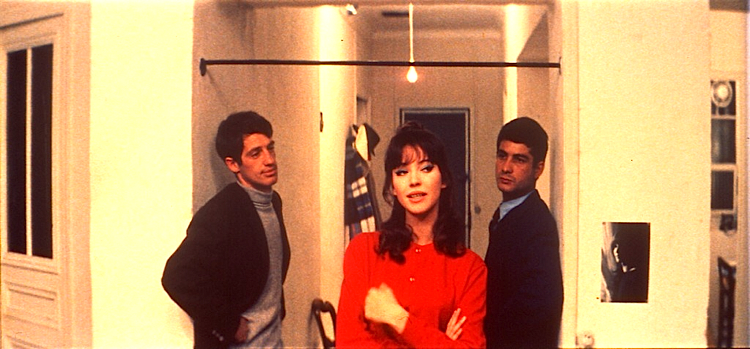
From Godard's "A Woman is a Woman."
Designing my course – “Film and Society” – was a two-tablet headache due to the unanswerable questions above. I was not sure what a film course should be, because I have only a confused idea what film is and what it’s for. In the end, I treated film as high art on the model of literature, not because this makes the most or best sense of film as a medium, but because students have so little exposure to the old Renaissance aspiration, and because no opportunity to complicate their sense of the sufficiency of Avatar and Twilight can be passed up. At the same time, one must make certain concessions (Miyazaki for example) in order to avoid civil unrest and student evaluations drenched in one’s own blood (see here).
Not long ago, I described Into Great Silence (2005), a documentary about life in a Carthusian monastery in the mountains of France, as “one of the more difficult and beautiful films ever made, and perhaps film’s most sincere and respectful attempt to portray the life of religious devotion.” It occurs to me that Ordet (1955), even more so, knows how to bend its Medieval knees (to borrow a phrase from Yeats).
I would have liked to teach the Tykwer-directed, Kieslowski-penned Heaven (2002) in conjunction with A Serious Man (2009). The films are fascinatingly obverse. The former concerns a seemingly compromised woman who experiences a mysterious and miraculous beatitude; the latter, a seemingly righteous man who suffers endless punishment.
My syllabus is still germinal. I would, of course, appreciate any advice. One thing to keep in mind is that the course is already busting a seam. Adding necessarily entails subtracting.
The Palace of Art
The Mystery of Picasso (1956, Henri-Georges Clouzot)
8 1/2 (1963, Federico Fellini)
Russian Ark (2002, Aleksandr Sokurov)
Hero (2003, Zhang Yimou)
Masculin/Feminin
A Woman is a Woman (1961, Jean Luc Godard)
Woman of the Dunes (1964, Hiroshi Teshigahara)
My Night at Maud’s (1969, Eric Rohmer)
Annie Hall (1977, Woody Allen)
God in the Dock
Ordet (1955, Carl Theodor Dreyer)
Aguirre: The Wrath of God (1972, Werner Herzog)
Fanny and Alexander (1983, Ingmar Bergman)
A Serious Man (2009, Coen Brothers)
The Smell of Napalm in the Morning
The Grand Illusion (1937, Jean Renoir)
The Battle of Algiers (1965, Gillo Pontecorvo)
Shame (1968, Ingmar Bergman)
Apocalypse Now (1979, Francis Ford Coppola)
Earth Abides
Derzu Uzala (1975, Akira Kurosawa)
Stalker (1979, Andrei Tarkovsky)
My Neighbor Totoro (1988, Hayao Miyazaki)
Maboroshi No Hikari (1995, Hirokazu Koreeda)
Utopias and Dystopias
Smiles of a Summer Evening (1955, Ingmar Bergman)
Raise the Red Lantern (1991, Zhang Yimou)
Koyaanisqatsi (1982, Godfrey Reggio)
The Lives of Others (2007, Florian Henckel von Donnersmarck)
Brave New World
2001: A Space Odyssey (1968, Stanley Kubrick)
Solaris (1972, Andrei Tarkovsky)
Cache (2005, Michael Haneke)
Encounters at the End of the World (Werner Herzog, 2007)
From Tarkovsky's "Solaris."
Other films I seriously – yearningly in some cases – considered, but in the end could find no place for:
PLEASE NOTE: Living with the Infidels Episode 2 – “Voracious Virgins” features raw language and salty situations. If that might offend you, please don’t watch the webisode. Otherwise, enjoy.
Here is Episode 2 of Living with the Infidels. We hope you enjoy the series.
• Mao’s Last Dancer continues to do nicely at the indie box office. The film recently expanded to 102 screens, and has now taken in over $2 million. These are great numbers, given how the film is being completely ignored by the media outlets who would presumably appreciate its message the most.
• My friend Patrick Goldstein at the LA Times has a wonderful piece out about Werner Herzog’s new 3D documentary Cave of Forgotten Dreams, a film covering the 32,000 year old cave paintings at Chauvet-Pont-d’Arc. I will freely say that I am green with envy at Patrick’s opportunity to see 30 minutes’ worth of this film before it heads to Toronto! I worship the ground Herzog walks on, and volunteer to carry his shoes the next time he travels underground, or to the Arctic, or out into Loch Ness or grizzly country, or wherever he next makes a film. In related news, Carla Bruni and her husband recently made a splash in Montignac where they were commemorating the 70th anniversary of the discovery of the Lascaux cave paintings.
• AND IN TODAY’S MOST IMPORTANT NEWS … Battleships’s Brooklyn Decker tells The New York Post today that she’s not anorexic enough, or grungy enough, to be a runway model. “I have boobs. I’m very all-American.”
I’m puzzled by this fixation on her looks, because I thought she landed the Battleship role as Liam Neeson’s daughter due to her idiosyncratic, off-Broadway turn as Anya in The Cherry Orchard. Shows you what I know!
And that’s what’s happening today in the wonderful world of Hollywood.