LFM Reviews When You Can’t See the Film @ The 2014 UN Association Film Festival

From "When You Can’t See the Film."

By Joe Bendel. For Hollywood, Chinese multiplexes are paved with gold. Unfortunately, you will be more likely to see a leprechaun inside one than a locally produced independent film or documentary. Any film accurately reflecting the struggles of China’s underclass and the corruption of the Communist government will never be approved for domestic distribution. Of course, that will not be an issue for our left coast moguls, but it is a persistent frustration for discerning cineastes and just plain curious viewers. The sad state of official Chinese film distribution is analyzed in Yijun He’s short but revealing documentary, When You Can’t See the Film, which screens as part of the 2014 UN Association Film Festival in the Stanford area.

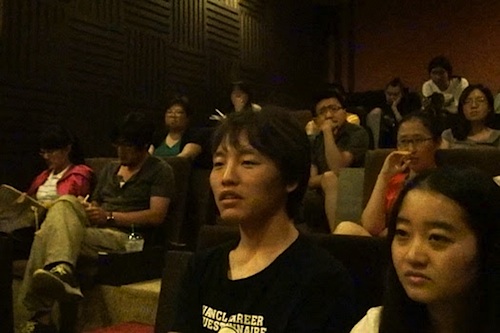
Sadly, Yijun’s film is especially timely in the wake of the thuggish forced closure of this year’s Beijing Independent Film Festival. This is a familiar story to a small but hearty band of the underground film clubs that have sprung up to fill the demand for unsanctioned independent film, particularly documentaries. Often meeting in bars or universities, organizers risk arrest and persecution for the sake of cinema, but they are not bandits. Clubs always screen films with the consent and participation of filmmakers grateful to have a forum for their works, typically offering a small honorarium for their appearance.

Since their previous venues were shut down under suspicious circumstances, the primary club featured in WYCSTF ironically rents space from a local multiplex, sort of following the hide-in-plain-sight strategy. It is nice to see American documentarian J.P. Sniadecki (whose The Iron Ministry was one of the unlikely hits of this year’s NYFF) present his previous film Yumen and graciously engage with patrons. On the state authorities’ Richter scale, Yumen is probably about a three, given it applies Sniadecki’s uncompromising ethnographic observational aesthetic to an abandoned Northwest industrial ghost town.
From "When You Can’t See the Film."

However, Xu Xin’s Karamay qualifies as a radioactive ten-plus. The nearly six hour epic documentary exposes the infamous (despite a total media blackout) fire in which nearly three hundred school children perished while government officials were ushered to safety. It is clearly the film to program if you want your screening swarming with cops.

The club organizers Yijun profiles and the filmmakers they support truly represent independent film in its bravest and most honest manifestation. It puts to shame our smug little so-called indies that cling to the label and the marketing platforms that come with it. At a svelte thirty minutes, When You Can’t See the Film is quite illuminating and sadly frustrating for film lovers. Highly recommended, it screens this Saturday (10/25) in Palo Alto, as part of session 27 of this year’s UNAFF.

LFM GRADE: A-

Posted on October 21st, 2014 at 11:49pm.
LFM Reviews Twin Sisters on PBS’ Independent Lens

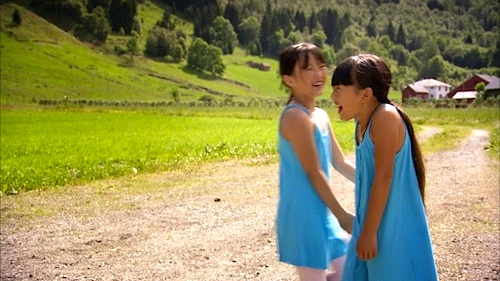
By Joe Bendel. It is hard to imagine how a parent could ever abandon two good kids like Mia and Alexandra, but China’s draconian One Child policy and the extreme rural poverty force people to do desperate things. At least they were each adopted into loving homes—that is, each of them separately. Evidently, the orphanage thought they stood a better chance of adoption individually, rather than as a package deal. However, through the intercession of fate, the sisters would maintain not just an awareness, but also a love for each other, despite living on opposite sides of the Earth. Mona Friis Bertheussen documents their indomitable bond in Twin Sisters, which airs this Monday as part of the current season of Independent Lens.

In 2003, the Hauglums from Norway and the Hansens from Sacramento came to China to adopt a baby girl. The Norwegian group was supposed to be gone by the time the American adoptees arrived, but events conspired to delay the Hauglums. Suddenly, they were amazed to see the Hansens holding a little girl, who was the spitting image of their Alexandra. Despite the orphanage’s denials, they exchanged contact information and eventually performed a DNA test, but it would hardly be necessary as the girls got older. Seriously, look at them.

Although there are cultural and linguistic barriers, both girls grow up feeling a deep connection to each, even though they had never really met. Eventually, the parents arrange to visit each other and are rather staggered by the girls’ similar mannerisms and personalities.

Obviously, the twins’ situation is imperfect, since they would dearly wish to live together, but their respective parents are good people, who do the best they can. Frankly, that is quite nice to see in a documentary, for a change. For sociologists, there is probably plenty of nature versus nurture grist as well, but most viewers will just be charmed by the sweet tempered girls themselves.

From "Twin Sisters."

Cheers to Bertheussen for making Sisters, because its European festival screenings served as another catalyst to bring together the twins. However, there is a conspicuous lack of follow-up with respects to the orphanage. Many viewers might like to see her try to get some bureaucrat there to admit on-camera they flat-out lied, as the Hansens and Hauglums can prove. Instead, she maintains her focus on the families, preferring a humanist vibe over potential confrontations.

Consequently, Twin Sisters is a sensitive film that borders on outright feel-goodism. Bertheussen’s young subjects are more than engaging enough to sustain the film, convincing viewers China’s loss will be America and Norway’s considerable gains. Recommended for those in search of wholesome family viewing, Twin Sisters airs this Monday (10/20) on most PBS outlets nationwide.

LFM GRADE: B+

Posted on October 20th, 2014 at 9:22pm.

LFM Reviews Young Ones

By Joe Bendel. For centuries of human history, more battles have been fought over water than probably any other natural resource. Apparently, Gwyneth Paltrow’s brother only recently discovered the strategic value of water, but he is duly impressed. Unfortunately, viewers will find an entertainment drought in Jake Paltrow’s Young Ones, which opened Friday in New York.

Ernest Holm was once a farmer, but his parched land is almost as arid as the characters he encounters. Following some sort of vaguely defined environmental disaster, Holm and his socially underdeveloped son Jerome eke out a modest living selling supplies to the knuckle-draggers working for the corrupt water works in the mountains. Flem Lever (a name everyone says with a straight face, to their estimable credit) covets Holm’s trading business and his eternally distant daughter, Mary. Despite Holm’s rugged manliness, the pretty boy Lever still manages to kill him in the desert, framing his new pack mule android for the murder most foul.

Of course, it takes Jerome quite a while to suspect Lever, because intuition hardly runs in the family. Ironically, Lever is much better suited to reversing the family’s fortunes, given his devious nature and ruthless follow-through. Nevertheless, little Jerome will get himself some payback when the time is right.

From "Young Ones."

Ernest Holm is the sort of role Michael Shannon was born to play, but sadly that is the only bit of casting that makes sense in Young Ones. A slow burning brooder like Shannon should be counterbalanced with someone who can project and maybe even chew a bit of scenery. Instead, for Holm’s sort of grown children, Paltrow calls on Kodi Smit-McPhee and Elle Fanning, two of the mousiest screen thesps you will ever come across. Watching them shuffle around the farm makes the films of Bela Tarr look like madcap romps.

Without question, Young Ones’ MVP is cinematographer Giles Nuttgens, who also lensed Perfect Sense, an infinitely superior apocalyptic allegory. He gives the parched vistas the proper John Ford treatment, but unfortunately he does not have much else to shoot in terms of narrative or characters. Unremittingly dull, yet also pretentious, Young Ones is a would-be futuristic western genre-bender that completely melts down. Not recommended for anyone, it opened Friday (10/17) in New York at the Village East.

LFM GRADE: D-

Posted on October 20th, 2014 at 9:21pm.

A Sherman Tank’s Last Stand: LFM Reviews Fury

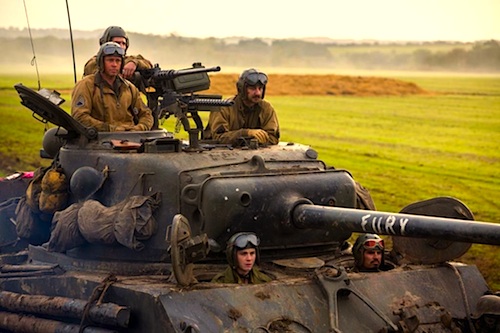
By Joe Bendel. Sherman tanks such as the one Sgt. Don “Wardaddy” Collier commands were like portable Alamos. During WWII, American tank crews suffered staggering losses to Germany’s superior armored forces, but they could still do a lot of damage before their number came up. Essentially, that was also the strategy of the fanatical German remnants, who refused to recognize National Socialism’s imminent defeat. Instead of a march to victory, a new post-Normandy addition to Collier’s crew will have the mother of all fiery baptisms in David Ayer’s Fury, which opens tomorrow nationwide.

For years, Collier has beat the odds, somehow bringing his men safely through each battle. Unfortunately, his luck, or at least his machine-gunner’s, has just run out. For a replacement, he is stuck with Norman Ellison, a transfer from clerical services, who could not possibly be anymore naïve. In contrast, the German-speaking Collier has no illusions about the nature of war or the enemy they face. His tank, “Fury,” is indeed aptly named, reflecting his general attitude, particularly when it comes to the SS.

Of course, Ellison will take plenty of not-so good-natured ribbing from his new brothers-in-arms: Boyd “Bible” Swan, the token fundamentalist, Trini “Gordo” Garcia, the token Hispanic, and Grady “Coon-Ass” Travis, the token sociopathic jerkweed. When the rookie Ellison makes a mistake that leads to the death of another crew, Fury becomes an even more tense and awkward place to be. However, Collier is determined to make a stone cold killer out of Ellison, one way or another. The process might even involve a fair amount of climatic heroics.

Frankly, Fury’s first act is a tonal traffic accident, designed to shock us out of our supposed “jingoism” and rub our noses in the war crimes committed by the Greatest Generation. We see a lot of Collier dispatching surrendered Germans, until some script editor apparently noticed the film was making the Nazis look sympathetic. As a result, the second act is a sort of war crimes poker game played out between Collier and the SS, in which battlefield executions are called and raised with strafed civilians.

It is a darned shame Ayer wastes so much time trying to be hip and revisionary, because when Fury gets down to the a-man’s-gotta-do-what-a-man’s-gotta-do action, it is pretty spectacular. The early battle scenes are certainly tense and brutal, but they also clearly and dramatically establish the mechanics and dynamics of armored combat. They are all well staged, but the big centerpiece showdown-conflagration is an instant classic. (Sensitive viewers should be warned: there are graphic scenes of limbs severed by all manner of projectiles and explosives.)

From "Fury."

Without question, Fury features the best tank-fighting sequences ever staged on film. Unfortunately, the further they get from the Sherman M4, the shakier the film gets. As a case in point, an overly long sequence in which Swan, Travis, and Garcia crash a quiet moment Collier and Ellison are trying to have with two German women makes no sense within the film’s dramatic context.  They are supposed to fear and revere Collier, but they are acting like knuckle-dragging savages, just to make the audience hate them.

Nevertheless, Brad Pitt gets down to business quite effectively and efficiently as Collier. He is one of the few contemporary American screen actors with genuine movie star presence, but he is still completely credible playing a grizzled hardnose. Shia LaBeouf is also surprisingly flinty as Swan, so his reported self-mutilation did not go to waste. As Ellison, Logan Lerman also brings more grit and substance to the table than one might expect. Conversely, Jon Bernthal’s Travis is all bug-eyed shtick, while Michael Peña’s Garcia has really no distinguishing personality traits whatsoever.

There is a real disconnect between the extraordinary armored combat scenes and Ayer’s problematically erratic screenplay. Flirting with moral equivalency, he keeps telling us war is Hell when he is not blowing stuff up real good. Still, Pitt and the awesome warfighting scenes are just enough to carry the day. Recommended for fans of war movies, Fury opens wide tomorrow (10/17), including the AMC Loews Lincoln Square in New York.

LFM GRADE: B-

Posted on October 16th, 2014 at 2:40pm.

LFM Reviews In the Wake of Stalin @ The UN Association Film Festival

From "In the Wake of Stalin."

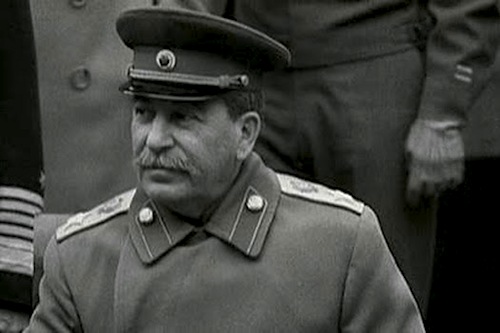
By Joe Bendel. The fact that assassinated independent journalist Anna Politkovskaya supported the work of the Russian research and archival non-profit Memorial pretty much tells you all you need to know about its mission and place in the Putin-era body politic. Dedicated to exposing Stalin’s crimes against humanity and preserving the oral history of his victims, Memorial endures constant harassment and demagoguery. The dictator’s pervasive legacy and the drive to whitewash its enormity are examined in Thomas Johnson’s In the Wake of Stalin, which screens as part of the 2014 UN Association Film Festival in the Stanford area.

Through forced agricultural collectivization, willful acceptance of the resulting famines, a notorious series of purges and show trials, and periodic anti-Semitic campaigns, Stalin physically and spiritually devastated the Soviet people. Yet today, more and more Russians use loaded terms like “strong leader” and “iron willed” to describe Stalin.

In part, matters reached such a frightening and depressing state because there has never been a national reckoning of the Communist Party’s crimes. There is a government appointee officially charged with investigating Soviet human rights violations, but his lack of initiative is rather appalling, even by the standards of Soviet era bureaucrats. Memory stepped in to fill that void, but the reaction from Putin’s enforcers and loyalists has not been pretty.

While the title suggests more of a survey of Stalinist horrors, Johnson’s film, co-written with Marie Brunet-Debaines evolves into a documentary tribute to Memory, but they clearly deserve the ovation. The testimony they capture from Memory interview subjects is truly harrowing, while the thuggish graffiti and threats they document are simply ugly.

From "In the Wake of Stalin."

Nonetheless, Wake consistently draws a clear distinction between Stalin and Putin, readily conceding they are not moral equivalents (thus far). However, the dictum regarding those who forget the past deafeningly echoes throughout the film. Clearly, there are those who wish to render the past forgotten—and they presumably have their reasons.

Indeed, Wake is a level-headed analysis of Russia’s current ideological climate, enriched by its wider historical context. It is not alarmist, but it is alarming. Thoroughly researched and substantiated, it is a valuable work of cinematic reportage. Highly recommended, In the Wake of Stalin screens this Sunday (10/16) at Stanford University as part of session 10 of the 2014 UNAFF.

LFM GRADE: B+

Posted on October 16th, 2014 at 2:40pm.

LFM Reviews Studio Ghibli’s The Tale of Princess Kaguya

By Joe Bendel. It is a quite a story of social mobility, especially for Tenth Century Japan. Of course, it is a folktale, but it is considered Japan’s oldest surviving narrative (even predating The Tale of Genji). It inspired adaptations from the likes of Kon Ichikawa, but the lush, budgets-be-damned Studio Ghibli treatment may very well come to be recognized as the definitive big screen production of “The Tale of the Bamboo Cutter.” Representing most likely the penultimate release from the storied studio, Isao Takahata’s The Tale of Princess Kaguya opens this Friday in New York at the IFC Center.

One day, Okina, the stout-hearted bamboo cutter, discovered a miniature princess dressed up in regal finery within one of the shoots he had chopped. Taking her home to his wife Ona, the precious princess transforms into the infant they never had. Miraculously, Ona discovers she is still able to nurse the baby they presume to be heaven-sent. “Princess,” as Okina simply calls her, grows up quickly, soon maturing to the level of the nearest children, who affectionately call her “Bamboo.” She loves the simple pleasures of nature and the company of her rambunctious friends. However, Okina believes his faith in her royal destiny is vindicated when he discovers miraculous caches of gold and silk in yet more fateful bamboo shoots.

Okina uses the gold to build a palatial estate in the capitol, buying his way into elite society. Unfortunately, his worldly ideas of happiness are at odds with her more spiritual conceptions. Despite her love for her adopted parents, Princes Kaguya, as she has been officially dubbed, consistently foils his plans to codify her royal status. Eventually, her ensuing unhappiness will have cosmic repercussions.

It is hard to imagine another animated film prominently featuring a princess that is as likely to frustrate young Frozen fans as Princess K surely will. It is an extraordinarily elegant, visually arresting film, but it is also exquisitely tragic, unabashedly literate, and rich with symbolic texture. It additionally represents some of accomplished Japanese film composer Joe Hisaishi’s most distinctive work, but the entire film is probably too sophisticated, in an almost rarified way, to garner much Oscar love in any category.

From "The Tale of Princess Kaguya."

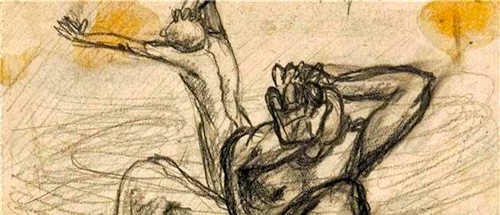
Regardless, Princess K is a stunning example that animation can truly be a work of art. Takahata’s hand-drawn animation evokes the austere beauty of traditional Japanese watercolor, but the resolution and color palate shift to reflect Kaguya’s emotional state. Dramatically, it is a disciplined slow-builder, earning every tear it jerks down the stretch, fair and square.

Frankly, it is easy to get stuck on the ethereal beauty of Princess K, but there is an awful lot going on beneath the surface. Kaguya represents a refreshingly independent-minded and psychologically complex princess, particularly during the Heian era. Arguably, it is also the first science fiction story ever, taking into account Kaguya’s full origin, which is only revealed late in the third act. It is easily the best new animated film of the year, unless you also count Hayao Miyazaki’s Studio Ghibli release, The Wind Rises (which had a brief Oscar qualifying run late last year). Very highly recommended for mainstream audiences as well as animation enthusiasts, The Tale of Princess Kaguya opens this Friday (10/17) at the IFC Center, with special preview screenings scheduled for tonight and tomorrow night.

LFM GRADE: A

Posted on October 15th, 2014 at 9:10pm.