Gina Carano Misplaces Her Husband: LFM Reviews In the Blood

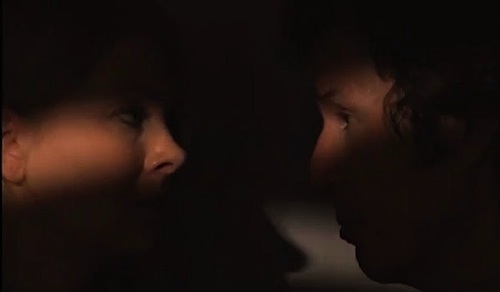
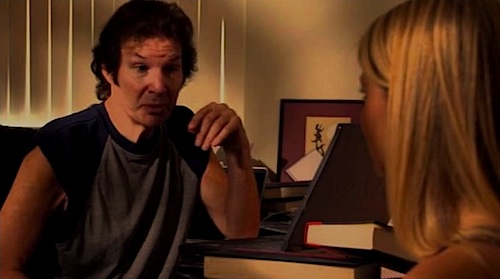
By Joe Bendel. You would think two recovering addicts would go to a tightly controlled “Club Med” environment for their honeymoon. Instead, the Grants visit the most corrupt island in the Caribbean. They stay on the wagon, but even more serious problems develop. When the new Mr. disappears, the new Mrs. will unleash all her street-fighting skills to find him in John Stockwell’s In the Blood, the newest vehicle for MMA star Gina Carano, which opens this Friday.

Ava’s father Casey was an original hardcase, who taught her how to fight good and hard. Even during her strung out days, following his untimely demise, she could take care of her would be predators. She cleaned up when she met the well-heeled Derek Grant in rehab. His father is not exactly thrilled with their union, but has stopped fighting it. Aside from a little dust-up in a club, their honeymoon is all very sweet and romantic—until the zip-line accident.
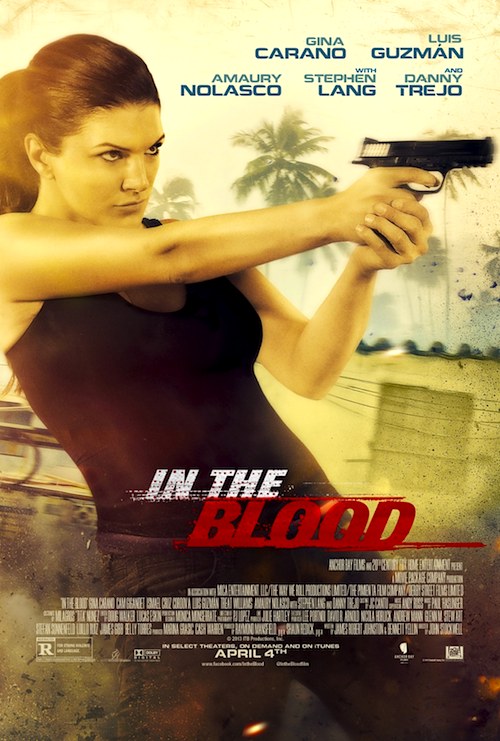
Unfortunately, that is not even the worst of it. Mysteriously, the ambulance carrying Grant to the central hospital never arrives with the patient. Of course, the fat and lazy police chief is happy to shift suspicion onto his ex-junkie wife, finding a receptive ear in old man Grant. Determined to find her husband, Ava Grant sets out to give the Jack Bauer treatment to every lying witness and corrupt cop in her path.

In the Blood is a pretty straight forward martial arts programmer, but it maintains Carano’s viability as an action star. There are several down-and-dirty fight sequences that nicely showcase her chops. She also gets nice support from a colorful cast of supporting characters, including Luis Guzmán and Danny Trejo (who kills it in his final scene). It is also impressive to see that Stephen Lang continues to get rougher and tougher with age during his brief flashback scenes as dear old dad. As a Twilight alumnus, Cam Gigandet does not inspire much confidence, but he manages to scratch out some okay chemistry with Carano.

For genre fans, In the Blood could be considered the rough equivalent of early Van Damme films. The plots were never extraordinary, but they were serviceable enough to build up his credibility as an action star and a romantic lead. In the Blood serves the same function for Carano, even with its unfortunate and potentially spoilery title. Stockwell does an okay job framing the action, but he is no Isaac Florentine, let alone a Dante Lam or Wilson Yip.

Still, Carano delivers on her end. She has screen presence and chops. In the Blood will not take her to the next level, but it will keep her existing fanbase engaged and ready for more. Enjoyable as a quality B-movie with serious MMA aptitude, In the Blood is recommended for genre enthusiasts when it opens this Friday (4/4) in New York.

LFM GRADE: B-

Posted on April 2nd, 2014 at 11:08pm.
A Talky Apocalypse: LFM Reviews Goodbye World

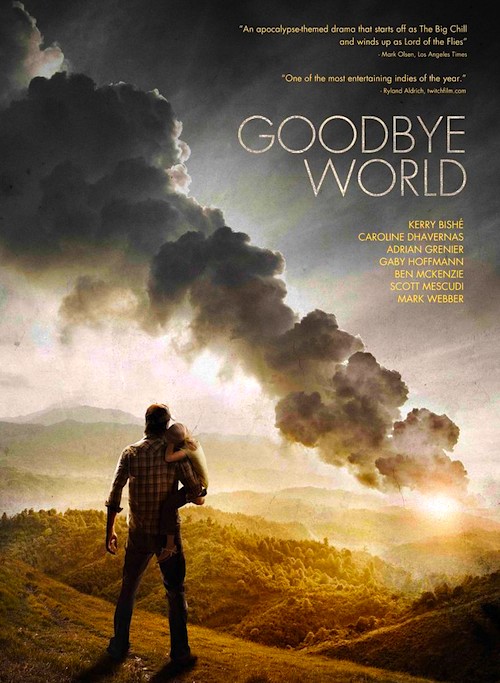
By Joe Bendel. Rat race dropouts James and Lily live in the place where hippies and survivalists intersect. Given its strategic hilltop position and the well-stocked freezers full of food and medicine, their Mendocino County home will provide refuge to a number of their long lost college friends. Unfortunately, human nature keeps doing what it does in Denis Henry Hennelly’s Goodbye World, which opens this Friday in New York.

Nick and Becky were already en route for an awkward weekend visit to his estranged college pals. He was once engaged to Lily and business partners with James, until the hypocritical hippie forced him out over a philosophical disagreement. That is a lot of shared history, but surely they ought to be able to put it aside once the apocalypse hits, right?

Of course, it is hard to get reliable reporting on the freshly minted end of the world. Fortunately, they can rely on the analysis of Laura, another college chum, who was recently an aide to the chairman of the Homeland Security committee, until a leaked sex tape ruined her career. To further increase tensions, their Bill Ayers-lite college professor pal and his latest coed conquest also make their way to their Northern California refuge. To round out the cast of problematic houseguests, their weirdo hacker pal Lev Berkowitz turns up in state of near catatonia, openly inviting viewers to suspect he might have had a role precipitating the cyber attack.

Somehow, millions of smart phones simultaneously received the same cryptic text: “goodbye world.” Then systems started failing left and right, leading to riots in the street. James believes they can sit tight for several years, presuming they can stomach each other, until ominous outsiders start showing up and making demands.

Frustratingly, the sketchy details Hennelly and co-writer Sarah Adina Smith dole out on the early process of Armageddon are far more intriguing than the post-apocalyptic melodrama. For the most part, these are shallow, self-absorbed creeps. Even James & Lily’s daughter is an entitled princess. Still, making the scandal-tarred Laura an American Revolutionary War re-enactor is a nice bit of character detail.

As in the nearly unwatchable First Winter, the end of the world and the widespread casualties that result do not seem to cause anyone much lasting sorrow. Instead, they are preoccupied with their own petty jealousies and resentments. It is one thing to compartmentalize, but that is just cold. Logically, Gaby Hoffman fares the best amid the large vanilla ensembles, since she is blessed with the most distinctively limned character.

To be stuck in the same house as these people would be a fate far worse than any urban anarchy. The special effects team nicely evokes the end times with some subtle but clever bits of business, but Hoffman cannot single-handedly compensate for the massively boring characters her Laura must deal with. Although it gets out of the blocks quickly, Goodbye World soon loses steam. Best saved for fanatical hippie survivalists, it opens this Friday (4/4) in New York at the Village East.

LFM GRADE: C-

Posted on April 2nd, 2014 at 11:01pm.

Midnight Movies Get New Agey: LFM Reviews Fateful Findings

From "Fateful Findings."

By Joe Bendel. Prepare to have all your suspicions about the New Age mindset confirmed. We might be poised on the brink of the Age of Aquarius, the Harmonic Convergence, or whatever, but it comes bundled with some of the stiffest performances and clunky dialogue you will ever feast your previously jaded eyes and ears upon. Self-financed by writer-director-producer-lead actor-craft services Neil Breen, Fateful Finding blew into town for a weekend of ‘round midnight screenings at the Landmark Sunshine. Let the “magic” commence.

Any attempts to describe Fateful must be approximate. The link between cause and effect is often rather tenuous in this world and the exposition is more confounding than explanatory. We can say with certainty, eight year-old Dylan and Leah were once inseparable. On the last day of their final summer together, they discover a magic rock that he will keep with him as a talisman. We know it was a “magical day” because that is what she wrote in her diary, underlined multiple times for effect. Shortly thereafter, her parents whisked her away, perhaps because they were concerned about that creepy Dylan kid.

Flashing forward, Dylan is now a successful novelist with a devoted wife, but he never got over Leah. However, when a Rolls Royce plows into him, spraying red food coloring everywhere, Dylan makes a remarkably speedy recovery thanks to that cosmic stone. Finding himself in a spiritual crisis, Dylan chucks his writing career, resolving to use his hacker skills to expose all the corrupt collusion between the government and big business. You see, it’s actually believable – because he has his masters in computer science.

Meanwhile, he also facilitates his wife Emily’s addiction to the meds he refuses to take, perhaps because she read the script and figured she would need pharmaceutical help to get through the shoot. Eventually, he completely loses interest in Emily once he realizes the physician consulting on his case is none other than his long lost love, Leah, who did not recognize him under the Invisible Man bandages and evidently never bothered to read his chart.

Right, so there is some kind of plot afoot to get Dylan as well as some kind of paranormal agency at work, but you would hardly know it, because Breen devotes far more time to the marital travails of Dylan’s next door neighbors, Amy and Jim. As far as the shadowy conspiracy goes, it seems to consist solely of an underachieving henchman, who conveniently leaves his written instruction behind at the scene of the crime.

Indeed, Breen has a maddening habit of getting bogged down in the most mundane details at the expense of his big picture concept. Occasionally, we see visions of Dylan leafing through a big glowing mystical book (probably an old heirloom dictionary bought at a garage sale), but he painstakingly establishes whether or not Amy wants to try the wine at Dylan’s dinner party.

From "Fateful Findings."

Be that as it may, just like fellow cult favorites The Room and Birdemic, it is sheer folly to apply any sort of rational critical standard to Fateful. These are passion projects that come from an indescribably bizarre aesthetic plane of existence. Logic is completely out the window from the get-go in nearly all respects, starting with the fact Breen looks about twice as old as the adult Leah. More importantly, there is able space for vocal audiences to insert their own commentary (such is the advantage of a talky film with frequent awkward pauses).

Frankly, some of Breen’s choices will mystify even experienced screen-talking midnight movie patrons. Still, it amply lives up to the singular reputation it developed on the festival circuit. Recommended for those who appreciate a healthy dose of communal cinematic lunacy, Fateful Findings screened this weekend in New York at the Landmark Sunshine.

Posted on March 31st, 2014 at 9:07am.

Life Under Russian Occupation: LFM Reviews Giovanni’s Island @ The 2014 New York International Children’s Film Festival

By Joe Bendel. If Russia successfully annexes Crimea, what happens to the ethnic Ukrainian and Tartar population? If history is any guide, we should not be shocked by forced deportations. Frankly, they should probably consider themselves lucky if they do not take a detour through a Russian gulag. Residents of the Soviet occupied Kuril Islands were not so fortunate. The Production I.G team best known for the Ghost in the Shell franchise revisits a painful episode of Japanese history with Mizuho Nishikubo’s Giovanni’s Island, which screened during the 2014 New York International Children’s Film Festival.

Giovanni and Campanella are not traditional Japanese names, but they are the main characters of Kenji Miyazawa’s fantastical classic, Night on the Galactic Railroad. Tatsuo Senō is so fond of the novel he named his sons Junpei and Kanta to roughly correlate. At the time of Japan’s surrender, the elder Senō is the island’s civil defense coordinator, but since he is not technically military, he is not rounded up with the other soldiers.

Initially, rumors spread like wildfire of what the Americans would do when they arrive. Unfortunately, it is the Soviets instead. Needless to say, their arrival is quite disruptive for the island community. Many families, including the Senōs, are displaced to make room for the occupiers. Similarly, Junpei’s class is forced to share space with the lower grades to make room for the soldiers’ children. Still, he forms an unlikely friendship with the commander’s daughter Tanya that steadily develops romantic overtones.

Sadly, the Soviets will do no favors for tweener romance. After his father is arrested for distributing rice to needy villagers (so much for “to each according to their needs”), Junpei, Kanta, and their school teacher Sawako (who long carried a torch for dad) are forced to board the supposed repatriation transport without him. Ominously though, they do not seem to be bearing south towards Japan.

Frankly, screenwriters Shigemichi Sugita and Yoshiki Sakurai are remarkably restrained in their depiction of the Russian occupiers, perhaps for fear of reprisals. Nevertheless, the grim realities of the forcible deportations are inescapable. For all intents and purposes, the occupied islands were ethnically cleansed. Those familiar with Miyazawa’s short novel will also realize the Senō family is destined to experience acute tragedy.

From "Giovanni’s Island."

Indeed, the way the Galactic Railroad is weaved into Giovanni’s narrative is quite thoughtful and literate. Hardly stuck in denial, the film forthrightly acknowledges the misfortune of Koreans displaced by the Imperial military, whom the Russians never bothered to repatriate. There are also a few decent Russians in Giovanni (such as Tanya’s parents), but the Stalinist war machine is a brutal, impersonal fact of history.

Much like Jack and the Cuckoo Clock Heart, Giovanni uses poetic imagery to soften the blow of the on-screen heartbreak. Yet, there is a maturity to the film and how its characters (especially the young) resolutely “endure the unendurable” that is quite powerful. Viewers will not feel bereft at the end, despite the grueling journey it takes us on. While it focuses quite intimately on the Senōs and those closest to them, it is a rather epic story. Featuring characters you will care about caught up in historical forces likely to repeat themselves, Giovanni’s Island is the sort of animated film adults will appreciate as much or more than children.

Highly recommended as a legit big screen drama, Giovanni’s Island had its first screening outside of Japan at this year’s NYICFF. Patrons should keep an eye on their website, just in case another screening is added. Regardless, it should have a long life on the festival circuit.

LFM GRADE: A

Posted on March 25th, 2014 at 6:30pm.

Censored (Temporarily) by the Morsi Regime: LFM Reviews Jews of Egypt

By Joe Bendel. Why would a supposedly democratically elected government prohibit any public screening of a film with absolutely no violent or sexual content? In the case of the Muslim Brotherhood-backed Mohamed Morsi administration, a documentary describing how a sizable Jewish community once peacefully coexisted with Egypt’s Muslim majority was evidently not considered fit for public consumption, despite slavishly hewing to an “anti-Zionist” line. Arriving as a modest cause célèbre due to the fallen Morsi government’s misadventure in censorship (they eventually relented), Amir Ramses’ Jews of Egypt opens this Friday in New York.

During the first half of the Twentieth Century, a number of Egypt’s leading citizens happened to be Jewish. To this day, Laila Mourad remains one of the nation’s most popular recording artists, though many are apparently unaware of her Jewish heritage, judging from the brief man-on-the-streets interviews that open the film.

According to surviving members of the community, nearly all Jewish Egyptians self-identified with their country first and foremost, whereas their Jewish religion and culture was of secondary concern—if that. Everyone goes to agonizing lengths to distinguish between Jews and Zionists, clearly pre-supposing there is something fundamentally problematic about the latter. Yet, despite the vehement anti-Israeli sentiment expressed by many prominent Jewish Egyptians, they collectively found Egypt increasingly inhospitable following Nasser’s ascent to power.

From "Jews of Egypt."

Ironically, the experience of the unflaggingly loyal anti-Zionist Jewish Egyptians dramatically proves the Zionist point. Despite their Communist, anti-colonialist political affiliations, they were still arm-twisted into immigrating and, most painfully, renouncing their Egyptian nationality. Some were even imprisoned on the scantest of charges, solely because they were Jewish.

Nonetheless, Ramses and his assembled talking heads are not particularly inclined to ironic self-awareness. As far as historical accuracy goes, JOE is also highly suspect. Frankly, the film works best when examining the interrelations between the various members of the loose-knit Jewish-Egyptian society. Who knew whom and where they all wound up is rather engaging stuff.

The Orwellian impulse to erase all trace of Egypt’s considerable Jewish population is depressing, but not especially shocking. At least Ramses plants a flag that says these people existed. Considerably better at painting a picture of a unique cultural milieu than explaining the wider geo-political forces at play, Jews of Egypt is still a decidedly mixed bag. Viewers should go in already well grounded in the history of the region and Israel’s constant battle for survival. For those intrigued by its rocky pre-release reception, it opens this Friday (3/28) at the Quad Cinema in New York, via Art Mattan Productions.

LFM GRADE: C

Posted on March 25th, 2014 at 6:25pm.

Casanova Lives: LFM Reviews The Story of My Death @ FilmLinc/MoMA’s New Directors/New Films

By Joe Bendel. Remember Tony Curtis in the naughty Euro-farce, The Amorous Mis-Adventures of Casanova? Sure you don’t, but forget it anyway. This incarnation of the aging rogue is worlds removed from Curtis’s leering carouser. It is the end of the party and the close of the Enlightenment era for Casanova, announced by none other than Dracula himself in Albert Serra’s defiantly dense and stately slow The Story of My Death, which screens during this year’s New Directors/New Films, co-presented by the Film Society of Lincoln Center and MoMA.

Casanova has become a dirty, sacrilegious old man. He still pursues his pleasures where he may, be they pomegranates or chamber maids. Initially, this all seems like a good gig to his new manservant, whose primary duties appear to listening to Casanova pontificate on whatever. However, he becomes somewhat disillusioned with his master during their questionable Carpathian holiday. Naturally, Casanova starts trifling with the daughters of a suspiciously accommodating land owner, but the undead Count also has eyes for the lasses.

On paper, Death probably sounds like a super commercial mix of sex and gothic blood-sucking, but Serra’s approach is unapologetically meditative, bordering on the explicitly experimental. This is not Anne Rice or even Chelsea Quinn Yarbro. It is one hundred fifty-eight minutes—and viewers will feel each and every second.

Serra might have a healthy contempt for narrative, but he has an eye for composition. Frame after frame intentionally evoke the Old Masters with their chiaroscuro effect and Serra’s extraordinary attention to mise-en-scene. Even though the score is credited to four composers (count them: Ferran Font, Enric Juncá, Joe Robinson, and Marc Verdaguer), there is not a lot of music heard during Death’s two and a half hours. Yet, in a rare genre concession, what there is sounds surprisingly distinctive and creepy.

From "Story of My Death."

Heading a typical Serra cast of non-traditional actors, poet Vincenç Altiaó rather livens up the proceedings, hedonistically chewing the scenery and relishing his self-consciously wicked dialogue. Eliseu Huertas also has an intriguing screen presence as the Count and his high-pitched keening is truly unsettling. Still, it is strange that he looks as old (or older) than Altiaó’s Casanova, yet his Dracula is supposed to represent coming era of Rousseau’s Romantic savagery.

Death could be considered the Hammer Horror film Terrence Malick has yet to make. Few vampire films feature half as many scenes of wind rustling through the grass. Frankly, Serra’s work demands to be considered solely on its own terms. Maddening and anesthetizing for the uninitiated, Death still takes viewers from one specific point to another. Selectively recommended for hardcore fans of Malick and Ben Rivers, The Story of My Death screens this coming Wednesday (3/26) at MoMA and next Saturday (3/29) at the Walter Reade, as part of the 2014 ND/NF.

LFM GRADE: B-

Posted on March 25th, 2014 at 6:19pm.