LFM’s Govindini Murty at The Huffington Post: Thirteen Years in the Making: Michèle Stephenson & Joe Brewster Talk About Their Film American Promise

[Editor’s Note: the post below appeared yesterday at The Huffington Post.]

By Govindini Murty. One of the enduring hopes of the digital age is that technology can break down the barriers between peoples and races. Joe Brewster and Michèle Stephenson explore this idea first hand in their compelling new documentary American Promise. A film thirteen years in the making, American Promise follows two African-American boys (one of them Brewster and Stephenson’s own son) from first grade through high-school, showing the challenges and opportunities young black men face in today’s education system. Currently playing in select theaters nationwide, American Promise expands to additional cities this week and will air on PBS in February of 2014.

2013-12-08-americanpromisedoc.jpg
From "American Promise."

Winner of a Special Jury Prize at the 2013 Sundance Film Festival, American Promise follows Idris Brewster and his friend Seun Summers as they attend The Dalton School, an elite private school in Manhattan’s Upper East Side. Despite the high hopes of their parents and teachers that Idris and Seun will succeed as part of the school’s diversity program, the boys have trouble dealing with the pressures of their environment. In part this is because Idris and Seun have learning disorders that go undiagnosed for years, and in part it’s because neither boy feels at home in the predominantly WASP culture of Dalton. Ultimately, Idris and Seun must balance their needs for self-determination with the high expectations of their successful, hard-charging parents.

Ever since the pioneering anthropological documentaries of Robert Flaherty and Merian C. Cooper in the 1920s, and Albert and David Maysles ‘direct cinema’ documentaries of the ’60s and ’70s, the cinema has played a powerful role in collapsing the distinctions between peoples and creating a sense of empathy and common humanity.

Michael Apted’s acclaimed 7-Up documentaries took this idea a step further. An inspiration to Brewster and Stephenson, the series documented the lives of a group of fourteen English children at seven-year intervals, beginning in 1964 and continuing through today. The 7-Up series (the kind of project known in sociology as a ‘longitudinal study’) took advantage of the cinema’s ability to master time, using the movie camera as an all-seeing eye to examine human lives over the course of decades.

2013-12-08-IdrisandMicheleAMERICANPROMISE.jpg
From "American Promise."

The observational capabilities of the cinema have been further expanded by the digital revolution, with low-cost digital cameras making possible the kind of lengthy, first-person videography that comprises American Promise. A classic longitudinal study, American Promise draws on an impressive accumulation of thirteen years of footage to distill insights about families and children that otherwise would go unnoticed in the rush of day-to-day life.

As a result, American Promise elicits lessons that apply not just to African-American children, but to all children as they navigate the shoals of childhood and adolescence. As co-director Joe Brewster noted when we spoke at Sundance, “when people see the film, they get so immersed in the characters, these become their kids.”

The monumental size of the American Promise project required a special level of commitment from the filmmakers and their talented crew. As I chatted with American Promise’s editors and videographers at Sundance (in the photo below with Brewster & Stephenson), it became clear what a labor of love the film had been for them. Editors Erin Casper, Mary Manhardt, and Andrew Siwoff and cinematographers Errol Webber, Alfredo Alcantara, Margaret Byrne, and Jon Stuyvesant all deserve kudos for their work. Continue reading LFM’s Govindini Murty at The Huffington Post: Thirteen Years in the Making: Michèle Stephenson & Joe Brewster Talk About Their Film American Promise
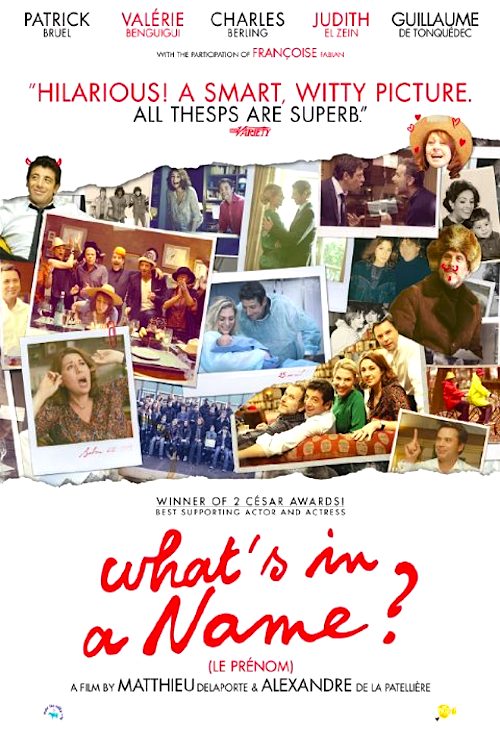
LFM Reviews What’s in a Name

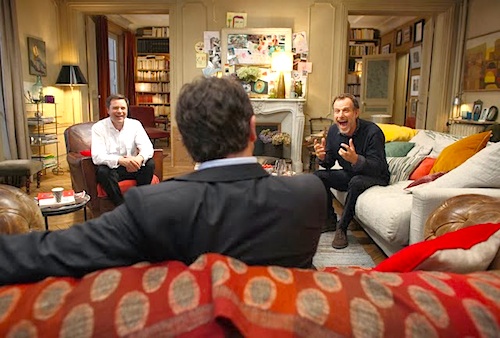
By Joe Bendel. It is a question Shakespeare and Asimov asked, in very different contexts. A group of family and friends will wrestle with it anew during the sort of dinner party you might find in the work of Yasmina Reza. In fact, the name game hysterics unleashed by an expectant father also have their roots on the French stage. After dominating the French box office, co-writer-co-directors Alexandre de La Patellière & Matthieu Delaporte’s screen adaptation of their play What’s in a Name now opens this Friday in New York.

Even though it comes fairly early in the first act, you really have to hear for yourselves what Vincent Larchet plans to name his son. Everybody is rather stunned by the news, particularly his brother-in-law Pierre Garraud, a popular literature professor who wears a lot of corduroy. He might be the most vocal in his disapproval, but Larchet’s sister Elizabeth (a.k.a. “Babu”) and childhood chum Claude Gatignol are rather taken a back as well. Just as emotions start to settle, Larchet’s very pregnant yet still compulsively late wife Anna Caravatti arrives to kick things up again.

Arguably, Name really is a lot like Carnage, except it has considerably more warmth (which is admittedly an easy bar to clear). The initial round of bickering is wickedly funny, even though you have to wonder how any parent could propose doing that to their child. Of course, the heated argument duly dislodges other closely held secrets and resentments, making it quite a dramatic night.

If you like talky movies (in the best sense) than Name is where you want to be. Even in translated subtitles, de La Patellière & Delaporte’s dialogue is deliciously sharp and punchy. Featuring most of the original stage cast, the ensemble’s crisp delivery would pass muster with Howard Hawks and his stop-watch. There are also some rather politically incorrect moments, particularly with everyone’s assumptions regarding Gatignol, a suspiciously sensitive trombone player in the Radio France Orchestra.

From "What’s in a Name."

The Fab Five are all quite strong, but Patrick Bruel really puts his stamp on the film, displaying comedic chops American audiences probably will not expect from his excellent work in A Secret and O Jerusalem. Even though they all get their quirks, Charles Berring’s Garraud becomes what passes for an anchor of stability in this bedlam, yet the newcomer still has some fine moments losing his cool with Bruel. Frankly, Valérie Benguigui’s frumpy martyr act as Garraud-Larchet gets a bit tiresome, but Judith El Zein brings notable grit and verve to bear as the late-coming Caravatti.

Even though Name is essentially still a five character one set affair, de La Patellière & Delaporte open it up enough so it does not feel distractingly claustrophobic. It never drags either. Infused with attitude yet ultimately forgiving of all its characters’ shortcomings, What’s in a Name is smart entertainment, recommended for Francophiles and those who appreciate literate comedy when it opens this Friday (12/13) in New York at the Cinema Village.

LFM GRADE: B+

Posted on December 9th, 2013 at 12:48pm.

LFM Reviews Good Morning Karachi @ The South Asian International Film Festival

By Joe Bendel. Perhaps the only job Arif would allow his fiancée Rafina to take might be Prime Minister. He is an ardent supporter of the exiled Benazir Bhutto, because her party pays him to be. With little education or prospects, he clings to his chauvinism when Rafina finds unlikely success in the Pakistani fashion industry. Despite Bhutto’s example, Rafina will have to overcome constant opposition to pursue her modeling career in Sabiha Sumar’s Good Morning Karachi, the centerpiece selection of this year’s South Asian International Film Festival in New York.

The very notion of a Pakistani Models Inc. sounds like a healthy step in the right direction, but Sumar and her co-writers, Malia Scotch Marmo and Samhita Arni, are not exactly overflowing with optimism. Set in the days leading up to Bhutto’s assassination, Karachi will obviously intersect with tragedy sometime in the third act. However, it resists the temptation to completely intertwine the fate of its characters with that of real world figures. Arguably, Bhutto’s shadow is more of a reality check than a dramatic device.

Yearning for relative independence, Rafina convinces Rosie, a close friend of the family, to find her a spot with her employer: Radiance, an exclusive beauty salon operated by a modeling agency. Of course, Rafina will not have to labor long before her unspoiled beauty lands her in front of a camera. As it happens, she has the perfect look for a difficult client. Naturally, Arif feels betrayed by her success and Rafina’s mother worries about the sort of attention she might attract. She is not being unduly concerned, given the film starts in media res, as masses of Islamist protestors set fire to fashion billboards.

From "Good Morning Karachi."

As fashion model melodramas go, Karachi is a pretty good one, especially considering the general state of Pakistani society. Shrewdly, Sumar does not over-venerate Rafina’s virtues. She makes mistakes and sometimes passively accepts the easier but not necessarily best course of action. She is human and therefore has a right to live her life as she sees fit, which she rather steadfastly does her best to do. However, the film’s attitude towards Bhutto is much more ambivalent, clearly questioning why her administration did so little to improve the outlook for forward thinking women like Rafina.

As Rafina, Amna Ilyes commands the screen, conveying the runway ingénue’s naiveté, without coming across nauseatingly immature. Beo Raana Zafar also adds mountains of dignity as her beloved auntie Rosie. The rest of the cast is a bit spotty, with Yasir Aqueel perhaps being the spottiest as the flyweight Arif. Still, everybody earns some props for appearing in a film that seriously addresses gender issues in Pakistan.

Sumar’s aesthetic restraint and artistic honesty keeps Karachi on course and even keeled the whole way through, while cinematographer Claire Pijman works wonders wonders with Rafina’s lower middle class neighborhood, making it glow suggestively. Sure, to some extent you grade on a curve to encourage a film like this, but Karachi will keep just about any viewer focused on and invested in its business on-screen. Recommended for those interested in women’s issues and/or Middle Eastern-South Asian cinema, Good Morning Karachi screens this Friday (12/6) as the centerpiece of the 2013 SAIFF.

LFM GRADE: B

Posted on December 5th, 2013 at 8:23pm.

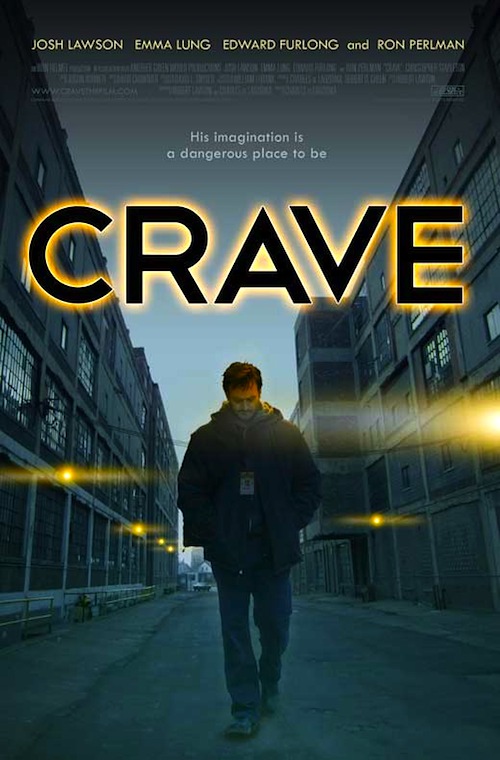
A Violent Imagination: LFM Reviews Crave

By Joe Bendel. This freelance crime photographer certainly lacks the endearing personality and slightly ribald history of the great Weegee (a.k.a. Arthur Fellig). He is also a bit challenged in the mental health department, as well. His violent fantasies threaten to erupt into his real life during Charles de Lauzirika’s Crave, which opens in select theaters later in the week.

Aiden is constantly thinking of what he might do to stand up the rampant crime around him, if he only had the guts. Typically, his fantasies involve some bloody form of payback, followed by an expression of appreciation from an attractive bystander. Photographing crime scenes has probably warped his perspective on humanity. At least he still has one friend: Pete, a cop and fellow AA member.

Against all odds, Aiden commences a halting romantic relationship with Virginia, the neighbor he has long carried a torch for. However, his extreme social awkwardness and simmering anger predictably pushes her away, just about the time he pockets a discarded hand gun from a crime scene. These developments will not have a positive effect on his general stability.

Few genre-ish films are as uncompromisingly gritty and pessimistic as the ill-titled Crave. Set in a pointedly crime-infested Detroit, things start out thoroughly crummy and head swiftly downhill from there. The Walter Mitty sequences are a bit cartoonish, but Lauzirika never stints on the gore. Yet, it is the mental implications for Aiden that are truly disturbing.

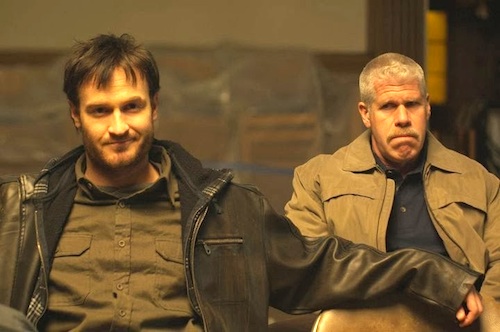
As problematic as Aiden undeniably is, Josh Lawson still manages to connect with audiences on a human level. Light years beyond nebbish, his self-defeating and delusional behavior is absolutely excruciating to behold. This is a hard film to watch, precisely because of acute embarrassment we frequently experience on his behalf. Still, Crave certainly makes you feel more than a month of quirky indies.

From "Crave."

Fortunately, the extreme pathos and lurking creepiness of Lawson’s work is occasionally leavened by Ron Perlman doing his thing as Pete. Holding his shtick in check, he wisecracks within reason, while giving the film a down-to-earth anchor. Emma Lung’s Virginia comes across as a rather bland, lightweight object for obsession (and her intuition is obviously substandard), but perhaps that is sort of the point.

Known for producing deluxe DVD boxed sets, Lauzirika won the AMD Next Wave Best Director Award at last year’s Fantastic Fest and one can see why. His approach is stylish, but he keeps the visual madness tightly under control. Despite Aiden’s tenuous connection to the world around him, ostensive reality is always easy to determine throughout the film.

Lauzirika maintains the courage of his convictions throughout Crave, which is impressive, but frankly it is easy to wish he had punked out a little bit. Not really a horror film or a vigilante thriller, but mindful of both cinematic traditions, Crave is a distinctive downer, recommended for those who looking for something bold. It screens this Thursday night (12/5) at the NoHo Laemmle in Los Angeles and opens in limited release on Friday (12/6),  also launching on VOD via iTunes the same day.

LFM GRADE: B-

Posted on December 5th, 2013 at 8:19pm.

Dying to Leave the Red Planet: LFM Reviews Last Days on Mars

By Joe Bendel. They were gypped out of those long promised canals, but there might just be some form of bacterial life on the Angry Red Planet. Of course, that turns out to be a very bad thing in Ruairí Robinson’s The Last Days on Mars, which opens this Friday in New York.

The first manned mission to Mars is about to head home, destined more for footnote status rather than lasting fame. However, at the eleventh hour, the ambitious Marco Petrovich thinks he may have unearthed the brass ring—bacterial life. Unfortunately, a freak accident causes his death and leads to the apparent disappearance of another crew member. Yet much to everyone’s surprise, Petrovich and his colleague return to base a short time later. Of course, they are not really alive—they are undead and spreading their infection the way zombies do.

Hoping to hold out until the scheduled arrival of their transport ship, the crew of the Tantalus Base applies their scientific expertise to the contagion, but it turns out to be a distinctly slippery biological agent. Human nature also takes an ugly turn as the situation deteriorates.

Right, so first contact is kind of rough. Zombies on Mars might sound distinctly pulpy, but Robinson’s distinguished cast sells it with conviction. Liev Schreiber brings instant credibility as the grizzled but psychologically damaged chief engineer Vincent Campbell. Likewise, Romola Garai classes up the proceedings as his medic lover, Rebecca Lane. Johnny Harris (from BBC America’s The Fades) has a natural talent for getting all panicky and twitchy on-screen. Still, Olivia Williams overwhelms them all as the unrepentantly undiplomatic senior science officer, Kim Aldrich.

In a sense, Last Days is the more stylish and competent version of Roger Christian’s klutzy B-movie, Stranded. Both achieve an effectively claustrophobic vibe, but the former is a vastly more polished package overall. Cinematographer Robbie Ryan (probably best known for his work with Andrea Arnold) gives everything an appropriately dark, crimson-hued look, while production designer Jon Henson’s team creates a convincing near future, other worldly environment.

Last Day’s thematic predecessors are many in number and vary considerably in quality. Nevertheless, the combination of Mars, zombies, and some first class British character actors guarantees a certain level of genre entertainment. What screenwriter Clive Dawson’s adaptation of Sydney J. Bounds’ short story lacks in originality is largely made up for through Robinson’s slick execution. Recommended for its horror flavored science fiction (and vice versa), Last Days on Mars opens this Friday (12/6) in New York at the Landmark Sunshine.

LFM GRADE: B

Posted on December 4th, 2013 at 3:33pm.

Broadway in Movie Theaters: LFM Reviews Duke Ellington’s Newly Restored Sophisticated Ladies

By Joe Bendel. Don’t call the Ellington Orchestra a ghost band. At least it wasn’t in the early 1980’s. The maestro would still recognize most of the members, especially the leader, his son Mercer. Though the Ellington patriarch had gone off to the great bandstand in the sky, the family business was still going strong, thanks to a Broadway show featuring Ellington’s most popular songs and the band, under Mercer’s direction. More of a revue than a musical per se, Sophisticated Ladies ran for 767 performances at the Lunt-Fontanne. Captured live, in performance in 1982, Ellington’s Sophisticated Ladies makes its big screen debut in all its restored and re-mastered glory, courtesy of SpectiCast, beginning today at participating theaters.

If there is one theater Sophisticated Ladies tries to evoke, it is the Cotton Club. Our first clue is probably the big neon sign hanging from the back of the stage that says, “Cotton Club.” However, the production conceived by choreographer Donald McKayle and directed for the stage by Michael Smuin is not pedantically faithful to the era or venue. Ellington’s final theme song, “Satin Girl,” duly finds its way into the program. Also conspicuously anachronistic is the multiracial company of hoofers who dance to Ellington’s classics together, which would have been a major no-no during the Cotton Club’s heyday—so some things really aren’t how they used to be.

On the other hand, the immortal appeal of Ellington’s swinging standards comes through loud and clear. Ladies actually starts with the “Sophisticated Gentlemen” performing a relatively minor piece of Ellingtonia, “I’ve Got to be a Rug Cutter,” but it sure is a handy vehicle for some tap pyrotechnics. Likewise, “Music is a Woman” has never been excessively covered, but it is a nice up-tempo introduction for Paula Kelly, who looks terrific in flapper fashions (some might also recognize her, or perhaps not, from her trailblazing appearance in Playboy).

In a related development, one of the Ladies’ few missteps is a Josephine Baker-esque “jungle” style rendition of “The Mooche” that is probably quite true to the show’s Cotton Club roots, but has not aged well. The band still sounds great on it, though. Terri Klausner then commences torching up the old chestnut “Hit Me with a Hot Note and Watch Me Bounce” something impressively fierce. Kelly, two gentleman admirers, and a red piano keep the sassiness cranked up to the max with a “Love You Madly/Perdido” medley. It is elegant, but also pretty darn hot.

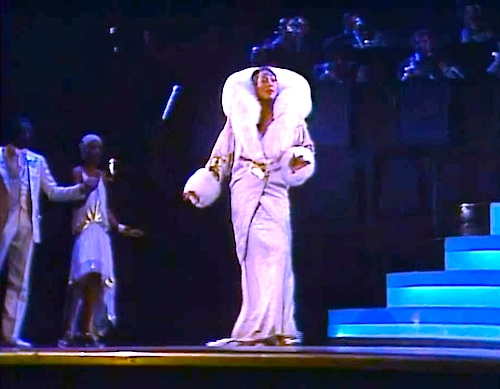
Phyllis Hyman starts “It Don’t Mean a Thing” in an unusally diva-ish bag, but it segues into show-stopping tap showcase for the gents. The video crew really shines during these big dance numbers. Clearly, multiple cameras were involved, mostly captured the company in full Astaires, with a few close-ups of their flying feet thrown in for good measure. The jitterbuggers take over during “Cotton Tail” and they don’t skimp on the air-steps. The rendition of “Solitude” is a bit miasmic for jazz tastes, but Kelly cranks the energy level back up with a duet-medley of “Don’t Get Around Much/I Let a Song Go Out of My Heart.” Unfortunately, a killer “Drop Me Off in Harlem” is slightly marred by a dated Chinese caricature.

From "Sophisticated Ladies."

For hardcore Duke fans, “Diminuedo in Blue” leads into the intermission, but without the “Crescendo,” probably because nobody would want to try to replicate Paul Gonsalves’ epic solo. Oddly, there is nothing representing the Sacred Concerts, which seems like a lost opportunity, but so be it. Considered the star, Hyman specializes in ballads like “In a Sentimental Mood” that are all very nice, but Kelly steals the show out from under her with saucy twists on favorites like “I’m Beginning to See the Light.” There is also good reason why she is the featured dancer for the pseudo title song, “Sophisticated Lady.”

The choreography of McKayle and Smuin (with a tap assist from Henry LeTang) translates well to the screen. In fact, the dance sequences are distinguished by an exuberance that remains fresh and appealing thirty-some years later. The cats in the band sound great too, but they are mostly stuck behind a gauzy curtain for most of the show (at one point future Lincoln Center mainstay Joe Temperley can be positively id’ed, but few others get even fleeting face time). The current Broadway production After Midnight does a better job in this respect, featuring the Jazz @ Lincoln Center affiliated band clearly on-stage, even giving them their own front-and-center number. It is a great show, but if you cannot make it to New York, there is considerable crossover between the two productions’ choice of tunes, so keep an eye out for Ladies.

Indeed, there is both timelessness and nostalgia to be found in Sophisticated Ladies. Most of Ellington’s songs sound as vital today as they did in the 1930’s and a few outliers are nicely rehabilitated by the Sophisticated Ladies and Gentlemen. Yet, when the camera pans the audience, we see folks dressed to the nines for Broadway. The men are wearing suits at the least, with a fair smattering of tuxedoes out there. Those days are gone, but the music swings like it always did. Highly recommended for fans of Ellington and Broadway, Sophisticated Ladies will have limited screenings in select theaters nationwide, beginning December 4th until the 18th, depending on the schedules of participating locations—including today (12/4) at the Chelsea Cinemas in New York.

LFM GRADE: B+

Posted on December 4th, 2013 at 3:29pm.