La Dolce Vita: LFM Reviews The Great Beauty, Italy’s Oscar Submission

By Joe Bendel. Writers write, that’s what they do. Jep Gambardella still qualifies, just barely. After the publication of his acclaimed first novel, he chose to spend the rest of his career penning Vanity Fair-style celebrity profiles. It was much easier, but far less satisfying. Gambardella belatedly realizes this holds true for all aspects of his life in Paolo Sorrentino’s The Great Beauty, Italy’s official foreign language Oscar submission, which opens this Friday in New York.

It is Garbardella’s sixty-fifth birthday and his social circle is ready to party like they are really his friends. The magazine writer is in his element. However, he turns uncharacteristically pensive when he learns his great lost lover has passed away, perhaps still harboring undiminished feelings for him. Hoping to experience a similar passion, Gambardella commences a relationship with Ramona, the daughter of his old strip-club owner crony, who still works in the family business at the impressive age of forty-two. Perhaps there is some substance to their affair, but at the very least, her presence on his arm thoroughly scandalizes Rome’s high society.
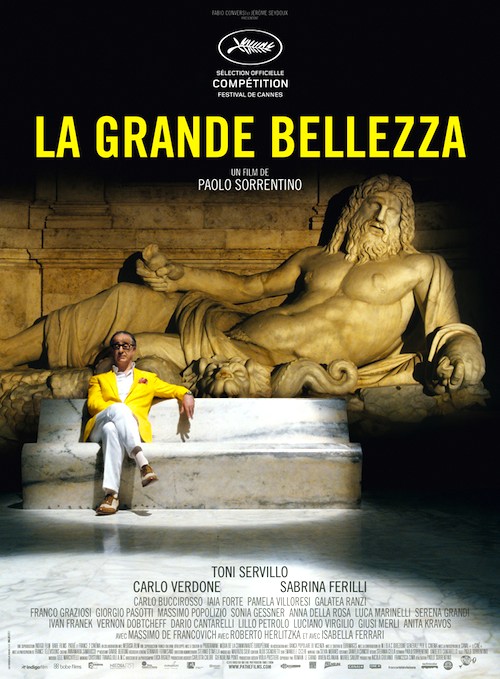
A rapturous viewing experience, Great Beauty must be the most elegant looking and sounding film since Luca Guadagnino’s I am Love. Frankly, it takes considerable guts to make a film that so perilously invites comparison to Fellini’s La Dolce Vita, but Sorrentino has boldly gone there nonetheless. He masterfully maintains a mood that is palpably seductive and elegiac. Indeed, Great Beauty is likely to induce a midlife crisis in viewers, regardless of their age or accomplishments. Yet, it is an elusive cinematic statement that slips through your fingers whenever you try to analyze it.

Sorrentino’s frequent collaborator Toni Servillo gives the career performance of an accomplished career as Gambardella. Wonderfully urbane and devilishly witty, he nonetheless acutely expresses Gambardella’s each and every regret. This is Academy Award caliber work, but Great Beauty is so refined and mature it will probably be lucky just to make the foreign language cut.

Of course, Servillo is not laboring alone. As Ramona, Sabrina Ferilli’s earthy vulnerability perfectly complements Servillo’s cerebral angst, while the manic melancholy of Carlo Vendone as Gambardella’s writer-associate further heightens the Fellini-esque vibe, whereas Giovanna Vignola is simply incomparable as his acerbic editor, the diminutive Dadana.

Clearly, nobody shoots statuary and architectural edifices like cinematographer Luca Bigazzi. Similarly, the themes composed by Lele Marchitelli, as well as several shrewdly licensed selections from the likes of Arvo Pärt, provide a rich feast for the ears. Altogether, Great Beauty is a powerful and assured film on every level. Very highly recommended (especially to Academy members), it opens this Friday (11/15) in New York at the Lincoln Plaza Cinemas.

LFM GRADE: A

Posted on November 11th, 2013 at 2:48pm.
A Homecoming for Russians Artists: LFM Reviews Enter Here

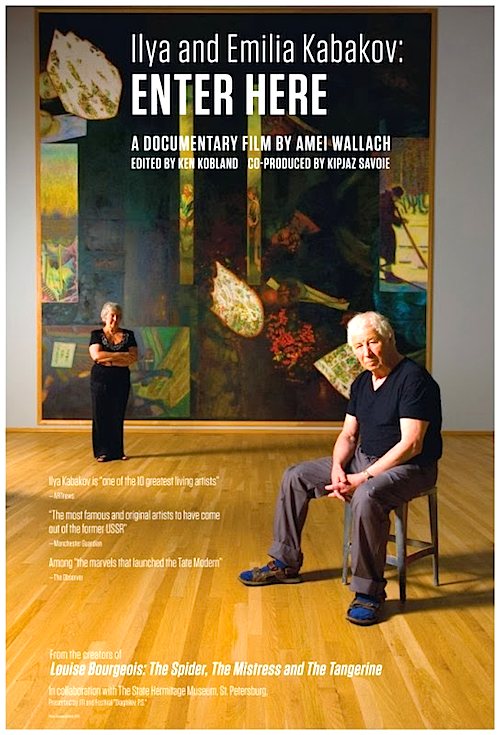
By Joe Bendel. Ilya Kabakov does not really care how many millions of people Stalin murdered—more relevant to him is the way the Soviet state treated his mother like dirt. His intensely personal experiences under Communism profoundly shaped his conceptual work, created in collaboration with his wife, Emilia. After twenty years in the West, Kabakov finally returns to Moscow for an ambitious series of installations. Amei Wallach documents their mostly triumphant homecoming in Ilya and Emilia Kabakov: Enter Here, which opens this Wednesday at Film Forum.

Kabakov’s contemporaries all acknowledge the Moscow Conceptualists started with him. Like most of his colleagues, Kabakov paid the bills illustrating children’s books. It allowed him plenty of free time to pursue to pursue his own work – in secret, of course. Arguably, the young Kabakov was rather fortunate when the Leningrad Art School accepted him, at a time when both pupil and institution had been evacuated to Samarkand. However, his formative art school years remain a source of pain and anger for Kabakov.

Years later, Kabakov’s mother agreed to his request for a written account of her difficult life. The narration of her words form the film’s strongest sequences, chronicling her hand-to-mouth years, working as the night watchman at his art school, living illegally in a converted water-closet, because she lacked the proper residency papers. Constantly evicted by bureaucrats and snitches, Kabakov’s mother was essentially homeless and shunned in the workers’ paradise. Her missive-memoir became the framework for Labyrinth, My Mother’s Album and its influence on other pieces is unmistakable.

While Ilya Kabakov clearly emerges as the senior partner, Emilia Kabakov seems perfectly content to serve as the more practical liaison with the business side of the art world. Twelve years his senior, Emilia Kabakov carries far less personal baggage from the Soviet years. However, it is rather eye-opening for her coming across an old informer’s journal with her family somewhat ominously identified as “the Jews.”

The Kabakovs’ brand of conceptual art is far more accessible than what might come to mind after watching the Herb & Dorothy documentaries. Unlike some of their colleagues, the Kabakovs’ work is clearly both intellectually and emotionally engaging, with their ironic use of Soviet symbols and the trappings of crummy everyday Russian life speaking volumes. Kabakov frequently incorporates his paintings into their so-called “total installations,” which further heightens their visual impact.

With an eye for telling details, Wallach and her crew nicely capture a sense of the viewing experience of the Kabakovs’ installations. Likewise, she also catches the artists, particularly Ilya, in reflective moods. Executed with sensitivity, insight, and a dash of style, Ilya and Emilia Kabakov: Enter Here is recommended for those who appreciate fine art and Russian history when it opens this Wednesday (11/13) at Film Forum.

LFM GRADE: B+

Posted on November 11th, 2013 at 2:45pm.

The Iranian New Wave: LFM Reviews Tall Shadows of the Wind

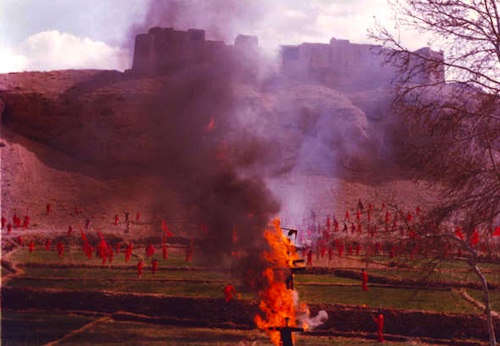
From "Tall Shadows of the Wind."

By Joe Bendel. It could be world cinema’s most iconic scarecrow after The Wizard of Oz, but this severe figure definitely lacks a heart. Conceived as a protest against the Shah’s rule, it eerily foreshadowed the tragic disappointments of the Islamic Revolution, thereby earning it the distinction of being banned by both regimes. Fittingly, Bahman Farmanara’s Tall Shadows of the Wind screens next week during the Asia Society’s Iranian New Wave 1960’s-1970’s film retrospective.

Produced in 1979, the timing for Wind was profoundly unlucky. Right from the opening sequence, one can see how the new authorities would take issue with Farmanara’s heavily symbolic adaptation of Houshang Golshiri’s short story. A hardscrabble village has assembled in the fields to chant their prayers to their long awaited deliverer. It is a primal scene with a vaguely pagan character, feeling rather out of place in the Abrahamic tradition.

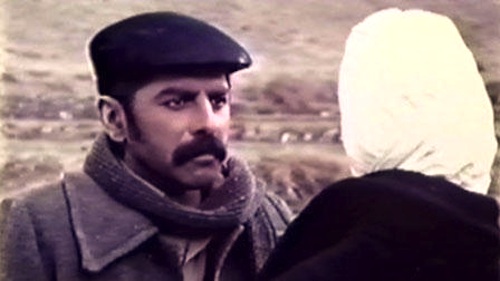
Clearly, life is desperately hard for the village, due to reasons only vaguely alluded to. A scarecrow has been erected in the fields, which should be a positive development. However, when Abdullah the bus driver draws the rough approximation of his own features on the straw man, it starts to exert a malevolent influence on the local populace. Anxiety and general feelings of dread run rampant through the hamlet, leading to some very real physical repercussions. As the indirect cause of it all, the somewhat eccentric Abdullah is further marginalized within the community. Yet, he remains the one member of the tight-knit group inclined to take action.

From "Tall Shadows of the Wind."

Even with Wind’s otherworldly vibe, the significance of a new progressive guardian bringing even greater misery is impossible to miss. Likewise, its pointed depiction of the nonconformist’s troubled place within society did not exactly fit the new government’s playbook, either. Causal relationships can get a little sketchy, but the mysterious uncertainty is part of what makes it so unsettling. Farmanara creates an impossibly hard to describe vibe, combining gritty naturalism and a feverish sense of supernatural oppression. Although Wind is a decidedly cerebral allegory, it could have easily been converted into a horror film with a handful of re-shoots and a different score.

Evidently finding a clean print of Wind is a bit of a challenge, but even in imperfect formats, Farmanara’s visuals are unusually powerful and loaded with meaning. A compelling fusion of the unreal and the too real, Tall Shadows of the Wind defies comparison to other films. Since it will be projected from a DVD, the Asia Society will not charge admission to Wind this coming Tuesday (11/12). Highly recommended regardless, Farmanara’s film has never been as widely screened as it deserves to be (especially in Iran), so any showing is an event to take advantage of.

LFM GRADE: A-

Posted on November 11th, 2013 at 2:38pm.

Getting Macro on the Micro Level: LFM Reviews Economic Freedom in Action

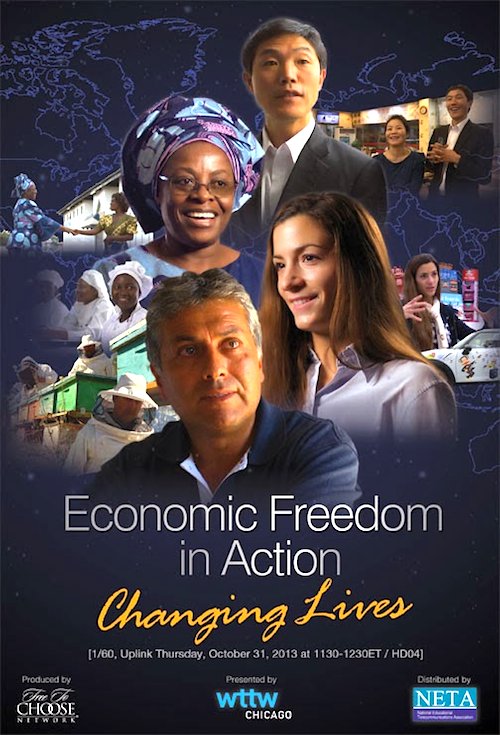
By Joe Bendel. Thanks to economic freedom, you can buy Paul Frank merchandise in Slovakia. The availability of monkey-face t-shirts might not sound like an epochal triumph, but it has made a world of difference for the Rybárikovás and their standard of living. Even more dramatic are the case studies of the North Korean defector providing start-up capital to his fellow refugees in the ROK and the Chilean beekeeper exporting queens to struggling European bee farms. Drawing upon these highly personal case-studies and the Fraser Institute’s annual report on world economic freedom, host-economist Johan Norberg argues that policies of economic liberty make the world a better place whenever they are adopted in Economic Freedom in Action: Changing Lives, which airs on Chicago’s WTTW this Thursday.

Written and directed by James & Maureen Castle Tusty, the filmmakers responsible for inspiring Singing Revolution, and produced in conjunction with the Free to Choose Network, Action follows the template established by Milton & Rose Friedman’s groundbreaking series, sprinkling manageable nuggets of analysis amid plentiful real world examples. Spanning the globe, Action starts in Africa, examining the country’s extraordinary turn-around from the perspective of Sylvia Banda.

Under Socialist president-for-life Kenneth Kaunda, Zambia was an economic basket case – but following his ouster, it has become one of the continent’s fastest growing economies, thanks to an ambitious privatization program. Banda was able to ride that wave. Starting with an unfurnished one-room restaurant, she now operates one of the nation’s largest food supply companies. Through capitalism, she has enacted a series of agricultural and hygiene reforms that the government and NGOs struggled to implement.

The contrast between economic liberty and authoritarianism is starkly demarcated on the Korean peninsula. While famine is an everyday fact of life in the tightly regimented DPRK, the ROK is a land of plenty, often leading to culture shock for defectors like Daesung Kim. To help his fellow refugees adapt, Kim started a venture capital firm that invests in their small enterprises. Once struggling to survive, those he works with now have a stake in South Korea’s economy and can provide entrepreneurial expertise if and when the North finally liberalizes its markets and political system.

Arguably, Kim is the bravest capitalist featured in Action. In contrast, the stakes were never so high for Katerina Rybáriková, but her story nicely illustrates the necessity of economic liberty in addition to political liberty. After the fall of communism, Slovakia still lagged behind most of Eastern Europe and ranked relatively low on the Fraser Institute’s index. However, a concerted program of privatization and property rights guarantees created the climate that allowed Rybáriková to successful pitch a Slovakian franchise to the Paul Frank corporate office.

One might expect Action to steer clear of Chile, yet it completely proves the thesis of Friedman’s Capitalism and Freedom, with political liberty duly following the establishment of economic liberty. While acknowledging the abuses of the Pinochet regime, Action charts the explosive growth following his economic reforms that remain largely unadulterated to this day. Thanks to the market-based economy, brothers John and Miguel Hernandez have been able to build their bee farm into a going pollination service and bee queen exporting concern, a business with particularly positive global ramifications, given environmental concerns regarding dwindling bee populations.

Chile and South Korean have consistently ranked high on the Fraser report, while Zambia and Slovakia have been recent up-and-comers. That begs the obvious question: how does America rank? For years, we usually held the second or third spot, but we have fallen in recent years, to number nineteen. Norberg and the Tustys do not engage in a lot of finger-wagging, but the significance of this tumble is hard to miss.

Indeed, Action is a remarkably sure-footed exploration of the real world impact of economic policies. By focusing on human stories it never comes across like an econ lecture or a ration of polemics. It is thoroughly convincing, but it is also really good television, taking viewers to places they rarely see in the mainstream media. Highly recommended, Economic Freedom in Action: Changing Lives airs this Thursday (11/14) on Chicago’s WTTW and can be seen in syndication on PBS stations throughout the month. It will also be available for online viewing courtesy of the Free to Choose Network.

LFM GRADE: B+

Posted on November 11th, 2013 at 2:20pm.

LFM’s Jason Apuzzo at The Huffington Post: Putting Computers in Their Place: Computer Chess & The Nerd Origins of Today’s Technopoly


[Editor’s Note: the post below appears today at The Huffington Post.]

By Jason Apuzzo. Computers need to be put in their place. They really do.

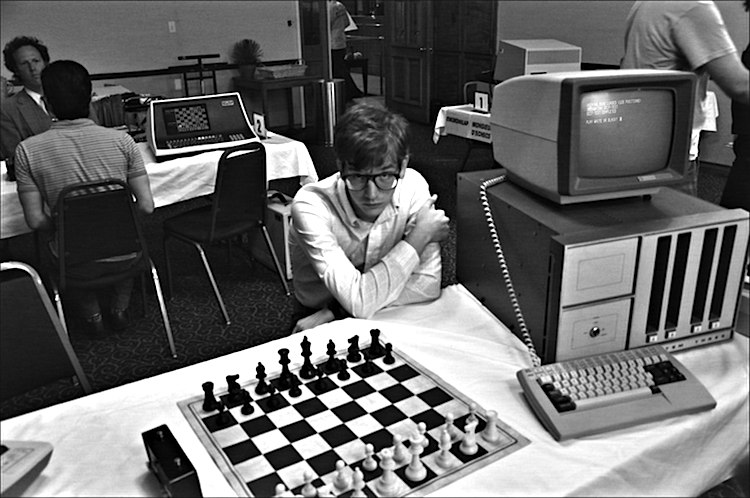
That’s why I’ve been looking forward to the DVD release this week of Andrew Bujalski’s cult Sundance hit Computer Chess. Computer Chess finally spills the beans about where these little monsters came from in the first place.

Every time I pick up a newspaper these days – I’m one of the twelve people left who still read physical newspapers – I read about how computers are spying on us, destroying jobs, or infuriating health insurance customers. Like a hungry Rottweiler off its leash, computers are getting out of control and tearing up the neighborhood.

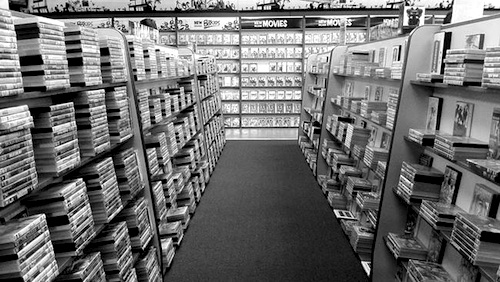
If you believe what you read, computers are also in the process of wrecking the book publishing and music industries, eliminating celluloid photography – and just this week computers claimed their latest victim, one near and dear to my heart: the local video store, as Blockbuster finally succumbed to laptops, smartphones and tablets as the preferred ways of renting all those movies you couldn’t afford to see (or were too embarrassed to see) when they were in theaters.

2013-11-08-VideoStoreaisle.jpg
The demise of the American video store.

No more video stores – who would’ve believed it, even just ten years ago? That means no more pimply teenagers to recommend midnight horror movies to me (“Sir, I definitely recommend C.H.U.D. over TerrorVision“), no more aimless browsing or listening to neighbors argue over which Steven Seagal movie to rent, no more cheap licorice sticks at the checkout counter.

I never thought I’d miss those things so much – but suddenly I do. And it’s all because of our ‘friend’ the computer. Computers are becoming like the Yankees during the ’90s: gobbling up everybody else’s talent, then telling us how good it is for baseball.

The propaganda over the wonders that computers supposedly bring to our lives is getting out of hand. In the very least, it’s out of proportion to the destruction computers are simultaneously causing – that ‘disruptive’ effect Silicon Valley gurus salivate over, like vampires at a blood drive.

So as Twitter – the company currently reducing our public discourse to snarky, 140-character outbursts – celebrates its gaudy IPO right now, I’d like to recommend a new movie out on DVD this week that casts digital technology in a very different light: Computer Chess. Continue reading LFM’s Jason Apuzzo at The Huffington Post: Putting Computers in Their Place: Computer Chess & The Nerd Origins of Today’s Technopoly

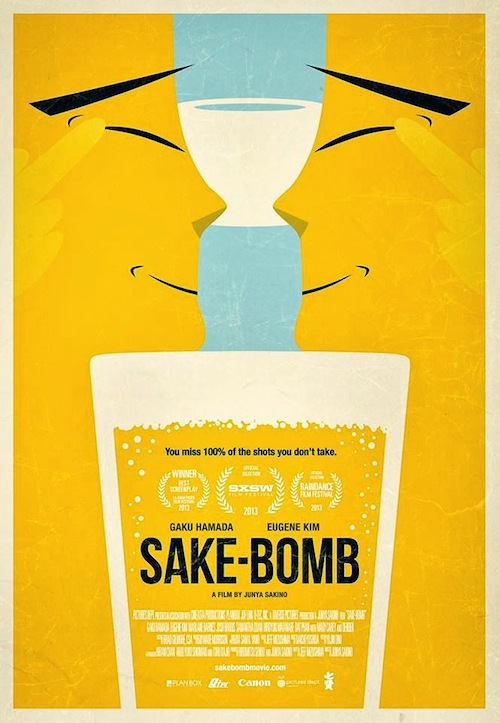
Have a Drink, Cousin: LFM Reviews Sake-Bomb

By Joe Bendel. As a sake-brewing apprentice about to succeed his master, Naoto relates to the potent potable on a deep level. It is almost sacrilegious to ask him to drink a sake-bomb (the old sake shot submerged in a beer). Nonetheless, he acquits himself fairly well when he hits the California party scene with his snarky cousin (better than the churlish vlogger, in fact). Eventually, everyone will learn a thing or two in Junya Sakino’s extended family road comedy, Sake-Bomb, which opens today in Los Angeles.

Naoto could not possibly be more earnest. When he agrees to take over his master’s brewery, he also follows the old man’s advice, taking a week’s vacation to finish working through any lingering regrets he might have in his personal life. His pursuit of Olivia, his long lost summer lover, brings him to the Moritas’ apartment in Los Angeles.

Sebastian is crashing there with his father, because he is unemployed and has just been dumped by his girlfriend. He is not exactly keen to shuttle Naoto up to Petaluma in hopes of finding the elusive Olivia, but his father insists. Naturally, they first take a detour to a party in Irvine, so Sebastian can make a complete clown of himself in front of his ex. At least they meet a few interesting types there, including Joslyn, the naughty graphic novelist who catches Sebastian’s eye.

Pound for pound, there might be more identity jokes in S-B than any other film this year, largely taking the form of Sebastian’s video posts. He is angry with Asian women who date white guys. He is angry with white women who do not date Asian men. He is angry with white people who cannot distinguish between Asian nationalities. He is not too thrilled with the Chinese either, so buckle up. On one hand, some of this material pushes the envelope of politeness. On the other hand, it is pretty funny sometimes.

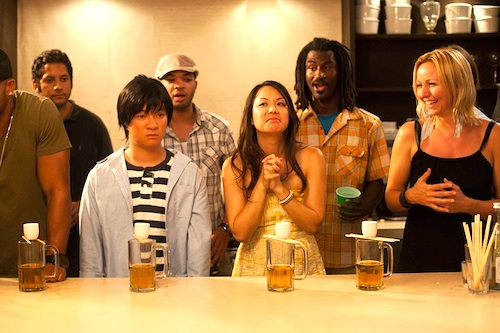
From "Sake-Bomb."

As Sebastian, Eugene Kim never holds back on the attitude. He is almost too abrasive, considering the audience obviously is supposed to embrace him during the third act. However, likability is not a problem for Gaku Hamada, the popular Japanese star of Potechi (Chips), who subtly but surely conveys the strength of character beneath Naoto’s naivety. Together, their over-the-top and understated personas play off each other quite nicely. Future star-in-the-making Jessika Van also scores in her scene as a friend of Sebastian’s girlfriend, giving him what-for. Yet, for a certain demographic, former porn star and California gubernatorial candidate Mary Carey upstages everyone as, you know, a porn star.

Sake-Bomb never reinvents the buddy movie-wheel, but it has an edge and a good deal of heart. Better than the typical Phillips and Apatow grind ‘em outs, Sake-Bomb is recommended for fans of slightly raucous but well-intentioned rom-coms when it opens today (11/8) in Los Angeles at the Downtown Independent.

LFM GRADE: B

Posted on November 8th, 2013 at 3:09pm.