LFM Reviews As Time Goes By in Shanghai @ The Margaret Mead Film Festival

By Joe Bendel. Jazz musicians are forward-looking by temperament, constantly anticipating the next gig or recording. For a group of elderly Chinese swing musicians who endured the Cultural Revolution, living in the here-and-now rather than the past is not merely an aesthetic choice, it is a survival strategy. The Peace Old Jazz Band is Guinness-certified as the oldest continually performing band and they will finally have their spotlight moment in Uli Gaulke’s As Time Goes By in Shanghai, which screens during the 2013 Margaret Mead Film Festival at the American Museum of Natural History.

When five out of six band members are nicknamed “Old” (as in “Old Sun” or “Old Li”), it is pretty clear what you’ve got here. For the last twenty years, they have hit nightly at Shanghai’s Peace Hotel, following in the grand tradition of the big bands of the Swing Era. Accustomed to playing for dancers, most of the band is not inclined to start experimenting now. They might sound like “moldy figs,” but they have a right to stick to their thing. After all, the Cultural Revolution was a living nightmare for any musician performing decadent jazz and Western classical music.

When booked to play the North Sea Jazz Festival in Rotterdam, the Peace Old recruits a younger vocalist to perform standards as well as a few jazz renditions of traditional Chinese songs. Naturally, they shamelessly flirt with Yin “Yasmin” Chen—we would worry about them if they didn’t. Clearly, this gig will be a career zenith for the band, but they seem to take it in stride.

At first, As Time Goes By seems to be another documentary chronicling the late life triumphs of a group of plucky oldsters. However, it progressively deepens over time. The Peace Old musicians are understandably reluctant to talk about their experiences during the Cultural Revolution (after all, it never officially happened), but when Gaulke catches them alone, they start to open up and when they do it is heavy.

Frankly, the Peace Old’s technique is just kind of okay overall, but Holy Cats, do they play with feeling. While it is difficult for them to talk about their experiences verbally, it all comes out through their instruments. Gaulke mostly has the good sense to focus on the band and stay out of the way, but his transition shots capture a sense of the less affluent side of go-go Shanghai. The Peace Old can relate to both worlds, but do not quit fit into either.

As Time Goes By is deeply moving, both in musical and personal terms. It is rare to find a film that speaks so directly to both the gigging life and the residual collective emotional baggage of the Cultural Revolution, but it certainly does. Gulke’s doc should particularly resonate with working musicians in any major city. Wonderfully wise and bittersweet, As Time Goes By in Shanghai is very highly recommended.  A highlight of this year’s Margaret Mead Fest, it screens this Saturday (10/19) at the AMNH.

LFM GRADE: A

Posted on October 16th, 2013 at 10:25am.

One of the Scary Season’s Best: LFM Reviews Haunter

By Joe Bendel. Imagine watching the same episode of Murder She Wrote over and over again. If that isn’t Hell, it is probably close enough. Maybe a Columbo wouldn’t be so bad, but Lisa Johnson’s parents have pretty vanilla tastes. Do not judge them too harshly for being stuck in the 1980’s, because they are sort of dead. Recovering awareness of their eternally looping existence, Johnson will reach out to other girls like her in hopes of breaking a pernicious supernatural cycle of terror in Vincenzo Natali’s Haunter, which opens this Friday at the IFC Center.

The Johnson family was murdered in 1986. Every day since, they relive that fateful Sunday, unaware of their paranormal condition. At least they still have a cool President. Somehow, their daughter has awakened, to some extent. Cognizant of the wicked déjà vu happening, she starts having what might be described as ghostly experiences. Soon she suspects other families are trapped in a similar stasis within the house, but in different time periods. Eventually, she will make contact with teen-aged girls in both the past and the future, but her consciousness does not go unnoticed.

Haunter is easily one of the best horror films of this Halloween season. Natali maintains an overwhelming vibe of creeping dread, while Brian King’s screenplay ranges into surreal, mind-bending territory. The closest comparison film would probably the metaphysical horror of H.P. Mendoza’s ambitious indie I Am a Ghost, but Haunter has a more mainstream, Nightmare on Elm Street dimension to it.

Regardless, Haunter is the freshest horror outing probably since Mendoza’s film. It delivers about a half dozen game-changing twists and they each work surprisingly well. There is no padding in King’s script. Everything happens for a purpose. Perhaps most importantly, it keeps viewers on edge from start to finish.

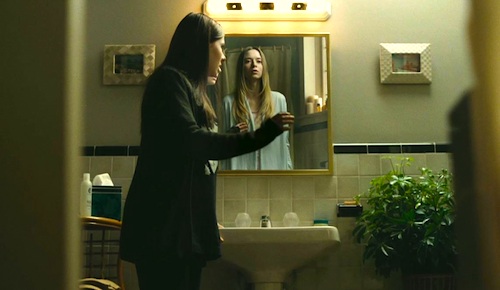
From "Haunter."

As Johnson, Abigail Breslin is on-screen front-and-center more or less the entire time, so the film largely depends on her. Fortunately she is convincingly smart, resilient, and increasingly freaked out as the young protagonist. Stephen McHattie also brings a fittingly severe presence as the mysterious figure simply billed as the “Pale Man.” However, if there is one misstep in Haunter it comes in showing too much of him. More mystery is always better.

Frankly, this is a perfect example of the direction more indie genre films ought to take. There is hardly any gore or special effects to speak of in Haunter, yet it completely gets under your skin. Smart and tightly focused, Haunter is easily the horror movie pick of the month. Highly recommended for fans, it opens Friday (10/18) at New York’s IFC Center.

LFM GRADE: B+

Posted on October 16th, 2013 at 10:21am.

LFM Reviews All is Lost

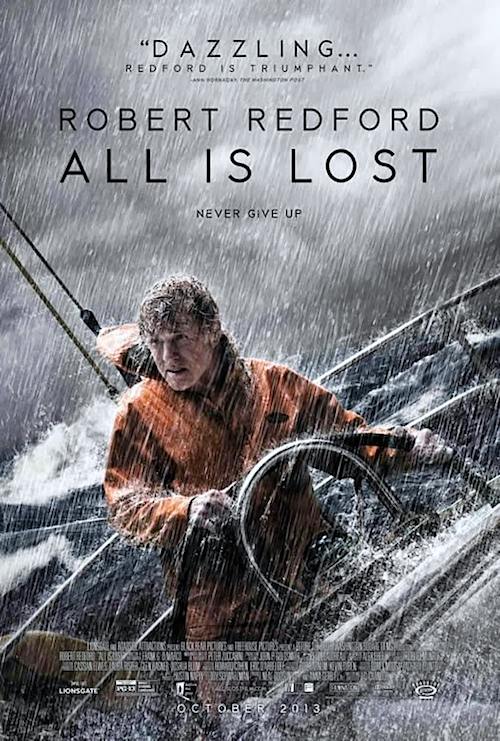
By Joe Bendel. There is an old man and the sea—sans marlin. There is no tiger, either. Instead, it is an errant workaday cargo container that leads to a mortal and existential crisis in J.C. Chandor’s All is Lost, which opens this Friday in New York.

“Our Man,” as he is simply billed, is in the midst of a solo cruise through the Indian Ocean when his small yacht is struck by said container. He wakes to find his boat taking on water and the electronics, including the radio, shorted out. He is able to patch up the gaping hole and bail out most of the water, but lasting damage has been done. Sailing blindly as a result, Our Man unknowingly proceeds towards a Sebastian Junger-level storm.

Considering it arrives so soon after Ang Lee’s Oscar winning Life of Pi, viewers might assume Lost is just more of the same. However, there is a muscular leanness to Chandor’s film that frankly compares favorably to its predecessor. All the New Age allegories and comforting sentimentality are stripped away, leaving a mere man to face the elements alone.

On one level, Chandor’s screenplay is relatively simple, with almost no dialogue to be heard from start to finish. Still, despite the limits of the water-bound location, Chandor dexterously introduces one darned thing after another to torment his sole character. Being the one and only face of a film is always a considerable challenge, but the shockingly haggard looking Robert Redford (showing his full seventy seven years) rises to the occasion. Rather than acting out and raging against fate, he vividly portrays the man’s slow deflation, which is far more compelling over time.

If not as visually arresting as Pi, Lost fully conveys the cold, damp, claustrophobic crumminess of Our Man’s precarious situation. Technically, it is quite an accomplished film, with particularly credit due to the Tahoe, the Tenacious, and the Orion, the three vessels that sailed their last as stand-ins for Our Man’s ill-fated Virginia Jean.

If nothing else, Lost should convince viewers not to look in the middle of the Indian Ocean if they want to go find themselves. It is surprisingly gripping stuff, buoyed by a remarkably disciplined performance from its craggy star. Recommended for those who appreciate a realistic man versus the elements survival story, All is Lost opens this Friday (10/18) in New York at the Angelika Film Center.

LFM GRADE: B+

Posted on October 15th, 2013 at 12:17pm.

LFM Reviews This Ain’t No Mouse Music @ The Margaret Mead Film Festival

By Joe Bendel. Chris Strachwitz was born to an aristocratic family in Lower Silesia, but WWII drastically altered his destiny, turning him into the song-hunting heir of Alan Lomax. News that the advancing Soviet army was summarily executing “capitalists” convinced his family to emigrate west. Encountering New Orleans Jazz and Delta Blues as an American teen, he subsequently founded Arhoolie Records (named after a form of field holler Lomax recorded) to seek out and preserve the earthy sounds that spoke to him. Fifty years later, Strachwitz looks back on it all in Chris Simon & Maureen Gosling’s This Ain’t No Mouse Music, which screens during the 2013 Margaret Mead Film Festival at the American Museum of Natural History.

“Mouse Music” is a vague term Strachwitz uses for the sort of slick, mass produced music he can’t abide. His musician friends cannot really define it either, but they know you don’t want to be it. Like Lomax, Strachwitz did much of his recording in the field, tracking down many of the real deal Blues, Cajun, Creole, Cajunto, and Appalachian musicians that had slipped through the modern world’s cracks. The first time out, he hit major pay dirt, “discovering” Mance Lipscomb. Thanks to Arhoolie, artists like Big Joe Williams, post-“Hound Dog” Big Mama Thornton, Mississippi Fred McDowell, Michael Doucet, and Clifton Chenier would find a dedicated national audience.

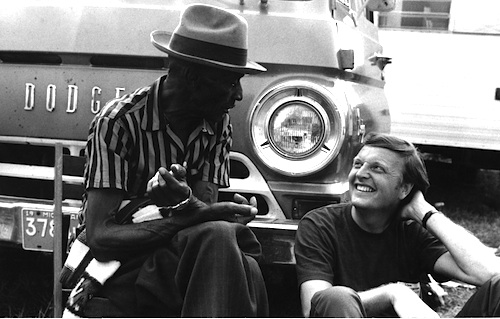
From "This Ain’t No Mouse Music."

During his travels, Strachwitz met and collaborated with filmmaker Les Blank (to whom Mouse Music is dedicated) and became a family friend to scores of musicians. Evidently, Strachwitz largely picked up the Bay Area politics surrounding him, but Simon and Gosling mostly steer clear of potentially divisive subjects. However, they cannot resist including the story of how Strachwitz obtained publishing rights to Country Joe McDonald’s “I Feel Like I’m Fixin’ to Die Rag.” Evidently, the folk-rocker needed to lay down the future Woodstock ditty quickly and was referred to Strachwitz’ living room-studio by friends. In lieu of payment, Strachwitz accepted publishing rights, proving former Silesian aristocrats are better businessmen than hippies.

Simon and Gosling keep up with the only slightly manic Strachwitz quite well, conveying a good sense of the man and his label’s roster of artists.  While not everything Arhoolie releases will be to everyone’s tastes, the depth and breadth of it is quite impressive. Indeed, there is something very Whitman-esque about Strachwitz’s far-ranging pursuit of this roots music. The doc also provides a nice Blues fix, which is tough to get through mainstream media outlets. Recommended for fans of unvarnished musical Americana, This Ain’t No Mouse Music screens this Friday (10/18) as part of this year’s Margaret Mead Film Festival at the AMNH.

LFM GRADE: B

Posted on October 15th, 2013 at 12:14pm.

LFM Reviews Embrace of the Vampire; Now Available on Blu-ray/DVD

By Joe Bendel. There’s one thing vampires dig almost as much as blood. Lurking about a hormonally stoked college campus is as good a place as any to find it. It isn’t even spring break yet, but college life is distinctly feverish for one innocent freshman coed. There will be blood and nudity. The details will sound vaguely familiar to those who fondly remember the erotic cult favorite that forever changed how film geeks thought about Alyssa Milano. Remade for a new generation, Carl Bessai’s unrated Embrace of the Vampire (trailer here) releases today on DVD and Blu-ray (where it so obviously belongs).

Right, if you’re still with me after that, then sweet, let’s do this. Like so many disadvantaged orphans before her, Charlotte Hawthorn is determined to fence her way to a better life. However, the scholarship student feels out of step with the hedonism enjoyed by her trampy roommate, Nicole and her mean girl BFF, Eliza. At least Hawthorn has a nice barista job lined up, working for her sensitive frat boy café manager.

Strangely, as soon as she arrives, Hawthorn starts experiencing sexually charged dreams and visions. It gets so bad, so quickly, she soon has trouble distinguishing reality. The fencing team hazing rituals do not help either. However, one upper class teammate is willing to shield her from the worst of it: Sarah Campbell, the bisexual nymphomaniac. Every fencing squad should have at least one. Meanwhile her coach and mythology professor seems to take an intense interest in her “stance.”

Add in a bit of warmed over vampire slayer mumbo jumbo and there you have it. Except, Bessai’s execution is better than you would expect. Granted, the flashbacks to the old country look like outtakes from a Syfy Channel original movie, but the contemporary campus sequences sort of work. The location is perfect. Every building seems to have an exterior staircase, and surrounding woods encroach on every corner. It is a bit unusual for the women’s fencing team to be at the top of the school’s social pyramid, but the film’s student power dynamics are as well realized as that in the overrated All the Boys Love Mandy Lane. The new Embrace is also less of a tease, pretty much delivering what it promises.

From "Embrace of the Vampire."

Be that as it may, this is not the film that will establish Sharon Hinnendael as the screen thespian of her generation. It is not really her fault, though. Most of her scenes involve her groggily coming to after falling into various states of altered consciousness. Unfortunately, Victor Webster’s Prof. Cole is a pretty cheesy excuse for a Byronic brooder. Still, C.C. Sheffield, Chelsey Reist, and Olivia Cheng play the catty fencing femmes to the hilt.

Embrace commits one cardinal sin. At one point, Cole refers to Hawthorn’s foil as a “sword.” That is a big no-no. Still, the target market is not apt to notice and even less likely to care. Bessai has some legit credits to his name (most notably Emile starring Sir Ian McKellen) and keeps the silly indulgences moving along at a decent pace. By now you should know what you’re getting, but it is still more entertaining than many of the genre underachievers limping in and out of theaters this month. Recommended for those who enjoy horror movies with plenty of naughty bits, the new Embrace of the Vampire is now available for home viewing.

LFM GRADE: C+

Posted on October 15th, 2013 at 12:05pm.

LFM Reviews The Prime Ministers: The Pioneers, Featuring the Voices of Sandra Bullock, Michael Douglas & Leonard Nimoy

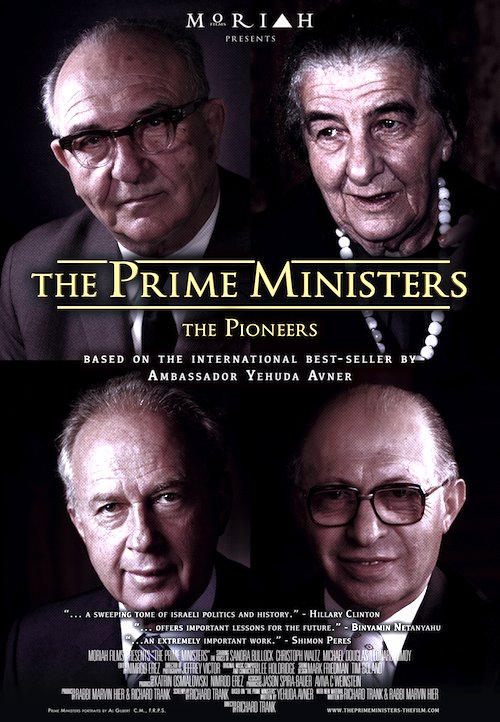
By Joe Bendel. It is not sufficient to merely declare yourself a would-be state. Any governing authority must establish the rule of law. This was never a problem for the State of Israel (its neighbors are a different story). It started at the top, with Prime Ministers who guided the fledgling nation through periods of profound crisis. Ambassador Yehuda Avner witnessed this tumultuous history first hand as a trusted aide to Prime Ministers Levi Eshkol, Golda Meir, Yitzhak Rabin, Menachem Begin, and Shimon Peres. Drawing upon Avner’s insider history, Richard Trank chronicles the Eshkol and Meir years in The Prime Ministers: The Pioneers, which opens this Friday in New York.

Given the wit and verve Avner shows during his interview segments, viewers might assume he was in grade school when he served as Eshkol’s speech writer and English correspondent. However, he was there, in the field, when the State of Israel was first declared. Becoming a young but trusted member of Eshkol’s inner circle, Avner was on-hand for the planning sessions during the Six Days War. Begin was also present, forcefully advocating that Israel take advantage of the crisis to liberate the Old City of Jerusalem. Although cautious, Eshkol recognized the historic opportunity presenting itself and acted decisively.

Where the Six Days War was an unqualified triumph for the Israeli military, the Yom Kippur War initially threatened the very existence of Israel. Yet, Golda Meir rallied the country. In desperate need of military aid, she turned to the Watergate-embroiled Richard Nixon, who authorized a massive emergency airlift. The Western European parties in the Socialist International were not so responsive, refusing to allow the American transports to refuel en-route to their embattled fellow member state. Fortunately, Israel survived, allowing Meir to publicly shame her socialist colleagues.

As the first of a two part documentary series (co-produced by Trank and Rabbi Marvin Heir), Pioneers focuses on Eshkol and Meir, but Begin and Rabin appear in brief but significant supporting roles. Considering Gravity’s continuing box-office dominance, a new Sandra Bullock movie ought to be major news, but her voice-over work as Meir is probably not likely to get the attention it deserves. Regardless, she well captures the Prime Minister’s humanity and resoluteness.

Likewise, it is great to at least hear Leonard Nimoy again, vividly bringing Eshkol’s words to life. Christoph Waltz, who narrated the writings of Theodor Herzl in Trank’s valuable It is No Dream, also nicely gives voice to Begin. Frankly, Pioneers is quite a big name production, with Michael Douglas rounding out the voice cast as Rabin and Emmy winning composer Lee Holdridge penning and conducting the score.

As a subsidiary of the Simon Wiesenthal Center, Moriah Films is a film production company parents and teachers can trust to portray history accurately. Like their previous productions, Pioneers is authoritative yet acutely aware of the human element underlying great geo-political events. One hopes Pioneers and Trank’s promised follow-up will eventually be widely available for high school and college viewing, because it provides the sort of comprehensive history of Israel students deserve, but are not getting from today’s media or academia. Yet, thanks to Trank’s brisk pacing and Avner’s engaging personality, Pioneers is never a dry or distancing viewing experience. Highly recommended for anyone fascinated by the great leaders of the Twentieth Century, The Prime Ministers: the Pioneers opens this Friday (10/18) in New York at the Quad Cinema.

LFM GRADE: B+

Posted on October 14th, 2013 at 2:14pm.