Our Voyeuristic Future: LFM Reviews Channeling @ The 2013 Dances With Films

By Joe Bendel. In the very near future, about five minutes from now, people will become even more exhibitionistic. Personal internet reality shows are the thing, made possible by special contact lens cameras. ‘Channelers’ broadcast themselves snowboarding, booty calling, and navel gazing. Some also broadcast criminal activity, such as an Army sergeant’s estranged brother. When the punk winds up dead, his avenging sibling assumes control of his channel in Drew Thomas’s Channeling (see viral teaser above), which screens tomorrow during the 2013 edition of Dances With Films.

The Maddox family was always pretty dysfunctional. The death of Wyatt, the Fast & Furious wannabe, does not help much. Returning on a bereavement leave, Jonah soon starts nosing around with the help of Tara, his brother’s on-camera co-host, sidekick, or whatever. Essentially, this leaves all the responsible stuff to his younger sister, Ashleigh. She broadcasts her life too, in hopes of finding validation from voyeuristic netizens. That is really the wrong place to be looking.

It is always pretty obvious who the bad guys are in this film, but it is never clear why they had it in for the Brothers Maddox. Wyatt’s ratings were always pretty good by channeling standards, unlike the late Howard Beale in Network. Regardless, it offers Jonah an excuse to boost some fast cars.

From "Channeling."

Channeling is a serviceable enough b-movie, but it pales in comparison to Bertrand Tavernier’s thematically similar Death Watch, which remains an eerily prescient critique of our media-driven society even over thirty years after its initial release. It is also hard to compete with Harvey Keitel, Harry Dean Stanton, and Romy Schneider.

Regardless, as a leading man, Dominic De Vore seems to have graduated from the Caspar Van Dien school of acting. He is adequately square-jawed in the action scenes, but that’s about all you get. However, Kate French (probably best known from The L Word and One Tree Hill) lends the film some style and presence riding shotgun as Tara, while Taylor Handley does a presentable James Dean impression as the ill-fated Wyatt.

Thomas and cinematographer Andrew Huebscher keep things looking slick and cool throughout. Cars will be wrecked and thugs will get their beatdowns. It’s all a cut above SyFy Channel original movies, but those primarily intrigued by the premise should checkout Tavernier’s underappreciated gem instead. For Kate French’s fans, it screens tomorrow night (6/2) as part of this year’s Dances With Films in Hollywood, CA.

LFM GRADE: C+

Posted on June 1st, 2013 at 1:02pm.

Post-Dystopia Depression: LFM Reviews A Better World @ The 2013 Brooklyn Film Festival

By Joe Bendel. Think of this as what happens after the famous 1984 Apple commercial. Big Brother has fallen. Unfortunately, Henry Dremmel is no Winston Smith. Adjusting to a post-dystopian world will be difficult for him in Sacha Feiner’s short film A Better World, which screens during the 2013 Brooklyn Film Festival.

Dremmel the tool, works for the Domestic Denunciation Program. All day he monitors security cameras, reporting even the slightest deviations from the norm. One fateful night, Dremmel wakes to the sound of fireworks. The regime has fallen. Freedom has broken out, but the Denunciator cannot handle it. He prefers the structure of his drab, harshly regimented former existence.

Audiences are unlikely to see a film more explicitly associating the compulsive need for security with oppressive statism in a month of Sundays. What’s even more mind-blowing is that it hails from Belgium, the EU’s happy host nation. Regardless, writer-director Feiner really cuts to the heart of the matter. Dremmel is not an odious villain. A pathetic figure, he is the final victim of a de-humanizing collectivist system.

From "A Better World."

A Better World is also quite an impressive looking production. Olan Bowland’s bleak, washed-out cinematography and Julia Irribaria’s imposing sets create a perfectly Orwellian environment. Almost a prop himself, Vincent Kohler is appropriately cringey and clammy as Dremmel.

Despite its twenty-four minute running time, A Better World has more to say than most features. A genuinely challenging work (especially for Williamsburg hipsters), it is one of the best dystopian films of any length to hit the festival circuit. Very highly recommended, it screens this coming Monday (6/3) and Wednesday (6/5) as part of the 2013 Magnetic edition of the Brooklyn Film Festival.

Posted on May 31st, 2013 at 12:05pm.

LFM Reviews Kumpanía Flamenco Los Angeles @ The 2013 Dances With Films

By Joe Bendel. Maybe there’s still yet hope for Los Angeles: the city is home to a small but vibrant flamenco scene. Of course, nobody is making much money—quite the contrary. The musicians, vocalists, and dancers all simply share a passion for the music. Katina Dunn documents their musical camaraderie in Kumpanía Flamenco Los Angeles, which screens this afternoon during the “Sweet Sixteen” edition of Dances With Films.

Flamenco originated in the tightly knit Roma community of Seventeenth Century Spain. Musicians and dancers from other cultures have been drawn to the music, but according to one vocalist, only Spaniards can sing Flamenco with the right accent. (Yes, he happens to be a Spanish expat.) Regardless of authenticity issues, the Los Angeles Flamenco community is distinctly diverse. Many local Hispanic musicians have adopted the music as their own – including Joey Heredia, a professional drummer comfortable crossing stylistic lines, whose impressive credits include work with Tania Maria, Poncho Sanchez, and Diane Reeves.

From "Kumpanía Flamenco Los Angeles."

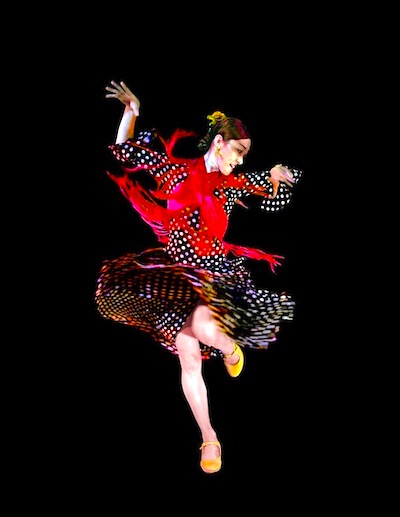
Japanese artists are also well represented in KFLA. Kyoto native Jose Tanaka is not just a leading guitarrista and composer, but clearly serves as a leader holding the community together. However, if one star truly emerges from the film, it would have to be Bailaora (dancer) Mizuho Sato. A striking performer with flawless technique, her sequences will hold viewers spellbound. She also provides real insight into the Flamenco aesthetic, especially when explaining how the demur nature of the presentation is part of what makes it all smolder.

Dunn nicely conveys the scene’s vibe and gives interested viewers an easy starting point to check out the assembled artists live—namely, the Fountain Theatre. Her selective but clever use of archival footage adds fitting context as well. She does right by the music, which is the most important thing.

While not reaching the lofty heights of Fernando Trueba’s Calle 54 (the true gold standard of music performance docs), KFLA is still quite a dynamic and engaging film. At just a whisker over an hour, it will leave most viewers wanting more. Appealing to the eyes and ears, Kumpanía Flamenco Los Angeles is recommended for general audiences when it screens this afternoon (5/31) as part of the 2013 edition of Dances With Films, in Hollywood, California.

LFM GRADE: B

Posted May 31st, 2013 at 12:04pm.

Kung Fu in The New China: LFM Reviews Dragon Girls @ The 2013 Brooklyn Film Festival

By Joe Bendel. Will one of these girls be the next Michelle Yeoh?  Possibly, but none of them seems to harbor such lofty aspirations. Regardless, they all train harder than most professional athletes in hopes of earning a better life for their families (shouldn’t that be the other way around?). Inigo Westmeier observes the rigorous routine of the Shaolin Tagu Kung Fu School’s students in Dragon Girls, which screens during the 2013 Brooklyn Film Festival.

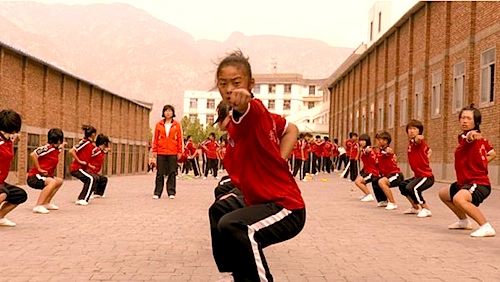
For these mostly poor provincial students, kung fu school can lead to better military and police jobs than might otherwise be available to them. Unfortunately, the seven day training regime does not leave much time for the kids to be kids. The Shaolin Tagu School accepts both boys and girls, but Westmeier devotes about ninety percent of his attention to the latter, focusing on three particular girls with complicated family circumstances.

Much like the apparently abusive Shanghai Circus School documented by Guo Jing & Ke Dingding, life at Shaolin Tagu does not look like a lot of fun. On the other hand, at least it offers the girls some camaraderie. Given the realities of life for poor rural girls (such as the protagonist of Wang Bing’s Three Sisters), things could arguably be worse for the students. Still, the sanctimonious headmaster is obviously cutting corners with respects to sanitation and nutrition. Yet the most trying aspect for most of the girls is the lingering sensation of abandonment. Clearly, the school functions as an alternative to an orphanage for many essentially absentee parents.

Westmeier captures his three primary POV figures at their most open and vulnerable moments. Frankly, it is often difficult watching them struggle physically and emotionally, because they are really just kids. The extent of the headmaster’s authoritarian indoctrination is nearly as disturbing, if not more so.

From "Dragon Girls."

Despite all the issues the film raises, seeing the collective student body of 35,000 in action is admittedly impressive. For an observational style doc, there is a heck of a lot of spectacle in Dragon Girls. These kids are good—but the monks in the Shaolin monastery next door are probably better. As one might expect, they are less dogmatic and far more Zen-like in their approach to martial arts. Westmeier tellingly contrasts the two so-close-yet-so-far-apart Shaolin institutions without belaboring the point.

Dragon Girls further testifies to the vast class divisions demarcating today’s China. It might be tough viewing, but it is an honest reflection of reality. The extent to which Westmeier melds the social issue documentary with martial arts cinema is also rather notable. Recommended for fans of both genres who can handle some unvarnished truth, Dragon Girls screens this Saturday (6/1) at Windmill Studios and the following Thursday (6/6) at IndeiScreen as part of the “Magnetic” 2013 Brooklyn Film Festival.

LFM GRADE: B+

Posted on May 30th, 2013 at 4:27pm.

A Very Private Apocalypse: LFM Reviews The Wall

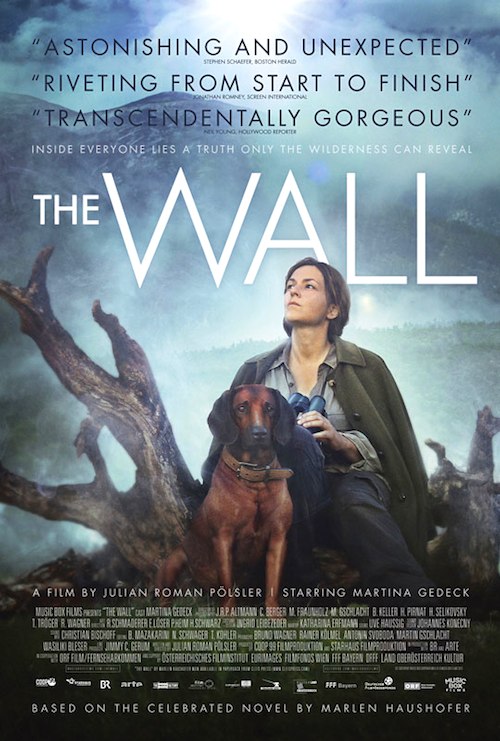
By Joe Bendel. When the television adaptation of Stephen King’s Under the Dome hits the airwaves, fans will duly wonder where he gets his ideas from. Hmm, maybe Christoffer Boe’s Allegro or Marlen Haushofer’s Die Wand. Of course, both predecessors are much more introspective in nature. Indeed, viewers witness a very private apocalypse in Julian Pölsler’s adaptation of Haushofer’s 1963 novel, The Wall, which opens this Friday in New York at the IFC Center.

A woman is holidaying with friends in an Austrian mountain lodge. Her hosts drive into town for supplies and never return. Venturing out the next morning she discovers an invisible barrier blocking the road. Scouting the mountainside, she discovers that the strange wall encircles her. She can see people on the other side, but they appear frozen in place. Time seems to only pass on her side of the wall, but it passes very slowly.

Told in flashbacks via the unnamed woman’s journal entries, The Wall consciously echoes Robinson Crusoe. With no Man Friday, the woman develops a close bond with the couple’s dog, Lynx. Indeed, it is largely her rapport with animals that keeps the woman engaged in her solitary world.

Obviously, The Wall implies much about man and our unbalanced relationship with nature. The English language voice-overs are often rather heavy-handed (and clash with the limited subtitled German dialogue) but the film’s vibe and rhythm are eerily evocative. Viewers will feel like they are getting a true taste of what it would be like to be the last sentient person on Earth.

Shot over the course of several seasons, Pölsler and his battery of cinematographers fully capitalize on the stunning scenic vistas that utterly dwarf the lone woman. Carrying the film almost single-handedly, Martina Gedeck (co-star of the modern classic The Lives of Others) gives a remarkably assured performance. Mixing depression and empowerment, it might be the purest cinematic portrayal of existential living. However, it is also worth noting Pölsler’s own dog Lynx is quite the performer in his own right.

The Wall may well be a rebuke of patriarchy and industrialization, but it still works rather well as a survivor’s story. Admittedly, it is deliberately paced (for obvious reasons), but the overall effect is hypnotic. Recommended for those who appreciate apocalyptic and allegorical cinema, The Wall opens this Friday (5/31) at the IFC Center.

LFM GRADE: B

Posted on May 30th, 2013 at 4:26pm.

LFM Reviews 113 Degrees @ The 2013 Brooklyn Film Festival

By Joe Bendel. In space, no one can hear a heart break—unless the aggrieved lover decides not to bear her disappointment in silence. Confined environments are difficult places to work out relationship problems as the crew of a two-person space station learns in writer-director Sabrina Doyle’s short film 113 Degrees (trailer here), which screens during the 2013 Brooklyn Film Festival.

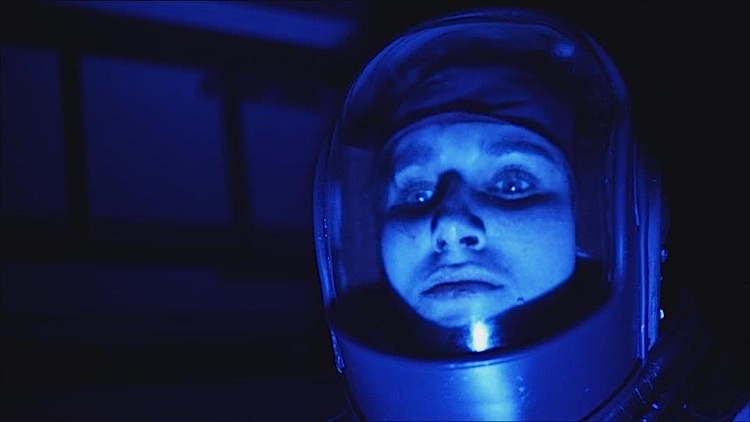
Francesca and Joe have grown close during their time in space together. At this point, they share the same bunk. It would seem to be an Eden-like situation, but an interstellar call from Joe’s terrestrial wife serves as a rude awakening for his commander. Disturbed by the incident, she carries her agitation with her during a supposedly routine space walk. This leads to serious complications.

Granted, most romantic tragedies are not overly concerned with cooling systems, but the guts of 113 involve the lovers’ betrayal and sacrifice. This is really the sort of film that uses science fiction trappings to tell a straight forward human story. Indeed, it hits some deep chords. However, it is important to note that Doyle, producer Matilde Barbagallo, and editor Marian Jiménez are all women – lest the film be accused of perpetuating the stereotype that women are more likely to become emotionally overwrought than men.

As Francesca and Joe, Lizzy Davis and Brian Groh quickly convey a sense they share some long, intimate history together. They are a believably flawed couple. However, his long haired hipster coif looks rather out of place. Even in the future, aside from space tourists, most astronauts are still likely to be ex-military.

Regardless, the rest of the production is technically quite impressive, especially considering Doyle’s budget constraints. Hollywood tent-pole veteran Greg Derochie’s VFX team convincingly renders Francesca’s space walk outside the station and the deteriorating conditions within. One could easily believe this is the same world as the Alien franchise or Duncan Jones’ similarly scrappy Moon. Recommended for SF fans with a weakness for tales of star-crossed love, the twenty-one minute 113 Degrees screens Monday (6/3) and Wednesday (6/5) as part of this year’s “Magnetic” BFF.

Posted on May 30th, 2013 at 4:25pm.