Post-Communist Bulgaria: LFM Reviews The Color of the Chameleon @ The 2012 Toronto International Film Festival

By Joe Bendel. Batko Stamenov is like a character in a Samizdat novel come to life, but not necessarily in a good way. The former informer is a figure of existential absurdity rather than defiance. He is still dangerous, though, but to whom is the question in Emil Christov’s The Color of the Chameleon (trailer here), which screens during the 2012 Toronto International Film Festival.

On her deathbed, Stamenov’s mother confesses she really is his mother, whereas he had always been told she was his aunt and adoptive-mother. This does little to develop his sense of belonging. Stamenov is ingratiating by nature, but also reflexively deceptive—swell traits to the secret policeman who recruits a student as an informer and agent-provocateur. Stamenov’s first assignment has him infiltrating a literary club obsessed with the underground novel Zincograph. Like the fictional Samizdat protagonist, Stamenov also takes work in a state zinc etching plant, which happens to be a fine place to pick up some chemical know-how.

Stamenov commits many questionable acts, beginning by signing up as an informer in early 1989, when the writing was already on the soon to be toppled Wall. He has two eggs containing secret instructions should Communism fall in either Bulgaria or the Soviet Union. This is not a good sign. Yet, the task just seems to appeal to Stamenov for non-ideological reasons. When terminated by the official intelligence service, he starts recruiting his own informers for a phony agency just like the protagonist of Zincograph.

Adapted from screenwriter Vladislav Todorov’s real life novel titled Zincograph, Stamenov’s anti-heroics could easily lend themselves to an outrageously over-the-top big screen treatment, but Christov’s approach is rather severe and chilly. Frankly, it takes a while for the film to come together, as Stamenov largely creeps about unappealingly. However, the third act is an intrigue-fueled doozy, making some razor-sharp points about the state of post-Communist Bulgaria, in between the twists and turns.
From "The Color of the Chameleon."

Chameleon is a film for everyone who enjoys movie references (remember the Bulgarian couple in Casablanca?), thinly veiled critiques of politicians you will never recognize, and liberal helpings of paranoid gamesmanship. There is also an unhealthy preoccupation (as if there were any other kind) with the evil effects of “onanism.” Such is Communism’s continuing legacy for Stamenov.

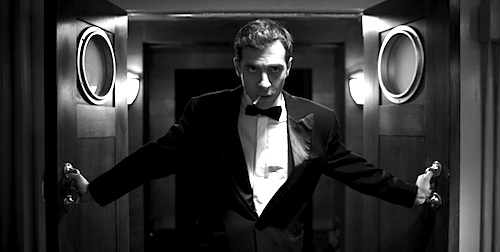
Looking a lot like a Bulgarian Jude Law, pop star Ruscen Vidinliev’s Stamenov is one cold fish, but he is convincingly calculating and sociopathic. He keeps the film moving along well enough, while the supporting cast provides plenty of color. Rousy Chanev brings the right sort of Machiavellian charisma to bear as Stamenov’s former handler, while Deyan Donkov is notably intense and just plain interesting looking as the Mr. Clean hardball fixer pursuing the freelance saboteur.

The politics of Chameleon are rather ambiguous, particularly for viewers not deeply steeped in the Bulgarian scene. Yet the lingering toxicity of the old regime is unmistakable. Clearly, it spawned a culture of lies and deception that Todorov and Christov argue cannot be easily shrugged off. A slow starter very much worth sticking with, The Color of the Chameleon is recommended for literate, “free-thinking” viewers when it screens again this coming Sunday morning (9/16) as part of this year’s TIFF.

LFM GRADE: B

Posted on September 17th, 2012 at 10:25am.

Wars at Home and Abroad: LFM Reviews Last Ounce of Courage

By Joe Bendel. Don’t say “Happy Festivus” to Mayor Bob Revere. He is sick and tired of substituting the word “holiday” for Christmas and he is going to do something about it. In the process, he just might heal his family in Darrell Campbell & Kevin McAfee’s Last Ounce of Courage (trailer here), which opens nationwide today.

Fifteen years ago, Tom Revere willingly enlisted, with full knowledge he would fight in a Middle Eastern war. He wanted to serve his country and follow in his decorated father’s footsteps, even though it meant temporarily leaving his pregnant wife Kari. He never returned. Nobody took it harder than his father Bob. Emotionally withdrawing from life, the pharmacist-mayor is basically going through the motions until his daughter-in-law moves back to town with the grandson he hardly knows.

It turns out Christian Revere is something of a rebel, doing subversive things like sneaking Bibles into the public high school. At one point, he challenges his grandfather as to why his town no longer publicly celebrates Christmas. It is a question the Mayor has no good answer for. Suddenly, the town’s crèche is out of mothballs and media-lawyer Warren “The Hammer” Hammerschmidt is seriously bent out of shape.

While not exactly perfect, Campbell and McAfee step up the evangelical filmmaking game with Courage. The main performances are all professional grade, including those from several genuine “name” actors, and there are some well conceived plot points. Shrewdly, screenwriter Campbell casts the teenaged Revere and his friends as the rebels in their uber-P.C. high school, which is quite representative of current reality. The cleverest bit involves their plan to hijack the school’s winter space alien visitation play and turn it into a Christmas pageant. And though Campbell, McAffe, and company clearly faced severe budget constraints, the war scenes are rendered in rather dramatic fashion.

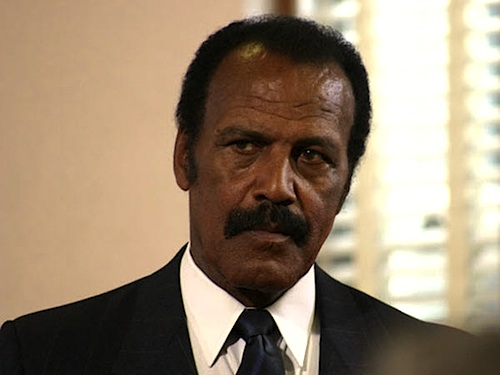
Cult movie icon Fred "The Hammer" Williamson.

Indeed, the best scenes in Courage feature the younger cast members, including Hunter Gomez as the grandson and Jenna Boyd as the daughter of his late father’s best friend. Unfortunately, Mayor Bob’s campaign to save Christmas is pretty clunky stuff. Still, it is always cool to see Fred “Black Caesar” Williamson, even if he does little more than villainously chomp his cigar as Hammerschmidt. Action movie veteran and real life veteran Marshall Teague also does quite respectable work as Mayor Revere. He just has too many over-written speeches down the stretch.

Frankly, you have to dig pretty deep into the cast before you find the awkward performances that have given faith-based productions a bad name. It is also pretty mind blowing to think Jennifer O’Neill of Summer of ’42 fame is in such a radically different film, but here she is, portraying Mrs. Revere with admirable conviction.

However, like previous films produced with the evangelical market in mind, Ounce has a hard time resisting the temptation to preach. The trick is to embed the message rather than stopping to announce it. Still, Last Ounce of Courage carries the official Chuck Norris seal of approval, so you’d probably better go see it. Better safe than sorry. It opens nationwide today (9/14) and opened in select theaters, including the AMC Empire in New York, this past September 11th.

Posted on September 14th, 2012 at 12:33pm.

‘Justice’ in Today’s China: LFM Reviews When Night Falls @ The 2012 Toronto International Film Festival

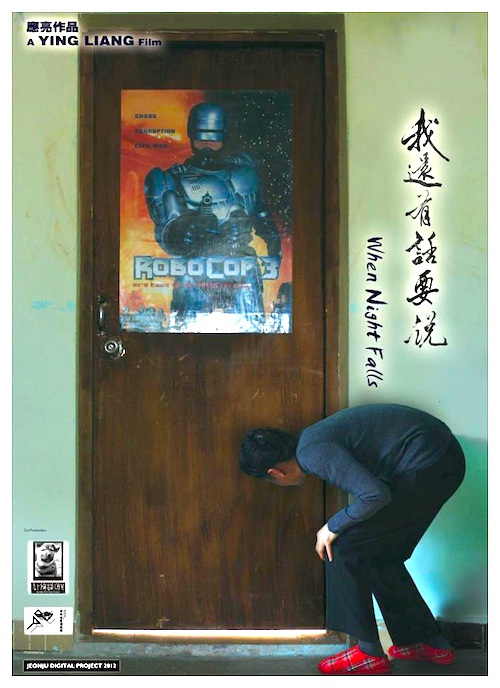
By Joe Bendel. Ying Liang is an artist without a country. In large measure, this film is why. After it premiered at the Jeonju International Film Festival earlier this year, word reached Ying that he should not to return to China—or else. A dramatized documentary about the suspicious irregularities surrounding the prosecution (or persecution) of an accused murderer is hardly the project to curry favor with the Chinese Communist Party. Yet, any production from a filmmaker of Ying’s integrity necessarily entails risk in today’s China. As a result, When Night Falls will be even more timely and significant when it screens during the 2012 Toronto International Film Festival.

After suffering a severe beating at the hands of the Shanghai police, Yang Jia allegedly firebombed the police courtyard, stormed the station, and stabbed six active duty officers to death. This sounds like a man they should have recruited for their special forces. Instead, they tried and convicted him in a series of kangaroo courts, while holding his mother Wang Jingmei incommunicado for one hundred forty-three days in a Soviet-style mental hospital. None other than Ai Weiwei filed a missing person report on her behalf. By the time she is finally released, her son’s fate is effectively sealed, but the mother and a well-meaning but unwieldy group of human rights attorneys desperately try to overturn Yang Jia’s death sentence.

Without question, Night is a forceful indictment of the Chinese justice system, which the government has so cleverly rebutted by harassing Ying’s parents and threatening him with arrest. At each step of the case, Ying makes it clear the police and prosecutors disregarded their own rules to suit their purposes. Several times characters flat-out denounce the state, including the judges passing sentence, as the real criminals in this affair. That is rather bold filmmaking in contemporary China, some might even say foolhardy, but it in no way excuses the Party’s vindictive response.

Ying is a very good filmmaker, but he is also a demanding one. He definitely shares some of the aesthetic sensibilities of Jia Zhangke and the so-called Digital Generation of independent filmmakers. Severely restrained, Night is like an anti-melodrama, despite the gross injustice and tragedy unfolding around Wang Jingmei. Yet, there is no mistaking her terrible anguish thanks to Nai An’s remarkable performance. Viewers can feel in their bones how broken this woman is, as she struggles to find a way to keep fighting for her son.

Ying notably incorporates still photos (some courtesy of the real Wang Jingmei) to establish the facts of the case with economy and quiet authority. Nonetheless, though Night clocks in at a manageable seventy minutes, it is not a film for the easily distracted. Thoughtfully put together and honest in every way, When Night Falls is highly recommended for those who can handle its uncompromising style and a depressing shot of the truth when it screens this Thursday (9/13) and Friday (9/14) as a Wavelengths selection at this year’s TIFF.

LFM GRADE: A-

Posted on September 12th, 2012 at 11:25am.

Black-and-Blue Nordic Humor: LFM Reviews Snowman’s Land

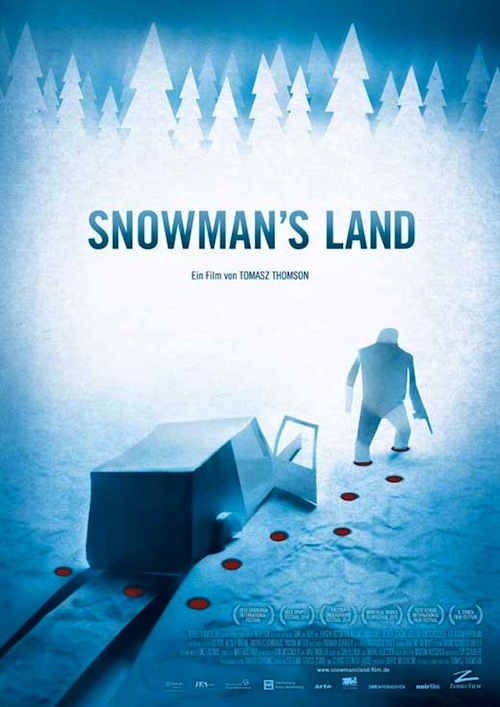
By Joe Bendel. It is an area so cold and remote, even Germans find it depressing. Yet, a mysterious crime boss envisions it as the next winter playground for the rich and beautiful. He is clearly rather cracked—a fact that leads to many complications for the hitman-protagonist of Tomasz Thomson’s Snowman’s Land (trailer here), which opens this Friday in New York.

Being a hired killer was a real grind for Walter, even before he botches a workaday assignment. With his contractor down on him, the slovenly Walter needs to lay low for a while. Out of nowhere, he is offered the seemingly perfect gig, subbing for a colleague somewhere vaguely to the east. Essentially, he is to house sit the mountain villa of a notorious gangster widely thought to be dead. As it happens, old Berger is alive and as erratic as ever.

Walter will have a buddy for this assignment, but the presence of the unstable Micky will prove a mixed blessing at best. When the younger thug accidentally kills Berger’s unfaithful trophy wife Sibylle in a freak accident, Walter’s peaceful retreat becomes anything but. Things will get bloody as Burger and Kazik, his lieutenant with a “third eye,” start demanding answers.

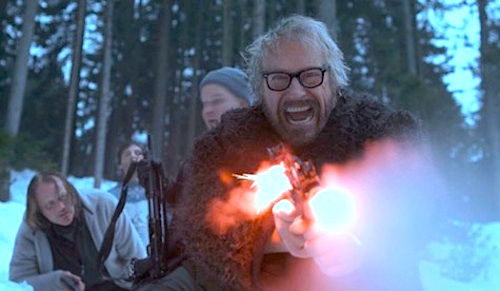
Snowman might be German, but it is stylistically compatible with the recent bumper crop of Scandinavian thrillers, featuring a similar brew of lethal black-and-blue comedy against a Nordic backdrop. Thomson keeps the double-crosses coming at a good clip, without excessively plundering the Tarantino playbook. He and cinematographer Ralf Mendle actually create a pretty creepy vibe, as Walter’s colleagues and tormentors descend into madness. While starting as a gangster movie, Snowman almost evolves into a Carpathian Shining.

From "Snowman's Land."

Jürgen Riβmann has the appropriate morose hound-dog presence as Walter, the comparative gentle giant of an assassin. However, the film’s real strengths are its villains, played with set-chewing dash by Reiner Schöne and Waléria Kanischtscheff, as Berger and Kazik, respectively. Though not long for the film, Eva-Katrin Hermann’s Sibylle makes a convincingly shrewish femme fatale. Suffering in comparison, Thomas Wodianka comes across somewhat blandly as the immature Micky.

While not redefining any genres, Snowman is quite an entertaining, character-driven one-blasted-thing-after-another thriller. Sort of a chamber gangster piece, Snowman’s Land is recommended for those who appreciate laughs derived from blood and paranoia, when it opens this Friday (9/14) in New York at the Cinema Village.

LFM GRADE: B

Posted on September 10th, 2012 at 12:34pm.

Motorcycle Robots & Busty Cyborgs: LFM Reviews Karate-Robo Zaborgar on DVD/Blu-Ray

By Joe Bendel. Don’t call it a knock-off—this is a reboot. Yutaka Daimon’s crime-fighting partner is a robot that can turn itself into a motorcycle. You could say he transforms—just like he did in the early 1970’s Japanese television series Denjin Zaborger. The spelling is slightly different, but the spirit is the same in Noboru Iguchi’s Karate-Robo Zaborgar (trailer here), which officially launches on DVD and Blu-ray this Tuesday from Well Go USA.

Somehow fabricated with the DNA of his twin brother who died in infancy, Zaborgar represents more than a weaponized motor bike to Daimon. He considers him a brother. Nursing a grudge against Sigma, the THRUSH-like international crime syndicate that killed his (their) father, Daimon is obsessed with “righteousness.” Yet, he frequently finds himself protecting venal politicians (and their DNA) from Sigma’s machinations. Further complicating matters, the secret agent starts developing feelings for Miss Borg, the chief hench-cyborg of Sigma’s evil wheelchair-bound mastermind, Dr. Akunomiya. Despite her initial resistance, Miss Borg begins to reciprocate his affections. Their resulting affair clouds Daimon’s judgment, leading to his disgrace and the apparent destruction of Zaborgar.

But wait, there’s more, including possible redemption for the older but possibly dumber Daimon and even a relationship with Akiko, the cyborg-daughter he never knew he had. He needs to get his act together quickly, though, before Akunomiya completes his plan to turn Akiko into a giant, mindless, city-stomping robot. Tokyo property values are depending on Daimon and maybe a rebuilt, reprogrammed Zaborgar.

Based on the clips of the original 1974 show seen during the closing credits, KRZ is remarkably faithful to its original source material. A production of Sushi Typhoon, Nikkatsu’s low budget genre specialists, from Iguchi and FX director Yoshihiro Nishimura, the behind classics like Machine Girl, KRZ does not feature the sort of extreme gore fanboys might be expecting. The Film Society of Lincoln Center actually programmed it as part of the children’s series, but that was really pushing it. After all, those busty cyborgs have some lethal torpedoes. It also has a strangely downbeat vibe at times.

Given Iguchi and Nishimura’s reputation as Japan’s answer to Troma, the effects in KRZ are surprisingly well rendered, even including the little remote-controlled bots coming out of Zaborgar’s head and feet. Conversely, the performances are as cheesy as you would expect, except maybe more so. As the tandem of Daimons, Yasuhisa Furuhara and Itsuji Itao are especially wooden and relentlessly un-self-aware. Still, Mami Yamasaki somehow maintains her dignity as the tragic Miss Borg, regardless of her Metropolis-fetish wardrobe.

Not exactly a masterpiece of world cinema, KRZ still has a weird way of invoking nostalgia in viewers, even if they never saw Denjin Zaborger in the first place. Anyone familiar with Ultraman of the mid 1960’s, or the subsequent Power Rangers, will be able to get it. More of an exercise in manic energy than a comic send-up, per se, Karate-Robo Zaborgar is recommended for specifically self-identifying fans old-school Japanese sci-fi monster movies when it releases tomorrow (9/11) on DVD and Blu-ray from Well Go USA.

Posted on September 10th, 2012 at 12:32pm.

Oscar-Qualified and Ready to Haunt the Festival Circuit: LFM Reviews House of Monsters

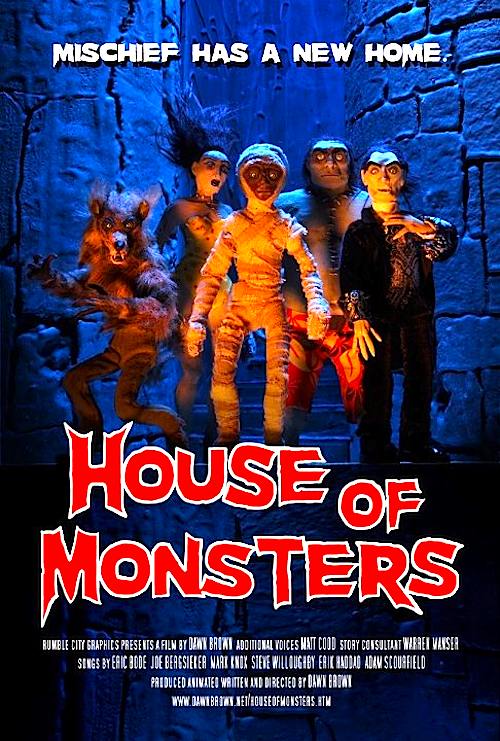
By Joe Bendel. You’d think monsters would be anti-social, but strangely enough, they can often be found sharing haunted digs. This leads to a bit of friction between the Mummy and the Frankensteins. Alas, the former pharaoh gets the worst of it in Dawn Brown’s stop-motion animated short House of Monsters, which just completed an Oscar qualifying run at the Laemmle and should now have plenty of festival action ahead of it.

One of the drawbacks of being undead is dry itchiness of desiccated skin. Fortunately, there is a mad scientist in the house to prescribe something for the Mummy. Once quite the catch, he would like to put the moves on Frankenstein’s Bride. Despite an assist from Dracula, things turn out rather badly for him. No worries. Classic monsters never die, they just come back for revenge later.

Brown, a frequent animator and special effects artist on Tim Burton films, is something of a one-man band on House, serving as writer, director, animator, and producer. Animation enthusiasts should be duly impressed by the quality and rich detail of Brown’s work here. It is easy to see why she has been in such demand. In fact, one might suspect her contributions have been the best part of many big budget films she has worked on. While House is a complete, self-contained (but admittedly brief) story, it could easily serve as a pilot or constituent episode of a longer monster project in the future.

Also an artist for Vampirella comic books, Brown clearly understands and shares an enduring affection for these characters. Indeed, you can never go wrong with the iconic undead scampering about an old dark house. While never too macabre for children, the real audience will probably be nostalgic adults who read Famous Monsters of Filmland as pre-teens and never outgrew their love of the classic Universal monster movies. (The opening title even evokes Ackerman’s famous fan magazine’s type treatment.)

At just over seven minutes, most fans will be left wanting more, which is probably the idea. Recommended for animations connoisseurs and famous creature lovers, House of Monsters should be coming to a festival near you soon and deserves a serious look come awards season.

Posted on September 10th, 2012 at 12:30pm.