By Jason Apuzzo. I wanted LFM’s regular readers to know that although I’ve been busy of late, I’m still keeping close tabs on what’s happening at your local multiplex. Here are some micro-reviews of important recent releases:
The Avengers
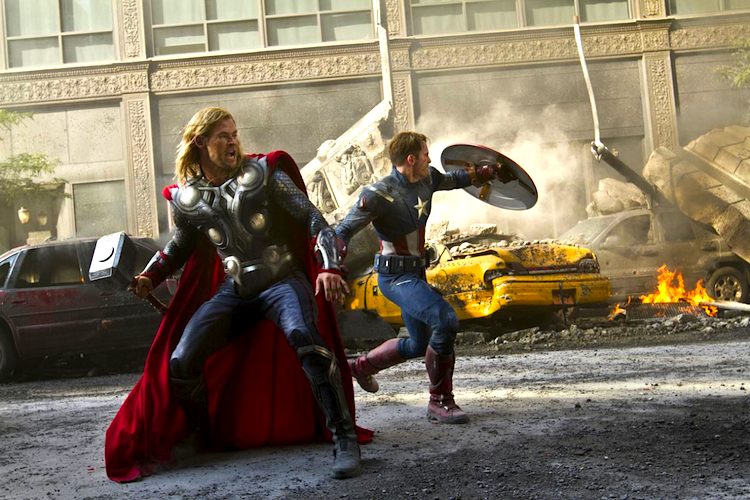
Sparkling interactions among the characters, an electrifying sequence aboard a floating aircraft carrier, cheeky good humor, and another breakout performance by Tom Hiddleston as Loki lift Marvel’s The Avengers far above conventional comic book fare – to the point that it’s already become its own event in pop mythology. Several things hold The Avengers back from being a gold-plated classic, though: trite assertions of moral equivalency between the good guys and the bad guys, cringe-inducing scenes involving goofy aliens, and a third act copied (lamely) from Transformers: Dark of the Moon. Still, you sense that this is what comic book movies were supposed to be like all along.
LFM GRADE: A-
Spotting the enemy in "Battleship."
Battleship
After a dreadful first act involving a soccer game and a chicken burrito (don’t ask), Battleship settles in and delivers some exciting combat sequences – especially when the USS Missouri gets hauled out of mothballs to exchange ear-shattering salvos with an invading alien cruiser. Director Peter Berg – the son of a naval historian – takes the tactical, cat-and-mouse aspects of naval warfare (and of Hasbro’s board game) seriously, although he can’t summon a credible performance out of Taylor Kitsch – assuming that’s even possible. Kudos to Berg, however, for featuring real-life combat veterans in the cast like Col. Gregory Gadson, an inspiring Iraq war vet and amputee who brings an aura of seriousness to the movie’s otherwise over-the-top scenario. And if that’s not enough for you, there’s also Brooklyn Decker in a tank top.
LFM GRADE: B
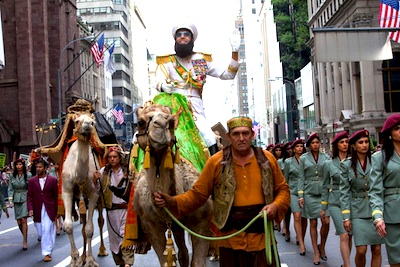
Admiral-General Aladeen enters New York in "The Dictator."
The Dictator
A treasure-trove of great gags at the expense of petty Middle Eastern tyrants is drowned away in a deluge of mindless vulgarity and gross-out humor, all of which probably should’ve netted this film an NC-17 rating. Writer-director-star Sacha Baron Cohen also throws in an obnoxious closing speech in which he essentially equates America with Middle Eastern dictatorships. Is this guy kidding? Take your dictators-are-brainless-narcissists act to Syria, Sacha, and see how well it plays with the local gentry. A major disappointment, and probably Cohen’s final shot at mainstream success.
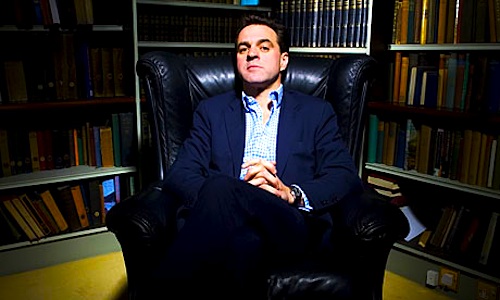
By Joe Bendel. The Ottoman Empire’s decree banning printed type in 1483 was obviously a noteworthy historical event. According to economic historian Niall Ferguson, it was a particularly telling incident, emblematic of the increasingly sharp distinctions between the West and the rest of the world. Ferguson lucidly explains six key attributes or so-called “killer apps” contributing to the West’s ascendency for the last five hundred years or so – and pointedly asks if they are now beginning to shift to the East – in the two-part sweeping survey Civilization: The West and the Rest, adapted from his bestselling book of the same name, which airs the next two Tuesday nights on most PBS outlets nationwide.
One of Ferguson’s touchstone figures is a “Resterner” rather than a Westerner. During the reign of Emperor Yongle, the technologically advanced China was a relatively pleasant place to live, especially compared to the dismal conditions of Europe. However, Yongle’s successors would turn China’s focus inward, ceding the global stage to upstart Westerners. The West was well suited to capitalize because of those six killer apps: competition (first between grubby European city-states for prestige, and than in the more traditional capitalistic sense), science, democracy (particularly when coupled with widespread property ownership), modern medicine, democracy, and the work ethic.
While many of these might sound rather obvious, Ferguson puts each into a fresh perspective. Science would indeed seem like a glaring no-brainer, but not to the Ottomans. Just as the Catholic Church was relaxing its attitudes towards scientific inquiry, the Muslim religious authorities were taking an even harder line, including but not limited to the prohibition against type in favor of calligraphy.
Historian Niall Ferguson.
Even when analyzing American history, the British historian offers some intriguing insights. Though public schools largely give short shrift to the founding of the Carolina Colony and the Fundamental Constitutions written by John Locke, Ferguson contends they represented an unprecedented opportunity for social mobility. In less than a decade, a despised member of the English underclass could bind himself into indentured servitude, receiving free and clear title to his own land holdings at the end of his term. As a property owning man, thereby entitled to vote, he became a fully vested member of the economic and political establishment.
While Ferguson largely avoids normative judgments, he makes time to critique what he dubs America’s “original sin,” slavery, and its bastard child, segregation. Yet, in keeping with his previous scholarship, Ferguson is more forgiving of European colonialism, especially with regards to the spread of modern medicine (in this case a kindly app) throughout Africa.
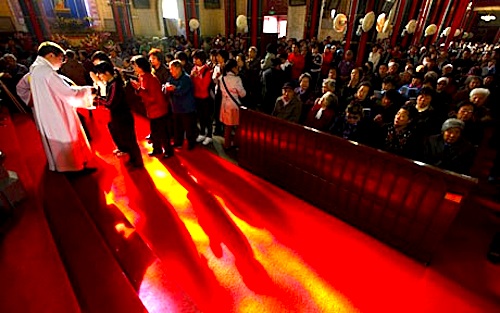
Of course, the central questions concerning Ferguson are whether the West still believes in its killer apps and if Resterners have developed better upgrades. This really comes to the fore during his discussion of the work ethic—the Protestant Work Ethic to be more precise. Here the Chinese are demonstrably outperforming the West, even America, by any standard of productivity. The real revelation, though, is the linkage Ferguson posits with the upsurge in Protestant religious observance in Mainland China. Ferguson’s observation: “today there may actually be more practicing Christians in China than in Europe” is a heavy statement rife with implications few are seriously grappling with. In no uncertain terms, China is identified as the Restern power to watch. Yet Ferguson never fully addresses the enormous disparities between the go-go coastal cities and the desperately poor rural villages, where consumerism and even modern medicine have yet to fully arrive.
Christians in China.
Granted, Ferguson’s approach is somewhat anecdotal, but those stories are truly fascinating, more often than not. Naturally, compressing five hundred years into four hours will lead to odd allocations of focus. As a case in point, German sociologist Max Weber has at least twenty times more screen time than Lenin, Stalin, Hitler, and Bismarck combined. On the other hand, his scholarship withstands history’s scrutiny better than their ideologies.
Simultaneously erudite and telegenic, Ferguson is an almost chatty host, who could be accused of glossing over decades and even centuries with the wave of a hand. Yet he is dashed convincing, pulling viewers through his arguments, step by logical step. It all might sound dry, but it is surprisingly entertaining. Frankly, viewers will be rather sorry to see Civilization end, so to speak. Immensely timely and intellectually engaging, Ferguson’s Civilization is very highly recommended television. It begins this coming Tuesday (5/22) and concludes the following week (5/29) on most PBS stations.
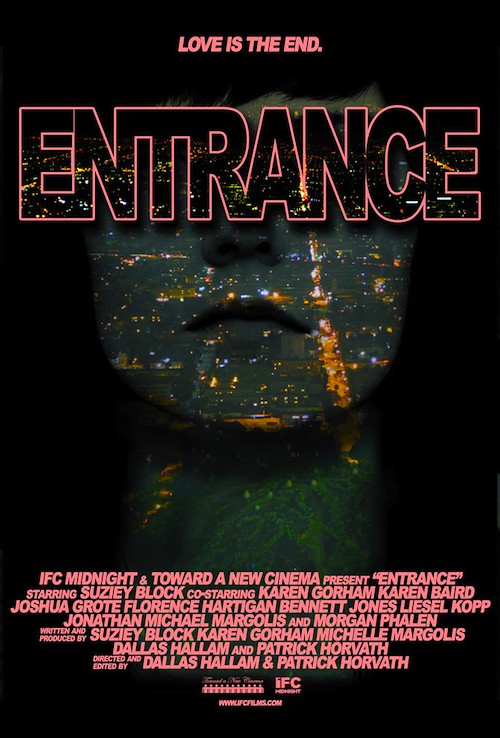
By Joe Bendel. Suzy is carless in LA. That is about as depressing as it gets. Frankly, she might as well let her psycho-stalker kill her, if she really has one. Regardless, there is something seriously amiss with her life in Dallas Hallam & Patrick Horvath’s Entrance (spoilery trailer here), which opened a week of late night screenings at the IFC Center last night and is now available via IFC Midnight’s VOD platforms.
Suzy has a nice pad and her roommate Karen’s friends have accepted her readily enough. Yet she has yet to make any deep human connections in LA and her barista job is profoundly unfulfilling. There is something wrong with this picture, but we cannot determine if it is because of Suzy or someone around her.
Initially, Entrance sets off every mumblecore alarm bell, depicting Suzy’s workaday life in mind-numbingly repetitive detail. However, there are occasional what-the-heck-was-that moments that should not be ignored. Hallam & Horvath are steadily inching towards something and it is rather shocking – precisely because of the time we have invested in the scrupulously ordinary characters.
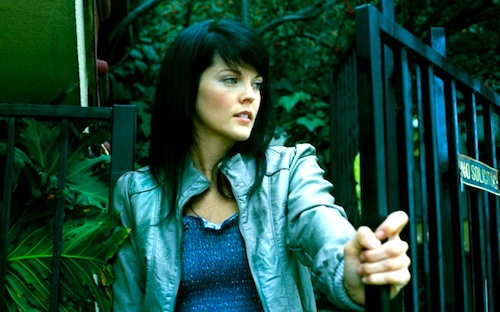
Actually, there is nothing commonplace about Suziey Block’s performance as Suzy (with the more conventional spelling). Quite attractive in a real world way, she withstands the co-directors’ harsh close-ups, vividly portraying a woman on the verge of an ambiguous breakdown. While the deliberately grubby DIY style might put off some viewers, most will find themselves caring about the increasingly alienated protagonist, despite her frequently problematic nature.
Suziey Block in "Entrance."
Hallam & Horvath shrewdly use the LA setting, but not necessarily with love. Instead, it represents an isolating, compartmentalized environment. The city also attracts a lot of sketchy types. There is indeed a reason why Entrance is being released as a Midnight special, but explaining why would give the game away.
Co-written by the co-directors with most of their principle cast, Entrance represents an unusually patient genre outing, taking considerable (perhaps even excruciating) time and effort to set up the third act that pulls the rug out from everyone’s feet. Though not another found footage film (thankfully), it feels substantially more real, which ultimately makes it far more disturbing. A slow build that eventually pays off, Entrance is recommended for genre fans who appreciate something a bit outside the norm. Now available on VOD, it also screens for a week of midnights (or thereabouts) starting tonight (5/18) at the IFC Center in New York.
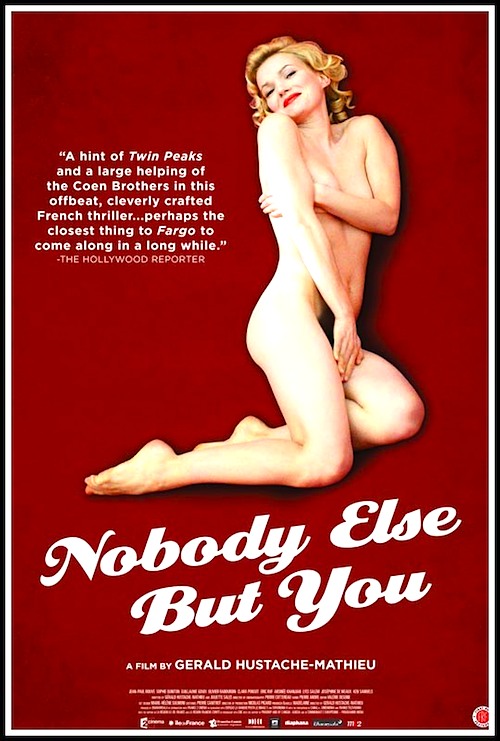
By Joe Bendel. Generally speaking, it is a bad idea to emulate self-destructive movie stars. However, the sexpot of Mouthe, the coldest town in France, does not have a lot of role models to follow. Unfortunately, she meets the same fate as her idol Marilyn Monroe in Gérald Hustache-Mathieu’s slyly inventive Nobody Else But You (a.k.a. Poupoupidou), which is now screening in New York.
David Rousseau is a series mystery author with a severe case of grinder-outer’s block. In Mouthe on a time-wasting errand (the sort of excuse editors refer to as “waxing the cat”), Rousseau is intrigued by a tragic local death. The body of weathergirl and aspiring actress Candice Lecoeur was found in the no man’s land between the French and Swiss borders. As a result, her death will not be properly investigated, unless he does it himself.
As he reconstructs Lecoeur’s life, largely by reading her diaries, Rousseau begins to fall for the woman who honestly believed she was the reincarnation of Norma Jean. Likewise, Lecoeur develops affectionate feelings for the hack writer turned sleuth. Yes, she serves as the real time spectral narrator of the film, just one of the many potential pitfalls Hustache-Mathieu nimbly skirts.
NEBY obviously suggests comparisons with Otto Preminger’s Laura, but Lecoeur really is dead. Even so, it really is a love story between Rousseau and Lecoeur, distinguished by if-only regrets rather than romantic courtship. Yet somehow Hustache-Mathieu manages to keep the tone relatively light and buoyant, which is a neat trick indeed. He also fully develops the Marilyn Monroe connection in a spirit similar to Kenneth Branagh’s Dead Again and clearly demarcates each of the many flashback sequences.
Looking like Michael Fassbender’s dissolute older brother, Jean-Paul Rouve is scruffily charismatic as Rousseau, but he has an undeniably intelligent screen presence. Appropriately not exactly a drop-dead beauty, Sophie Quinton still exudes unbridled sex appeal as Lecoeur, while conveying all her inner insecurities. Rarely together on-screen, they still develop their not-relationship quite convincingly.
A great noir thriller with a fair sprinkling of laughs and a hint of paranormal romance, NEBY is a wholly original and completely satisfying film. Cleverly written yet totally engaging and accessible, it is highly recommended for general (if somewhat adult) audiences. It is now playing in New York at the Cinema Village and opens in Los Angeles at the Landmark Nuart on June 8th.
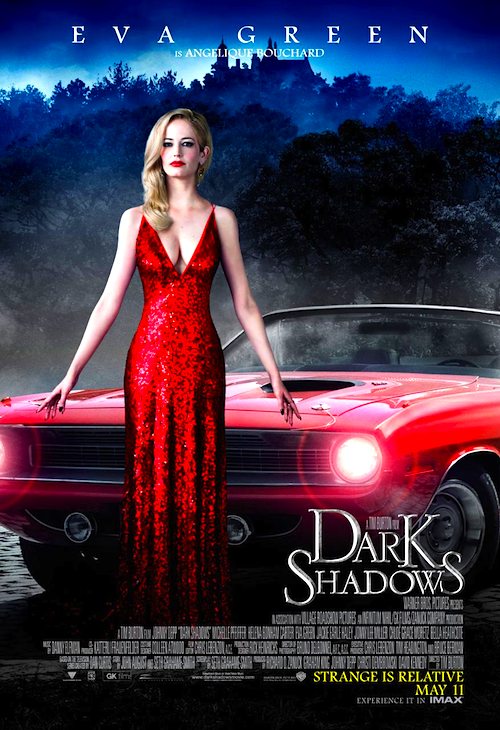
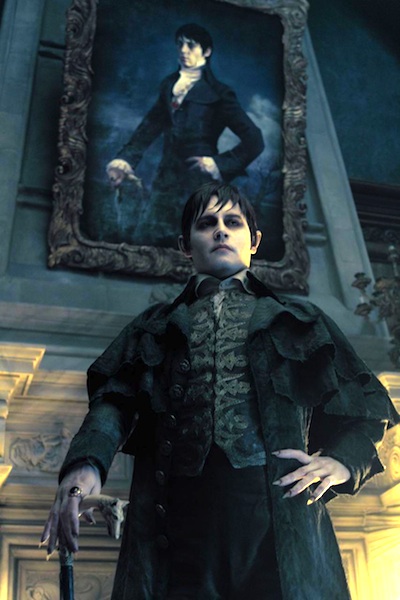
By Joe Bendel. Fans of The Adams Family get psyched. Tim Burton has revived your favorite franchise. He is calling it Dark Shadows now, but the goofy vibe remains the same. Die-hard devotees of the ostensive source material – Dan Curtis’s cult television show – might not be overwhelmed by the results, though. Burton and his regular repertory players certainly do their thing in the latest reboot of Dark Shadows, which is now playing widely throughout the country.
Barnabas Collins was the privileged son of an English fishing magnate, who built the coastal Maine town of Collinsport largely through his industry. Despite his fascination with the occult, the arrogant Collins spurns the love of Angelique Bouchard, a domestic servant who also happens to be a powerful witch. In retrospect, this was a mistake. Seething in fury, Bouchard bewitches Collins and his true love, compelling her to throw herself from the impossibly Burtonesque cliffs and turning him into an undead vampire.
Whipping the village rabble into a frenzy, Bouchard entraps Collins in a coffin, secretly burying him, so he can feel the anguish of his loss and unquenched thirst for all eternity. Then one fateful 1972 night, workmen discover Collins’ burial site. A spot of blood-letting and a liberal supply of fish-out-of-water gags soon follow.
It turns out the Collins family fortunes have suffered during the centuries Collins was away. Of course, the prodigal patriarch sets about righting matters, through the help of his supernatural powers. As per the rules of Tim Burton films, Sir Christopher Lee duly appears in a cameo as a salty dog sea captain falling victim to Collins’ mesmerism. Yes, that is one Burton tradition well worth maintaining.
Johnny Depp as Barnabas Collins.
Granted, Shadows looks great. Burton is clearly in his element when exploring spooky old houses and the 1970’s era wardrobe and soundtrack adds the right kind of kitsch. If only the script had benefited from the same attention to detail lavished on the banister in Collingwood, the Collins family manor. Instead, the story is really just a clothesline on which to hang Adams Family-style jokes, while Collins and Bouchard act like the Tracy and Hepburn from Hell.
As Collins, Johnny Depp basically does his shtick. In spite of viewer resistance, he gets laughs (particularly with his old school swearing invoking all manner of hellfire invective), but this is very definitely a one-note performance. At least Eva Green seems to get it. She is gleefully wicked as Bouchard. The fact that she looks like she was poured into her wardrobe does not hurt, either. Michelle Pfeiffer also looks great as Elizabeth Collins Stoddard, the living head of the Collins household. Still, aside from Depp and Green getting their supernatural groove on, the talented ensemble does not have much to do.
While the original cast members, including the recently deceased Jonathan Frid, briefly appear as party guests, the film’s truly inspired cameo features Alice Cooper as himself. Bizarrely, Burton tries to offer olive branches to the traditional fan-base by shotgunning about a half dozen of the revelations from the original show into the final climax. However, it would have worked much better had he sprinkled more of that plot throughout the film.
To some degree, Bruno Delbonnel’s dark and stormy cinematography, combined with Burton’s typically eccentric baroque sets and costumes, helps compensate for a thin screenplay and repetitive jokes. Overall, though, it is just a mildly diverting summer confection filled with empty cinematic calories. For Burton fans, it is now in theaters across the country, including the Chelsea Clearview here in New York.
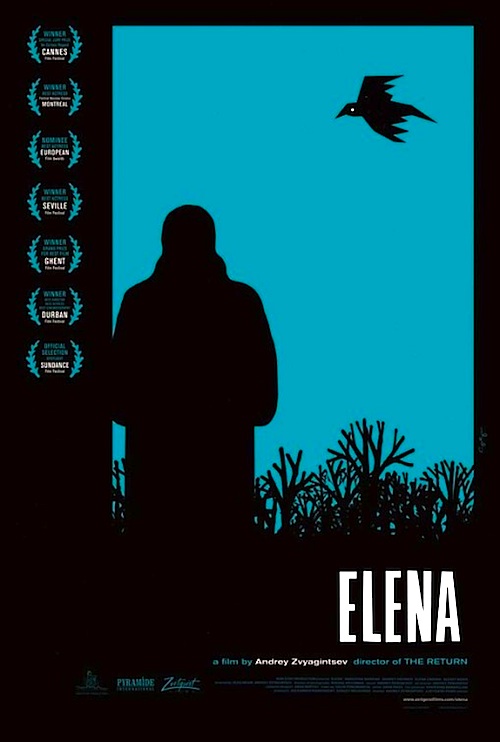
By Joe Bendel. Elena could have been an old world Russian babushka. She even still wears the traditional head scarves. Yet, she has married into the world of oligarchic privilege. It is a pleasant if loveless marriage, but fundamental disagreements with her wealthy husband will take a dark turn in Andrey Zvyagintsev’s Elena, which begins a special two week engagement at New York’s Film Forum this Wednesday.
The working class Elena met the sophisticated Vladimir while working as a nurse during his convalescence two years ago. They have little in common except their dismal records as parents. His grown daughter Katerina is an entitled party girl emblematic of New Russia’s excesses. Elena’s slobby, unemployed son Sergey is only fit for queuing in lines and getting drunk. That might have been perfectly fine during the Soviet era, but it does not cut the mustard any more. While Vladimir readily underwrites Katerina’s high-flying lifestyle, he begrudges any support Elena offers her deadbeat family.
If anything, Elena’s thuggish grandson Sasha is even less accomplished than his father. In order to forestall his military service, Sergey will have to bribe Sasha’s way into college, but Vladimir is not having any of it. After collapsing in the gym, issues of inheritance come to the fore, provoking Elena to action for the sake of her proletariat family.
Such “action” is a relative term in Zvyagintsev’s deliberately paced film. He is much more interested contrasting the dramatic class distinctions of contemporary Russian than engaging in Double Indemnity style suspense. Frankly, viewers need to pay attention throughout Elena, because it is easy to miss the crossing of the Rubicon.
In contrast, it is impossible to not notice the differences between the two Russias. One is a world of glass and steel luxury (perfectly underscored by sparing excerpts from Philip Glass’s 1995 Symphony No. 3), whereas the other is a grubby suburb of Brutalistic socialist era architecture dominated by noxious looking nuclear containment domes. There is also a pronounced psychological difference, as well. Vladimir harshly dismisses Sergey as a lazy drunken slacker, but he is not exactly wrong.
Indeed, a mother’s love may oftentimes be blind (it might have been clever to have opened Elena over the weekend, but it is hard to imagine any son taking mom to see it) and Elena is arguably indulgent to a fault. However, it is her relationship with Vladimir that is most intriguing. Nadezhda Markina palpably conveys a complicated lifetime of struggle as the title protagonist, while developing some ambiguous yet very real chemistry with actor-director Andrey Smirnov’s Vladimir. The precise nature of their union remains hard to pigeonhole, with several scenes supporting disparate interpretations.
Elena certainly shines a spotlight on the inequalities of Putin’s Russian – still a playground for compliant oligarchs. Yet, as a film it is really a showcase for Markina’s remarkable, unadorned performance. Though the tempo is undeniably leisurely, there is a real point to it all, as it heads towards a very specific destination. Recommended for viewers with adult attention spans, Elena opens this Wednesday (5/16) at Film Forum.