Faith in the Face of Islamist Violence: Cannes Grand Prize Winner Of Gods and Men

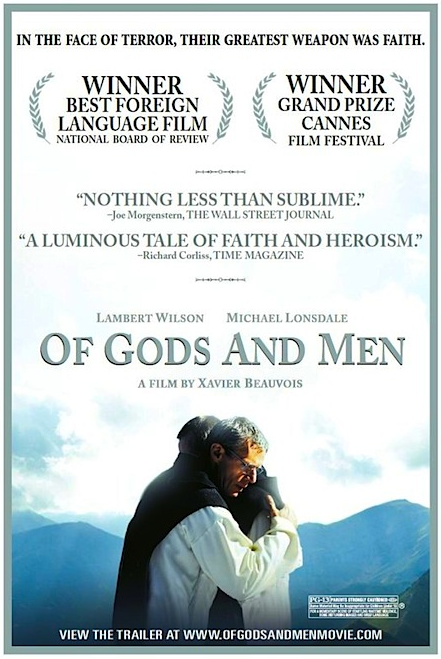
By Joe Bendel. They lived in perfect harmony with their Muslim neighbors. Their mission was one of charity, conducted with tolerance, yet seven of their ranks were executed in 1996, either by Islamist guerillas (who claimed responsibility) or the Algerian army in an attempt to cover up a botched rescue attempt—opinions vary. Though a small group of French Trappist monks knew they were in harm’s way, they went about their final days just as they always had. Xavier Beauvois captures their faith and fellowship with genuine sensitivity while trying to finesse the worldly hatreds that ensnared them in his thinly fictionalized Of Gods and Men, the 2010 Cannes Grand Prix winner, which opens in New York and Los Angeles today.
They do not reside in seclusion, but are actively engaged in their adopted community. The eight Trappists of Tibhirine do many good works, yet their daily existence is still comparatively quiet and meditative, filled with prayer and liturgical singing. Brother Luc runs the free clinic and distributes clothes to the needy. Brother Christian is a learned scholar of Islamic theology. Brother Christophe struggles with his faith, yet their provincial corner of Algeria is the only place he feels a sense of belonging.

Unfortunately, the world around them is far from peaceful. As French Christians, they are prime targets for the Armed Islamic Group of Algeria. Fearing their presence will attract trouble, the Algerian government wants them to evacuate. However, many of their neighbors want them to stay, believing only the monks’ presence has protected them from the atrocities reported throughout the countryside. The dilemma for the monks is obvious: what course of action is most consistent with their mission and the tenets of their faith?

Working closely with monastic advisor Henry Quinson and choirmaster François Polgar, Beauvois renders their not-so cloistered life with respect and scrupulous attention to accuracy. The issues of faith the monks grapple with are serious, not just because of their obvious life-and-death implications. Indeed, Beauvois and co-screenwriter Etienne Comar offer the most insightful and compelling depiction of Christian monasticism seen on-screen since Into Great Silence, a film Men somewhat resembles in tone – despite the former being a documentary about Carthusians.

As befitting men of God, the monks forgive their captors (and likely executioners). It is their final act of Christian charity, explicitly elucidated in the concluding narration of Brother Christian’s journal. However, Beauvois’ constant pleas to distinguish Islam from Islamists run the risk of protesting too much. Frankly, he somewhat undercuts the feelings of humanist empathy and solidarity inspired by his graceful portrayal of the Trappists by fetishizing their murder as an act of martyrdom on behalf of their Muslim murderers. As not just men of the cloth, but as those trespassed against, it is their place and perhaps their highest calling to forgive. That right is not ours to exercise.
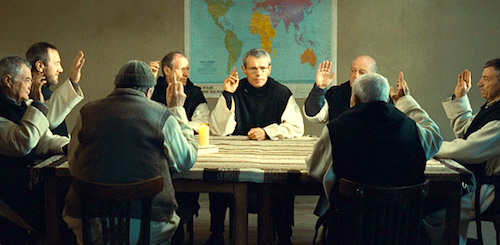
From "Of Gods and Men."

Despite the agenda ultimately appended to Men, it is a finely crafted film. Caroline Champetier’s warm lens finds the weathered beauty in the Algerian land and its people. Beauvois’ use of both silence and Polgar’s arresting chorale music is equally adept. Yet, it is the dignity and intelligence the cast invests in the monks that are redemptive above and beyond any pat message tacked onto their tragic story. Truly, the eight principles give career performances, but veteran French character actor Michael Lonsdale is a genuine standout as Brother Luc – while Lambert Wilson effectively centers the film as wise Brother Christian.

These are men, albeit of God, but men none-the-less, rather than symbols. The greatest aspect of Men is its success in delineating the monks as characters and conveying the distinct ways Christian faith manifests itself through their callings. Though it requires time to contemplate and digest, in the final analysis Men is a quietly moving film of considerable substance. It opens today (2/25) in New York at the Landmark Sunshine and next week in Los Angeles at Laemmle’s Playhouse 7.

Posted on February 25th, 2011 at 4:39pm.
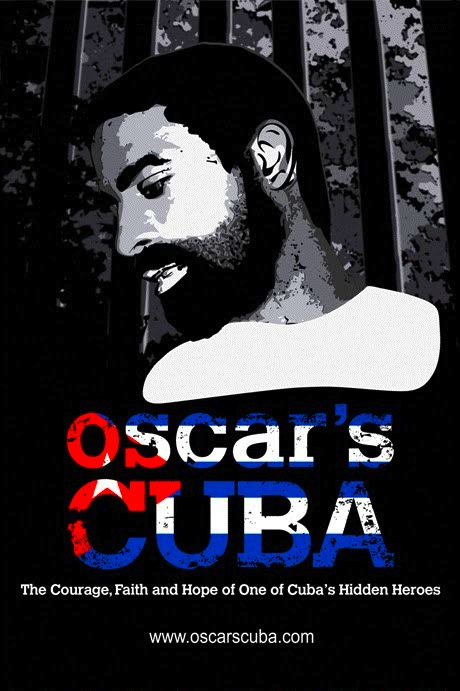
Prisoner of Conscience Under Castro: Oscar’s Cuba

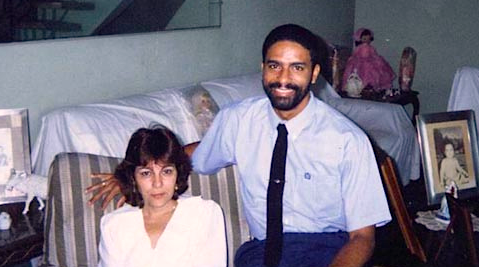
By Joe Bendel. It is not hard to see why the Castro brothers fear Dr. Oscar Elías Biscet. A medical doctor with commanding leading man looks, Dr. Biscet has been a selfless and tireless champion of human rights in Cuba. In short, he is everything they are not, which would make him a formidable political rival if Cuba were a free democracy.

Of course, this is not the case. Imprisoned for years, usually in solitary confinement, Dr. Biscet has become a unifying symbol of hope and non-violent resistance throughout the island gulag, as filmmaker Jordan Allott documents in Oscar’s Cuba, a selection of the 2011 John Paul II Film Festival, which has a special screening this coming Wednesday in Las Vegas at the Clark County Library Theatre.

When allowed her brief bi-monthly visit, Dr. Biscet’s wife Elsa Morejon always brings him toilet paper, because his Communist captors refuse to supply such everyday staples necessary for basic human dignity. This ritual encapsulates the essence of the Cuban police state. However, it has not broken Dr. Biscet’s spirit according to those who have met him in prison. No stranger to Castro’s dungeons, thirty-six days after serving a three year prison sentence, Biscet was swept up again in the notorious 2003 Black Spring round-up of seventy-five Cuban dissidents. To this day, he remains in a dark, confined, unsanitary cell.

Born shortly after the unsuccessful Bay of Pigs invasion, Biscet has lived his entire life under Castro’s regime. Yet, the dissident doctor has always maintained a profound Christian faith. In fact, much of the pro-life Biscet’s activism began in protest of the Communist government’s policies of forced abortions – and even infanticide – of premature newborns to bolster their internationally vaunted infant mortality statistics. He would become Cuba’s leading advocate of democratic reform and a proponent of non-violence, often referencing the works of Martin Luther King, Jr. and Henry David Thoreau.

Though not able to talk to the man himself (for obvious reasons), Allott interviews many of Biscet’s former prison-mates and fellow human rights activists, without the sanction or supervision of the Cuban regime. We also hear from former Cuban political prisoner and U.S. Ambassador (to the UN Commission on Human Rights) Armando Valladares, a figure well worthy of his own documentary.

Dr. Biscet & his wife.

While clearly produced to spur grassroots activism, Allott still earns props for his on-the-spot undercover reporting, capturing first-hand the unsavory realities of Cuban life, like Castro’s thuggish flash-mobs sent to intimidate dissidents and their families. Jazz and Afro-Cuban music lovers will also appreciate the original score composed by bandleader-defector Arturo Sandoval, Dizzy Gillespie’s close collaborator and heir as the king of the trumpet’s uppermost registers.

Far too much of Oscar’s Cuba will come as a revelation to general audiences who rely on the absentee media for international news. Highly informative, but also an inspiring portrait of one man’s faith, courage, and dignity in the face of oppression, Oscar’s Cuba was a truly fitting selection for the JP2FF. Recommended along with a prayer for Dr. Biscet and his colleagues, Oscar’s Cuba screens this coming Wednesday (3/2) in Vegas.

Posted on February 25th, 2011 at 4:37pm.

Ido Haar in San Francisco: Melting Siberia

By Joe Bendel. Ido Haar’s road to San Francisco ran from Israel through Novosibirsk. Chosen as the inaugural filmmaker to launch the San Francisco Film Society’s Artist-in-Residence program, the still youthful looking Haar has already established an international reputation. At one point an editor for BeTipul, the Israeli series on which the HBO series In-Treatment is based (often word-for-word), Haar is probably best known on the festival circuit for the naturalistic, issue-driven documentary 9 Star Hotel. In contrast, his first non-fiction feature was the distinctly personal Melting Siberia, which screens next Wednesday as part of two weeks of programming related to his residency.

Filmmaker Ido Haar.

Given its uniquely tragic history, many grieving spouses and children immigrated to Israel without parents and loved ones. Such was the case with Haar’s mother and grandmother, but his grandfather was very much alive. A Soviet Red Army officer stationed in Latvia, Marina’s father abandoned her and her mother shortly after the war. Always understandably resentful, Haar’s mother never sought out the father she never knew. However, when Haar tracks down his grandfather in frozen Novosibirsk, Marina reluctantly but resolutely follows-up in a series of phone calls, letters, and finally a fateful visit – all faithfully documented by Haar.

Deliberately modest and intimate, Melting is true to life, capturing the messy conflicting emotions and social awkwardness of Haar’s family reunion, finding closure where it can. Clearly a strong woman, Haar’s mother emerges as the star, tough but vulnerable all the way through. Yet even on his supposed best behavior, his grandfather remains a deeply problematic figure. Before their eventual meeting, Marina muses whether deserting one’s family was conduct becoming a Soviet officer. It is a fair question, perhaps even more so following a devastating confrontation between a father and daughter still strangers to each other.

Unlike Haar’s other works, he frequently appears in Melting, good naturedly taking his family ribbing.It augurs well for his stint in-residence at SFFS (2/21-3/5), especially his classroom visits and master class scheduled for this Saturday (2/26). Haar will also be in-attendance for a special screening of Melting next Wednesday (3/2) at New People Cinema in San Francisco. Unblinkingly honest, it is a quietly moving film, well worth seeing at any time.

Posted on February 23rd, 2011 at 5:30pm.

Jafar Panahi (Not) At The Asia Society: The White Meadows

By Joe Bendel. It is so tragically appropriate that the latest film from unjustly persecuted Iranian film directors Mohammad Rasoulof and Jafar Panahi uses tears as a major plot device, that it is almost embarrassing to point out the aptness. However, it is the repressive Iranian government that should be ashamed. It has sentenced both filmmakers to six year prison terms, on the flimsiest of pretexts. To its credit, the recently wrapped Berlin International Film Festival went out of its way to protest their plight, holding Panahi’s invited place on the Berlinale jury vacant, while screening five of his films in various festival sections. Now the Asia Society follows suit with an equally timely retrospective Panahi’s work, starting this Friday with Rasoulof’s The White Meadows, a strange and unsettling cinematic fable edited by Panahi.

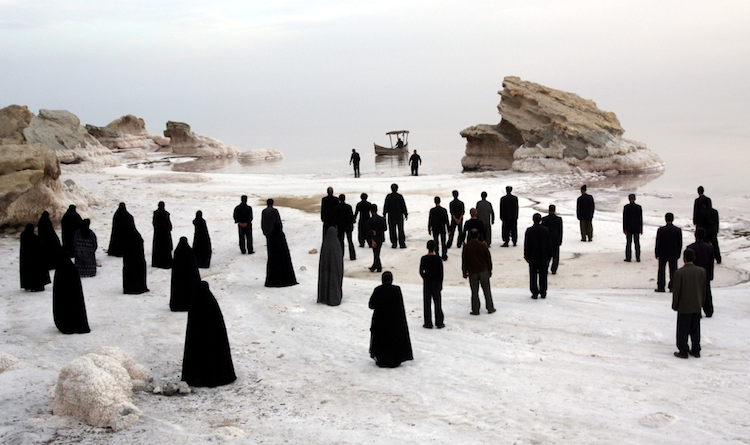
The water has never been saltier and the people living on Lake Urmia’s sandy white isles have never been so miserable. A karmic hand seems to be at work. Seeking relief from their sorrow, they turn to Rahmat, a tear collector, who gathers his watery harvest during their funerals, confessions, and inquisitions. However, after leaving one grieving family, Rahmat is surprised to find a stowaway on his small boat, the young Nissim, who has set out on a truly archetypal quest to find his prodigal father.

From "White Meadows."

As Rahmat and his unexpected apprentice travel from one island to another, Meadows subtly grows ever more fantastical and sad. Indeed, its episodic nature seems like a conscious attempt to evoke the spirit of ancient epics like The Odyssey, while keeping its exact time-frame deliberately vague.

Though he functions as an enigmatic journeyman, Hasan Pourshirazi’s Rahmat is still fascinating to watch as he slowly yields up his mysteries. As young Nissim, Younes Ghazali shows talent beyond his years, effectively serving as the audience’s proxy, viscerally and believably expressing horror at the various injustices he witnesses.

Totally absorbing despite its unhurried pace, Meadows is a testament to the filmmaking talents of director Rasoulof and editor Panahi. As lensed by cinematographer Ebrahim Ghafouri, it is a visually stunning film, often utilizing arresting wide angle shots of its black-clad figures, standing out as contrasting specks against the blinding sunlight and Urmia’s eerie white sand and saltwater vistas.

Given the prevalence of tears and suffering in Meadows, it is hard not to read additional meaning into its story. Rasoulof wisely keeps the political allegory largely shrouded (though evidently not obscure enough). Still, there seem to be clear parallels between the bad karma the islanders are suffering and the sins of the Islamic Revolutionary government. Certain critiques of Iranian society are also inescapable, especially its rampant misogyny. Indeed, when a beautiful woman dies terribly young, one Islander tells Rahmat it is for the best, lest she should inspire unfulfilled lust in the men. Also worth noting, Meadows scrupulously adheres to Iran’s stringent regulations forbidding all forms of physical contact between men and women on-screen.

The standout film at last year’s Tribeca Film Festival, Meadows is a masterfully crafted work that resists lazy categorization (such as “political allegory” or “Arabian fantasy”). Filmed under difficult circumstances, it is also recommended beyond reasons of its considerable cinematic merits. Clearly, the current Iranian regime would like the outside world to forget Rasoulof, Panahi, and their films. Instead, make a point of attending White Meadows at Asia Society this Friday (2/25) and return for Panahi’s films in the coming days and weeks to enjoy their art, but also to remain mindful of their perilous situation.

Posted on February 22nd, 2011 at 12:49pm.

Jafar Panahi (Not) At The Asia Society: Offside

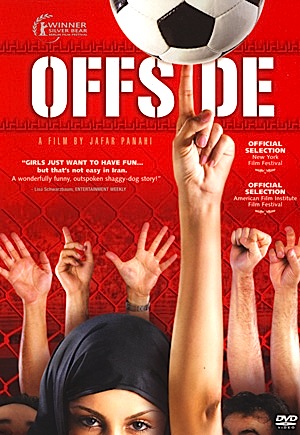
By Joe Bendel. Only the current Iranian regime could make patriotism subversive. Supposedly to protect women from harsh language and rampant testosterone, the paternalistic Iranian regime will not allow women to attend men’s sporting events. It may not be the most pressing human rights abuse in Iran, but it is emblematic of the Islamic Republic’s institutionalized misogyny. Produced under difficult circumstances without official sanction, Jafar Panhi’s Offside depicts the unfortunate drama surrounding several young Iranian girls’ coordinated attempt to sneak into a crucial World Cup qualifying match. Like several of his characters, Panahi would soon find himself behind bars. Currently facing a six year prison term on trumped-up charges, Panahi is not likely to attend when Offside screens this Saturday at the Asia Society as part of their important retrospective-tribute to the persecuted filmmaker.

Disguising themselves as boys, with varying degrees of success, a group of teenage girls successfully bluff their way into the forbidden stadium. Eventually though, they’re rounded up by the equally young military conscripts working the security detail, to be turned over to the morals police at the end of the match. As the young women cool their heels in a holding pen, they try to engage their captors, who have difficulty defending the policy they reluctantly enforce. In fact, several of the female fans seem much more knowledgeable about the game than the soldiers guarding them.

Since Panahi was (not surprisingly) denied official permission to film Offside, he shot rebel-style on digital video, which gives the film a definite cinema vérité look. Panahi’s brave cast of non-professionals duly avoids any sense of affectation. Although some young actors are perhaps a tad uncomfortable in their roles, many, like Shayesteh Irani as the tomboyish “Smoking Girl,” are consistently quite good.

As a film Offside is certainly engaging, as a sort of the dystopian version of Bend it Like Backham, but only too real. Yet it is particularly valuable as an intimate, unfiltered snapshot of Iranian life. Far from a full scale indictment of the Iranian regime, Offside is a small, but telling, slice of everyday absurdism. To borrow an American cliché, one cannot use the film to question Panahi’s patriotism. In fact, the film is suffused with a love of country, as the young fans want nothing more than to chant and cheer for their beloved national team.

Reportedly, even though Offside had only been screened once in Iran at the time of its initial American release, word of the film helped temporarily overturn the ban on women at sporting events, until the religious authorities vetoed the policy change. Offside might seem slight—a group of women simply trying to watch a sporting event—but it signifies the act of questioning authority, even ending with a very minor rebellion of sorts, foreshadowing the Green almost-Revolution.

In addition to his six year sentence, the Iranian government has also imposed a twenty year filmmaking ban on Panahi. This punishes not just the filmmaker, but all Iranian citizens and world cineastes.  Winner of the Silver Bear at the 2006 Berlin International Film Festival (Berlinale), Offside is an excellent example of what the world is losing through the mullahs’ oppression. It screens this Saturday (2/26) at the Asia Society and tickets are free.

Posted on February 22nd, 2011 at 12:46pm.

Aliens in the Heartland: LFM Mini-Review of I Am Number Four

Alex Pettyfer and Teresa Palmer in "I Am Number Four."

By Jason Apuzzo. THE PITCH: Sexy alien teenagers flee to planet Earth on the run from another alien race out to exterminate them. One such teenager, played by Brit star Alex Pettyfer, hides out in a small Ohio town (‘Paradise’) where he falls for a cute blonde at his high school – played, conveniently enough, by Glee‘s Dianna Agron – and otherwise learns to love Heartland America, pickup trucks, pet puppies and middle class life.

THE SKINNY: This very solid, D.J. Caruso/Michael Bay adaptation of the popular young adult novel, I Am Number Four, works effectively because of its excellent casting and detailed attention to the emotional lives of its young characters. The film also works as an affectionate encomium to the values and lifestyle of middle America, right at a time when those things seem most under assault. Frankly, I never thought Ohio could look like such a great place to live – especially post-LeBron.

Alex Pettyfer and Dianna Agron.

WHAT WORKS: • The cast, top to bottom. Alex Pettyfer as the teen alien ‘John Smith,’ and Dianna Agron as his girlfriend Sarah steal the show. Pettyfer comes across as a brooding hunk, and Agron has an ironic, quirky quality to her that makes her appealing. The two have definite chemistry – and, not surprisingly, they’ve apparently been dating off-screen since making this film.

• The depiction of ‘Paradise,’ Ohio as, well, a ‘paradise’ of warm suburban families, football games, Halloween carnivals … I’m ready to move right in. Hollywood so rarely tries to make the Heartland look appealing; here they actually make it look lyrical and inviting.

• Aussie Teresa Palmer nearly steals the show in the third act when she swoops in from Planet Michael Bay on her Ducati motorcycle and starts laying waste to the alien bad guys. Even though she looks to be about 85 pounds – and has a thin, raspy voice – she’s perfectly convincing as an ass-kicker due to the vaguely insane look in her eye (á la Jolie). Also: Aussie accents are sexy, especially when burnished by cigarette smoke.

• The alien creatures were excellent, and suitably menacing. Nice wok, as always, by ILM.

WHAT DOESN’T WORK: • The appearance of the alien bad guys. Essentially they’re 7-foot tall white guys with tattoos, pig-like faces, wearing dark trenchcoats. For some reason they reminded me of ‘Birdman’ Chris Andersen of the Denver Nuggets. It was, however, admittedly rather creepy when they walked into the high school with assault rifles near the end of the film – because they looked like the Columbine killers.

• The general sense that you’ve seen films like this a thousand times; especially films featuring white teenage guys with ‘special powers,’ who need to learn to use them responsibly, etc. Just for variety’s sake, I’d love to see someone make a movie about, say, a chubby Hispanic gal with ‘special powers’ who needs to use them responsibly. Continue reading Aliens in the Heartland: LFM Mini-Review of I Am Number Four