LFM Reviews The Light Shines Only There @ Japan Cuts 2015

By Joe Bendel. Shortly after his 1989 source novel was published, author Yasushi Sato took his own life. Clearly, it did not sufficiently cheer him up. Decades later, director Mipo O has helmed a big screen adaptation, showing a pronounced empathy for that sort of dark and depressed state of being, despite her reputation for light comedy. Life is nasty and brutish for two young lovers. Any respite they find in each other’s arms will be paid for on credit with future misery in O’s The Light Shines Only There, which screens as a selection of this year’s Japan Cuts, the Festival of New Japanese Film in New York.

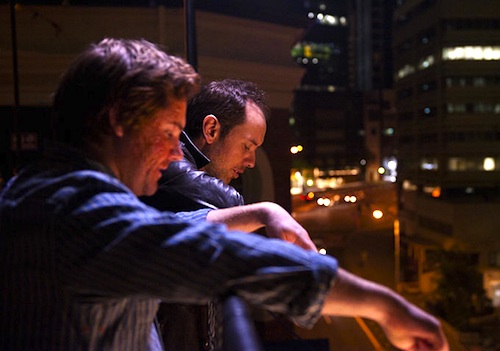
Tatsuo Sato has basically given up living. He shambles through the streets and pachinko parlors of the blighted Hokkaido port town of Hakodate like a zombie. Yet, for some strange reason, Takuji Oshiro will not stop talking to him. Somehow, he even drags Sato back to his family’s beach shack, where his put-upon sister Chinatsu serves them lunch, without a smile. Nonetheless, there is a bit of something that passes between her and Sato. It is even there when he drunkenly stumbles into the bar where she works as a “hostess.”

Despite several false starts, Sato and Oshiro become lovers, at least as best they can. It is safe to say they both have severe intimacy issues. Further complicating matters, the local mobbed up squid factory owner considers her his personal property. He is a violent lover, but she is stuck with his abuse, because he is the guarantor for her brother’s parole.

So, happy times. Nevertheless, it is hard to truly be depressed by a film so well acted and executed. As Chinatsu Oshiro, Chizuru Ikewaki is a staggering revelation. While in real life she is quite stunning, for Light she is glammed down and bedraggled to truly look like a cast-aside victim of life’s rottenness. Her performance is brave as hell and relentlessly honest, forcing us to watch the explicit realities of those who subsist in the margins of polite society.

From "The Light Shines Only There."

By design, it is much harder to draw a bead on Gou Ayano’s distant Sato, at least until his former boss from the stone quarry (nicely played with gruff sensitivity by Shohei Hino) arrives to fill in some backstory. As annoying as his character might be, Masaki Suda’s Takuji ultimately provides the film’s tragic heart.

For the purposes of easy symbolic short-hand, water is often associated with purification, but not in Light. Instead, screenwriter Ryo Takada’s adaptation of Yasushi Sato’s novel contrasts the healthy cleanliness of the mountains where Tatsuo Sato once worked, with the predatory corruption of the beachfront town.

It is potent stuff, but absolute Kryptonite for the Academy, who declined to nominate Light in the foreign language category, even though Japan duly submitted it. They would have much better award season luck with a classy historical. On the other hand, this is a film that will speak to young and disillusioned audiences much more directly for years to come. Driven by Ikewaki’s frighteningly frank performance, The Light Shines Only There is recommended for those who appreciate uncompromisingly naturalistic drama. It screened this past Wednesday (7/15) at the Japan Society, as part of the 2015 Japan Cuts.

LFM GRADE: A-

Posted on July 16th, 2015 at 11:04pm.
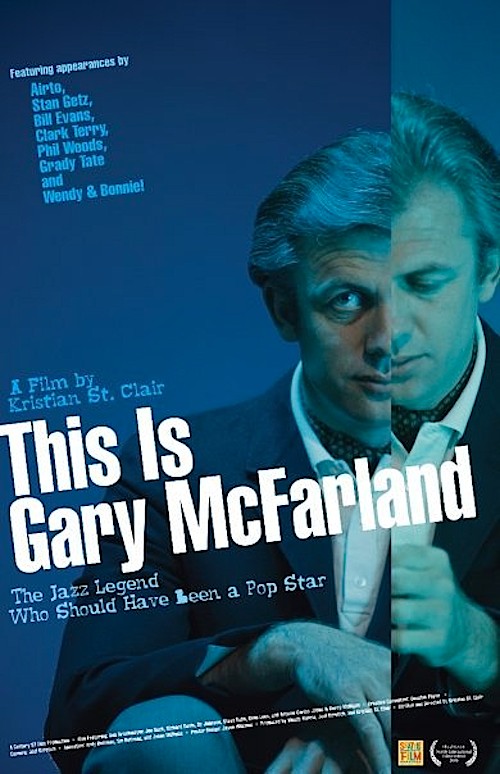
LFM Reviews This is Gary McFarland

By Joe Bendel. The Israeli Broadway musical To Live Another Summer, To Pass Another Winter had some surprising spring in its step, but pioneering jazz-and-pop musician-composer Gary McFarland’s work-for-hire supervision of the original cast album hardly seems like a fitting final session. Alas, fate and a criminally irresponsible prankster would deem it so. McFarland’s life and music are surveyed in Kristian St. Clair’s This is Gary McFarland, which screens tomorrow in Albany in conjunction with a performance of the Gary McFarland Legacy Ensemble—and also streams online for Fandor subscribers.

McFarland died too soon and he started playing professionally unusually late in life. Somehow, in between, he still had time to record absolutely classic sessions with Bill Evans, Steve Kuhn, and Clark Terry. He broke into the business as a vibraphonist, but soon became more in-demand as an arranger and composer. He is now most in/famous for his trailblazing pre-“fusion” fusion of jazz and pop music, which overshadowed his Third Stream-esque classical style jazz arrangements.

Had he lived longer, the rest of the world might have caught up with McFarland. Frankly, it is rather baffling his funky environmental protest album America the Beautiful has yet to catch on. Sadly, he did not survive to see jazz-pop fusion reach critical mass, due to no fault of his own. Yes, St. Clair makes it clear McFarland struggled with many of the demons that afflicted his fellow musicians, but he had nothing to do with the fatal dose of methadone that killed him. Not afraid to name names, the film calls out Mason Hoffenberg (co-writer of Candy with Terry Southern), a registered methadone user who was at the 55 Bar on the fateful night McFarland and others were mysteriously dosed with the potent drug. Gee, didn’t the counter-culture have the darnedest sense of humor?

For the most part though, St. Clair focuses on the music, incorporating extensive musical samples into the film. Logically, he includes generous selections from the America concept album, but there are also a number of less obvious choices, such as “High Camp,” a McFarland tune recorded by Mingus drummer Dannie Richmond on his only LP as a leader (and a personal favorite around here). For perspective and reminiscences, St. Clair sits us down with a number of McFarland’s legendary friends and colleagues, such as the aforementioned Terry and Kuhn, as well as Bob Brookmeyer, Grady Tate, Phil Woods, Chet Amsterdam, and Airto [Moriera].

Visually, TIGM is rather lively by documentary standards, vividly conveying a flavor of McFarland’s career through periodic montages of record jackets and press clippings. St. Clair has an ear for McFarland’s music, picking selections that best reflect the bright tonal colors of his music. Admirably well done, This is Gary McFarland is highly recommended in its own right for Fandor users. It will should also make for quite an event as part of the Gary McFarland Legacy Ensemble concert-tribute, which should be a terrific show, since it features the piano and arrangements of Bruce Barth. For all our lobbyist readers, the program started this past Tuesday (7/14) at the Madison Theater in Albany.

LFM GRADE: A-

Posted on July 16th, 2015 at 11:03pm.

LFM Reviews The Suicide Theory

By Joe Bendel. Poor, pitiable Percival is sort of like Larry Talbot. He is convinced he cannot be killed. However, he can be disfigured and maimed—and he has the scars from past suicide attempts to prove it. Somehow, he has developed a New Agey notion that a wildly unstable contract killer is the man who can get the job done, because of their fateful connections. Maybe it makes sense or maybe it doesn’t, but it provides the unlikely foundation of a strange pseudo-friendship in Dru Brown’s The Suicide Theory, which is now playing in the Los Angeles area.

Steven Ray kills people, when he is not wallowing in grief over his late wife’s hit-and-run death. He first met Percival when the suicidal artist took a header off a building onto Ray’s cab. At first, Ray assumes Percival’s self-ordered hit will be easy money, but alas no. Of course, he dismisses the notion that he can only whack his client when he is in such a good frame of mind, he temporarily wants to live again. Yet, in spite of his better judgement, Ray starts to wonder when Percival survives his multiple gunshot wounds to the head. As he confers with his unhappy customer, Ray actually starts to like the lovelorn, guilt-ridden, open-sore of a person. He also starts to question some of his own life choices.

From "The Suicide Theory."

“You’re lucky to be alive” is the film’s designated punch line—and it often works rather well in context. In fact, Theory is pretty darned entertaining when it sticks to the pitch black humor and grimy noir atmosphere. Oddly enough, Brown’s attempts to wrap it all up in a cosmic package somewhat dilutes the grungy fun. Still, Steve Mouzakis’s stone cold deadpan delivery gives Ray a flinty edge, even more than his voluminous tics and quirks. He also develops some decidedly distinctive buddy chemistry with Leon Cain’s increasingly battered Percival.

To be fair, Brown fits his ironic pieces together quite dexterously. Nonetheless, the film is more entertaining when reveling in its brutish urban jungle environment rather than trying to make cosmic connections. At its best, Theory is sort of like early Tarantino without the self-conscious pop culture riffing. It is somewhat uneven down the stretch, but overall, it’s not bad, even if you have seen a whole lot of indie thrillers. Recommended as a decent little VOD discovery, The Suicide Theory opened this Friday at the Music Hall 3 in Beverley Hills and also launched on iTunes.

LFM GRADE: B-

Posted on July 16th, 2015 at 11:03pm.

LFM Reviews The Newly Restored Belladonna of Sadness @ Japan Cuts 2015

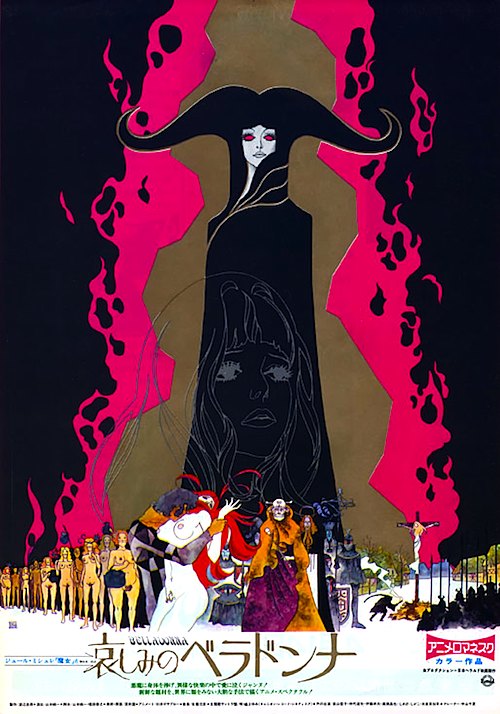
By Joe Bendel. Think of it as something like Bernard Christensen’s Häxan, but in color and with even more sex. While the notorious Danish silent was based on the Fifteenth Century Malleus Maleficarum, the third of Osamu Tezuka’s animated features for adults was inspired by Jules Michelet’s Nineteenth Century study Satanism and Witchcraft. The practice of the dark arts is largely a product of class and gender exploitation in the brand new 4K restoration of Eiichi Yamamoto’s 1973 cult classic Belladonna of Sadness, which screens as part of the 2015 Japan Cuts Festival of New Japanese Film.

French peasants Jean and Jeanne love each other deeply and truly, but unfortunately their marriage requires a sacrifice to their lord. Tragically, he claims his feudal deflowering right of jus primae noctis, at which point he turns the ravaged Jeanne over to his lecherous court. Initially, Jean tries to comfort her, but henceforth they can never truly be happy together. Sensing her pain and anger, the imp-like Satan approaches Jeanne tempting her with power and exciting her lust. She slowly yields to him, inch by metaphysical inch, amassing influence in the village to become a serious rival to the lord, especially while he is away fighting a fruitless war. Naturally, this does not sit well with her ladyship or the parish priest.

Even though it is animated, Belladonna is absolutely, positively not for children—not even the particularly mature and precocious. Yamamoto’s film is rife with images of sex and violence that often bleed into each other. However, the animation is extraordinarily striking, often looking like a cross between Alphonse Mucha and Gahan Wilson. For long stretches, the pictures do not even move, per se. Rather, the camera pans over the baroquely detailed paintings.

Frankly, it is rather baffling that Belladonna never caught on more widely in its day. The trippy visuals and open invitation to identify with and even support Jeanne’s self-damnation seem pitch perfect for the indulgent 1970s. As a bonus, legendary Kurosawa and Kobayashi regular Tatsuya Nakadai memorably gives voice to the puckish Satan.

In many ways, Belladonna is a startling accomplishment in animation. It really feels like it taps directly into the ancient grievances of women who were driven to witchcraft for the sake of solidarity and resistance, which is rather unsettling. There is an eerie subconscious familiarity to Belladonna, even though it is a wholly original work. Highly recommended for mature animation connoisseurs, the newly restored Belladonna of Sadness screens this Friday (7/10) at the Japan Society, as a classic rediscovery of this year’s Japan Cuts.

LFM GRADE: A

Posted on July 10th, 2015 at 4:48pm.

LFM Reviews Seven Weeks @ Japan Cuts 2015

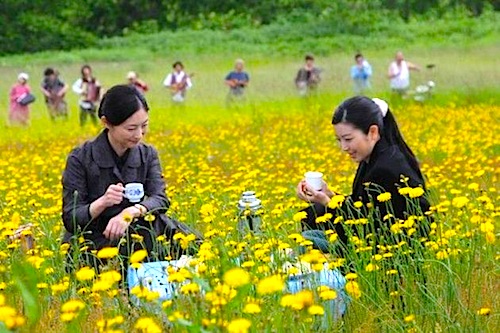
By Joe Bendel. In early September of 1945, most of Japan thought WWII was over, but not the residents of Karafuto (now Sakhalin) Island. They were still being razed and rounded-up by the marauding Soviets. That grim historical episode played a pivotal role in the history of the Suzuki family, in ways that are only now coming to light as they gather to mourn their patriarch in Nobuhiko Ôbayashi’s Seven Weeks, which screens during Japan Cuts 2015, the Festival of New Japanese Film in New York.

At ninety-two, Mitsuo Suzuki had quite a run, but it was not always a bed of roses. Due to random post-war tragedies, the doctor-turned-local-cultural-curator survived all of his sons and daughters-in-law. He had already lost his great love during the war, through circumstances that will be revealed over time. Still, he was never lonely, having personally raised his granddaughter Kanna and third grandson Akito, with the help of his nurse, Nobuko Shimizu, whose position in the household is ambiguous but significant.

Following his death, Kanna plans the traditional seven seventh day mourning rituals, along with Suzuki’s grandsons, his sister, and his great-granddaughter Kasane, but most of the work falls on her, until Shimizu mysteriously reappears. As they pay their respects, Suzuki’s spirit offers his own running commentary, seeming to inspire flashback reveries for most of his family.

Eventually, we learn exactly how the Suzuki family reached this point in time. Yet, Seven Weeks is more than just a family saga. Ôbayashi essentially turns the Japanese national psyche inside out, making connections between the Suzukis and the Soviet occupation of Karafuto (still going on, by the way), the fall of Imperial militarism, the bust and boom of the Japanese coal industry, and the Fukushima nuclear crisis.

From "Seven Weeks."

If you only know Ôbayashi as the mad man responsible for the utterly insane cult classic House (Hausu), you don’t know the half of him, at least not anymore. Seven Weeks is an achingly sensitive work, yet there is a symbol stylistic boldness—a willingness to go for broke—shared by the two films. Ôbayashi restlessly segues between point-of-views, throwing realism to the wind with frequent fourth wall breaches, some stunning super-imposed visuals, a Greek chorus of strolling troubadours, and a substantial element of magical realism hiding in plain sight. Yet, he maintains a visceral connection to the Suzuki family’s raw and formerly repressed emotions. If you cried during Departures, Ôbayashi will probably get you misty-eyed too, even though he breaks every possible rule of tear-jerking melodrama, several times over. To that end, he gets a critical assist from Kôsuke Yamashita’s unclassifiably mournful theme.

Seven Weeks is generous with its large ensemble, giving just about every character of standing an opportunity for a grand, telling moment. However, the film is anchored by the trio of Toru Shinagawa, Saki Terashima, and Takako Tokiwa, as Old Man Suzuki, Kanna, and Shimizu, respectively. You will be hard-pressed to find three performances of such mature reserve and expressive power in another film. However, Hirona Yamazaki might just provide the film’s X-factor as young Kasane, who is shallow and self-centered, but also so much fun she energizes and elevates all her scenes.

Frankly, it is exhilarating to see a film that is so big in its conception and so intimate in its execution. Somehow, Ôbayashi reconciles the micro with the macro, offering a very personal and idiosyncratic perspective on some profoundly turbulent national history. When it is all said and done, you really feel like you understand this family and share its grief. Very highly recommended, Seven Weeks is the absolutely-can’t-miss film at this year’s Japan Cuts. It screens this Saturday (7/11) at the Japan Society.

LFM GRADE: A+

Posted on July 10th, 2015 at 4:48pm.

LFM Reviews The Vancouver Asahi @ Japan Cuts 2015

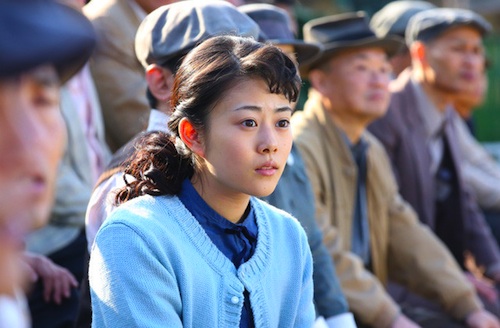
By Joe Bendel. This underdog 1930s team is sort of like the New York Cubans and other early African American baseball teams. Everyone loves them now, but they faced constant struggles in their day. However, the titular community team organized by the sons of Japanese immigrants actually played against white Canadian clubs in an otherwise all-white league. Life will be a challenge for them on and off the diamond in Yuya Ishii’s The Vancouver Asahi, which screens as part of the 2015 Japan Cuts Festival of New Japanese Film.

Reggie/Reiji Kasahara works tirelessly at the lumberyard, but he dreams big when it comes to baseball. Unfortunately, the Asahi have never won a game. They are simply over matched by the big, beefy maple syrup-swilling Canadians’ power hitting and fastballs. Nonetheless, Kasahara must take some responsibility for strategy when he unexpectedly ascends to the team captainship. On the second game of the season, he experiments with bunt-and-run small ball, shocking everyone by scoring a run.

Soon, the Asahi are regularly winning games with what the local papers call their “Brain Ball” approach. After years of futility, the team finally becomes a source of pride in the Japanese immigrant community. They will need something positive to cheer, considering how the swirling clouds of war will further complicate their lives of economic marginalization.

Yes, Asahi follows a very predictable story line, but it is refreshing to see Canada take its lumps for a change after all their tongue-clucking at the U.S.  Yes, there is plenty of discrimination documented in the film, but it is richer and more challenging when it explores the assimilation experience, for which there can be no better example than their passion for the game of baseball.

From "The Vancouver Asahi."

The sad and nostalgic tone is somewhat reminiscent of Ishii’s previous film, The Great Passage, but its characters are not quite as distinctly drawn as those in Ishii’s reference publishing drama. Reggie and his pals basically work hard and play hard, enduring all that comes their way. However, his younger sister Emmy is a deeper, more complicated figure, who truly strives to integrate into the Canadian society that never truly accepts her.

Ishii and screenwriter Satoko Okudera are not exactly subtle when making their points. Still, it is a painstakingly detailed period production. It also captures a sense of just how significant baseball was in the 1930s. It is almost inspiring to watch the Asahi’s scrappy style of play win over the white Anglo Canadians, even though we know it will all be undone by the WWII internment.

All the Asahi players look like they are young and hungry, starting with the wiry Satoshi Tsumabuki as Reggie Kasahara. Yet, it is Mitsuki Takahata and Koichi Sato who really elevate the film as his studious sister and rough-hewn father, respectively. Ultimately, it is an earnest and endearing film that wears its tragic fate with dignity. Recommended for fans of old fashioned baseball dramas, The Vancouver Asahi screens this Saturday (7/11) at the Japan Society, as part of this year’s Japan Cuts.

LFM GRADE: B

Posted on July 10th, 2015 at 4:47pm.