LFM Reviews Wife Be Like a Rose @ MoMA’s Japan Speaks Out Series

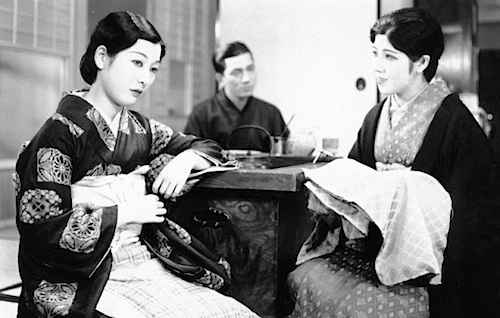
From "Wife Be Like a Rose."

By Joe Bendel. A man maintaining two households ought to at least be gainfully employed. Unfortunately, that is not the case for Kimiko Yamamoto’s deadbeat father, Shunsaku. Yet, for the sake of social convention and her heartsick mother, she will try to reconcile her parents. Even though it is hard to say no to Yamamoto, things still do not go according to her plans in Mikio Naruse’s breakout hit Wife! Be Like a Rose! which screens as part of Japan Speaks Out, MoMA’s current survey of early Japanese talking pictures.

When Shunsaku absconded to set up house with the scandalous former geisha Oyuki in the provinces, his family was appalled, especially his judgmental brother. Nevertheless, the plucky Kimiko Yamamoto more or less supports herself and her tragic-poetry writing mother on her office salary. Everyone is convinced old man Yamamoto will eventually do the right thing and come home. However, when her father never calls on his real family while visiting Tokyo for business, Yamamoto resolves to take matters into her own hands.

On a practical level, Yamamoto needs her father to finalize her engagement with her junior salaryman fiancé. She is also tired of watching her mother mope around the house. Originally, she plans to frog-march her father home from his den of vice, but the reality of his second home is much different than what she envisioned. Instead of a gold-digging harlot, Oyuki is the long-suffering mother of her half-sister and half-brother, who all live under much more impoverished conditions than her and her mother.

Rose is a gentle film, but it is chocked full of shrewd social commentary. It is fascinating to compare Kimiko Yamamoto, a career woman who is consciously navigating familial, social, and gender roles in an increasingly modernized world, with typical parts assigned to Hollywood actresses in the 1930s. Okay, so she is also cute. In fact, lead actress Sachiko Chiba was Naruse’s fiancée and chief muse at this time.

Their relationship would not last, but her performance holds up undeniably well. She is forceful and flirty, but also extraordinarily subtle and sensitive. It is rather remarkable to see her Yamamoto come to terms with her parents’ faults and failings. The dignity and fragility of Yuriko Hanabusa’s Oyuki is also quite touching.

Rose is considered the first Japanese film to be distributed in America, but evidently it did not exactly set the box office on fire. Despite its beauty, the way in which it subverts dramatic expectations will probably always trouble some viewers. That will be their loss. For Naruse admirers, it would be interesting to watch Rose in dialogue with his late career masterpiece, When a Woman Ascends the Stairs, about an aging Ginza hostess facing an uncertain future. Highly recommended, Wife! Be Like a Rose! screens again this Sunday (5/17) as part of MoMA’s Japan Speaks Out film series.

LFM GRADE: A

Posted on May 12th, 2015 at 10:50pm.

LFM Reviews Hannah: Buddhism’s Untold Journey

By Joe Bendel. How did an impossibly serene Dane wind up in the middle of a struggle for the soul of Tibetan Buddhism? Along with her husband Ole, Hannah Nydahl earned a place at the table as arguably the religion’s busiest Twentieth Century evangelists. She was scrupulously spiritual rather than ideological, but Nydahl’s travels took her to some of the most politically contentious corners of the globe. Marta György-Kessler & Adam Penny chronicle her life in Hannah: Buddhism’s Untold Journey, which has three more special screenings this Friday and Saturday at the Rubin Museum of Art.

The Nydahls were basically hippies when they somehow beamed themselves to Kathmandu, but thanks to the innocence of youth, the revered Bhutanese lama Lopon Tsechu Rinpoche first took them under his wing, before entrusting their studies to His Holiness the 16th Gyalwa Karmapa, one of the most venerated lines of reincarnated lamas in Tibetan Buddhism. Before his death, the Karmapa sent them back to the West to share their teachings. After a bit of scuffling, the Nydahls soon found they had a talent for outreach, becoming tireless road warriors.

Some of the film’s most intriguing sequences contrast the guileless Nydahls with the extreme socio-political climates they blithely walked into. Bizarrely, the Communist government granted the Nydahls permission to visit pre-martial law Poland, in the vain hope Tibetan Buddhism would undermine the Catholic Church. Needless to say, it was a tense trip, but the bonds of some lasting friendships were formed then.

However, Untold is truly newsworthy for its insider account of the disputed elevation of the 17th Karmapa. It is a case Westerners might be hazily aware of. Communist China (Tibet’s atheist occupiers, who had previously denied the legitimacy of reincarnation) officially recognized one Karmapa, while leaders in exile recognized another. György-Kessler & Penny provide full context to the controversy, explaining the implications of each development, while largely relying on footage of the Nydahls recorded in-the-moment.

To their credit, the Nydahls did not rush to judgement. However, when the time came, they acted decisively to protect His Holiness, Trinley Thaye Dorje, the rival of China’s compliant candidate. Just when you thought the Communist government could not sink any lower, György-Kessler & Penny document thuggish behavior that manages to lower the bar even further.

From "Hannah: Buddhism’s Untold Journey."

For those who are fascinated by Tibetan Buddhism and Chinese geo-politics, the Karmapa crisis is clearly the film’s centerpiece. However, for the more right-brained and sentimentally inclined, the grand romance shared by the Nydahls always takes center stage. As a former friend and student of Hannah Nydahl, György-Kessler clearly has a deep appreciation for them as individuals. The portrait that emerges is sensitively rendered, but still quite intimate.

Frankly, the Nydahls were disgustingly attractive, charming, and calm, but they used their gifts selflessly on behalf of their faith and for the sake of others. You can get a sense of their stature from the interviews His Holiness, the 17th Karmapa granted the filmmakers (but not the other guy). There is a lot to learn from Untold, but it is also a touching story. Highly recommended, Hannah: Buddhism’s Untold Journey screens again Friday night (5/8) and twice on Saturday (5/9) at the Rubin Museum of Art, Manhattan’s home for Himalayan art and culture.

LFM GRADE: A-

Posted on May 7th, 2015 at 11:50am.

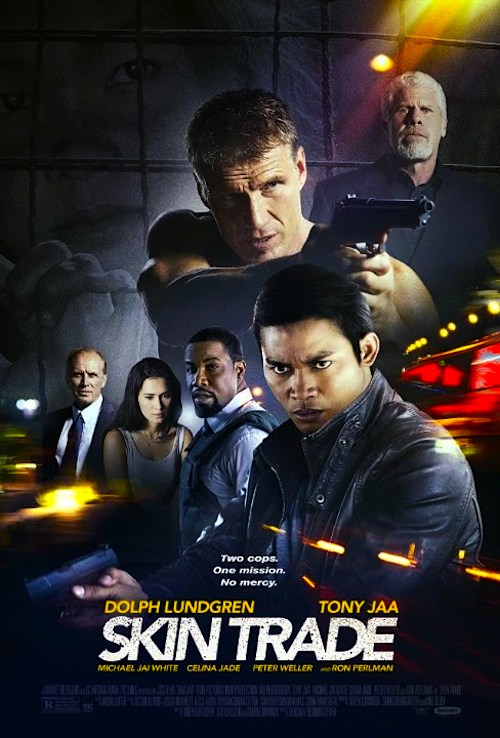
The Dolph Lungren-Tony Jaa Team-Up: LFM Reviews Skin Trade

By Joe Bendel. If testosterone were enough to solve a problem like human trafficking, Det. Nick Cassidy could pretty much lick it single-handedly. Even with the whole world allied against him, Cassidy will still basically take that one-angry-cop approach. Fortunately, he will eventually team-up with a Bangkok copper proficient in Muay Thai. At that point, all bets are off in Ekachai Uekrongtham’s Skin Trade, which opens this Friday in Los Angeles.

Serbian gangster Viktor Dragovic stands atop a global trafficking empire, but the most important hub is in Thailand. Much to his regret, one of his more talented sons is killed by Cassidy during the course of an operation on the Jersey docks. In retaliation, Dragovic gets Biblical, killing Cassidy’s wife and daughter and leaving him for dead. The thing is, you can never leave a cat like Cassidy dead enough. Despite about fifty bullets wounds, Cassidy drags himself out of the hospital and hops on a plane to Thailand for some stone cold vengeance.

Sure, so far, so good. However, things get a little dicey when corrupt FBI Agent Eddie Jones frames Cassidy for the murder of Bangkok cop Tony Vitayakul’s partner, about five minutes after landing. While Cassidy works his way through Dragovic’s organization, Vitayakul pursues the rogue cop. He also frets over his girlfriend, Min, a victim of trafficking now serving as an undercover informant.

Just get a load of this cast: Tony Jaa, Dolph Lungren, Ron Perlman, Michael Jai White, Peter Weller (as Costello, Cassidy’s crusty captain), and Celina Jade. You’re probably thinking: “what, no Michael Ironside?” He must have had a conflict. Needless to say, if you have Jaa and Lungren fight each other and then square-off against Perlman and White, you are on psretty solid ground.

Indeed, Jaa’s moves do not disappoint. The indestructibleness of Lungren’s Cassidy becomes almost a running gag, but let’s face it, the man looks like a tank. White clearly enjoys getting his villainy on as Jones, and he hasn’t lost a step since the criminally under-appreciated Falcon Rising either, while Perlman chews the scenery like an old genre pro. Jade shows off a few moves here and there, but the Legendary Assassin star is definitely the one who gets short-changed in the action department.

Skin Trade follows in the long, noble tradition of taking a serious issue (often with tragic implications) and turning it into an exploitation movie. To his credit, co-writer-producer Lungren started developing the idea when he read about a particularly egregious trafficking case, so consider your consciousness duly raised. He and his co-writers display a style similar to his character’s, relentlessly plowing straight ahead. At least it’s serviceable and the action sequences deliver plenty of red meat. Come for the martial arts and stay for the payback when Skin Trade opens this Friday (5/8) in Los Angeles, at the Sundance Sunset Cinemas (and New Yorkers can catch it on June 12th at MoMI or get it now VOD via iTunes).

LFM GRADE: B

Posted on May 6th, 2015 at 10:39pm.

LFM Reviews D Train

By Joe Bendel. There are two kinds of people—those who look forward and those who look back. Dan Landsman is definitely a rearview mirror kind of guy. As he gears up for his high school reunion, he will painfully illustrate why such a neurotic approach to life is so deeply unprofitable. Prepare to squirm when Landsman makes a last ditch effort for popularity twenty years after graduation in Jarrad Paul & Andrew Mogel’s D Train, which opens this Friday in New York.

After college, Landsman stayed in the same Pittsburgh suburb, attending community college, taking an office job, and marrying the nicest girl from high school who would talk to him. At every meeting of the high school alumni committee, he offers up a textbook example of trying too hard. Smarting from the rejection he continues to invite, Landsman hatches an unlikely plan to convince Oliver Lawless to attend the reunion, so he can hopefully ride on his coattails of coolness.

Lawless was the sort of roguish popular kid everyone wanted to hang with. After graduation, he left for Hollywood, where he barely scrapes by on commercial work. However, Landsman and their fellow alumni see him as the embodiment of all their unfulfilled dreams and aspirations. Landsman will indeed trek out to California to woo Lawless, but the cover story he fabricates about a potential business meeting inconveniently blows up in his face when his technophobe boss, Bill Shurmur, insists on accompanying him. Nevertheless, Landsman manages to meet-up with Lawless, but things get a little out of hand, with much awkwardness ensuing.

The good news is Lawless is coming to the reunion. The bad news is Lawless is coming to the reunion. Frankly, you may never see another film that so thoroughly confuses humiliation with humor. D Train is a truly a cringe fest. Anyone with a shred of empathy will be extremely uneasy watching Landsman’s degradation, but Paul & Mogel keep pouring it on. It gets to be punishing—for the viewer.

From "D Train."

You have to give Jack Black credit for taking it and liking it. As Landsman, his desperate neediness is uncomfortably convincing. It makes you think he could do an entire postscript to Kevin Pollak’s Misery Loves Company by his lonesome. On the plus side, believe it or not, James Marsden turns some surprisingly nice moments as Lawless and it is always amusing to watch Jeffrey Tambor do his thing as Shurmur.

It is hard to judge D Train, because the cast always hits their marks and inhabit their characters pretty credibly. Eventually though, all the piling-on poor Jobish Landsman just makes you shake your head. This year, there were at least two films at Sundance that used Erasure’s “A Little Respect,” but Seoul Searching is exponentially more fun because it remembers both the good and the bad of high school (and Korean culture camp). Honestly, it is a real shame Paul and Mogel were apparently so unhappy during high school, but hopefully making this movie helped them work through some of their issues. An exhausting film, D Train will should bring out Jack Black fans nonetheless when it opens this Friday (5/8) in New York, at the AMC Empire.

LFM GRADE: C

Posted on May 6th, 2015 at 10:38pm.

Lighter than it Sounds: LFM Reviews 1001 Grams

By Joe Bendel. Drug dealers will tell you the weight of kilos can vary quite considerably. Scientists also suspect this is true, but they must prove it with data. Towards that end, Marie Ernst will be lugging the Norwegian prototype kilo to a conference in Paris, where a new international standard will hopefully be set. With her life at a crossroads, the trip might just offer an opportunity for personal discovery as well in Bent Hamer’s 1001 Grams, which opens this Friday in New York.

Ernst’s day-to-day responsibilities largely entail certifying various public pumps and scales to ensure the measurements are on the up-and-up. It is the sort of solitary detail-oriented work she seems to be well suited for. Having recently divorced her caddish husband, she has no real social life to speak of. Aside from her father Ernst Ernst, the director of the laboratory, Marie Ernst has little meaningful human contact. When her more garrulous father falls ill, she assumes his place at the Paris conference, where there are plenty aloof delegates quite like her. However, the institute has a surprisingly smart and engaging gardener named Pi (an unmeasurable constant, you see), whose company she finds pleasant.

Unfortunately, Ernst will have to deal with some family business before she can finally take control over her own life. Worse still, she has a mishap with the Norwegian national kilo. In isolation, all the fuss over a weight in a bell jar seems rather ridiculous, but Hamer makes the characters’ passion for precision measurement look like a noble eccentricity.

From "1001 Grams."

As a filmmaker, Hamer is one of the few stylists who can rival the whimsical visuals of Wes Anderson and even Jacques Tati. Frame after frame in 1001 Grams has such a strikingly composed look, one wonders how long it took Hamer to artfully arrange each scene. There is always the danger that sort of self-consciously idiosyncratic approach can descend into overly precious quirkiness. However, 1001 Grams is permeated with such maturity and grace, it never becomes cloying or shticky in any manner.

Ana Dahl Torp plays Ernst with a profoundly Scandinavian reserve, but the way she slowly and subtly expresses her stirrings of an emotional awakening is beautiful to behold. Laurent Stocker of the Comédie Française comes across like a nice earthy chap as Pi, while Stein Winge adds gravity and humanity as old Ernst Ernst, but Torp must quietly carry 1001 Grams for long stretches on her own. It is a feat she repeatedly pulls off quite remarkably.

There are numerous references, analogies, and call-backs revolving around the act of measurement that could have been absolutely grating in the hands of another filmmaker. Yet, Hamer makes them feel effortlessly light. He fluidly guides the pieces together into a seamless whole. A truly lovely film, 1001 Grams is highly recommended for general audiences when it opens this Friday (5/8) in New York, at the Lincoln Plaza Cinemas.

LFM GRADE: A

Posted on May 6th, 2015 at 9:59pm.

LFM Reviews Maggie @ Tribeca 2015

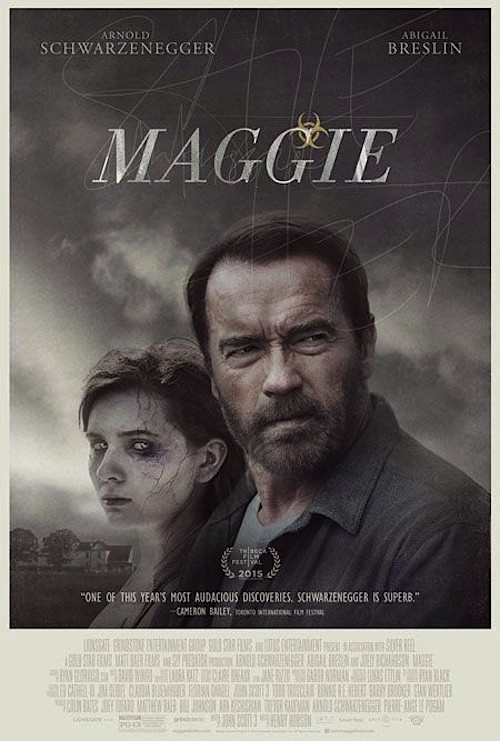
By Joe Bendel. The zombie apocalypse has come, but the everyday mundane rituals of life continue. For instance, NPR is still broadcasting (and providing exposition), which is about as dull and trivial as life gets. The cities are like demilitarized zones, but those who reside in the countryside continue on relatively undisturbed—unless one of their family members is infected. A rugged Iowa farmer with an Austrian accent must deal with his daughter’s painful transition, ominously known as “the turn,” in Henry Hobson’s Maggie, opening this Friday in New York, following its world premiere at the 2015 Tribeca Film Festival.

Like many infected teens, Maggie Vogel ran off to the big city rather than putting her family through the pain of her turn. Checking into one of the nightmarish government field hospitals is not an option, but unfortunately that is where she is forcibly detained until her father finds her. While she is still lucid, she will have time to make her goodbyes to family and friends, but it clearly will not be easy.

Maggie always adored her twin step-brother and step-sister and got on reasonably well with her step-mother. However, Caroline Vogel’s top priority is clearly protecting the twins, which creates friction with Wade. The local sheriff and his jerkweed deputy are also anxious to whisk Maggie back into custody, but it is hard argue with a man the size of Wade Vogel, who is holding a shotgun. Vogel obviously intends to cling to every last hope and does not care what some county employee thinks about it. However, Maggie Vogel is only too aware of the reality of her situation, because she can see it in the mirror.

There have already been a number of anti-genre deconstructions of the zombie film, such as BBC America’s post-zombie cure series In the Flesh and the Canadian feature The Returned, so Maggie’s focus on the intimate human drama of the zombie uprising is not so unusual anymore. Still, Hobson (the title design for The Walking Dead) and screenwriter John Scott 3 carve out a small niche, where zombies are contained (more or less), but not cured. Still, what makes Maggie work so well is the first rate cast.

Believe it or not, that starts with Arnold Schwarzenegger. This is finally the sort of film he should be pursuing for his post-politics return to the big screen. Let’s face it, he was a disappointing governor who just continued all the fiscal problems he promised to stop, but he still has an awful lot of accrued good will with movie fans. Up until Last Action Hero he was batting nearly one thousand, if we make allowances for Red Sonja. He has a reassuring screen presence that gives comfort and inspires confidence. As Vogel, he is able to build on that reservoir of good feeling, creating a surprisingly tender portrait of a father facing the unthinkable.

As the titular Maggie, Abigail Breslin gives a refreshingly smart and subtle performance, conveying a powerful sense of how quickly she has grown up as she faces her fate. Although she is likely to be overlooked, Joely Richardson is also terrific as the step-mother trying her best, despite her very human failings. In fact, it is the intelligent, heartfelt rendering of the Vogel family dynamics that really elevates Maggie.

Yes, Wade Vogel kills a handful of zombies, but the film is highly likely to disappoint fans expecting a vintage 1980s Schwarzenegger film. However, it suggests he might be able to pull off a third act comeback, after all. Appropriately moody and shockingly touching, Maggie is highly recommended for sophisticated genre fans when it opens this Friday (5/8) in select theaters, following its premiere screenings at this year’s Tribeca Film Festival.

LFM GRADE: A-

Posted on May 6th, 2015 at 9:58pm.