LFM Reviews Angry Sky @ Tribeca 2015

By Joe Bendel. There are good reasons why Nick Piantanida did not factor in Tom Wolfe’s The Right Stuff, but it was not due to a lack of guts. Arguably, the amateur skydiver put together history’s first private space program, but he fell short in his attempts to break the world record for highest parachute jump. Needless to say, falling short is a dangerous prospect when jumping from over one hundred thousand feet in the air. Jeff Tremaine chronicles Piantanida’s bid for glory in Angry Sky, which screens during the 2015 Tribeca Film Festival.

Piantanida was a restless non-conformist with a taste for adventure. He had quite the reputation as a basketball player in New Jersey, but he refused to sign a pro contract because he was more or less uncoachable. Thanks to his natural physique and swagger, Piantanida became the first climber to scale Angel Falls, despite his lack of mountaineering experience. He applied the same attitude to his parachuting career, but the results were not so happy.

In the mid-1960s, skydiving was quite the exotic pursuit. Naturally, Piantanida took to it like a fish to water. Before long, he became preoccupied (obsessed might be more accurate) with breaking the record for the highest jump. Technically, the title was held by a Soviet. However, USAF parachute-specialist Joseph Kittinger had successfully completed higher jumps, but intentionally declined to participate in the record-certifying process. Piantanidia meant to break both the official and unofficial records, but he would need to appeal to Space Race fervor to raise the necessary support and sponsorship.

There was a time when Piantanida was quite the national celebrity, but for most viewers who grew up after the Moon landing, his story will be a revelation. Tremaine presents a scrupulously balanced portrait of Piantanida, suggesting he is a figure of classically tragic hubris. Indeed, those who knew him well, including his widow and brothers, remember him as both courageous and irresponsible. Frankly, it is a far more nuanced and cautionary perspective than viewers might expect from Tremaine, one the co-creators and directors of the Jackass franchise. However, his interest in Piantanida makes sense, given his editorial background in extreme sports.
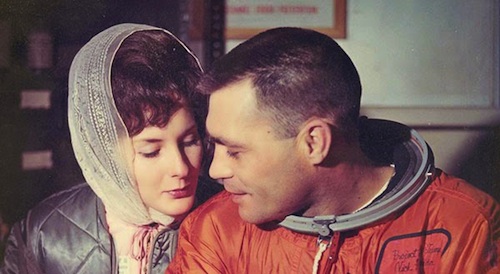
From "Angry Sky."

Tremaine uses some brief recreation sequences, which always risk riling up the documentary police, but in the case of Angry Sky, they are easy to identify as such and help convey the tenor of the era. He also scored extended interviews Piantanida’s wife Janice and Kittinger, who intuitively recognized the daredevil’s Achilles Heel. Without question, Kittinger, an eleven month Hanoi Hilton POW, deserves his own documentary, but it is nice to see aspects of his career acknowledged on-screen here.

There are moments in Angry Sky that will have viewers shaking their heads in disbelief, even though Tremaine maintains a sensitive tone throughout. It is downright strange it has taken so long for Piantanida to get the documentary treatment, since his story so nicely compliments that of test pilots like Chuck Yeager and the Mercury Seven astronauts. Give Tremaine credit for recognizing the void and filling it with a compelling film. Highly recommended for fans of extreme sports and The Right Stuff, Angry Sky screened as part of this year’s Tribeca Film Festival.

LFM GRADE: A-

Posted on April 27th, 2015 at 1:21pm.
LFM Reviews Backtrack @ Tribeca 2015

From "Backtrack."

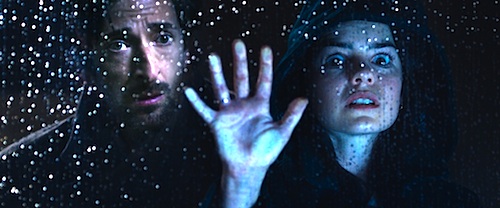
By Joe Bendel. There are two things that always worked in Hitchcock movies: trains and psychiatrists. It is therefore a rather shrewd strategy for screenwriter Michael Petroni to combine them in his feature directorial debut. Sometimes it makes sense, sometimes it doesn’t, but it is always stylish when head-shrinker Peter Bower tries to get his head around his traumatic past in Petroni’s Backtrack, which was recently acquired by Saban Films after successfully screening at the 2015 Tribeca Film Festival.

Still devastated by the accidental death of their pre-teen daughter, Bower and his wife Carol have moved back to Melbourne, hoping the change of scenery will do them good. For the time being, Bower’s practice consists of evaluation-cases referred by his former teacher, Dr. Duncan Steward. These patients seem to have a lot of issues, but they can hardly compare to the visibly disturbed teenager Elizabeth Valentine. She has all kinds of problems, starting with the fact her records say she died in 1987.

Evidently, one Elizabeth Valentine was a victim of a tragic train derailment accident that devastated Bowers’ provincial hometown of False Creek years ago. While Bowers investigates the circumstances surrounding the catastrophe, he starts to remember his own unfortunate involvement. As he stirs up a hornet’s nest of local resentment, the pushback of the living and the torments of the ghosts start to jog Bowers’ long suppressed memories.

Frankly, there are a lot of logical holes in Backtrack, but they are mostly concentrated in the first half hour. If you are willing to gloss over them, the film picks up considerable steam in the second and third acts. Throughout it all, Petroni demonstrates a mastery of atmosphere, building suspense through creepy ambiance and the restrained use of Grudge-like supernatural effects.

From "Backtrack."

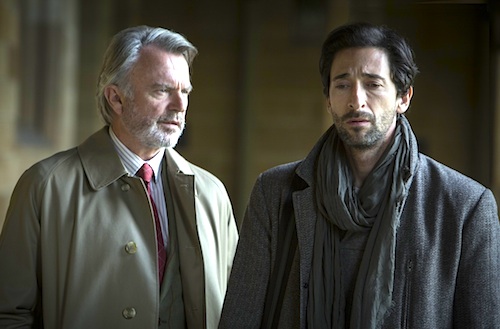
It is hard to imagine Adrien Brody saying “put another shrimp on the Barbie,” but his sad-eyed, hang-dog screen persona works quite well for Bowers. As usual, Sam Neill’s forceful bearing classes up the joint, even if his character, Dr. Steward, really doesn’t make a lot of sense. George Shevtsov also adds some grizzled seasoning as Bowers’ old man. However, Bruce Spence (whose mind-blowing credits include the Mad Max, Star Wars, Matrix, and Narnia franchises) arguably lands the best scene as Bowers’ jazz musician patient.

Part of the fun of Backtrack is identifying where the pieces fit seamlessly into each other and where they are just sort of jammed together. Cinematographer Stefan Duscio (who lensed the breathtaking Canopy) gives it all the perfect look of noir foreboding. Petroni rewards viewers who can overlook the narrative’s early ragged edges with a lot of clever bits down the stretch. Recommended for psychological thriller fans not inclined towards pedantry, Backtrack will eventually hit theaters following its successful world premiere at this year’s Tribeca Film Festival.

LFM GRADE: B

Posted on April 27th, 2015 at 1:20pm.

LFM Reviews The Wannabe @ Tribeca 2015

From "The Wannabe."

By Joe Bendel. How are Tommy and Rosemarie Uva like Truman Capote, Yves Saint Laurent, Coco Chanel, Jean Harlow, and Steve Prefontaine? They were all the subjects of rival film treatments produced at roughly the same time. Obviously, when faced with the prospects of a competitive production, you either want to be the first or the best. Unfortunately, Nick Sandow settles for second best on both scores with The Wannabe, which screened during the 2015 Tribeca Film Festival.

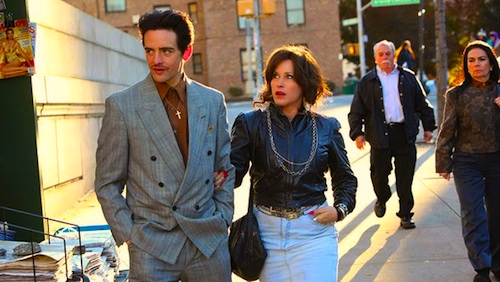
In Raymond De Felitta’s superior Rob the Mob, Tommy Uva is a low life operator, who hates the Mob. Sandow changes his name to Greco and gives him a hero-complex fixated on John Gotti, “the Dapper Don.” For obvious reasons, the Mafia has no need of a loser like Greco. Rose from Ozone Park still loves him anyway, despite his whininess. To ingratiate himself with the Mob, Greco hatches a hair-brained scheme to fix the Gotti trial. Unfortunately, it only leads to a humiliating reality check from a neighborhood captain. Smarting from the dressing down, Greco and his wife finally start the holding up Mafia social clubs—the crime wave De Felitta shrewdly focused on throughout his punchier second act.

As Thomas and Rose “Greco,” Vincent Piazza and Patricia Arquette are cringingly annoying. Frankly, the Mob just can’t whack them soon enough. Yes, with a title like Wannabe, you have to expect a sad, pathetic protagonist, but that does not make it any more pleasant to spend time with these characters. Frankly, the Uvas were not especially grabby in Rob the Mob either, but De Felitta had some wonderfully colorful supporting help from Andy Garcia as composite don of dons “Big Al” Fiorello, Ray Romano as nervy crime reporter Jerry Cardozo, and Burt Young as aging Mafia lieutenant Joey D. Unfortunately, Wannabe does not have analogs for any of these characters, preferring to focus almost exclusively on the Grecos’ codependent relationship.

From "The Wannabe."

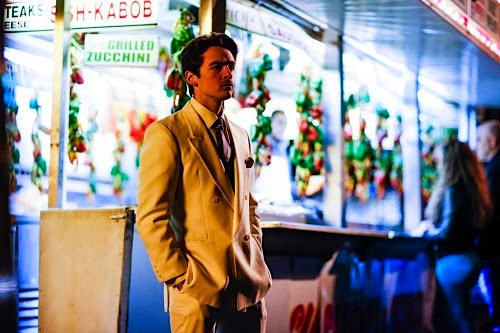
Still, Wannabe captures the vibe of pre-Giuliani New York quite well. It also inadvertently establishes the gutsiness of Guardian Angel founder and media gadfly Curtis Sliwa’s radio crusade against Gotti. Genre fans will also appreciate Michael “Spider” Imperioli’s brief but finely turned work as Greco’s florist brother, Alphonse. Nevertheless, when the slow starting film finally gets going, we have still already seen it all before.

It might seem unfair to compare films like Rob the Mob and The Wannabe or Capote and Infamous, but potential viewers should know if there is a better and more readily accessible doppelganger film available. Frankly, considering De Felitta’s past history with Tribeca, it is somewhat ironic Sandow’s film is the one that found its way into the festival, but Martin Scorsese’s role as executive producer probably counted for a lot. A wan also-ran, The Wannabe premiered at this year’s Tribeca Film Festival.

LFM GRADE: D

Posted on April 27th, 2015 at 1:20pm.

The Ghosts of Gallipoli: LFM Reviews The Water Diviner

By Joe Bendel. Joshua Connor has the Australian version of The Shine. The grizzled farmer senses certain things, like where to drill for water. If he can only get to the blood-soaked beaches of Gallipoli, he is sure he can find the remains of his three sons who died in combat there. That is something the British authorities are not so eager to facilitate in Russell Crowe’s The Water Diviner, which opens today in New York.

All three of Connor’s sons enlisted in the ANZACs and all three presumably perished at Gallipoli. When the bitter news drives their mother to her grave, the salt-of-the-earth Connor promises his late wife he will find their sons and bring them home to her. However, Gallipoli is not exactly a tourist attraction in 1919. The British military consul flatly refuses him access to the prohibited beaches. Of course, he is not about to be dissuaded after such a long and arduous journey.

Bribing a fisherman, Connor makes his way to the fateful beaches, where a combined team of British and Turkish military personnel are working to identify and properly bury as many fallen combatants as possible. Although Lt. Col. Cyril Hughes is a little put off by Connor’s sudden appearance, his Turkish counterpart, Maj. Hasan, convinces him to assist Connor’s search. Sure enough, the farmer quickly finds his sons, but only two of them. Through a little bureaucratic digging, Hasan discovers the eldest Connor brother might have been taken captive as a POW.

Suddenly, Connor has a glimmer of hope and a knotty mystery to entangle. The British are even more determined to send him packing, but Connor finds unlikely allies in Hasan and his veteran aide-de-camp, Sgt. Jemal. As Turkish nationalists loyal to Ataturk, they are more concerned with the Greek occupation of Smyrna. The fact that Hasan commanded Turkish troops at Gallipoli also makes their relationship somewhat awkward, but the slowly develop a degree of mutual respect. Much to his surprise, Connor also finds himself acting as a surrogate father for Orhan the urchin-like son of Ayshe, the widowed proprietor of the hotel he is staying at.

From "The Water Diviner."

In Australia, Gallipoli is still the source of strong national emotion, so this was a somewhat bold choice for Crowe’s feature directorial debut. Presumably, his countrymen are okay with it, since Diviner tied with The Babadook for best picture at the Australian Academy Awards. Frankly, Crowe’s film should have had the award all to itself or shared it with the Spierig Brothers’ Predestination. Crowe uses an epic story to tell an acutely personal story—and quite effectively so.

Screenwriters Andrew Anastasios and Andrew Knight accurately reference all the macro forces roiling the Ottoman Empire’s final days, but they keep a lot of details hazy, such as Ataturk’s commitment to secularism. These days, Turkey could use a reminder on that score. Nevertheless, it is reasonable for the film to reflect Connor’s naïve confusion with Turkish mores and politics.

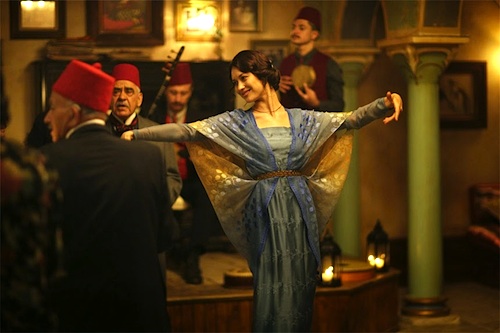
As his own lead, Crowe is perfectly on-key as Connor, the quietly grieving father. It is the sort of understated performance that pays far greater dividends than overindulgence, over-the-top Meryl Streepian wailing and garment-rending. The French-Ukrainian Olga Kurylenko also puts the “hot” in hotelier as Ayshe, developing some better-than-you-expect chemistry with Crowe. However, it is Yilmaz Erdoğan who really puts a stamp on the film, oozing integrity while avoiding cliché as the hard but compassionate Maj. Hasan.

There are a lot of potential potholes in Diviner, including Connor’s prophetic dreams and his chaste non-courtship of Ayshe. However, Crowe consistently brings a light touch to bear in scenes other directors would drive into the ground. More often than not, his filmmaking instincts are correct. Recommended for those who enjoy sweeping historicals, The Water Diviner opens today (4/24) in New York, at the AMC Empire.

LFM GRADE: B+

Posted on April 24th, 2015 at 2:36pm.

LFM Reviews Misery Loves Comedy @ Tribeca 2015

By Joe Bendel. Stand-up comedy is a tough racket. When you’re on, you’re killing and when you’re off, you’re dying—and you’re rarely anywhere in between. What kind of person is drawn to this business? Depressive neurotics. At least that is the casual thesis of Kevin Pollak’s riff-heavy interview documentary Misery Loves Comedy, which had a special Tribeca Talks screening at the 2015 Tribeca Film Festival, ahead of its official opening today at the IFC Center.

To explore the notion that comedy is either some kind of cathartic therapy or sick compulsion, Pollak interviewed over sixty comics and performers, as well as Jimmy Fallon. Of course, everyone was “on.” That is the whole point. Nevertheless, they said some revealing things. After all, they just can’t help themselves.

Pollak and editor Robert Legato went for and nailed the rat-a-tat pacing. They never linger long enough after a punchline for the audience to supply their own rim-shots. As a result, there are a lot of laughs in Misery. A good deal of attention will be focused on big names like Penn Jillette, Steve Coogan, Tom Hanks, Jim Gaffigan, Mike Birbiglia, Christopher Guest, Martin Short, and Richard Lewis, as well as filmmakers like Jason Reitman and James L. Brooks. Fittingly, Lewis Black and Jim Norton are also prominent in the film, considering they joined Pollak for the Tribeca Talk and will also represent at the IFC Center. However, some of the best material come from unlikely sources, like journeyman comic Dana Gould getting in a killer bit about his struggle with depression and Freddie Prinze, Jr’s reflections on his father.

Listening to Black and Norton after the screening really helps underscore Pollak’s general point. Clearly, they are both gallopingly neurotic, but in vastly different ways. It also provided Pollak with an opportunity to respond to criticism regarding the alleged lack of diversity in the film, but such charges are completely unfair. For instance, he features Whoopi Goldberg and she isn’t even funny.

Sure, you could ask about dozens of absent well-known comics, but a film like Misery is largely captive to people’s schedules. You get who you can get and then you go. Pollak’s film never delves too deeply into serious pain (arguably, Adam Carolla’s Road Hard offers a more revealing look into the trials of life as a comedian), but so what? It’s breezy and consistently amusing, which is what most people want from a comedy doc. Recommended for stand-up fans, Misery Loves Comedy opens today (4/24) at the IFC Center.

LFM GRADE: B

Posted on April 24th, 2015 at 2:35pm.

LFM Reviews All Eyes and Ears @ Tribeca 2015

By Joe Bendel. During his confirmation hearing, our current ambassador to China, former Sen. Max Baucus, admitted: “I’m no real expert on China.” At least he was being honest. In contrast, his predecessor’s predecessor certainly was. A former Ambassador to Singapore, Gov. Jon Huntsman was familiar with the region and fluent in Mandarin. However, his greatest asset was probably his adopted daughter Gracie Mei Huntsman. Vanessa Hope chronicles their posting to Beijing in All Eyes and Ears, which screens during the 2015 Tribeca Film Festival.

Huntsman’s nomination was a bit of a surprise in 2009, especially considering Huntsman was still widely seen as a conservative at the time. He would leave the Utah Governor’s Mansion with high marks from the Cato Institute, after having signed an ambitious school voucher program into law. However, it was fortunate America had an experienced adult serving as ambassador during Huntsman’s eventful tenure, which would include the aborted Jasmine Revolution and the diplomatic crisis arising from blind dissident attorney Chen Guangcheng’s request for asylum.

Essentially, All Eyes follows Huntsman’s term of service from three perspectives: that of the diplomat, his adopted daughter, and the so-called “Barefoot Lawyer.” While braiding the three threads can get a little unwieldy, it is crucial to have Chen’s viewpoint, because it often acts as a corrective to the Communist Party’s narrative. As a diplomat, Huntsman acts scrupulously diplomatic, whereas young Gracie Huntsman has a very personal reaction to the events unfolding.

Of the three vantage points, Hope arguably favors hers—and it is easy to see why. She is clearly a “good kid” with remarkable poise. Commentators in the film make the point that probably no other Chinese adoptee will ever return to their birthplace under similar circumstances. Most likely this is true, but Hope never really delves into what Gracie Huntsman truly represents to the Chinese people. She documents the Huntsman family’s return to the orphanage she was adopted from, which all parties clearly find quite moving. However, China’s One Child policies were very likely a major reason why her name is now Huntsman, yet they are only mentioned in passing. Likewise, the widening gap between the oligarchical urban haves and the provincial have-nots is a direct cause of other children getting put up for adoption. Only Chen talks about these issues in the film, which is why it is so important to have him there.

Frankly, so many significant events transpired during Huntsman’s stint and Hope’s three primary POV figures are so compelling, All Eyes could easily be expanded to a longer form series, which reportedly might be in the works. Yet, somewhat ironically, Hope’s short doc China in Three Words (also featuring the Huntsmans) is even more incisive and grabby. Still, Chen Guangcheng and Gracie Huntsman definitely deserve your full attention (but some of the old China hands, not so much). Recommended as a reflection of a good deal of contemporary Chinese reality and the often awkward messiness of diplomacy, All Eyes and Ears screens again tonight (4/24), at the reasonably located Chelsea Bowtie, as part of this year’s Tribeca Film Festival.

LFM GRADE: B

Posted on April 24th, 2015 at 2:35pm.