LFM Reviews Anita B.

By Joe Bendel. Anne Frank should have had the chance to become a young woman like Anita. Although she is a Holocaust survivor, she is ready to start living again. However, unlike the extended relatives she now lives with, she is absolutely unwilling to forget the past. This leads to tension in Roberto Faenza’s Anita B., which opens this Friday in New York.

Somehow, Anita survived Auschwitz, but most of her Hungarian family did not. She is finally leaving the Red Cross shelter to move in with the only relatives she has left—her Aunt Monika (sister of her dearly departed mother), Uncle Aron, and his kid brother Eli. Thanks to the expulsion of the Germans from the Sudetenland, they were able to find a sufficient flat in their new Czechoslovakian homeland.  Much to Anita’s surprise, Aunt Monika is decidedly cold when receiving her, but not Eli. Anita tries to discourage her advances, but she slowly falls for his awkward charms.

Whenever Anita tries to talk about her horrific experiences, she is abruptly shut-down. As a result, she can only really talk to Roby, Monika and Aron’s toddler son, who immediately adores Anita. Unfortunately, as she slowly falls for Eli, the mounting Communist oppression and the widespread anti-Semitic sentiment they foster do not bode well for the future. That is exactly why David, Anita’s salt-of-the-earth workmate, plans to immigrate to what will soon be Israel.
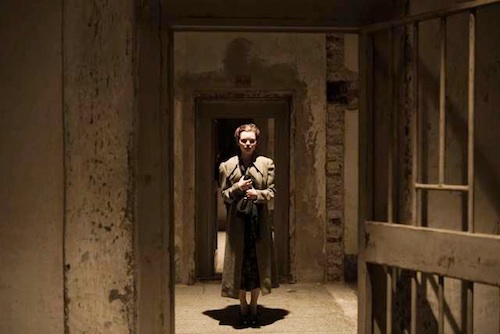
From "Anita B."

Anita B. is an English-language Italian-production set in Sudetenland Czechoslovakia, featuring Hungarian characters, but it does not have the tin ear you might fear. Faenza also shows a fair degree of restraint when it comes to the melodrama. The film rather matter-of-factly depicts Anita’s struggles with the coming-of-age process and the realities of being Jewish in postwar Eastern Europe.

Eline Powell (who had a small but memorable role in Private Peaceful) sensitively portrays Anita’s strength and vulnerability. On the other hand, Irish actor Robert Sheehan somehow combines the worst character traits of a womanizing cad and a gangly sad sack as Eli. However, Clive Riche and Jane Alexander add a lot of seasoning as an understanding doctor full of surprises and Sarah the local recruiter for the Zionist immigration movement.

There are no scenes of the actual horrors of the Holcaust in Anita B. Some might find that questionable, but this way, the unsavoriness of post-war anti-Semitism is not dwarfed on screen by the enormity of Anita’s time in Auschwitz. It is a respectful film and perhaps a tad too tidy, but it focuses on an intriguing but under-dramatizing transitional period of history. Evangelical audiences will also appreciate it holds pro-life implications, in a variety of ways. Recommended for those looking for a straight-over-the-plate, life-affirming film, Anita B. opens this Friday (4/24) in New York, at the Quad Cinema.

LFM GRADE: B

Posted on April 21st, 2015 at 2:28pm.
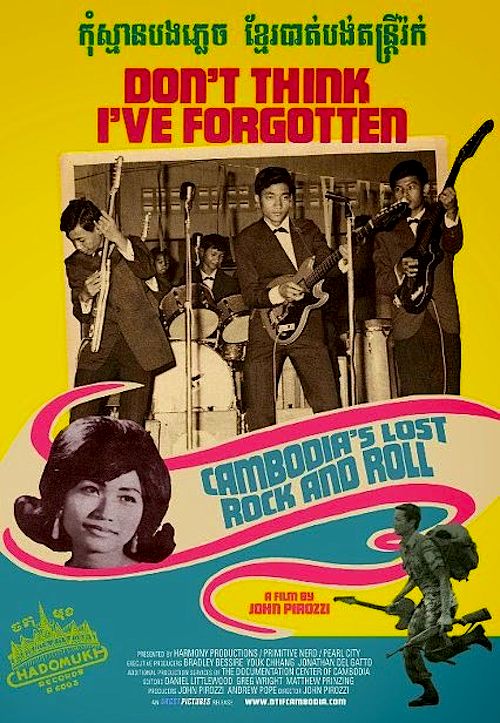
LFM Reviews Don’t Think I’ve Forgotten: Cambodia’s Lost Rock and Roll

By Joe Bendel. Before the Khmer Rouge take-over, Phnom Penh was a happening city, particularly if you were a musician. Once their reign of terror commenced, the city was the worst possible place to be from, especially for musicians. The few surviving veterans of the Phnom Penh music scene reflect on the lives and culture lost during the period of Maoist mass murder in John Pirozzi’s Don’t Think I’ve Forgotten: Cambodia’s Lost Rock and Roll, which opens tomorrow at Film Forum.

Frankly, it is a revelation just what a swinging good time it was in the capitol city during the 1950s, 1960s, and even into the early 1970s. There was a healthy nightlife, creating beaucoup jobs for musicians and singers. There was Pen Ran, who specialized in the sort of cute pop stylings you could also find on the American charts in the early sixties. Everyone loved Ros Serey Sothea, because she was the country girl that made good. Actually, the early stages of her career were a little rocky, but everything fell into place when she joined forces with popular bandleader Sinn Sisamouth.

Stylistically, Cambodian rock and pop followed a similar development pattern as it did in the west, except maybe not quite as heavy. Regardless, Pou Vannary made her name with hit covers of western songs, incorporating both the original English lyrics and Khmer translations. The scene rocked, but it looks and sounds like star vocalists often still fronted full bands, which was cool. Of course, we know it will end in incomprehensible tragedy and death.

DTIF is at its best surveying the Cambodian rock scene, giving viewers a good sense of each artist’s personal sound. Unfortunately, Pirozzi’s devotes a lot of time to an overly simplistic rehashing of early 1970s history. It is problematically reductive to say America bombed Viet Cong in Cambodia, therefore Pol Pot necessarily killed two million people. After all, a Communist conquest was exactly what the American government wanted to avoid.

Regardless, when Pirozzi sticks with the music and the oral history of survivors, DTIF is on rock-solid ground. Especially moving is the sequence chronicling Cheam Chansovannary’s radio performance of “Oh! Phnom Penh” when the city was finally recolonized after the fall of the Khmer Rouge regime.

One striking aspect of DTIF is just how much of the music has survived, at least when compared to the almost entirely devastated Cambodian cinematic heritage. Watching Davy Chou’s masterful documentary Golden Slumbers will give audiences a sense of how average Cambodians deeply mourn the loss of their beloved movies on a personal level. While Chou’s elegant elegy is the considerably superior film, Don’t Think I’ve Forgotten is still well worth seeing when it opens tomorrow (4/22) in New York, at Film Forum.

LFM GRADE: B

Posted on April 21st, 2015 at 2:27pm.

LFM Reviews Wednesday 04:45 @ Tribeca 2015

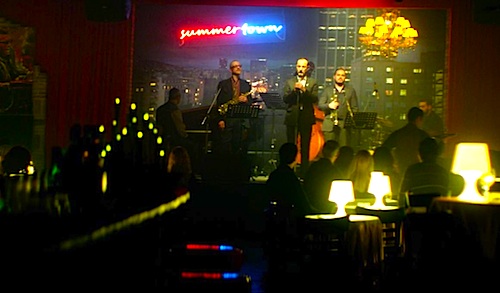
By Joe Bendel. Stelios Dimitrakopoulos is a jazz club owner in Greece. It should therefore come as no surprise to learn he is a terrible businessman. With his debt to a Romanian gangster about to come due, Dimitrakopoulos will scramble to find a way to save his club while also fulfilling his more mundane responsibilities in Alexis Alexiou’s Wednesday 04:45, which screens during the 2015 Tribeca Film Festival.

Dimitrakopoulos has great taste when it comes to identifying emerging Balkan jazz talent, but he is not so hot at the rest of club management. Through Vassos, an old crony-gone-more-crooked, Dimitrakopoulos arranged a loan from “the Romanian.” Naturally, he cannot pay, so he passively agrees to sign over his club. Being Greece, this turns out to be quite a complicated process. In his dealings with Vassos, Dimitrakopoulos crosses paths with Omar, an Albanian who also owes money to the Romanian. However, Omar is not so accepting of the situation.

Eventually, high tempers and deep debts lead to violence. It all rather baffles Dimitrakopoulos as he tries to run his more workaday errands. Of course, it is just a matter of time before the bedlam completely engulfs him.

Alexiou practically screams at the audience, it is all about the austerity program. However, German and American audiences might have trouble ginning up either sympathy or outrage for Dimitrakopoulos’s plight. Not to defend loan sharks, but generally speaking, it is understood when someone borrows money they will eventually have to pay it back, with some sort of interest. Dimitrakopoulos seems to understand this only slightly better than the Greek government. Frankly, considering who he is in hock to, he is getting off quite easy.

From "Wednesday 04:45."

Nevertheless, Alexiou’s noir style and thriller mechanics are quite strong. The Athens backdrop gives it an almost postindustrial-dystopian-noir ambiance, sort of like Godard’s Alphaville, but more neon. Cinematographer Christos Karamanis makes the rain-glistening streets and hazy nocturnal club scenes look great, in a genre appropriate way. The acts Dimitrakopoulos books also sound quite intriguing based on snippets we get to hear.

As Dimitrakopoulos, Stelios Mainas is a droopy-eyed middle-aged anti-hero in the Jean Reno tradition. He looks the part as he steadily ratchets up Dimitrakopoulos’s resentment-stoked intensity. In some ways, 04:45 compares to Schumacher’s Falling Down, at least until Alexiou unleashes his inner Johnnie To with a storm-drenched rooftop confrontation. Altogether, it is a distinctive thriller. Recommended for noir fans who do not consider the Regal Battery Park prohibitively inconvenient, Wednesday 04:45 screens again tonight (4/21), as part of this year’s Tribeca Film Festival.

LFM GRADE: B+

Posted on April 21st, 2015 at 2:27pm.

LFM Reviews Greatest Catch Ever @ Tribeca 2015

From "Greatest Catch Ever."

By Joe Bendel. The sports media loves to depict New England Coach Bill Belichick as a football genius and the New York Football Giants’ Tom Coughlin as an anachronistic disciplinarian. However, Belichick has an O and 2 record against Coughlin in the Super Bowl, so the New York coach must be an even smarter genius. Of course, Coughlin had help from some spectacular play-making. None stands out more than David Tyree’s one-handed leaping grab to keep the Giants’ fourth quarter go-ahead scoring drive alive. That 2008 Super Bowl catch is chronicled, analyzed, and celebrated in Spike Lee’s documentary short, Greatest Catch Ever, which screened Sunday as part of a special ESPN Sports Film Talk at the 2015 Tribeca Film Festival.

Spike Lee was watching Sports Center one night when he heard Tom Brady describe a teammate’s snag as the best he’d ever seen. That stuck in Lee’s craw and ultimately resulted in this short documentary. The format is simple. Lee interviewed the principle Giants players, in their practice facility, with their Super Bowl XLII and XLVI championship banners ever so conspicuous. Tyree, Coughlin, Plaxico Burress, Eli Manning, and linesman Chris Snee leave the trash-talking to Lee, but he is happy to fill that void.

However, Lee finds ways to open up the film a little, including traveling to the home of former New England safety Rodney Harrison, who is the Bill Buckner of the famous catch. He also compares and contrasts Tyree’s grab with subsequent Giants highlight catches superhumanly pulled in by Mario Manningham and Odell Beckham, Jr.

From "Greatest Catch Ever."

It is amazing how right Lee is on sports and how wrong he gets nearly everything else. Like Alex Gibney, he should pretty much stick to sports docs (or Scientology exposes, if he wants a real challenge). He was amusing ripping on Belichick both in the film and during the post-screening panel discussion. Yet, to Lee’s credit, he generously gave credit in turn to Harrison, for agreeing to face his ghosts on camera. Tyree, Burress, and Snee were also present, looking fit, and clearly enjoying the opportunity to reminisce and needle each other.

Even Giants fans will be surprised how many stories were intertwined with the big catch (depicted via stills, due to NFL Films’ difficulty playing nice with others). Christians in the audience were especially moved by the role Tyree’s faith played in the famous play. At about half an hour, Greatest Catch Ever always feels brisk and muscular—and never padded. In fact, one suspects Lee could have easily expanded it to forty-five minutes without repeating himself. Altogether, Tribeca’s presentation was a highly enjoyable trip down memory lane. New York Football Giants fans will love it when it eventually airs on ESPN, but the network’s Belichick apologists probably not so much.

LFM GRADE: B+

Posted on April 21st, 2015 at 2:26pm.

LFM Reviews Palio @ Tribeca 2015

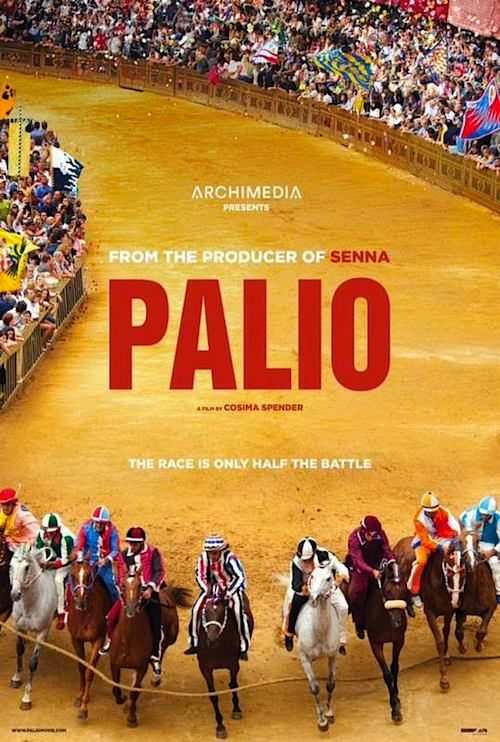
By Joe Bendel. The world’s oldest continuous horse race is a full contact, bareback spectacle. The rules seem perversely designed to maximize acrimony and anarchy—and the good citizens of Siena’s seventeen districts would not have it any other way. Viewers experience all the longstanding personal rivalries and district grudges fueling the summer tradition in Cosima Spender’s amazing documentary Palio, which screens during the 2015 Tribeca Film Festival.

If you live in Siena, you identify with your district, rather than the city as a whole. Since at least the Fourteenth Century, they have held some form of the Palio di Siena. Every July 2nd and August 16th, the districts compete in a horse race staged in the ancient Piazzo del Campo. There are no saddles and essentially no rules. Jockeys are free to bash each other and their horses black and blue. However, unlike every other horse race in the world, if a jockey is knocked off his steed, the riderless horse can still win. Current dominant Palio champion Gigi Bruschelli notched a victory that way, which his many critics are quick to belittle.

Bruschelli has amassed thirteen Palios in sixteen years. He has his sights set on Andrea “Aceto” de Gortes’ record of fourteen Palios. However, the Palio legend has formed an unlikely alliance with his former nemesis, Silvano “Bastiano” Vigni, who is training Bruschelli’s one-time protégé Giovanni “Tittia” Atzeni to unseat his old stable-master.

You might think you know horseracing from going to the Aqueduct, but the Palio is a completely different kettle of fish. Spender and cinematographer Stuart Bentley caught some absolutely jaw-dropping, up-close footage of horses crashing into the barrier wall and then careening back into the race. You can see the horses sweat and the men snarl. If you were to witness a Palio-style pile-up at an American track, you would expect to see the vet walk out with a shotgun. Yet, in Siena, everyone just shakes it off.

Yes, cornering is a bit of a challenge at the Palio, but perhaps even more mind-blowing, pay-offs and log-rolling are generally accepted parts of the game. It is common knowledge the other riders from Bruschelli’s stable are looking to cover his back, unless another district makes them a better offer. As a result, the behind-the-scenes intrigue is even more important than the action on the track.

Not so surprisingly, there is probably more trash-talking in Palio than any other sports doc one can think of. Like betrayal, it is a big part of the game. The old salty dogs Aceto and Bastiano are particularly good at it. Listening to them excoriate Bruschelli and needle each other is wickedly amusing. Yet, if you think they are harsh, wait till you hear some of the districts’ chants.

In many ways, the Palio is like stepping into the late Middle Ages. Visually, Spender’s Palio is a rich feast of chaos and color, vividly capturing all the traditional pomp as well as the bedlam on the track. There are real stakes to the narrative she chronicles and genuine roguish charm to her cast of characters. A documentary on Italian horseracing might sound like a decidedly specialized subject, but Palio is readily accessible and endlessly intriguing, in a stranger than fiction kind of way. In fact, it is so entertaining, it is even worth the time and hassle it takes to get to the Regal Battery Park. Highly recommended, Palio screens again Wednesday (4/22) and Saturday (4/25), as part of this year’s Tribeca Film Festival.

LFM GRADE: A

Posted on April 20th, 2015 at 4:41pm.

LFM Reviews 24 Days

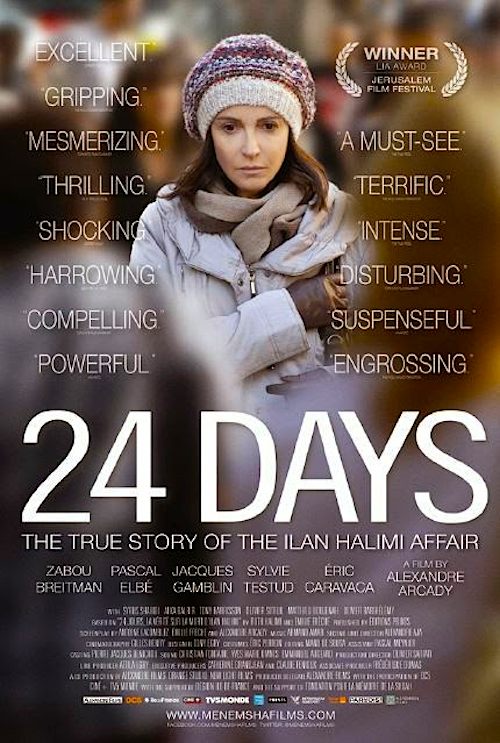
By Joe Bendel. The savage Charlie Hebdo shootings only just happened on January 7th of this year, but one can already feel complacency re-settling back in, predictably like the turning of the seasons. After all, it was not without recent precedent. The kidnapping and torture of Ilan Halimi was a hate crime that shocked France, but only too briefly. Taking the subsequent book written by Halimi’s mother Ruth as his source material, Alexandre Arcady chronicles the tragic events step-by-chilling-step in 24 Days, which opens this Friday in New York.

Ilan Halimi was a likable young man, who was always close to his mother and sister, but was also rebuilding his somewhat strained relationship with his divorced father in the months leading up to his abduction. Although he simply worked at a cell phone store, a Muslim gang operating in both Paris and Ivory Coast deliberately targeted him because he was Jewish. In their hatred, they assumed all Jews had money. Alas, the Halimis were rather lower middle class with little ready cash on hand. Therefore, they had little choice but to alert the police.

The police’s secret involvement will be both a curse and a blessing. Initially, the negotiator advising Ilan’s father Didier as the family’s chosen representative is somewhat helpful reducing the unrealistic 450,000 Euro ransom. Tragically though, the police’s refusal to acknowledge the anti-Semitic nature of the crime leads to a fundamental misunderstanding of the “Gang of Barbarians,” as the abductors called themselves.

Considering how easy it is to google Ilan Halimi, it is not much of a spoiler to say the case ends quite dreadfully. However, Arcady maintains a great deal of suspense, as the horror and outrage steadily mount. Yet, this is not a propagandistic passion play. Arcady and co-writers Antoine Lacomblez and Emilie Frèche prefer to focus on resulting emotional toll the ordeal takes on the Halimi family. It is not just limited to his nuclear family either. With the police tightly controlling Didier Halimi’s contact with the kidnappers, the Gang of Barbarians expand their game of psychological terrorism, sending unspeakably graphic photos of Ilan to his cousin and rabbi.

Zabou Breitman viscerally expresses the anguish and sorrow of Ruth Halimi, but it is the quieter, more understated work of Pascal Elbé that will truly haunt viewers over time. Likewise, Jacques Gamblin dials it way down as Commandant Delcour, a sort of problematically politically correct version of Harry Baur’s soul-deadened Maigret. Within the large and diverse supporting ensemble, Audrey Giacomini stands out as Halimi’s terrified pseudo-girlfriend (understandably so, since by grabbing Ilan, the kidnappers also had her flat keys).

24 Days will turn your stomach into ice-water. It is a tense, often brutal white-knuckle ride from start to finish. However, it is important to understand, Arcady and his co-writers somewhat water-down the torments inflicted on Halimi, probably because it would be impossible to release anything remotely accurate in mainstream French theaters. Nevertheless, what we do see is profoundly disturbing.

Frankly, this film speaks for itself, if audiences are willing to listen. Unfortunately, French politicians prefer to pander for “multi-cultural” votes rather than really facing the root causes of the precipitous rise of anti-Semitic violence. Sadly, it is probably only a matter of time before another Charlie Hebdo-Ilan Halimi style attack. Very highly recommended as a masterful work of cinema and an impassioned warning for those who value tolerance and the rule of law, 24 Days opens this Friday (4/24) at the Quad Cinema in Manhattan and the Kew Gardens Cinemas in Brooklyn.

LFM GRADE: A

Posted on April 20th, 2015 at 4:41pm.