Meeting the Parents: LFM Reviews Anita Ho

By Joe Bendel. What kid wouldn’t want to date a Power Ranger? What guy wouldn’t be interested in a woman like Anita Lee? Maybe one who has met her parents. Harry Ho is about to have the dubious pleasure, but since he is Korean rather than Chinese, it will be a difficult getting-to-know-you process in Steve Myung’s Anita Ho, which opens this Friday in Los Angeles.

Harry is really a Korean Oh, but when his family came through immigration, it was changed to a Chinese-sounding (and more easily mocked) Ho. After a while, they got tired of fighting it. Unfortunately, this leads to some initial awkwardness when he first meets his girlfriend Anita’s parents, the Lees—and it only goes downhill from there. Needless to say, they want their daughter to marry a good Chinese boy. That means a doctor or a lawyer. An unemployed writer just does not cut it.

Technically, Ho is a freelancer, who quit his gig on Lee’s “Power Raiders” kiddie action show to write his screenplay. That has not been working out so well. At least, his relationship with Lee has been fulfilling. In fact, he intends to pop the question while they are visiting for her special thirtieth birthday banquet, but her parents will do everything they can to belittle and undermine him.

Just about anyone who was ever raked over the coals by their date’s dad on prom night should be able to relate to Anita Ho on some level. Of course, they never had to face George Cheung (the notorious Lt. Tay in Rambo: First Blood II and senior member of the Awesome Asian Bad Guys). Unimpressed with the mild-mannered Ho, Mr. Lee will actually try to fix his daughter up with a former classmate. Yes, he happens to be a doctor.
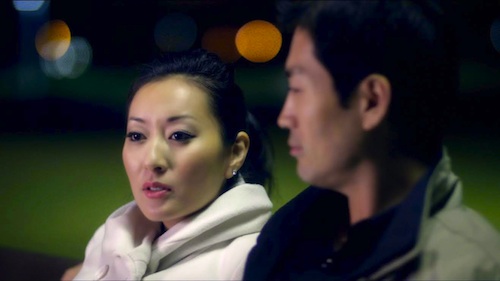
From "Anita Ho."

So maybe we have all been there, but director-co-writer Myung just cranks up the cringe factor when appearing as Ho. By the time the film is over that poor cat’s back is covered in “kick me” signs. He has some pleasant romantic chemistry with co-writer Lina So Myung, but it eventually becomes difficult to buy into them as a couple, while he wallows in humiliation and she essentially lets it happen. The Myungs also apparently dig romantic montages, because they are not stingy with them (though they really probably should have been).

Lina So Myung truly lights up the screen as Lee, while Cheung and Elizabeth Sung have their moments as the demanding parents. However, it is Kenny Waymack, Jr. who gives us something to latch onto as Lee’s Filipino brother-in-law and tough talking audience surrogate, Tyson Bautista. It is nice to see a film advocate inclusiveness, but some of the broad humor falls a bit flat. Frankly, the film would have been better served by a little more romantic courtship and a little less shtick. It is also cool to see the telegenic Myungs making their own opportunities. Nevertheless, Anita Ho is strictly a date-night kind of movie when it opens this Friday (2/27) at the Laemmle Playhouse 7 in Pasadena.

Posted on February 25th, 2015 at 9:57pm.

LFM Reviews Triumph in the Skies

By Joe Bendel. Where American networks failed with shows like Pan Am and LAX, Hong Kong found tremendous success with a prime time airliner drama. While it had the benefit of some star power from Francis Ng and Michelle Ye, it was really the multi-character romances that were powering the show. How big was it? Big enough to snag a New Year’s theatrical release for the big screen edition. Hearts will be broken on multiple continents in Wilson Yip & Matt Chow’s Triumph in the Skies, which is now playing in New York and select markets.

By-the-book Captain “Sam” Tong and his not-so-by-the-book co-pilot Jayden Koo used to be a regular flight crew, but they have split up. Tong is still the senior officer with Skylette, but the new boss’s son and heir apparent, Branson Cheung, has assigned him to serve as the technical advisor for their new commercial starring rock-star diva TM Tam. Nobody on-set wants to hear his quibbles, except maybe Tam. There are such polar opposites, they naturally start to attract.

Cheung, who also serves as a Skylette flight captain, is rather surprised to find his old flame Cassie Poon Ka-sze is part of the crew on his newly assigned plane. She is still disappointed he put their relationship on hold to please his father, but the sparks are still there. Meanwhile, Koo or “Captain Cool,” has landed a cushy job as the private pilot of a party plane, where he meets the seemingly ambitionless Kika Sit. However, he realizes almost too late there is far more to her story.

If you have seen a few Chinese romantic comedies you will basically know what to expect here, but Yip & Chow’s execution is wildly slick and lethally effective. You are not likely to see a sparklier movie anytime soon. Triumph has so much jet-setting, it makes Sex in the City look like EastEnders.

Sure, it is tons of manipulative, yet each of the three primary story arcs works surprising well, with the best being Tong’s halting flirtation with Tam. It is also the best written braided-storyline, featuring some wry, understated dialogue and terrific chemistry between series veteran Francis Ng and Sammi Cheng. You can almost think of it as an HK version of a James L. Brooks late middle-age relationship film. She also performs a catchy punk version of “Over the Rainbow” that will make you think that was what Harold Arlen & Yip Harburg really had in mind the whole time.

In contrast, Triumph totally goes for the tears with Captain Cool’s possibly tragic romance, but Amber Kuo just lights up the screen as Kika Sit. Of course, Julian Cheung is not exactly is not exactly a jowly sourpuss either—and they both know how to crank up the cute in their big feature spots.

From "Triumph in the Skies."

The third romance starring Louis Koo is a lot like an HK rom-com starring Louis Koo, but it is still one of the better ones. Again, he and Charmaine Sheh have surprisingly strong chemistry. However, the notion of an attractive working woman sitting around waiting for the man who walked out of her life to saunter back might not sit too well with American audiences.

Despite the vaguely Leni Riefenstahl-ish title, Triumph in the Skies is a pleasingly upbeat and colorful film. These days, it is just no fun whatsoever to fly on a commercial airliner or schlep through an airport, but it would be worth taking off your belt and shoes to fly with the ridiculously good looking crews of Skylette. Maybe it is a guilty pleasure, but it is fun. Recommended for those looking for an entertaining movie romance that pretty much covers all the bases, Triumph is now playing in New York at the AMC Empire.

LFM GRADE: B+

Posted on February 25th, 2015 at 9:57pm.

LFM Reviews Also Like Life

By Joe Bendel. Look in your pocket and you might find a smart phone made in Taiwan. They were the only one of the four Asian Tiger economies that largely dodged the regional financial crisis of the late 1990s. However, the Republic of China remains very aware of the extreme poverty it rose out of. The memories of its hardscrabble past were even fresher in the early 1980s, when Edward Yang and Hou Hsiao-hsien introduced the world to Taiwanese auteurist cinema. One of those watershed films was an anthology production Hou contributed to. Fittingly, Hou, Zeng Zhuangxiang, and Wan Jen’s The Sandwich Man screens this week as part of the traveling Hou retrospective Also Like Life, now playing in Vancouver.

Jin Shu is definitely a crying-on-the-inside kind of clown, but he doesn’t look very cheerful on the outside either. He tramps through his provincial small town wearing his shabby home-made clown costume and sandwich boards advertising the local theater. He has not even been paid yet for his humiliations. This gig was his idea and he is still working on-spec during the trial period. He badly needs work to support his infant son and increasingly impatient wife, but he does not have the right sort of personality for anything involving promotions to the public. Adding further anxiety to his wounded ego, Jin Shu’s little boy no longer recognizes him when he is out of make-up.

In some ways, His Son’s Big Doll (as the story’s title directly translates) also critiqued restrictive Taiwanese laws against contraception that were abolished a few years after the film’s release. It is a relentlessly naturalistic tale about economic desperation, but the surprisingly upbeat conclusion makes it feel like a sort of before-the-fact allegory of Taiwan’s rapid development—just hang on and everything will get better.

Since it is Hou Hisao-hsien and the titular story, The Sandwich Man would seem to be the main event, but the subsequent constituent films are just as good or better. In Zeng’s Vicky’s Hat, two new recruits try to sell Japanese pressure cookers throughout their provincial territory, but they soon start to suspect their product is categorically unsafe. It is a story that has a bit of Glengarry Glen Ross to it, but it is even more concerned with the younger salesman’s halting friendship with Vicky, a mysterious school girl in their neighborhood. There are some fine lines Zeng and his cast must walk—such as establishing his willingness to chastely wait for her to grow old enough for a relationship, but they turn the multiple tragic twists to devastating effect.

Wan’s concluding Taste of Apples is a bit O. Henry-ish—in fact, its irony now seems ironic. A migrant worker is hit by the American military attaché’s car, but this might not be the worst thing that could happen to his struggling family. He will have the best of medical care at the American military hospital, his wife and family will be financially taken care of, and his children will have educational opportunities that never would have otherwise been available to them. Plus, the American Colonel seems genuinely sorry about it all.

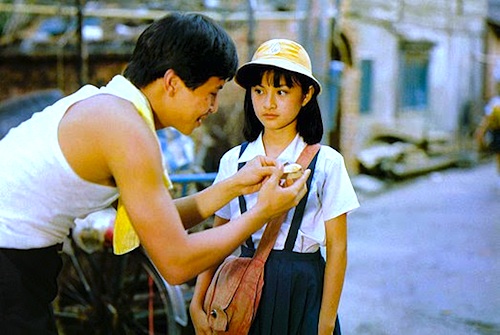
From "The Sandwich Man."

Reportedly, the Taiwanese government sought to suppress Sandwich Man because of its portrayal of American government personnel, but considering the anti-American propaganda out there, we should settle for Sandwich Man every chance we get. Sure, we try to fix problems by throwing a bunch of cash around, but that just might work for the family of Apples.

It is also rather fascinating to see how each narrative arc (all adapted from short stories by Huang Chunming, by screenwriter Wu Nien-jen, and shot by cinematographer Chen Kun-hou) speak in dialogue with each other. Those who survived the painful past and make it through the difficult present just might see a better tomorrow, but it will not be easy. A modern classic of Taiwanese cinema, The Sandwich Man could be even more significant when seen in the light of the subsequent thirty-some years of growth and liberalization. Highly recommended, it screens this Thursday (2/26) at The Cinematheque in Vancouver, as part of Also Like Life.

LFM GRADE: A-

Posted on February 25th, 2015 at 9:56pm.

LFM Reviews Fires on the Plain @ The 2015 Film Comment Selects

By Joe Bendel. Joseph Heller’s Yossarian has nothing on Private Tamura. He is caught in a miserable catch-22 and the only thing that will dislodge him from his vicious cycle will be a further downturn in Japan’s fortunes of war. There is absolutely nothing heroic about combat throughout intense auteur Shinya Tsukamoto’s faithful but bloody remake of Kon Ichikawa’s Fires on the Plain, which screened during Film Comment Selects 2015.

Tamura is suffering from a nasty case of tuberculosis and maybe some mild shell shock. Deemed too sick to serve effectively by his arrogant commanding officer, Tamura is ordered to check into the nearest field hospital on Leyte. However, the medical staff refuses to admit him, considering him too healthy to merit a spot on their disease floor.

Back and forth he trudges between the camp and the hospital, repeatedly being turned away by each, until Allied attacks essentially eliminate either option. Receiving word the Imperial forces have belatedly ordered them all to regroup at Palompon, Tamura falls in and out of small ragtag bands of retreating Imperial soldiers, but his increasingly desperate countrymen might represent a more immediate danger than the Yanks he is supposedly fighting.

The 1959 Plain has to be Ichikawa’s darkest, bleakest film. Tsukamoto does not exactly match its dour existentialism, but he certainly never whitewashes its atmosphere or implications. In terms of tone, the recent Plain could be described as one part Samuel Beckett and two parts Apocalypse Now, but with liberal helpings of severed body parts. Tsukamoto’s Plain is definitely not for the faint of heart, but it is considerably more accessible than the full-on assault to the senses delivered by his Tetsuo series.

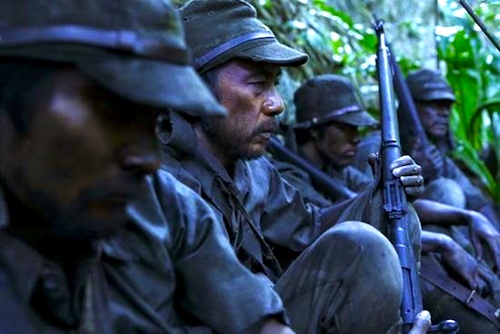
From "Fires on the Plain."

It is safe to say vanity had nothing to do with Tsukamoto’s decision to direct himself as Tamura. He is never flashy, but it is grimly compelling to watch the soul steadily seep out of him. You absolutely believe his is just a shell of a person, which is certainly some kind of performance.

Plain is truly serious stuff, intended for discerning audiences, but there might be enough gore to placate his loyal cult-following. It covers all the bases Ichikawa did, nearly beat for beat, yet it is unquestionably and readily identifiably a Tsukamoto film. Together with his co-cinematographer Satoshi Hayashi, Tsukamoto gives his slow descent into tropical madness a distinctively sweaty, feverish, and slightly surreal look that is equally transfixing and disconcerting. One of the better remakes of a genuine classic you will see in sometime, Tsukamoto’s Fires on the Plain is recommended for those who appreciate uncompromising anti-war cinematic statements after its screening at the Walter Reade, as part of this year’s Film Comment Selects.

LFM GRADE: B+

Posted on February 25th, 2015 at 9:55pm.

LFM Reviews The Last: Naruto the Movie

By Joe Bendel. Love hurts, especially for a ninja. Getting your chakra ripped out also kind of stings. Poor Naruto Uzumaki will just have to go through these things as a rite of passage (although he maybe could have skipped the latter). In fact, he is a bit older and perhaps fractionally wiser in the canonical capstone anime feature The Last: Naruto the Movie, which opens tomorrow in select cities.

For fans of the Naruto franchise, The Last pays off in a major way. This is no mere one-off shoehorned between the 72 volumes (or 700 chapters of manga), six hundred some television episodes, and ten feature films. It explains the manga’s final epilogue that was generally well received by fans, but came as a bit of a surprise nonetheless. What transpires in The Last will have a direct bearing on the course of Uzumaki’s life, but if that were not enough, the stakes are also apocalyptically high.

As the film opens, Uzumaki basks in his newfound popularity resulting from his heroic war service. Girls are finally talking to him—they are even getting pushy competing for his attention. This rather distresses the shy Hirata Hyuga, who has long carried a torch for the oblivious Uzumaki. Yet, when Hyuga’s younger sister Hanabi is kidnapped, she and Uzumaki are thrown together in the rescue party.

It seems her abduction is related to a doomsday plot launched by Toneri Otsutsuki, the last descendent of one of the great ancient clan leaders of the series’ intricate mythology. He intends to crash the moon into the Earth with the help of the Hyuga clan’s superhumanly enhanced eyes. Obviously, Uzumaki is super-motivated to stop Otsutsuki, especially when he realizes he is falling for his former classmate, Hyuga.

Unlike the previous Naruto film, The Road to Ninja, there is no jetting off to an alternate reality and back before anyone is the wiser. Everything counts this time around in a big way. It fills a major remaining gap in Naruto’s saga, wrapping it up in a way that keeps faith with the characters and their fans. For longtime readers and viewers, The Last is more closely akin to the MASH’s emotional sign-off than the wimpering final episode of Seinfeld.

From "The Last: Naruto the Movie."

There is considerable character development in The Last (especially by series shōnen anime standards) and a good deal of action. However, the old school hand-to-hand combat always looks far better on screen than the big fiery cosmic clashes, which all sort of blend together after a while. Nonetheless, the focus in The Last is particularly personal, freezing out many long-term supporting players in favor of Uzumaki and Hyuga.

Surely, the Naruto team can go back to the well for plenty more canonical adventures, but The Last would be a very satisfying place to definitively end it. It is a relatively self-contained story arc, so new arrivals should be able to follow and enjoy it well enough, but it really pays dividends to those who have invested in the series—and that’s actually pretty cool to see. A must-see for Naruto loyalists and a strong feature for shōnen enthusiasts in general, The Last: Naruto the Movie opens in select markets beginning this Friday (2/20), with a number of screenings scheduled in New York at the Village East starting this Saturday (2/21).

LFM GRADE: B

Posted on February 19th, 2015 at 7:40pm.

LFM Reviews Tales @ The 2015 Film Comment Selects

By Joe Bendel. Evidently, former Iranian megalomaniac Ahmadinejad did not think much of shorts. That was a good thing. Rather than compromising her artistic integrity to receive official state sanction for a feature, Rakshan Bani-Etemad embarked on a series of short films that were comparatively less regulated by the authorities. With his successor projecting a more conciliatory face, she has since joined them together into a braided narrative. You would hardly know it from watching the finished product, which flows together in an intricate Short Cuts kind of way. She presents a bracing vision of an Iran beset by all manner of social pathologies, but it is always most difficult for the women in Bani-Etemad’s Tales, which screens during the 2015 edition of Film Comment Selects.

In recent years, Bani-Etemad has largely worked as a documentarian for reasons explains above, but those who know her previous narratives will find even deeper meaning when her old characters return for call-backs in Tales, criss-crossing each other as they deal with life’s challenges. Fittingly, the two best segments, by far, are the first and the last, but there is still plenty of interesting material in between.

We will sort of see events unfold from the POV of an intrepid but much censored documentary filmmaker, who kinds of acts as Bani-Etemad’s surrogate. As some might know from Under the Skin of the City, the cabbie driving him into the city is deeply in debt from an ill-advised foray into crime. However, it will be his second fare, his sister’s childhood friend who has since been tarnished by scandal that delivers the first real jolt of stinging, naturalistic drama.

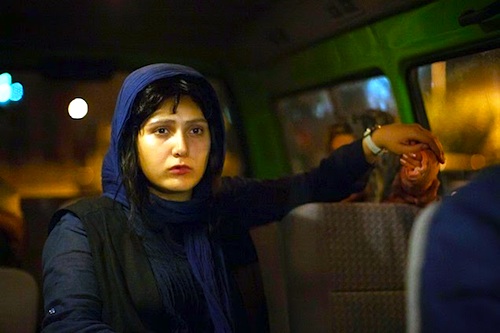
From there, we will witness the cabbie’s mother try to navigate the red tape of a Kafkaesque bureaucracy, eavesdrop on two grown children jokingly (we assume) planning to fake an abduction, and witness an abusive husband confront his acid-scarred wife (the eponymous character from Nargess) in her women’s shelter. Eventually, Bani-Etemad brings it home with an intimate but biting verbal sparring match conducted by one of the shelter’s reformed drug addict counselors and the organization’s mini-van driving, who is shuttling her and a new client back to their home base. In some ways, their exchanges are peculiarly Iranian, yet there is a universality to their increasingly heavy conversation that hits you on a deep level.

From "Tales."

In a strange way, the secondary tone of Tales constantly shifts between late night existentialism, free-wheeling absurdity, futile romanticism, and outright tragedy. Yet, the bedrock feeling of helplessness is always present. It features a consistently strong ensemble, especially Mohammadreza Forootan and Mehraveh Sharifinia as the cabbie and the fallen woman of the first tale and Baran Kosari and Peiman Moadi as the mismatched couple in the closer.

We like to think Iran has its own special problems rooted in its oppressive system of governance, which it clearly does, judging from the travails of Bani-Etemad’s characters. However, we generally presuppose they are immune to more worldly issues, like drugs, street crime, illiteracy, economic inequities, and AIDS as a result. Tales acts as a corrective to that assumption. They actually have both kinds of societal ills. It is also an engrossing film that really takes us into its characters’ long dark nights of the soul. Highly recommended, Tales screens this Friday (2/20) and Sunday (2/22) at the Walter Reade, as part of this year’s Film Comment Selects.

LFM GRADE: A-

Posted on February 18th, 2015 at 11:09am.