LFM Reviews On the Job

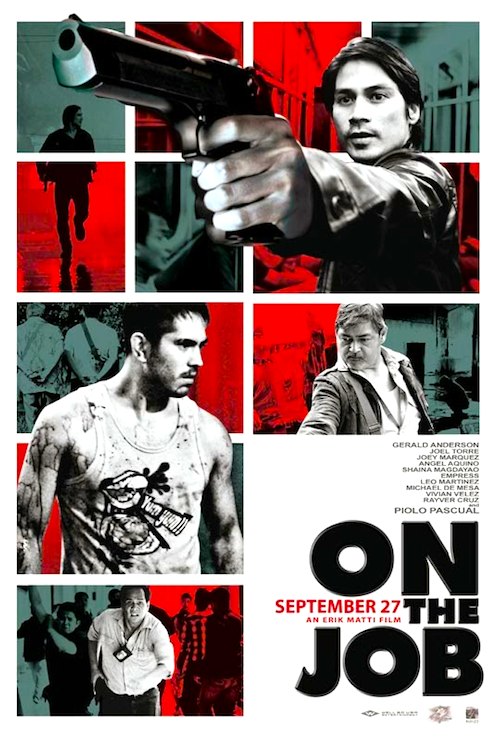
By Joe Bendel. One of Metro Manila’s most politically-connected prisons has one heck of a work-release program. Periodically, they send out two convicts to execute a gangland-style hit, and after a spot of shopping both are safely back inside before anyone is the wiser. However, a botched assignment and a troublesome cop will create headaches for the elites pulling the strings in Erik Matti’s On the Job, which opens this Friday in New York.

Evidently, murder for hire beats making license plates. Ever since Mario “Tatang” Maghari went to prison, he has provided for his family better than ever before. He only sees them occasionally, showing up “on leave” from his vaguely defined work out-of-town. His daughter is starting to get suspicious, but says nothing. After all, her father has paid her law school tuition.

While each job is strictly business for Maghari, his new partner, Daniel Benitez, appreciates their intensity, like a form of extreme sports. Frankly, Maghari has misgivings about Benitez, but with his parole approaching he must groom a successor. He genuinely likes the kid, but he constantly reminds Benitez that nobody can afford sentimentality in their world. When Benitez finally takes the lead on a job, it turns out disastrously. It was not entirely his fault, but he and Maghari still have to make it right quickly. To do so, they will tangle with Francis Coronel, Jr., an ambitious cop, whose career track has been greased by his congressman father-in-law.

When Maghari and Benitez go after their hospitalized target, OTJ deliberately echoes John Woo’s Hard Boiled, but where the Hong Kong crime epic was slick and operatic, Matti’s film is gritty and pure street. It is a massive action spectacle, but rendered on a scrupulously human scale. Every blow hurts like it ought to, because no one is superhuman.

From "On the Job."

Yet, Matti is just getting started. He and co-screenwriter Michiko Yamamoto paint a scathing portrait of a legal justice system rife with corruption. They are working on a large scale canvas, where complicated family history and political alliances will profoundly impact all the players. While the themes of loyalty and betrayal will be familiar to mob movie junkies, Matti gives them a fresh spin. The distinctive sense of place also sets OTJ well apart from the field. Viewers will practically smell the B.O. during the scenes set in the sweltering but bizarrely informal prison.

A radical departure from Matti’s clinically cold erotic drama Rigodon (which screened at this year’s NYAFF), OTJ seamlessly combines genre thrills with a naturalistic aesthetic, but Joel Torre is the lynchpin holding it all together. Not just a hard-nosed action figure (although he is certainly that), Torre fully expresses the acute pain of Maghari’s tragic failings, born of his violent circumstances. The entire ensemble is completely convincing, but OTJ is truly his show.

Fully engaging on both the macro and micro levels, OTJ is one of the year’s best hitman-cop dramas. Driven by the talents of Matti and Torre, it is a serious social critique that never skimps on the adrenaline. Highly recommended, On the Job opens this Friday (9/27) in New York at the AMC Empire and in San Francisco at the Metreon.

LFM GRADE: A

Posted on September 23rd, 2013 at 4:50pm.
LFM Reviews Let Me Out

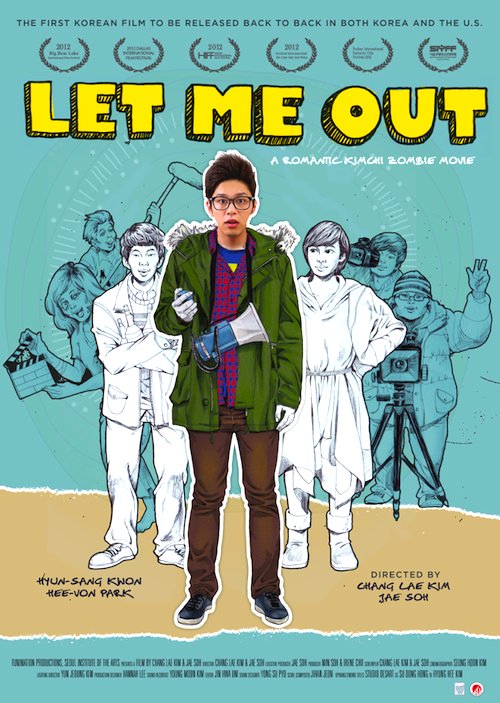
By Joe Bendel. In an era when technology allows Jafar Panahi to be about as prolific as Woody Allen, would-be filmmakers are running out of excuses. After years of snarking from the sidelines, senior year film student Kang Mu-young is suddenly put on the filmmaking spot. Bedlam will ensue as he tries to shoot his zombie melodrama in Kim Chang-Lae and Jae Soh’s Let Me Out, which screens in select cities this Wednesday, via Tugg.

A bit Holden Caulfield-ish, Kang loves to call out directors for being phonies. However, after a rather tactless Q&A session, Yang Ik-june (the indie director playing himself) turns the tables on the student, offering $5,000 in start up money for Kang’s senior film. Hurriedly, Kang dusts off his old discarded zombie screenplay (titled Let Me Out, probably because the characters are constantly banging on locked doors) and assembles a cast and crew who are not already attached to other projects.

Yang’s producer buddy Yong-woon recruits a motley but workable group, including Hong Sang-soo’s camera loader for their director of photography. The casting of Sun-hye, a third rate starlet enrolled in their film school, opens the door for some sponsorship opportunities—mainly from liquor and cigarette companies. This will definitely be a boozy set. Ah-young, a vastly more talented fellow classmate, also agrees to be the female co-lead. She is actually good in her part, even though she lacks confidence in both her abilities and Kang’s script.

Like the zombies it crudely portrays, the film-within-the-film takes hit after hit, but refuses to die. Cast and crew members will quit, equipment will break, and they will be evicted from their locations, but the film lumbers along erratically, just the same. Co-directors (and Seoul Institute of the Arts faculty members) Kim and Soh maintain a manic energy level, but they never lose sight of the human element. Despite all of Kang’s humbling frustrations, LMO remains a big, earnest valentine to scrappy DIY filmmaking.

From "Let Me Out."

Kwon Hyun-sang, the son of Cannes award winning director Im Kwon-taek, clearly relates to the wannabe Tarantino, nicely portraying his long deferred maturation process. K-pop and Korean TV star Park Hee-von provides an appealingly down-to-earth foil as Ah-young, while Jessica Choi relishes creating chaos as Sun-hye, the hot mess.

This is indeed the sort of film that will recharge your cineaste batteries. There are scores of in-jokes and cinema references, but that is all frosting on the cake. At its core, LMO is really all about a young filmmaker getting his act and his film together. It is a story a wide spectrum of viewers should be able to relate to, but it will have special resonance for fans of zombie movies, like the one Kang is trying to complete. Surprisingly heartfelt at times, Let Me Out is highly recommended for fans of Korean cinema and cult movies. It screens this Wednesday (9/25) in New York (at the AMC Loews Kips Bay), as well as San Francisco, Dallas, and Atlanta, but since these are Tugg shows, you had better book now to be sure you will have a ticket and the screenings will go forward.

LFM GRADE: B+

Posted on September 23rd, 2013 at 4:47pm.

LFM’s Govindini Murty at The Huffington Post: Finding Movie Inspiration in NASA’s Real Science: The Case Study of Europa Report

[Editor’s Note: the post below appears today at The Huffington Post.]

By Govindini Murty. Hollywood is in the midst of a science-fiction boom, yet few of its sci-fi movies are based on real science. That’s a shame, because the scientific discoveries emerging from NASA these days are as exciting as any Hollywood blockbuster. Whether it’s the stunning images from the Mars Curiosity rover, or the Hubble and Spitzer Space Telescopes’ observations of a dazzling array of exoplanets, or the announcement that Voyager 1 has become the first human-made object to leave the solar system, NASA is daily generating storylines that provoke the imagination and expand our horizons.

What makes these developments intriguing for adaptation into sci-fi movies is that they are real. At a time when audiences are increasingly jaded by computer special effects, there’s something fresh and engaging about a sci-fi movie that might actually have some basis in reality. Isn’t it time that we see more sci-fi films that explore the real mysteries of the universe all around us?

2013-09-21-Picture_by_Hubble_Space_Telescope_crop.jpg
NASA deep-space imaging.

As a case study for a sci-fi movie inspired by NASA science, I recommend that people take a look at Sebastian Cordero’s Europa Report. With a cast that includes Sharlto Copley, Anamaria Marinca, and Michael Nyqvist, Europa Report is currently playing in select theaters and on VOD, and will be available on iTunes starting October 8th. The movie is one of the few sci-fi films in recent years to offer a realistic depiction of a manned mission to outer space – in this case, to search for life on Jupiter’s moon Europa.

I chatted with NASA- JPL astrobiologist Steve Vance, one of the science advisors on Europa Report, at the film’s LA Film Festival premiere. Vance expressed to me his enthusiasm about the movie:

“I’m just thrilled that I got to be part of something that is bringing Europa more into the public eye. I’m really excited about how this movie captures the passion of exploration and also the science.”

Europa has been the focus of much attention in recent years because it may harbor life in the liquid water ocean that is theorized to exist under its icy crust. Vance, who studies the interiors of icy moons like Europa and who is acting staff scientist on NASA’s Europa Project, told me that he and his colleagues are “pre-formulating a mission that we hope will fly to Europa to address the same kind of questions that were addressed in the movie.” The most pressing of these questions is whether life independently developed on another body within our solar system.

2013-09-21-NASApia17043640.jpg
Concept image of Europa.

Although Vance noted that a manned mission to Europa isn’t currently feasible, due to the difficulties of even sending a human as far as Mars, he explained that NASA is assessing plans to send a robotic spacecraft to Europa (see NASA artist’s concept above): “The mission we’re looking at right now is [that] we’ll do multiple flybys to orbit Jupiter, and do thirty or more flybys of Europa and completely map the surface.” (See this paper in the August issue of Astrobiology on future missions to Europa, co-authored by Vance).

And this brings me to a larger point: whether it’s robotic spacecraft taking photos of the surfaces of distant moons like Europa – or movies that draw on that imagery to dramatize outer-space exploration – visual representation plays a crucial role in bringing science to life.

For example, the photos taken by the Galileo space probe as it orbited Jupiter and its moons from 1995 to 2003 gave the public the most detailed images yet of mysterious Europa and its icy, cracked outer shell. These photos (see below) then inspired the filmmakers of Europa Report. In turn, NASA scientists like Vance hope that movies like Europa Report will inspire public support for future missions back to Europa. In short, art and science play a surprisingly reciprocal role today.

2013-09-21-europagalileodoubleimage.jpg
NASA images of Europa.

Given how important photos and imagery have been to NASA, I was amazed to read in a recent NASA blog post that in the 1960s, NASA debated whether to even put cameras on board spacecraft. Fortunately, with the Mariner 4 mission that brought back the first close-up photos of Mars in 1965, the agency realized how crucial images were to advancing scientific knowledge and inspiring the public. Continue reading LFM’s Govindini Murty at The Huffington Post: Finding Movie Inspiration in NASA’s Real Science: The Case Study of Europa Report

Shakespeare’s Henriad: LFM Reviews Hollow Crown on PBS

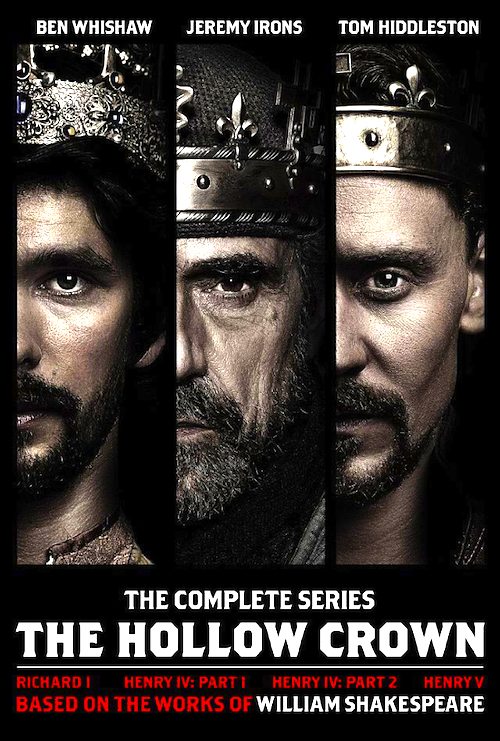
By Joe Bendel. The House of Plantagenet had a good run, but their dynasty would not last forever. You can blame Richard II. His fall and the rise of his Lancaster cousins provided ample inspiration for Shakespeare’s three king-four play cycle known as the Henriad. Executive producer Sam Mendes and three of Britain’s leading stage directors adapted the Richard and Henry plays for television as The Hollow Crown, which premieres on PBS this Friday as part of the current season of Great Performances.

Richard II begins with the title monarch on the throne, but that may soon change. Callous and erratic, Richard is a sad excuse for king. Nonetheless, the nobility has maintained their loyalty. Richard’s own actions will drive many lords into rebellion, starting with the precipitous banishment of Henry Bolingbroke. When the King confiscates the estate of his late uncle, Bolingbroke’s father, John of Gaunt, he pushes the Earl of Northumberland and his associates into rebellious conspiracy.

A bit of a slow starter, Richard II might be the weakest link of the Crown. However, it exceeds viewer expectations for one of the marquee Henriad highlights, when Patrick Stewart knocks John of Gaunt’s “This England” soliloquy out of the park. The stout Rory Kinnear and David Morrissey also bring an appropriately Shakespearean physicality to Bolingbroke and Northumberland, respectively. Unfortunately, Ben Whishaw’s sickly, petulant presence poorly serves the villainous Richard. Even more problematic is Richard II director Rupert Goold’s depiction of the deposed tyrant through Christ-like imagery.

Bolingbroke is now Henry IV, but he plays more of a supporting role in the two plays that bear his name: Henry IV Parts 1 and 2. The King has an heir to succeed him, but has little confidence in the free-spirited Prince Hal. The future Henry V would rather carouse with the disreputable Sir John Falstaff than worry about affairs of state.

Succeeding Kinnear as Henry IV, Jeremy Irons gives one of his best performances in years, acutely conveying the burdens of guilt, command, and fatherhood. Likewise, Tom Hiddleston relishes the roguishness of Prince Hal, while also convincingly growing in stature once Henry V ascends the throne. As director of both parts of Henry IV, Richard Eyre makes amends for misfiring with The Other Man. He seems to love Falstaff even more than Welles did, but Simon Russell Beale looks so haggard and dissipated as the jolly fellow, viewers will fear he might keel over well before his character’s spirit is broken.

Renouncing his wild past, Henry V turns his attention towards France in the Henriad’s conclusion, which should particularly interest Francophiles because of the presence of Lambert Wilson as the King of France and Mélanie Thierry as his daughter, Princess Katherine. Hiddleston’s courtship scene with Thierry has considerable charm, but Henry V director Thea Sharrock strangely underplays the St. Crispin’s Day speech, perhaps hoping to avoid comparison with Branagh’s rendition.

Shot on some notably picturesque locations, Hollow Crown opens up Shakespeare quite cinematically. While there is a considerable editorial hand at work, the language is never dumbed down. It is a smart way to present the Bard on television, with discrete productions that still have the continuity of a mini-series. The all-star cast should be of particular interest to fans of Downton Abbey (due to the too-briefly seen Michelle Dockery and Iain Glen). It is a great looking period piece, buttressed by a number of fine performances. Recommended for patrons of classical theater and fans of British television, The Hollow begins tonight (9/20) and continues for the next three Fridays on most PBS outlets nationwide.

LFM GRADE: A-

Posted on September 20th, 2013 at 1:25pm.

Sam Rockwell Goes Hunting: LFM Reviews A Single Shot

By Joe Bendel. Call it a simple improvisation rather than a simple plan. Nobody thinks too far ahead or particularly deeply in this criminal morality tale. As a result, there is a mess of trouble for everyone in David M. Rosenthal’s roughly passable backcountry noir, A Single Shot, which opens today in New York.

John Moon is an unemployed loser, whose wife Jess has filed for a divorce. Aside from some occasional farm labor temp jobs, Moon mostly puts food on his table through hunting. While stalking his game one fateful morning, Moon inadvertently kills a young woman squatting in the woods. Attempting to cover-up the accidental shooting he discovers a large stash of cash.

Now Moon has enough money to retain Pitt, the town’s slimiest lawyer, and throw some look-I’m-not-a-deadbeat-money Jess’s way. Of course, this is not exactly the best way to maintain a low profile. Suddenly he is on Cro-Magnon drug dealer Waylon’s radar, in a bad way. Everyone else around him is also acting rather suspiciously, but Moon is not so quick on the up-take.

Shot has a number of moody and atmospheric scenes that work quite well, but the tension always dissipates rather than growing and compounding. Perhaps the greatest problem is its dubious premise. An experienced hunter would never fire off the reckless shot that ignites this film. Someone like Moon, who has been hunting longer than Rosenthal has been making movies, knows never to pull the trigger unless you are absolutely certain of what you have in your sites.

From "A Single Shot."

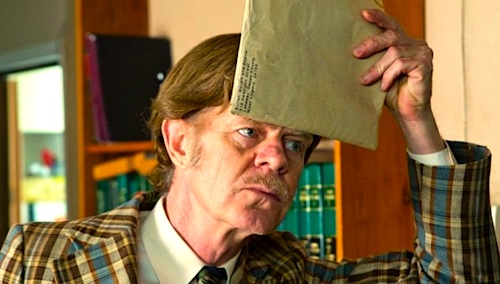
Still, Rockwell is convincingly slow-witted yet simultaneously slow-burningly intense as Moon. It is largely his work that will keep viewers invested in Shot, at least to some extent. William H. Macy is rather amusing as Pitt, but he might as well be credited as a “special guest star.” In contrast, the potentially interesting Jason Isaacs is completely wasted as Waylon, buried under a Wookie’s worth of greasy locks.

There are no big secrets or revelations in Shot, so despite some well executed bits of skullduggery, there is little suspense overall. Basically, it is a bad idea to come between a drug dealer and his illicit cash. Nor is it a winning strategy to pick a fight with an anti-social mountain man who lives and breathes hunting. As a result, everyone learns something in Shot, except the audience, who come in way ahead of everyone on-screen. Just sort of okay but not great, A Single Shot opens today (9/20) in New York at the AMC Empire.

LFM GRADE: C

Posted on September 20th, 2013 at 1:22pm.

The Future is on Ice: LFM Reviews The Colony

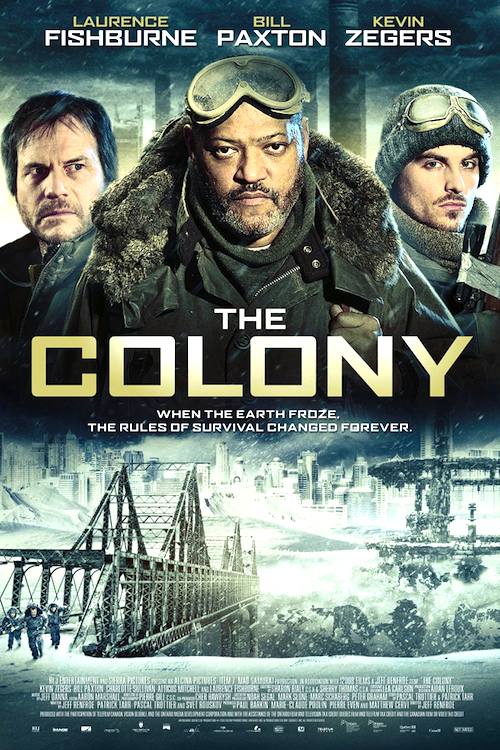
By Joe Bendel. The future will be nasty, brutish, and snowy. To combat global warming huge weather controlling machines were invented, but tragically they got stuck on snow—or something like that. On the positive side, summers in New York have become almost bearable. Cash out your 401K’s now, because if that all weren’t bad enough, cannibalism starts to spike in Jeff Renfroe’s The Colony, which opens tomorrow in New York.

So, its pretty cold out there. Only scattershot handfuls of humanity survive in underground colonies, hoping to somehow outlast the big freeze. Given their cramped living conditions, flu has become a matter of life and death. Basically, if you cough, you are sent out to die. The overzealous Mason is the one in charge of “quarantine,” a fact that does not sit well with Sam, the sensitive handyman. He takes the issue up with Briggs, Colony 7’s commander, who inconveniently has more pressing concerns.

Their sister colony sent a distress signal, ominously followed by radio silence, so Briggs takes Sam and an easily winded teenager out to investigate. After making the arduous journey past a series of surprisingly cool looking matte paintings, the expeditionary party discovers their allied colony was over-run by a pack of cannibals. Despite descending into savagery, they prove to be dashed difficult to kill.

It is rather ironic this tale is climate catastrophe is Canadian-made, because the weather will look rather temperate to half that country. Yet, the northern location shoots, filmed at an old, mothballed Canadian NORAD facility, are what work best for Colony. Likewise, the hulking, frost-encrusted weather machines are quite striking looking. Unfortunately, the script (credited to Renfroe and three others) feels like it was cobbled together from Roland Emmerich’s slush pile.

For a derivative film, Laurence Fishburne’s performance as Briggs is largely derived from his work in the superior Event Horizon, but frankly, that is not entirely bad. Similarly, Bill Paxton recycles his “game over, man” persona for Mason, but with less successful results. Kevin Zegers and Charlotte Sullivan are pretty bland as Sam and his potential love interest, Kai, the seed archivist and computer specialist – but at least her character listens to Duke Ellington, so you have to tip your hat to that. Considering Dru Viergever’s character is only credited as “Feral Leader,” it is probably safe to assume not much of an awards campaign is being planned on his behalf. Nevertheless, he certainly looks the part.

To call The Colony a meathead movie would over-praise it. Visually, it accomplishes much with its limited resources, but never rises above mediocrity in any other criteria. Just kind of whatever (at best), it is hard to imagine anyone will pay Manhattan ticket prices to see it when The Colony opens tomorrow (9/20) in New York at the AMC Empire.

LFM GRADE: C-

Posted on September 19th, 2013 at 11:23am.