LFM Reviews 113 Degrees @ The 2013 Brooklyn Film Festival

By Joe Bendel. In space, no one can hear a heart break—unless the aggrieved lover decides not to bear her disappointment in silence. Confined environments are difficult places to work out relationship problems as the crew of a two-person space station learns in writer-director Sabrina Doyle’s short film 113 Degrees (trailer here), which screens during the 2013 Brooklyn Film Festival.

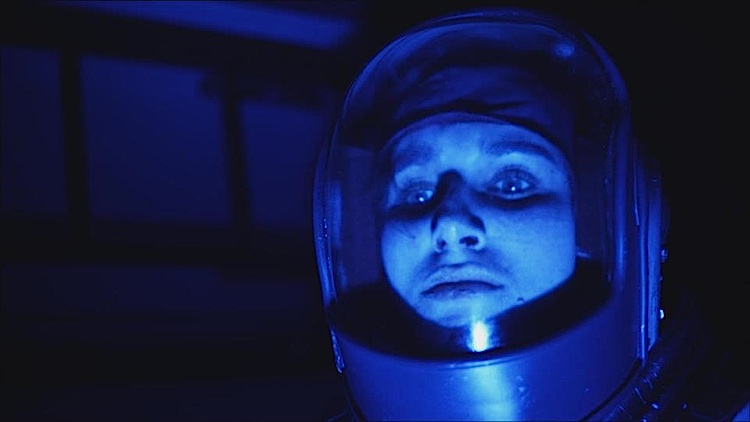
Francesca and Joe have grown close during their time in space together. At this point, they share the same bunk. It would seem to be an Eden-like situation, but an interstellar call from Joe’s terrestrial wife serves as a rude awakening for his commander. Disturbed by the incident, she carries her agitation with her during a supposedly routine space walk. This leads to serious complications.

Granted, most romantic tragedies are not overly concerned with cooling systems, but the guts of 113 involve the lovers’ betrayal and sacrifice. This is really the sort of film that uses science fiction trappings to tell a straight forward human story. Indeed, it hits some deep chords. However, it is important to note that Doyle, producer Matilde Barbagallo, and editor Marian Jiménez are all women – lest the film be accused of perpetuating the stereotype that women are more likely to become emotionally overwrought than men.

As Francesca and Joe, Lizzy Davis and Brian Groh quickly convey a sense they share some long, intimate history together. They are a believably flawed couple. However, his long haired hipster coif looks rather out of place. Even in the future, aside from space tourists, most astronauts are still likely to be ex-military.

Regardless, the rest of the production is technically quite impressive, especially considering Doyle’s budget constraints. Hollywood tent-pole veteran Greg Derochie’s VFX team convincingly renders Francesca’s space walk outside the station and the deteriorating conditions within. One could easily believe this is the same world as the Alien franchise or Duncan Jones’ similarly scrappy Moon. Recommended for SF fans with a weakness for tales of star-crossed love, the twenty-one minute 113 Degrees screens Monday (6/3) and Wednesday (6/5) as part of this year’s “Magnetic” BFF.

Posted on May 30th, 2013 at 4:25pm.

MoMA’s Chinese Realities Series: LFM Reviews The Questioning

From "The Questioning."

By Joe Bendel. When these cops show up to “inspect” your hotel room, it is a case of pure intimidation. It is also something of a badge of honor in today’s China. Film producer and festival impresario Zhu Rikun was the target of such a police roust, but he had the presence of mind to keep his camera rolling. His resulting short documentary The Questioning screens with Ai Weiwei’s thematically similar Disturbing the Peace as part of MoMA’s continuing Chinese Realities/Documentary Visions film series.

Evidently, it takes six cops to ask for Zhu’s papers. Surely being familiar with Teacher Ai’s experience, Zhu handles himself masterfully. He is distinctly uncooperative, but never gives them anything they could describe as provocative. The entire episode degenerates into absurdist theater, with Zhu refusing to answers basic questions, instead referring his interrogators to the very documents they hold in their hands. Viewers can well imagine the flustered enforcers reassuring themselves how badly they shook up Zhu once they retreat from his room.

Indeed, Questioning plays like a revised scene from the ill fated Chengdu trip in Disturbing, but unfortunately, Ai Weiwei and his team were not so deft at handling their harassers. Teacher Wei would take a shot to the head, which would eventually lead to a serious medical crisis, and his assistant would be held incommunicado in gross violation of China’s (ostensible) law.

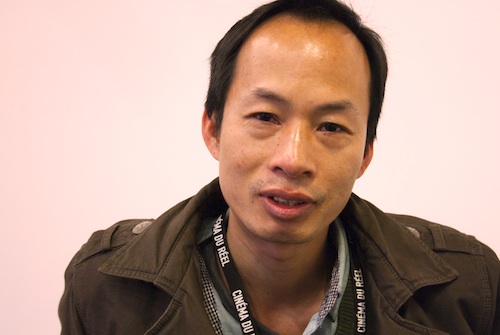
Filmmaker Zhu Rikun.

In her insightful post-screening Q&A, Ai Weiwei: Never Sorry director Alison Klayman really put her finger on the phenomenon both films document. Both Zhu and Teacher Ai could be so assertive in confrontations with authority figures because there is no rule of law to govern such encounters. As a result, the strongest personality has an advantage. Ironically, that gives Teacher Ai the advantage. And Zhu is certainly no shrinking violet, either.

Disturbing the Peace is a film everyone should watch to understand contemporary China. Zhu’s The Questioning is also quite valuable. It is short, but extremely telling. One could argue he does not do much directing, per se, merely turning on the stationary camera his surprise guests never notice -but as a cinematic journalist, he is incredibly gutsy. (However, one might say that his overly large cast is lousy at taking direction.) Both highly recommended films screen together again (sans Klayman) this coming Saturday (6/1), concluding Chinese Realities at MoMA.

Posted on May 28th, 2013 at 12:33pm.

LFM Reviews Black Out @ The 2013 Brooklyn Film Festival

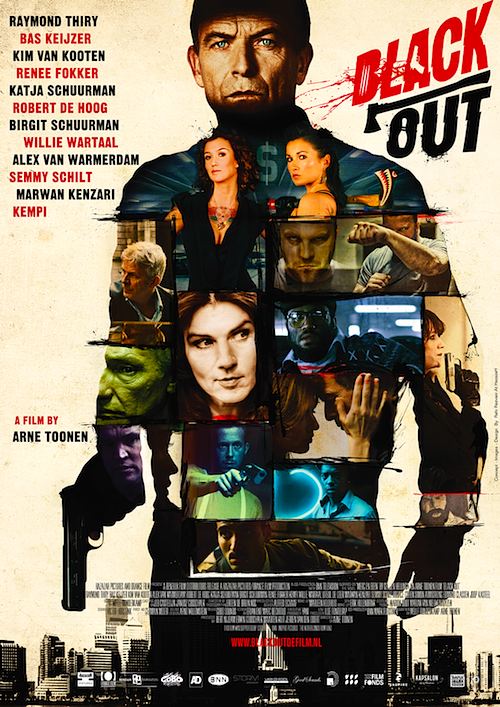
By Joe Bendel. Those idiots from the Hangover franchise have nothing on Jos Vreeswijk, who is about to wake up next to a dead body, a smoking gun, and no memory of the last twenty four hours. He has one day to get it all sorted if he wants to make it to the church in time for his wedding in Arne Toonen’s Black Out, which screens during the 2013 Brooklyn Film Festival.

Vreeswijk was once a criminal, but he went straight. It seemed to take, up until the point he woke up with a corpse in his bed. His fiancée Caroline knows he has a shady past, but she accepts him nonetheless. His prospective father-in-law is less understanding, but he seems to be up to his eyeballs in the mess enveloping Vreeswijk. Evidently it involves twenty kilos of cocaine two rival gang lords think he owes them. To get back to the straight-and-narrow, Vreeswijk will have to boost somebody else’s coke. There seems to be plenty around, but holding onto it is a trickier proposition.

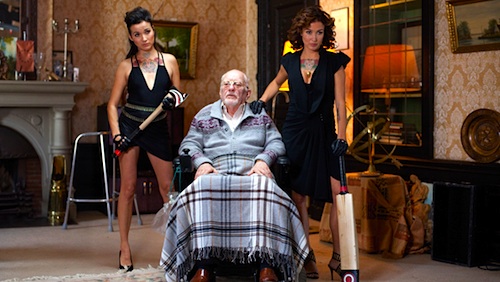
Black Out is a darkly comic, slightly cartoony criminal caper which hums along quite energetically. You have your ballet dancers-turned Russian mobsters, psycho baby doll enforcers, malevolent grandpas, and out of their depth dog groomers all getting in on the action. Yet, it is the steely Robert Conrad-esque Raymond Thirry who anchors the bedlam quite effectively as the reformed everyman, Vreeswijk. Despite all the betrayal and confusion exploding around him, he is always manly and never whiny.

From "Black Out."

Likewise, Kim van Kooten is pleasantly down to earth and pragmatic as the innocent Caroline. All the crazy acting out is left to the rest of the cast, who gorge on scenery like a Bonanza buffet. Arguably the subtlest, most intriguing supporting character is Renee Fokker’s Inez, the “Connoisseur of Coke” and formerly Vreeswijk’s close associate.

Tonnen is obviously influenced by Tarantino and the recent bumper crop of Scandinavian noirs, but even if he never reinvents the wheel, he keeps things punchy and pacey. Violence and eccentricity are liberally mixed together, but Black Out still feels fresh thanks to Thirry’s grounded center. A slickly entertaining one-darned-thing-after-another gangster romance-beatdown, Black Out is recommended pretty enthusiastically for genre fans when it screens this coming Sunday (6/2) and Monday (6/3) at Windmill Studios, as part of the 2013 Brooklyn Film Festival.

LFM GRADE: B+

Posted on May 28th, 2013 at 12:31pm.

LFM Reviews Sunny @ New York’s Korean Movie Night

By Joe Bendel. If Rizzo were dying of cancer, surely Frenchie would reunite the Pink Ladies. Such is the position married and well-to-do Im Na-mi finds herself in. Some members of the girl gang are happy to get back together, but others are harder to find in Kang Hyeong-chul’s monster hit Sunny, which screens tonight as part of the Korean Cultural Service’s free Korean Movie Night in New York.

While not exactly a life of quiet desperation, Im leads a sheltered existence that is not wholly fulfilling. Since her husband and daughter are too busy to visit her mother-in-law in the hospital, she upholds their obligations. During one such visit, she chances across the room of Ha Chun-hwa, the leader of the clique dubbed “Sunny.” When Im’s family moved to Seoul from the countryside, Ha took the shy teen under her wing. As we watch in flashbacks, most of Sunny quickly fell in line, but not Jung Su-ji, the moody prospective model.

When not rumbling with other girl gangs, Sunny practiced their choreography. However, they were never able to perform their big number, for reasons that will eventually be revealed. Hmm, anyone smell some unfinished business here?

In a Korean film, when a character is introduced with a fatal illness in the first act, it is a cinch there will be an emotional funeral coming down the pike. This goes way beyond Chekhov’s gun. Without a big weepy payoff, audiences would want their money back. Not to be spoilery, but Sunny delivers the goods.

Yes, this is a chick flick, but it is an admittedly well crafted film. Employing some surprisingly striking transitions for each temporal shift, Sunny is more visually stylish than it probably needed to be. In fact, Nam Na-yeoung won the best editing honors at Daejong Film Awards for good reason. As the narrative unfolds, it pulls you in – despite viewers’ macho or hipster resistances.

From "Sunny."

Yoo Ho-jeong plays grown-up Im with admirable restraint, never overplaying the gilded cage empowerment card. Likewise, Shim Eun-kyung is earnest and awkward as teenaged Im. Yet both Jin Hee-kyung and Kang Sora really outshine the ensemble as the ailing adult and fearless teenaged, Ha, respectively. Although hardly a teen herself, singer Min Hyo-rin has her moments as the high school ice queen, Jung. As for her adult counterpart, that is really the question driving Sunny’s third act.

If Cyndi Lauper floats your boat and you prefer Boney M’s version of the title song over Bobby Hebb’s original, than Sunny’s unabashedly 1980’s soundtrack will be your catnip. The ways screenwriter-director Kang interjects and darts around the May 1980 democracy protests also gives the film a bit of seasoning. He certainly conveys his point of view, without waving the bloody shirt. Sunny is shamelessly manipulative and sentimental, but it does exactly what it sets out to do. Recommended for those looking to celebrate sisterhood, it screens tonight (5/28) at the Tribeca Cinemas—free of charge, courtesy of the Korean Cultural Service in New York.

LFM GRADE: B-

Posted on May 28th, 2013 at 12:30pm.

The Irish Rep Revives The Weir

By Joe Bendel. Is it the booze or is it the blarney? The two go together for the patrons of a remote Irish pub. However, their ghostly tall tales take an unexpectedly serious turn in the Irish Repertory Theatre’s revival of Conor McPherson’s The Weir, which officially opened last Thursday night in New York.

Brenden’s pub is a quiet, out-of-the-way spot, aside from the dreaded nights when busloads of German tourists descend on the barkeep like locusts. Jack, the pugnacious mechanic, and the morose mother’s boy Jim have come to spy on Finbar Mack, the local wheeler-dealer as he attempts to charm the village’s newest resident. Valerie is a woman and therefore of interest to everyone present.

The former Dubliner seems genuinely interested in the history of the area and the legendary fairy road that supposedly runs through Brenden’s public house, opening the door for a series of ghost stories. Initially they seem like campfire fare, but they have a profound effect on her. It seems she has her own deeply tragic story to tell that will echo and amplify the uncanny elements of their prior anecdotes.

McPherson is a great writer, with a flair for dialogue and a wonderfully sly approach to the telling of a tale. His mature, humanistic handling of supernatural themes comes as a welcome antidote to the adolescent angst of Twilight and the like. McPherson’s dramas, most certainly including the Olivier award winning The Weir, are also Irish to the bone, making them perfect vehicles for the Irish Rep. Indeed, The Weir boasts some wickedly droll “pub” humor. Yet, despite the heavy portents, it is shockingly endearing. While there are definitely spooky components, at its core The Weir speaks to the therapeutic benefits of getting pie-face hammered and talking malarkey.

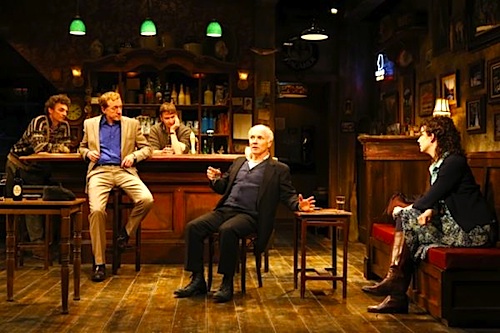
From "The Weir."

The Weir is a true ensemble piece, but Jack the diehard Guinness man gets the big, climatic monologue and Dan Butler (probably best known as Bulldog on the Frasier show) absolutely kills with it. He masterfully expresses all of Jack’s bluster and his deepest regrets. In contrast, the hospitable Brenden might be the least showy role, because he is the only character who does not have his own personal yarn to spin (remember, it is a bartender’s job to listen). Still, he gets most of the funny bits, which Billy Carter makes the most of. He also develops some subtle-as-a-dew-drop chemistry with Tessa Klein’s Valerie.

A strong five-handed cast all around, John Keating and Sean Gormley add earthy color and character as Jim and Mack, respectively. Listening to their eerie camaraderie is a finely staged pleasure.  Director and Irish Rep co-founder Ciarán O’Reilly seamlessly guides the memorable production through McPherson’s subtle tonal shifts. Patrons should know coming in it runs straight through without an intermission, but ushers will remind you about a thousand times before it starts. Highly recommended, The Weir runs through July 7th as part of the Irish Repertory Theatre’s 25th anniversary season.

Posted on May 28th, 2013 at 12:29pm.

Casks & Caskets: LFM Reviews Blood of the Vine Seasons 1 & 2

By Joe Bendel. Murder and vino have always gone together, ever since Montresor offed Fortunato in “A Cask of Amontillado,” so who would make a better amateur sleuth than an enologist (wine expert)? For a vintner accused of murder, Benjamin Lebel is the man to call in Blood of the Vine, seasons one and two, now available as two separate 2-DVD sets from MHz Networks.

In the series opener, Tears of Pasquin, the Bordeaux based Lebel puts the moves on an attractive colleague, France Pelletier. She is mature enough to consider his assistants, Mathilde and Silvère, wet-behind-the-ears kids, but she is still young enough to look good on his arm. Over the next two seasons, she will become accustomed to having romantic dinners and weekend getaways interrupted by murder.

Pasquin happens to be one of the series’ more intriguing crime stories. What appears to be a serial killer case ultimately involves the nasty legacy of Vichy era collaboration. That still seems bold for French television. Pasquin also introduces Lebel to Commander Barbaroux of the Bordeaux police force, who is admittedly befuddled by the rare bottles of Pasquin left at multiple murder scenes. He calls in Lebel as a consultant, but quickly has misgivings.

Loyal Silvère looks different in Le Coup de Jarnac, but replacement Yoann Denaive and the rest of the regulars will stick around for the balance of the first two seasons. Hired to audit the storied Aludel cognac distillery divided by feuding siblings, Lebel and his assistant receive a rather frosty reception at the chateau. However, Lebel is quite welcome at the tavern in town co-owned by his old flame, Shirley. Unfortunately, the legendary mixer and friendliest Aludel heir falls victim to an untimely accident.

From "Blood of the Vine."

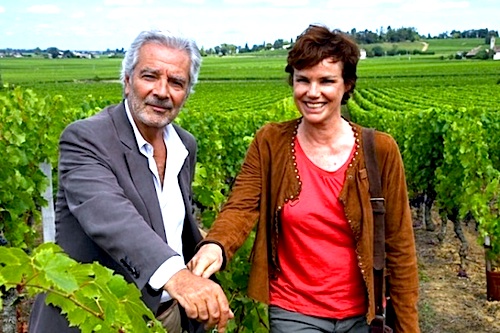
Vine often features well known guest stars (at least to French audiences), such as Marisa Berenson, the co-star of films like Barry Lyndon and Cabaret, as well as a one-time guest host of The Muppet Show. As Shirley, she and series star Pierre Arditi have a nice wistfully flirtatious thing going on.

Likewise, Margaux’s Robe features another notable guest star, Arditi’s daughter Rachel, playing Lebel’s daughter, Margaux. Recently, returned from New York, Margaux Lebel has accepted a PR job with a new Chateau owner who is absolutely, positively not a member of the Russian mob. When sabotage kills Margaux’s co-worker-lover and badly injures her, the Soviet educated Swiss mogul puts pressure on Lebel to solve the case quickly or he will do it his way, which adds a good twist to elegant sleuthing.

Fittingly, the first season ends with one of the better crafted mysteries, while also challenging Lebel’s loyalties. When a former assistant’s struggling chateau is beset by a suspicious outbreak, Lebel comes to investigate. Knowing the grand dame who once fired him covets their land, Lebel pays a visit to the regal Mme. Newman. Both Arditi and Judith Magre (probably best known for Louis Malle’s The Lovers) clearly relish their affectionately acid-dripped banter.

Season two begins with A Question of Brandy . . . or Death. Once again, Lebel and his assistants have been hired to assess a struggling distillery. In this case, it is the Baron Castayrac who expects Lebel to simply sign off on his insurance claim, but the enologist does not play that game. Pretty much every key element of the series comes into play in this episode, with a union boss of questionable repute thrown in as an added bonus. Continue reading Casks & Caskets: LFM Reviews Blood of the Vine Seasons 1 & 2