Mythic Themes in Pixar’s Brave

By Patricia Ducey. In a magical Celtic kingdom far, far away, lovely queen Elinor and her consort king Fergus are choosing a suitable husband for their daughter – but their sassy tomboy princess is one of those grrls who thinks she needs a man about as much as a fish needs a bicycle. In Pixar’s Brave, little Merida, our headstrong princess, rebels and hies to the forest on her trusty steed, her flaming red curls flying in the wind. Like many cinematic young female protagonists before her — Princess Ann in Roman Holiday, Princess Mia of The Princess Diaries, or even Wendy in Peter Pan — Merida craves independence and adventure as much as any boy or any commoner, and an arranged, political marriage inspires nothing but dread and an overwhelming urge to flee.

Merida’s effort to avoid marriage, which constitutes the first half of the movie, does not muster up much interest or suspense from an adult point of view. But at the midpoint, when Merida escapes into the forest to avoid her fate, the movie enters classical psychoanalytic symbol territory and becomes infinitely more compelling. A tiny CGI creature (think Tinkerbell) leads her deep into the forest, to the hut of an old crone who appears to be a wood carver. Merida soon discovers she can also cast spells, and begs the witch for a spell to help change her mother’s mind about the marriage issue. The witch warns her off – spells are tricky things and can go awry — but Merida brashly insists, and is soon on her way back to her castle, magic cake in hand. She tricks her mother into eating the toxic cake but is stunned when her mother suddenly transforms into a giant bear. The spell indeed has gone tragically wrong — and if Merida cannot break the spell in two days’ time, the transformation will be permanent. Merida has ignored the warning of the crone, and now she could lose her mother, as surely as if she had killed her, and ruin her kingdom, too — as the fragile peace treaty of the clans hinges on the alliance her marriage will create. In addition, the king has vowed revenge on Mordu, a huge killer bear, who had earlier chomped off his foot. Merida knows that Fergus will kill Elinor if he finds her in her bear form, thinking she is Mordu. Now, those are stakes.
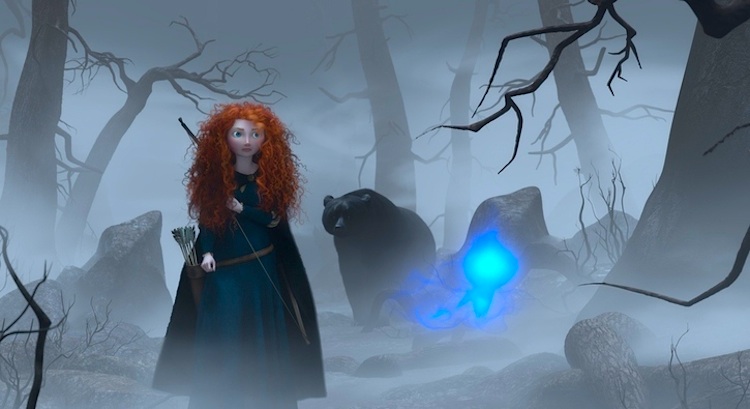
Gory, frightening fairy tales are believed by many theorists (Bruno Bettelheim in particular) to be the material manifestations of the issues that children are consciously and subconsciously dealing with. And so Brave deals with Merida’s anxieties at the prospect of growing up, of maturing into a sexual being, and of relinquishing some of her freedom for the bond of love. As in Brave, fairy tales often insist on the need for just that: bravery, to overcome evil and teach children that these difficulties can be overcome. Brave also delves into the Oedipal/Electra conflict, where the child competes with the mother for possession of the father, or of an independent, public life. It is telling that in Merida’s family dynamic, her father Fergus is a bit of a clown (think Braveheart meets Fat Bastard) and plays but a peripheral role in the family. And so Merida’s primal bond, and conflict, rests with her mother. Her mother oversees Merida’s life; she teaches a bored Merida the geography and history of her kingdom, when she really wants to go out hunting; she teaches Merida the proper grooming and deportment of a queen, which Merida ignores to engage in rough sports. In a final betrayal, Elinor plans Merida’s betrothal, but Merida despises what she views as the lowly position of her mother and has no intention of becoming her. The fierce giant bear that Elinor morphs into is thus a symbol of what Merida fears most: a terrible grownup life as a mature woman and queen. Will she kill the mother, so that she can escape her abject fate? There must be a way out of this dilemma!
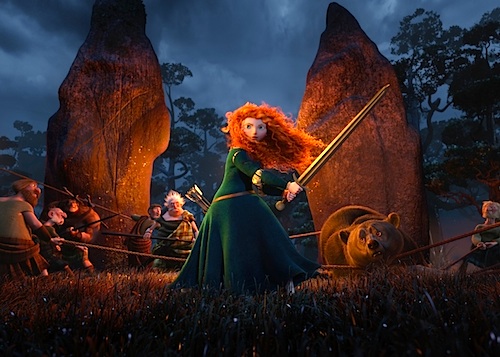
From Pixar's "Brave."

So Merida calls forth the crone, who then appears to tell her that the only way to reverse the spell is to “mend the bond torn by pride.” It’s up to Merida to figure out which bond, or bonds, she has torn asunder and to fix them. If she refuses to marry any of the suitors chosen by the clans, the peace forged by a long ago treaty could collapse. If she wants to save her mother, she must give up her childish ways and assume the responsibilities of a queen.

Brave‘s animation is beautiful: rolling green hills and misty valleys and dappled sunsets, a change from the bold primary colors of, for instance, the Toy Stories. The only discordant note is the snappy modern dialogue style, which works against the movie’s deep chords of myth and emotion so reminiscent of a Disney film. But Brave is a very good movie for the wee bairns, who will probably enjoy the first half more than you, and fear the impending loss of Merida’s mother as strongly as you.

Can you change your fate, without throwing a fatal wrench into the delicate web of life? Brave, like other myths and legends, suggests we can, with a pure and courageous heart. And that lesson, as the good doctors of the psyche have told us, is a good thing.

Posted on June 28th, 2012 at 3:22pm.
LFM Reviews War of the Arrows @ The 2012 New York Asian Film Festival

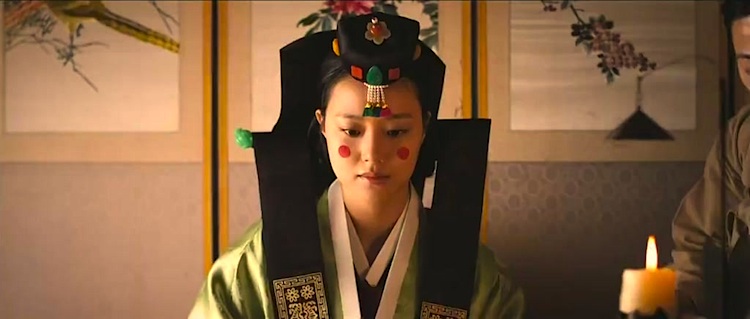
By Joe Bendel. Sure China invaded Korea, but it was all for the sake of greater regional stability. The year is 1636 and only an unemployable archer with an attitude problem stands between Joseon and an army of Manchurian invaders in Kim Han-min’s War of the Arrows, which screens tomorrow during the 2012 New York Asian Film Festival.

Choi Nam-yi and his sister Ja-in should not be alive. When their father is wrongfully branded a traitor, they barely escape to the home of his lifelong friend, who raises them in secret. Unable to live a productive public life, the grown Choi becomes a sullen slacker, wasting his life with his Falstaffian cronies. He only excels at one thing: archery.

In contrast, his sister has fallen in love with Kim Seo-goon, the son of their protector. Believing they can lead a normal existence together, Kim has convinced his parents to allow their marriage. Unfortunately, the Qing army happens to choose their wedding day for their invasion. They only make one mistake, scooping up Choi’s sister and new brother-in-law along with the rest of their prisoners. Somewhat put out by this, Choi dogs the returning Qing forces, becoming a guerrilla army of one. Of course, the trail of arrow-impaled bodies he leaves in his wake attracts the attention of an elite company of archers led by the seriously hardnosed Jyushinta.

From "War of the Arrows."

A commanding screen presence, Ryoo Syeung-ryong makes quite the villain as the relentless Jyushinta. He seethes with authority and projects a quiet sense of menace perfect for his role as the Qing commando leader. While Park Hae-il’s Choi lacks a similar gravitas, he is a convincing action figure, letting the arrows fly as he careens through the forest.

War is one fierce archery film. Those who considered Hawkeye the biggest take-away from The Avengers are in for a treat. This is warfighting at its most personal level. Though already available on DVD, War of the Arrows is the sort of film that should be a blast to watch with an appreciative NYAFF audience when it finally gets an overdue New York ovation tomorrow. Well worth seeing on a big screen, it would have also made a good 3-D fixer-upper (unlike say, Clash of the Titans), considering how many projectiles come flying out towards the audience. Like the best action historicals, War of the Arrows is both high tragedy and a total blast. Enthusiastically recommended, it screens Friday night (6/29) at the Walter Reade Theater as part of the intrepid 2012 NYAFF.

LFM GRADE: A-

Posted on June 28th, 2012 at 3:21pm.

The Young Inspector Morse: LFM Reviews Endeavour

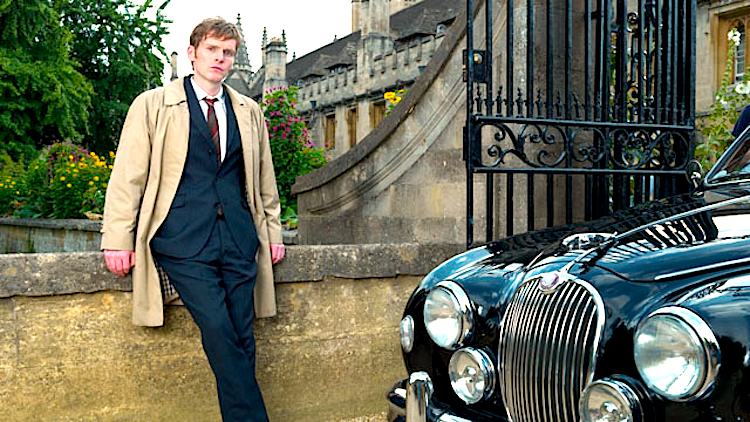
By Joe Bendel. Consider it a portrait of the curmudgeon as a young man. Inspector Morse would make a name for himself as the prickly but refined Chief Inspector with a taste for opera and poetry. However, in 1965, Endeavour Morse was an Oxford drop-out just hoping to catch on with the Thames Valley force after a stint in the military. His first case will be difficult, bringing him back to his former college in Endeavour, the one-off Inspector Morse prequel, premiering this coming Sunday on PBS’s Masterpiece Mystery.

Mary Tremlett, a local school girl, has been murdered and her former lover, an Oxford student, has committed suicide. It is supposed to look like an open-and-shut affair, but the details do not quite fit. Constable Morse’s inquiry leads him to the faculty member tutoring Tremlett (under questionable circumstances), who happens to be married to Morse’s favorite opera diva.

Though preoccupied on several fronts, Morse doggedly follows the clues leading to sleazy car dealer with half the force in his pocket. To proceed, he will need the career-risking assistance of his prospective mentor, the somewhat Morse-like Detective Inspector Fred Thursday, who drives a Jaguar and has little patience for his colleagues’ corruption.

For a television mystery, Endeavour is fairly successful at misdirecting viewers, despite dropping some fairly obvious clues. It also comes fully approved and vouched for, featuring a cameo appearance from Morse author Colin Dexter, as well as Abigail Thaw, the daughter of the late John Thaw (the star of the original Morse series), appearing briefly as the editor of the Oxford newspaper. Frankly, it seems strange that Endeavour was initially produced as a one-shot, much like the Morse spin-off, Inspector Lewis, but in each case the viewers have clearly spoken. A full four episode season of Endeavour is reportedly already in the works.

Shaun Evans as Endeavour Morse.

In his eponymous first outing, Shaun Evans looks appropriately awkward and earnest as Constable Morse, but it will be interesting to see how the character and his performance evolve over time. Indeed, it is easy to understand how this early case would appreciably contribute to his disillusionment. Fortunately, Roger Allam (who once played a suspect on the flagship Inspector Morse) provides plenty of color as the flamboyant but principled DI Friday. The only real weaknesses on Constable Morse’s maiden voyage are his suspects, who are a rather bland lot, in an English upper crust sort of way.

Sure to please the preexisting base, Endeavour should also appeal to viewers of PBS period dramas. There is definitely a sense of nostalgia here that should help the prequel series establish its own discrete identity. An entertaining feature length murder mystery that has plenty of potential for growth (again, much like Lewis before it), Endeavour is easily recommended for Brit TV fans when it airs this Sunday (7/1) on most PBS stations nationwide.

LFM GRADE: B

Posted on June 28th, 2012 at 3:19pm.

LFM’s Focus on Film Festival Coverage

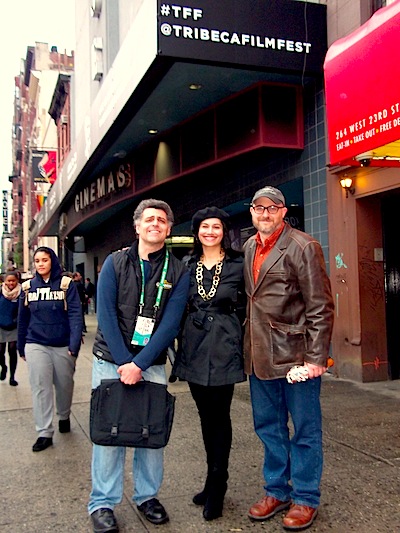
Joe Bendel, Govindini Murty & Jason Apuzzo @ The 2012 Tribeca Film Festival.

By Govindini Murty. As Libertas readers know, we’ve long been advocates of film festivals, especially those that celebrate independent film. Because they empower individual filmmakers to try out new ideas, film festivals are a crucial way to inspire the spirit of freedom and innovation in the culture. And did I also mention that they’re a lot of fun? Where else can you hang out with fellow film fanatics, see great films, meet talented filmmakers, and return to your own creative work buzzing with renewed energy and ideas?

That’s why we’ve been stepping up our film festival coverage here at Libertas. Jason and I had the chance to attend the Sundance Film Festival and the Tribeca Film Festival this year, and we also just finished attending the LA Film Festival. All three festivals have been terrific experiences. And of course, Libertas’ own Joe Bendel, the Zen master of the independent film review, has already been doing a fantastic job these past two years covering pretty much every film festival on the planet (maybe even in the known universe).

As a result of our indie focus, Indiewire has added us to Criticwire, which means that you can click on our names on their Criticwire page and find letter grades and film reviews for all the independent and mainstream movies we’re seeing.

To also make it easier for Libertas readers to find our film festival reviews, we’ve created new categories in the ‘Articles’ drop down menu above for each of the major film festivals we’re covering. We’ve created a new Sundance category, a Tribeca category, and an LA Film Festival category. Click on one of those categories and you will see all the reviews we’ve posted for that festival going back to the launch of Libertas Film Magazine.

We’ll add more festival categories as we proceed – and remember to go out and support these films! If a movie isn’t playing in a theater in your area, then remember that many of these movies are also available on your cable provider’s VOD, Netflix streaming, Amazon on-demand, or iTunes.

Posted on June 25th, 2012 at 11:41pm.

LFM Reviews Nameless Gangster @ The 2012 New York Asian Film Festival

By Joe Bendel. Though still a young democracy, by the early 1990’s the South Korean government had run out of patience with the unchecked lawlessness of organized crime. Choi Ik-hyun became one of their top targets. He did not look like much of a criminal, but he was very organized. It is time to get your gangland beatdowns on as the New York Asian Film Festival comes roaring in with a whole new slate of fresh selections. Yun Jong-bin’s Nameless Gangster: Rules of the Time will deliver plenty of said when it screens at the 2012 festival this Saturday.

Choi is a low level customs inspector, corrupt in the pettiest of ways. His family was once wealthy and respected, but their fortunes have fallen. However, he remains hyper-connected amongst the larger Choi clan hierarchy. Stumbling across a shipment of heroin, Choi parlays it and his surname into a business relationship with the Busan mob’s top gun, Choi Hyung-bae.

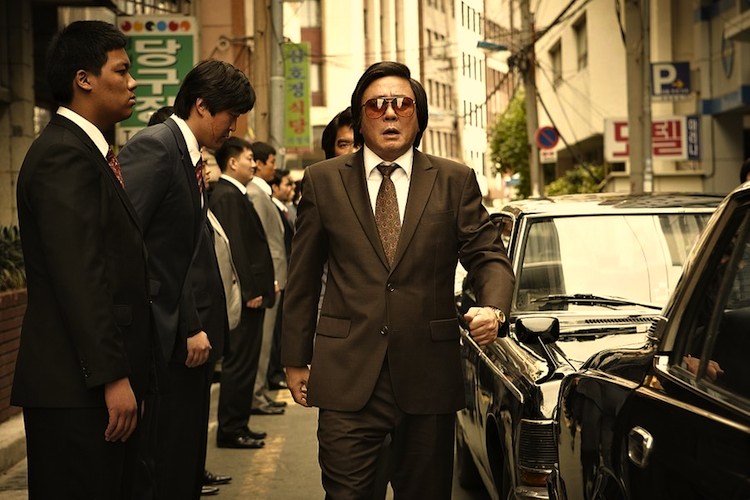
This Choi looks the part of a gangster. Though initially skeptical of the doughier Choi, the steely cool gangster comes to appreciate the value of the older man’s connections and his skill at exploiting them. For a while, they become a very profitable team. However, Choi Ik-hyun’s greed and vanity will lead him to flirt with his “god-son’s” chief rival, Kim Pan-ho, destabilizing their alliance. Gangsters always do that kind of thing.

From "Nameless Gangster."

Nameless is far broader in scope than a mere series of gangland rumbles. Nonetheless, when the Choi and Kim factions start bashing each other fifty shades of black and blue, it is quite impressively cinematic. Still, Yun is more concerned with the zeitgeist of the time, the ROK’s years of transitional democracy, while depicting the base cunning of a wanna-be consigliere.

Indeed, special festival guest Choi Min-sik is quite compelling as his slovenly namesake. It might sound like a role quite removed from the ferocious serial killer he played in I Saw the Devil. Yet both characters are small men who react desperately when their method of empowerment is threatened. However, it is Ha Jung-woo who really makes a lasting impression. Icily fatalistic, but not without the capacity for explosive rage, his Choi Hyung-bae is exactly the sort of performance that makes great gangster films tick. Likewise, Kim Seong-gyoon has a nice flair for ruthless and reckless villainy as the younger’s Choi’s lead enforcer.

It’s been a while since there was a mob movie with the sweep and ambition of Nameless. It certainly is good to have another one. Despite the wider historical context, Yun keeps the action gritty and violent. It is a big picture, but it has a tight focus. Enthusiastically recommended, it screens this Saturday (6/30) and next Tuesday (7/3) as part of the 2012 New York Asian Film Festival.

LFM GRADE: A

Posted on June 25th, 2012 at 11:40pm.