Aside from Battleship and classic naval war movies, we want to encourage LFM readers to spend Memorial Day watching a touching new documentary about real-life naval heroics from LFM contributor Steve Greaves, called Tin Can Sailors Will Not Be Forgotten. The film premieres this Memorial Day, Monday, May 28th on The Documentary Channel at 9:30pm EST/PST. You can watch Steve and other folks involved with the film talk about it above.
Tin Can Sailors tells the extraordinary World War II story of the USS Morris, a Sims Class destroyer that saw action from the North Atlantic all the way to the island-hopping campaigns against Imperial Japan. The Morris participated in a seemingly endless number of decisive battles during the war, including in the Battle of Coral Sea, the Guadalcanal campaign, the fighting around Leyte Gulf – and was nearly sunk by a kamikaze at Okinawa. For her efforts, the Morris received 15 battle stars for her action in World War II, placing her among the highest decorated American ships of the Second World War.
Tin Can Sailors tells the dramatic story of the Morris, and also documents how her remaining crew members to this day reunite to celebrate their service, and to honor their fallen shipmates who never made it back. Our own Steve Greaves co-directed the film, and also composed the film’s musical score. Tin Can Sailors is a moving tribute to the brave men and women of the Greatest Generation who fought the good fight and preserved our freedom, and we encourage LFM readers to take time out on Memorial Day to watch it on The Documentary Channel. You can also purchase the film here.
By Jason Apuzzo. Star Wars was released 35 years ago today. It’s hard to believe it’s been so long! All these years later, the original Star Wars and Errol Flynn’s The Adventures of Robin Hood are still my favorite films of all time. Unlike with Robin Hood, however – which I first saw on TV – I had the good fortune of seeing Star Wars when it first came out in theaters back in 1977. My six year-old imagination was completely overwhelmed, and I was hooked on the movies for good.
If memory serves, the trailer above represents all that many of us knew about the film prior to its release – and it was pretty exciting stuff. And although a lot has changed about the Star Wars universe since that time, it’s worth remembering how fresh, original and imaginative the film seemed back in 1977. I know that watching Star Wars in 70mm Dolby stereo with excited crowds at the then-Plitt Century Theater in Century City (Los Angeles) still represents the most fun I’ve ever had at the movies. And really, the film hasn’t changed that much for me after all these years – the many special editions and digital revisions aside. I still love the film, and I don’t think it’s ever been topped.
Writer-director George Lucas did a marvelous job with this film, breaking a lot of new ground and opening up a whole new imaginative universe to audiences and filmmakers. I’d say even more about the film, but I have to go over to the Toshi station right now to pick up some power converters. 😉 Congratulations on Star Wars‘ 35th.
By Joe Bendel. Two twelve year-old runaways would like to remake the generic sounding Mile 3.25 Tidal Inlet into a New England version of the Blue Lagoon, but they aim to maintain the cultural trappings of 1965 middle class America, as they relate to it, in the process. Unfortunately, the adult world keeps intruding on their private moments in Wes Anderson’s Moonrise Kingdom, the opening night film of this year’s Cannes Film Festival, which bows theatrically in New York tomorrow (Friday, 5/25).
Sam Shakusky is a terrible Khaki Scout. Actually, his skills are not that bad, but he does not fit in socially with Scout Master Ward’s troupe. Unbeknownst to Ward, Shakusky is an orphan, about to get the heave-ho from his foster family. However, the sensitive scout has successfully wooed Suzy Bishop, the eldest child of two self-absorbed yet profoundly unhappy attorneys.
When Shakusky fails to appear at revile one fateful morning, it sets off a manhunt throughout New Penzance Island, taxing the meager resources of Captain Sharp, Mrs. Bishop’s recently dumped lover. Chastely dedicated to each other, the two fugitives would like to permanently retreat from reality at the prosaically named inlet they duly redub “Moonrise Kingdom.” Instead, they will repeat a cycle of chase, apprehension, and escape, as a historic storm approaches New Penzance, as it always happens in an island-bound story.
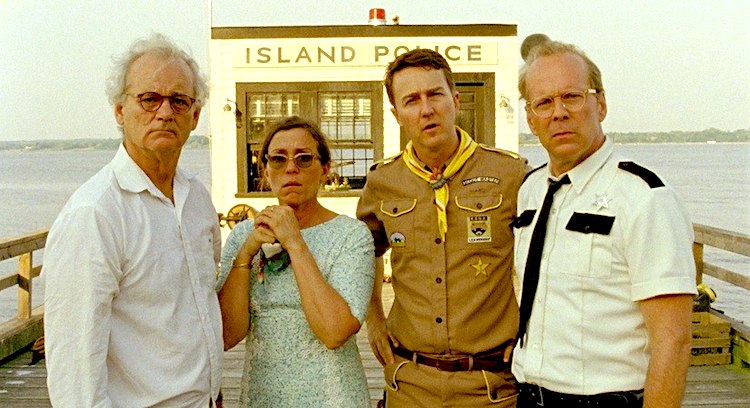
Bill Murray, Frances McDormand, Ed Norton and Bruce Willis in "Moonrise Kingdom."
It takes about ten seconds for Moonrise Kingdom to announce itself as a Wes Anderson film, through his constantly panning camera and the richly detailed vintage sets. Indeed, the attention to detail extends down to the covers of the chapter-books Bishop reads aloud to Shakusky. Yet, rather than detracting from his fable-like story, Anderson’s signature style is perfectly suited to the innocence of young love. Focusing on young POV characters is actually quite a shrewd strategy on his part, giving him the license to incorporate all kinds of nostalgic eccentricity (nod to Norman Rockwell? Check.) while staying faithful to their precocious worldview. Frankly, this is the sort of film a visual stylist like Tim Burton ought to be making, instead of aimless tent-poles like Dark Shadows.
As Mr. Bishop, Anderson mainstay Bill Murray once again plays a middle-aged depressive with deep-seated relationship woes. Fellow alumnus Jason Schwartzman is also back for more, getting some of Moonrise’s best comedy scenes as Cousin Ben, a slick operating senior Khaki Scout. Indeed, the film boasts several notably colorful supporting turns, including by Bruce Willis, acting his age and playing against his action hero persona as the put-upon Captain Sharp. Tilda Swinton also absolutely plays to the hilt the personification of bureaucracy known simply as “Social Services,” while the mere sight of Bob Balban’s “Narrator” in his bright crimson wardrobe generates laughter. Still, the dramatic load largely falls on the young newcomers, Jared Gilman and Kara Hayward, who are quite emotionally engaging leads, playing their scenes together scrupulously straight.
Essentially, Moonrise is a children’s movie for adults. Robert Yeoman’s cinematography gives it all a sensitive period sheen, while the soundtrack (dominated by the unlikely combination of Benjamin Britten and Hank Williams recordings, more than Alexandre Desplat’s original themes) effectively underscores the wistful vibe. Altogether, it is very Wes Anderson – but its gentle, humane spirit is quite winning. Recommended surprisingly highly (well beyond Anderson’s established circle of admirers), Moonrise opens tomorrow (5/25) in New York at the AMC Lincoln Square and Regal Union Square.
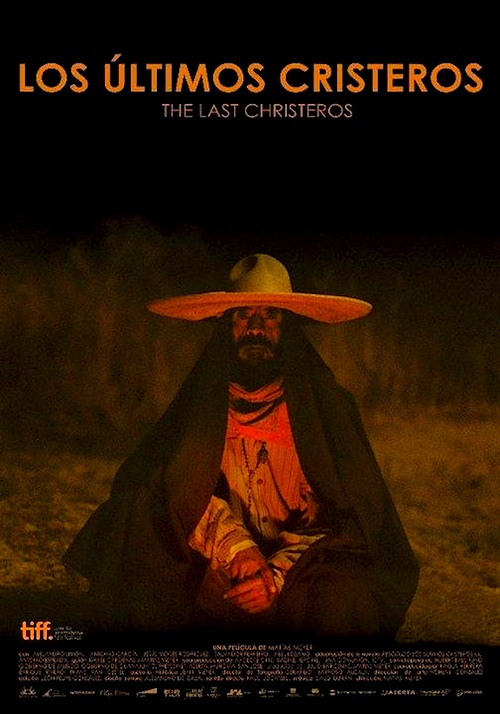
By Joe Bendel. One of the twentieth century’s bloodiest assaults on religious freedom happened in the western hemisphere. It was perpetrated by “revolutionary” Mexican socialist president Plutarco Calles, whose iron-fisted anti-clerical policies inspired a real grassroots revolution. By the 1930’s an uneasy and imperfect peace had been brokered, but scattered bands of Cristero resistance fighters held out as best they could. One of the final squads grapples with their destiny in Matías Meyer’s The Last Christeros, which screens during the 2012 Seattle International Film Festival.
Mexico is still a land of wide vistas John Ford could love, but it is steadily closing in on the Cristero remnants. Pursued by a company of Federales, Col. Florencio Estrada’s troops are running low on everything, including bullets. Word reaches them of an amnesty, which some of the men are willing to consider. However, Estrada has been down that road before. Calles had violated the terms of truces before, and the period of his unelected “Maximato” was still underway. Though he misses his wife and daughters, Estrada has long since realized he will meet his end through this war, one way or another.
To establish the stakes of the Cristero revolution, Meyer opens the film with the 1969 oral history recording of Francisco Campos, who very well may have been the last Cristero. However, that is about as deeply as the film delves into the political, historical, and religious significance of the civil war. Instead, Last Christeros (for some reason, the international title carries the Anglicized “h,” while most references to the Cristeros maintain the original spelling) is an impressionistic depiction of the trying conditions endured by the weary freedom fighters. Theirs is not an existential life, though. Rather, they live for a purpose.
Though the ensemble consists largely of neophyte actors, they all look convincingly gaunt and weathered. Alejandro Limon is particularly haunting as the dedicated (and/or resigned to his fate) Estrada. Yet the picture’s defining work is that of cinematographer Gerardo Barroso, who creates painterly-like tableau of the rugged terrain and hardscrabble villages the Cristeros silently trudge through. Galo Duran’s evocative soundtrack also helps set an appropriately wistful mood.
For those thinking the Cristero revolt would also readily lend itself to a more traditional historical drama take heart—Andy Garcia rides into theaters with For Greater Glory on June 8th. This mini-boomlet of interest in the Cristeros is actually quite timely. In an election year, it reminds us of the price many have paid for liberty. If not exactly a work of advocacy cinema, Meyer certainly respects the Cristeros’ sacrifices. Recommended for open minded cineastes, The Last Christeros screens again next Wednesday following (5/30) as part of this year’s Seattle International Film Festival.
By Jason Apuzzo. I wanted LFM’s regular readers to know that although I’ve been busy of late, I’m still keeping close tabs on what’s happening at your local multiplex. Here are some micro-reviews of important recent releases:
The Avengers
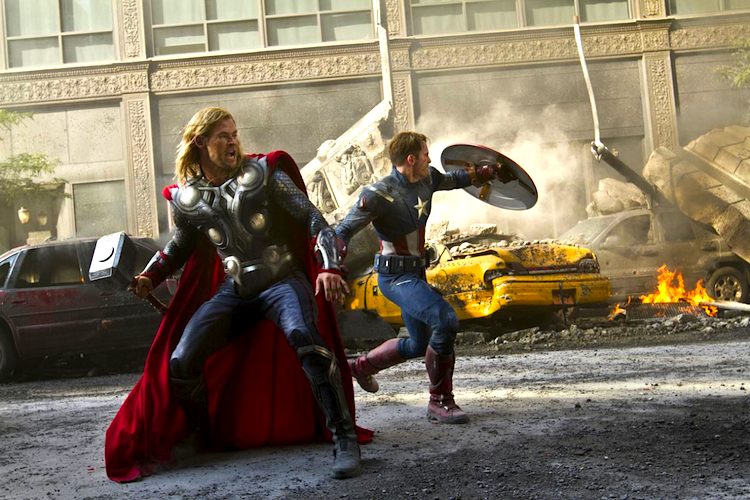
Sparkling interactions among the characters, an electrifying sequence aboard a floating aircraft carrier, cheeky good humor, and another breakout performance by Tom Hiddleston as Loki lift Marvel’s The Avengers far above conventional comic book fare – to the point that it’s already become its own event in pop mythology. Several things hold The Avengers back from being a gold-plated classic, though: trite assertions of moral equivalency between the good guys and the bad guys, cringe-inducing scenes involving goofy aliens, and a third act copied (lamely) from Transformers: Dark of the Moon. Still, you sense that this is what comic book movies were supposed to be like all along.
LFM GRADE: A-
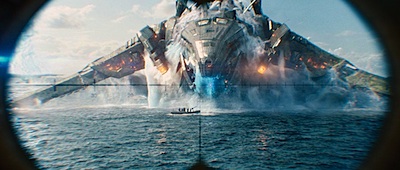
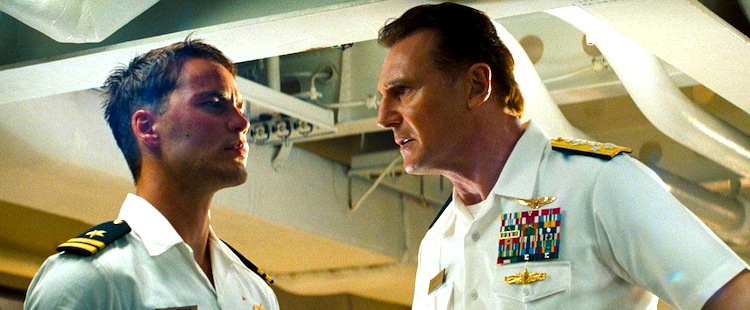
Spotting the enemy in "Battleship."
Battleship
After a dreadful first act involving a soccer game and a chicken burrito (don’t ask), Battleship settles in and delivers some exciting combat sequences – especially when the USS Missouri gets hauled out of mothballs to exchange ear-shattering salvos with an invading alien cruiser. Director Peter Berg – the son of a naval historian – takes the tactical, cat-and-mouse aspects of naval warfare (and of Hasbro’s board game) seriously, although he can’t summon a credible performance out of Taylor Kitsch – assuming that’s even possible. Kudos to Berg, however, for featuring real-life combat veterans in the cast like Col. Gregory Gadson, an inspiring Iraq war vet and amputee who brings an aura of seriousness to the movie’s otherwise over-the-top scenario. And if that’s not enough for you, there’s also Brooklyn Decker in a tank top.
LFM GRADE: B
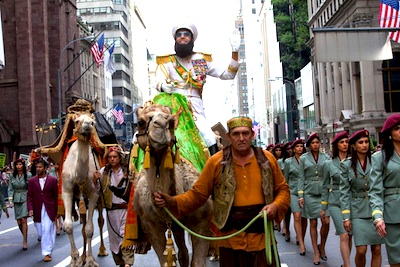
Admiral-General Aladeen enters New York in "The Dictator."
The Dictator
A treasure-trove of great gags at the expense of petty Middle Eastern tyrants is drowned away in a deluge of mindless vulgarity and gross-out humor, all of which probably should’ve netted this film an NC-17 rating. Writer-director-star Sacha Baron Cohen also throws in an obnoxious closing speech in which he essentially equates America with Middle Eastern dictatorships. Is this guy kidding? Take your dictators-are-brainless-narcissists act to Syria, Sacha, and see how well it plays with the local gentry. A major disappointment, and probably Cohen’s final shot at mainstream success.
By Jason Apuzzo. Memorial Day weekend is approaching, a time when Americans traditionally focus their attention on corn dogs, guacamole burgers and LeBron’s fading playoff hopes – but it’s also a time when we remember the men and women who’ve made the ultimate sacrifice for their country and for freedom.
And although Universal’s new film Battleship just capsized at the box office, unable to compete with the entertaining spectacle of The Avengers or Facebook’s Hindenburg-style IPO, it’s still a perfect excuse to take a look at The Top 10 Naval Warfare Movies of All Time.
Movies about America’s naval heroes – and there have been some great ones – teach us about courage under fire, about the importance of strategy, and recall a more romantic era when tactical masterminds made split-second decisions that changed the course of world history.
Old-school naval warfare in "Battleship."
Granted, America’s enemies these days don’t seem to like the water very much. Long gone are the days of legendary naval adversaries like Japan’s Isoroku Yamamoto (the Harvard-trained mastermind behind the Pearl Harbor attack), Germany’s Alfred von Tirpitz (whose submarines raised havoc during World War I), or even Britain’s Lord Sandwich – who somehow took time out from battling America’s Continental Navy to invent the sandwich.
Even the Russians don’t seem eager to confront the U.S. out in the open ocean, anymore – possibly due to the traditional Russian difficulty of keeping nuclear-powered ships afloat.
All of this is why Hasbro and director Peter Berg resurrected the cinema’s most reliable enemy, space aliens, to serve as the foe in Battleship.
And even though Battleship doesn’t make the Top 10 list below, as Memorial Day approaches the film may nonetheless put you in the mood to watch one of these classics of the World War II era and beyond, from the days when America proved her might – and sailors proved their mettle – by battling for supremacy on the high seas:
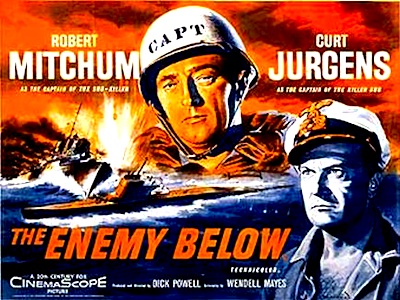
1. The Enemy Below (1957)
The Enemy Below pits laconic World War II destroyer captain Robert Mitchum against a craggy, war-weary German U-boat skipper played by Curt Jürgens. Mitchum and Jürgens play cat-and-mouse with each other across the south Atlantic, putting their tactical skill and nerves to the maximum test. And as their duel grows more intense, so too does their respect for one another. With a great musical score by Leigh Harline and directed by actor Dick Powell, The Enemy Below set the standard for realism in its day – although it’s Mitchum’s rivalry with Jürgens that puts the film over the top.
Best line: “I don’t want to know the man I’m trying to destroy.”
2. Destination Tokyo (1944)
Destination Tokyo stars Cary Grant as a conscientious sub captain who leads his crew on a daring mission from the Aleutian Islands to Tokyo Bay. Co-starring John Garfield as a skirt-chasing sailor named ‘Wolf’, and featuring colorful performances from Alan Hale and Dane Clark, Destination Tokyo brings the action like few other war films of its day. Grant’s sub torpedoes destroyers and aircraft carriers, and conducts bold night missions along the Japanese coast – all while dodging minefields, depth charges, bombs, even an appendicitis attack among its crew. Destination Tokyo was so good, it inspired a young Tony Curtis to join the Navy – years before he would appear on-screen with Grant in Operation Petticoat.
Best line: “Congratulations, Wolf … It’s been an hour since anything reminded you of a dame.”
3. Tora! Tora! Tora! (1970)
A mega-production that tells the story of the Pearl Harbor attack from both the American and Japanese perspectives, Tora! Tora! Tora! was so big that it needed three directors to make – one of whom initially was Akira Kurosawa. Tora! Tora! Tora! takes its history seriously, exploring the political and military context behind the infamous December 7th, 1941 raid. An epic film in every sense, including in its methodical pacing, Tora! Tora! Tora! shows what a complex, risky gamble the attack was for the Imperial Japanese – along with the many tactical failures on the American side that made it possible. In the pre-digital era, few war pictures seem bigger than Tora! Tora! Tora!, and the final attack sequence still looks incredible today – because so many of the pyrotechnics are real.
Best line: “I fear all we have done is to awaken a sleeping giant and fill him with a terrible resolve.”
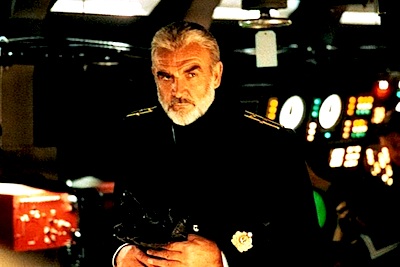
Sean Connery as Marko Ramius.
4. The Hunt for Red October (1990)
A signature film of the Cold War era and based on the famous Tom Clancy novel, The Hunt for Red October stars Sean Connery as Soviet sub captain Marko Ramius, who decides to defect to the U.S. and hand over his undetectable sub, the Red October, before the Russians can use it to launch World War III. Connery is perfect as the wily Ramius, and a young Alec Baldwin does a nice turn playing Jack Ryan before Harrison Ford took over the role in later films. A great musical score by Basil Poledouris – along with sharp performances by James Earl Jones, Sam Neill, Fred Thompson and Scott Glenn – rounds out this must-see classic.
Best line: “We will pass through the American patrols, past their sonar nets, and lay off their largest city, and listen to their rock-and-roll … while we conduct missile drills.”
5. Sink the Bismarck! (1960)
This neglected classic recounts the harrowing story of how Germany’s massive Bismarck battleship, the naval Death Star of its day, threatened to obliterate Britain’s Royal Navy – and actually did obliterate the HMS Hood, Britain’s most powerful battlecruiser. Sink the Bismarck! also dramatizes how blind luck often factors in to history’s most decisive battles. Strong performances by Kenneth More and Dana Wynter, as well as a colorful turn by Karel Štěpánek as Germany’s Admiral Lütjens, make Sink the Bismarck! key viewing for naval warfare buffs.
Best line: “We are unsinkable … and we are German!”
6. They Were Expendable (1945)
Director John Ford’s They Were Expendable brings an element of poetry and heightened realism to the genre in telling the story of how America’s PT boats fought the war against the Imperial Japanese in the Philippines. They Were Expendable stars John Wayne and Robert Montgomery – who actually commanded a PT boat during the war, and who took over directing the film when Ford (who shot footage of the Battle of Midway and also of D-Day for the Navy Department) fell ill. A sobering, moody look at the sacrifices made during wartime, and also at military innovation in the face of numerically superior forces, They Were Expendable was Ford’s last wartime film – and a memorable one.
Best line: “I used to skipper a cake of soap in the bathtub, too.”
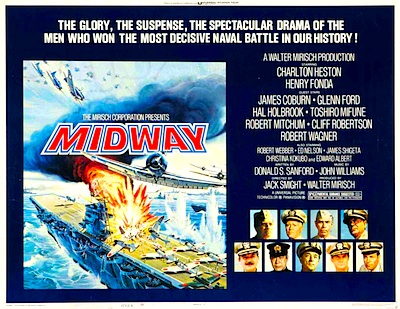
7. Midway (1976)
With a boffo cast featuring Charlton Heston, Henry Fonda, Robert Mitchum, Glenn Ford and Toshiro Mifune, and with music by John Williams, Midway recounts the decisive Battle of Midway on an epic scale. Although the film sometimes feels cobbled together with too much stock footage, Midway takes combat strategy more seriously than most war films – painstakingly setting up the options facing both the American and Imperial Japanese fleets in this crucial naval conflict that turned the tide in the Pacific. And even with Mifune playing Admiral Yamamoto, and Fonda as Admiral Nimitz, it’s Heston who steals the show as hard-ass Navy captain Matt Garth.
Best line: “‘Wait and see.’ We waited. December 7th, we saw. The ‘Wait and see’-ers will bust your ass every time.”
8. The Caine Mutiny (1954)
This exceptional adaptation of Herman Wouk’s novel is probably the finest film ever on the psychological strain of command. Humphrey Bogart (himself a former Navy man) was nominated for Best Actor for his iconic performance as Captain Queeg, who loses his composure – and possibly his sanity – during a dangerous typhoon, prompting his minesweeper crew to relieve him of duty. Scintillating performances by Fred MacMurray and José Ferrer, and vivid Technicolor cinematography by Franz Planer, round out this dramatic and provocative look at stress under fire. Plus, you’ll never look at a bowl of strawberries the same way.
Best line: “The first thing you’ve got to learn about this ship is that she was designed by geniuses to be run by idiots.”
9. Pearl Harbor (2001)
Michael Bay’s epic telling of the Pearl Harbor attack brought a new level of realism and detail to the depiction of combat – with ILM’s visual effects team re-creating not only the Japanese attack, but also the Doolittle raid and the Battle of Britain. Although the film’s romantic subplot never totally clicks, Pearl Harbor still packs an emotional punch once the Japanese raid kicks in – and the film’s old-fashioned, patriotic sensibility fits the subject matter perfectly. Bay’s team actually re-created a large-scale section of the doomed battleship USS Oklahoma and capsized it for the film. Don’t try that at home.
Best line: “I’ve got some genuine French champagne. From France.”
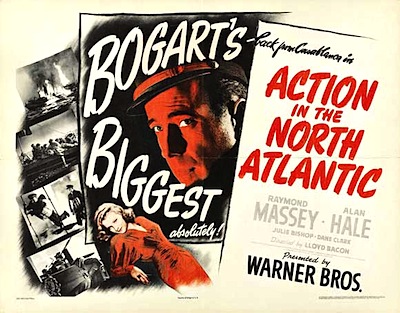
10. Action in the North Atlantic (1943)
Another classic from Humphrey Bogart, this wartime Warner Brothers gem was Bogie’s first film after Casablanca made him a superstar. Action dramatizes the vital role of the Merchant Marine in transporting armaments during World War II, as Bogie and Raymond Massey guide a Liberty ship on a harrowing mission to Murmansk – battling U-boats and the Luftwaffe along the way. Action is well-named, with more combat scenes than any World War II film outside of Destination Tokyo. And although the film was shot exclusively on the back lot, Bogie and Massey still made real-life dives off one of the film’s burning ships … after a few drinks.
Best line: “The trouble with you, Pulaski, is you think America is just a place to eat and sleep. You don’t know what side your future’s buttered on.”
Honorable Mentions: Crash Dive (1943), Operation Pacific (1951), In Harm’s Way (1965).
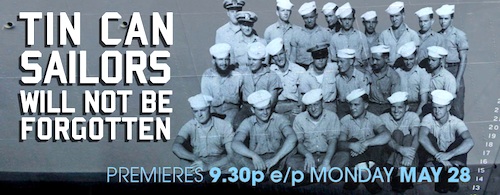 Tin Can Sailors tells the extraordinary World War II story of the USS Morris, a Sims Class destroyer that saw action from the North Atlantic all the way to the island-hopping campaigns against Imperial Japan. The Morris participated in a seemingly endless number of decisive battles during the war, including in the Battle of Coral Sea, the Guadalcanal campaign, the fighting around Leyte Gulf – and was nearly sunk by a kamikaze at Okinawa. For her efforts, the Morris received 15 battle stars for her action in World War II, placing her among the highest decorated American ships of the Second World War.