Tribeca 2012: LFM Reviews Whole Lotta Sole

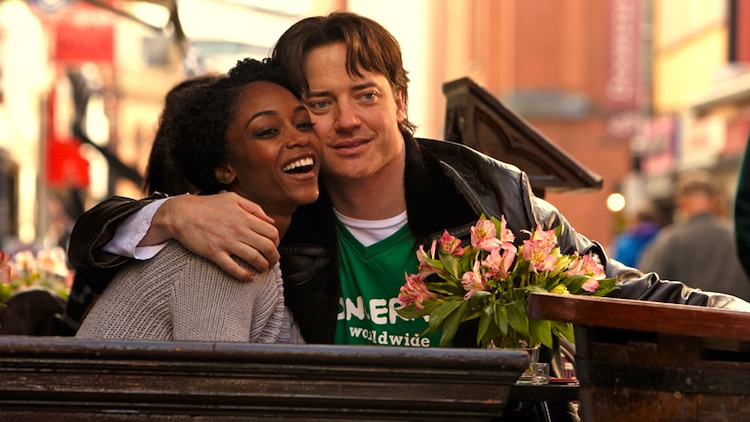
Yaya DaCosta and Brendan Fraser in "Whole Lotta Sole."

By Joe Bendel. If you haven’t heard, there are a fair number of Catholics in Belfast who are serious about their faith. As a result, a couple of luckless lowlifes think it would be a good idea to hold-up the fish market on a Friday night. Naturally, the caper quickly descends into chaos in recent Academy Award winner Terry George’s thoroughly entertaining Whole Lotta Sole, which screens during the 2012 Tribeca Film Festival.

It was Joe Maguire’s profound misfortune to marry the manic daughter of a Boston mobster bearing a strong resemblance to Whitey Bulger. Fearing for his life, he is hiding out in Belfast, minding his uncle’s antique shop. Though still quite jumpy, he starts cautiously courting Sophie, a beautiful Ethiopian refugee managing the record store across the street. Sad sack Jimbo Reagan thinks Maguire might be a figure from his past, but he is more concerned with the 5,000 pounds he owes the local paramilitary-turned-gangster Mad Dog Flynn.

Out of desperation, Reagan holds up the fish market, Whole Lotta Sole, but this turns out to be a bad idea. If you remember the Fulton Fish Market’s pre-Giuliani reputation, you will get the idea. With both the cops and Flynn out to get him, Reagan takes Maguire and Sophie hostage. From there, plenty of complications and miscommunications ensue.
Like Goldilocks, George (who just walked away with the Oscar for his gently forgiving short film, The Shore) maintains a tone than it light but not inconsequential. He injects plenty of humor into the story, but resists saccharine sentiment and self-conscious quirkiness. His sensitive treatment of Maguire and Sophie’s budding relationship is particularly refreshing, keeping them fully clothed throughout, while generating real sparks between them.

As Maguire, Brendan Fraser looks a wee bit young for the part, but he exhibits a kind of world weary everyman presence (really not seen in his prior films) that works quite well, nonetheless. Indeed, he establishes some genuine chemistry with the luminous Yaya DaCosta, whose smart, down-to-earth turn as Sophie ought to bring her to a new level of international recognition. Capping the picture off, Colm Meaney is perfectly cast as cranky but honest and decent Det. Weller. Sure, he has played many roles like this before, because he has such a flair for them.

Whole Lotta Sole is just a pleasure to watch. For a pure, broad-based crowd-pleaser, it is probably the pick of this year’s Tribeca. Highly recommended, it screens again tomorrow (4/25) and Saturday (4/28).

LFM GRADE: A

Posted on April 24th, 2012 at 12:46pm.
Tribeca 2012: LFM Reviews Francophrenia

By Joe Bendel. Prepare yourself for an act of slumming as performance art. If you were somewhat bemused by James Franco’s decision to play a recurring guest-starring role on the soap opera General Hospital, you will wonder why you wondered after watching Francophrenia (Or: Don’t Kill Me, I Know Where the Baby Is), the actor’s latest extended middle finger to his ever more beleaguered fans, co-directed with Ian Olds, which screens during the 2012 Tribeca Film Festival.

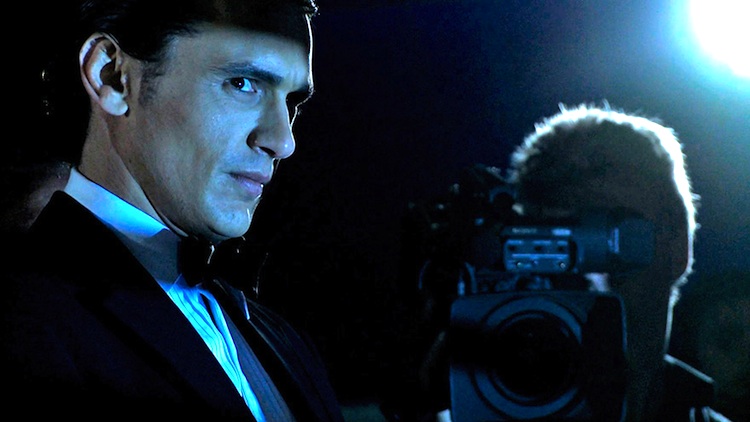
Evidently, a baby has been kidnapped from the famous fictional hospital, but Franco (and presumably Olds) considers that plot line too trite to bother explaining for Francophrenia’s audience. All we need to know is that James Franco magnanimously lent his prestige to the soap, as long as he played a killer also called Franco. Ostensibly, Francophrenia documents the production of an extra special episode filmed on location at the Museum of Contemporary Art in Los Angeles, but anyone expecting a candid behind-the-scenes look at the show will be sorely disappointed.

Instead, we watch long sequences of the clearly disinterested subject signing autographs and sitting in make-up, while voiceovers try to pose a dichotomy between Franco the actor and Franco the character, calling into question which is ascendant in any given scene. The problem is that neither ‘Franco’ is sufficiently established to create any dramatic or aesthetic tension between the two. All we know is that Franco the construct is a murderer, whereas Franco the NYU film school grad co-directed Francophrenia – which is absolute blue murder to watch. Essentially, this film is like the old Airplane! sunglasses gag. When you peel away one Franco smirk, you only find another smirk underneath.

Frankly, Francophrenia never deconstructs or subverts soap operas (or documentaries) in any meaningful way. We simply watch Franco float above it all on his cloud of hipster superiority. While allegedly an experimental film, Francophrenia suggests that the co-directors have only a cursory familiarity with the genre. The mere fact that Franco would deign to associate with such low brow daytime dramatic fare is thought to be sufficiently intriguing in and of itself. Indeed, the only real take-away from the film is the nauseating contempt Franco (the actor or the construct, it hardly matters which) so obviously has for fans of the show. However, he might just miss those rubes when they are gone.

Ultimately, Francophrenia is not a film, nor is it a concept. It is simply another manifestation of Franco’s continuing fascination with his own celebrity. Franco’s fans should be strongly dissuaded from seeing it, because it might be a rather bitter experience for them. They will find the joke (if it can be called that) is at their expense. Of course, there is no reason for the rest of us to endure it either, but for those looking to masochistically stoke their anti-Franco resentments, Francophrenia screens again tonight (4/24) and Saturday (4/28) as part of the Tribeca Film Festival.

LFM GRADE: F

Posted on April 24th, 2012 at 12:44pm.

New Trailer for G.I. Joe: Retaliation; Film Opens June 29th

Check it out above. The film stars Dwayne Johnson as Roadblock, Bruce Willis as the original ‘Joe,’ Adrianne Palicki as Lady Jaye, Channing Tatum as Duke, Ray Park as Snake Eyes and Jonathan Pryce as the President of the United States.

It’s going to be a busy summer …

Posted on April 24th, 2012 at 12:43pm.

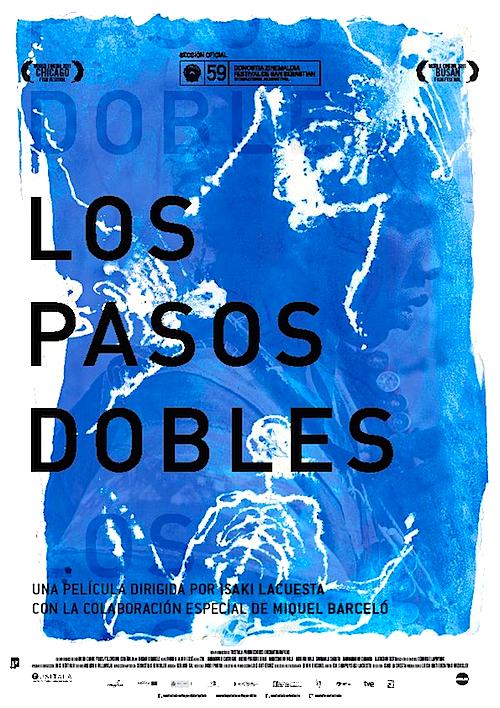
LFM Reviews The Double Steps @ The 2012 San Francisco International Film Festival

By Joe Bendel. Francois Augiéras definitely painted for posterity. After vandals destroyed a set of his desert bunker murals, he painted another, deliberately burying all signs of it in the sand. The European expatriate painter would only trust future generations to respect his work. Both a fictional Malawian and Spain’s leading contemporary artist Miguel Barceló search for those lost murals in Isaki Lacuesta’s odd hybrid The Double Steps, which screens during the San Francisco Film Society’s 2012 San Francisco International Film Society.

Augiéras does not appear directly in Steps, but his spirit appears to inhabit Abdallah Chambaa, a former soldier, mustered out of service by his commanding officer uncle, with whom he was involved in an incestuous relationship. Chambaa soon becomes as bandit, as former soldiers often do, but he also has a compulsion to paint. Periodically, Steps also follows Barceló in real life Mali, producing new work inspired by Augiéras and searching for the legendary murals.

Frankly, Steps is probably more interesting to read and write about than to watch. In no way should it be thought of as Raiders of the Lost murals. Feverish in tone, it has a loose narrative, featuring frequent shifts in time that are sudden, yet ill-defined. Lacuesta also simultaneously shot a documentary about Barceló that probably offers more of the historical and artist context many viewers might be wondering about.

From "The Double Steps."

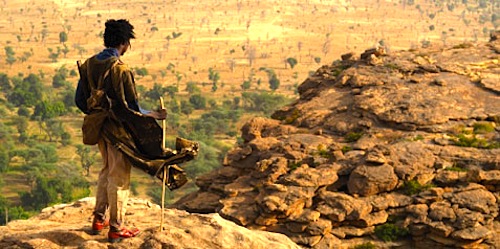
Lacuesta’s hazy style keeps his cast at an emotional arm’s length from the audience. At least Diego Dussuel’s breath-taking cinematography somewhat pulls them back in, capturing the rugged beauty of Mali’s landscape, especially the cliffs Barceló explores looking either for Augiéras’ murals or his own inspiration. Steps is a film anyone seriously dealing with art cinema will eventually have to take into account, making it a completely appropriate, even valuable, programming selection for the festival. However, those looking for an unpretentious film to get caught up in should probably look elsewhere.

In fact, there are some great films to choose from at this year’s SFIFF, including the inspiring and infuriating Ai Weiwei: Never Sorry, Hong Sang-soo’s characteristically clever The Day He Arrives, the intriguing interconnected German trilogy Dreileben, the outstanding documentary-lament for Cambodian cinema Golden Slumbers, Mohammad Rasoulof’s timely but intimate Goodbye, the surprisingly effective true story of French injustice Guilty, the breezy profile of the festival’s honored guest Pierre Rissient: Man of Cinema, the cerebral science fiction fable Target, Andrea Arnold’s challenging adaptation of Wuthering Heights, and Carol Reed’s always classic The Third Man. Undoubtedly an interesting work best appreciated self-selecting cineastes, The Double Steps also screens again tonight (4/24) as part of this year’s San Francisco International Film Festival.

LFM GRADE: C+

Posted on April 24th, 2012 at 12:42pm.

Internet Freedom in China: LFM Revews High Tech, Low Life @ Tribeca 2012

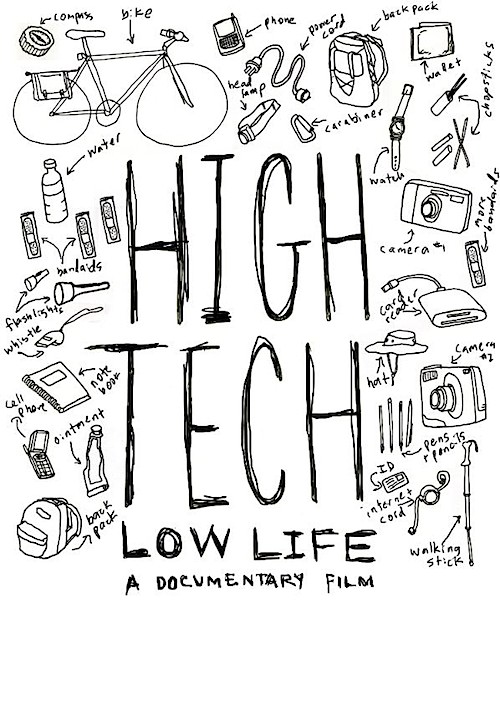
By Joe Bendel. The internet scares the willies out of the Chinese Communist Party. As a result, they have devoted tremendous resources to censoring underground journalist-bloggers. Yet their biggest challenge is not technological, but the sheer size of China’s discontented population. Huge numbers of average Chinese citizens have turned to the web as a source of unvarnished news and as a means of exposing official corruption. Stephen Maing follows two very different but very independent bloggers in High Tech, Low Life, the best non-music related documentary screening at the 2012 Tribeca Film Festival.

Twenty-seven year-old Zhou Shuguang, better known as Zola, will not deny he likes to get attention online. Posting candid photos of himself is part of his shtick. Whether he stirs up positive or negative comments hardly matters to him. It would be easy for some to dismiss the vegetable hawker, until he breaks the story of a middle school girl whose rape and murder, allegedly at the hands of a local official’s son, was covered up by the authorities.

While Zola largely fits the merry prankster revolutionary template, Zhang Shihe, a.k.a. Tiger Temple, is more akin to traditional anti-Communist dissidents. The son of a prominent Party leader purged during the Cultural Revolution, Tiger Temple has witnessed Communist oppression up close and personal throughout his life.

A more reflective blogger, Tiger Temple has documented the destruction of small provincial communities by rampant unchecked pollution, including the illegal dumping of raw human sewage. Not just raking the muck (and foul muck it is), Tiger Temple helps small, overwhelmed village councils draft complaints and package NGO presentations. Frankly, it is a leadership role that makes Tiger Temple a serious threat to the authorities.

While not as extreme as the circumstances facing dissident artist Ai Weiwei, both bloggers find themselves on the business end of Communist harassment as the film progresses. Obviously these are disturbing developments, particularly for Tiger Temple, but it clearly indicates Maing chose his POV-figures wisely.

By documenting the bloggers’ work, Maing has produced an expose of the pervasive graft throughout all levels of Chinese government by osmosis. It is also a profile of courageous truth-tellers (again, especially so in Tiger Temple’s case). If anything, the film might be slightly out of balance, seemingly granting more time to the admittedly attention-seeking Zola than Tiger Temple, who radiates hard-earned wisdom and gravitas.

Whether viewers are China-watchers concerned about the fate of citizen journalists such as Zola and Tiger Temple or Wired readers intrigued by the secret information war raging between dissenting bloggers and the Chinese authorities, HT,LL is a fascinating, alarming, and inspiring film, all at the same time. Clearly the best current events documentary at this year’s Tribeca, it screens again this Wednesday (4/25) and Saturday (4/28) as the festival continues in New York City.

LFM GRADE: A

Posted on April 23rd, 2012 at 2:37pm.

Epic Epicness: LFM Reviews Warriors of the Rainbow—Seediq Bale

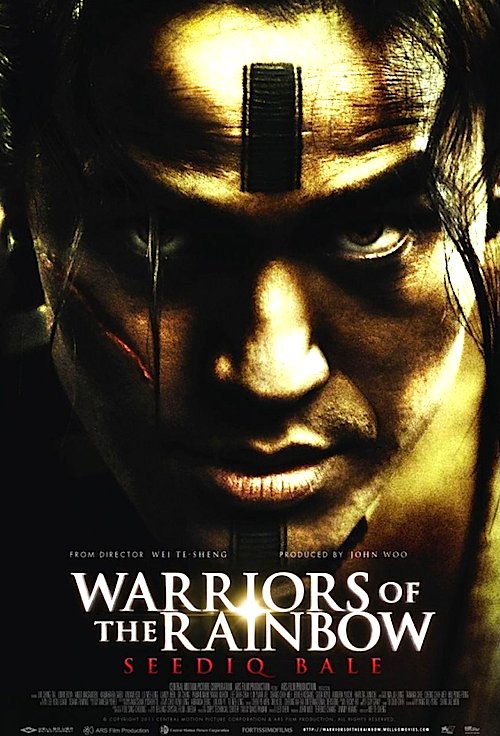
By Joe Bendel. For the aboriginal peoples indigenous to Taiwan, decapitating an enemy’s head in battle was an essential rite of manhood. In the early twentieth century, the occupying Japanese began the systematic suppression of aboriginal culture. It would cost them a whole lot of heads. Originally well over four hours long, Wei Te-sheng’s Warriors of the Rainbow: Sediq Bale in its more theatrical booking-friendly two and a half hour international cut opens this Friday in New York.

Mouna Rudao was one of the fiercest Seediq warriors ever. When the Japanese confiscate his collection of skulls, they are duly impressed. Unfortunately, as chief he must watch as the old ways atrophy under their oppressive rule. The tattoos of manhood are becoming scarce. However, this will change during the 1930 Wushe Uprising.

It started with a misunderstanding between Mouna’s family and the local Imperial authorities, snowballing from there. The Seediq forces strike first, ambushing the Japanese at a major sporting exhibition. Things only get bloodier thereafter. Frankly, Mouna knows their revolt is doomed to fail, but at least the young Seediq men will die as warriors, crossing over the Rainbow Bridge to their equivalent of Valhalla.

Submitted by Taiwan as their most recent official foreign language Academy Award candidate, Rainbow was released as two films in most Asian markets. However, the edited and cobbled together international version makes perfect sense from a narrative standpoint and includes plenty of Braveheart-style action. One suspects the axe fells disproportionately heavily on the female cast, including the great Vivian Hsu, who are rarely seen in the 150 minute cut until an emotionally devastating scene late in the picture.

It is too bad Mel Gibson went more or less insane, because he would have been the perfect celebrity “presenter” for Rainbow, executive-produced by John Woo, no less. There are death-scenes that will make you exclaim out loud. Yet, despite the frequent references to the Rainbow Bridge, there is little that could be deemed mystical or New Agey about the film, at least in its international configuration. It also resists the temptation to glorify Seediq traditionalism, unequivocally suggesting tribalism undermined their efforts to defeat the Imperial Japanese with a united front.

Lin Ching-Tai is all business as the steely old Mouna. He might just the best middle-aged action hero since the Eastwood of decades ago. Yet young Lin Yuan-Jie might be the most engaging member of the ensemble cast. There is absolutely nothing cute or cloying about his riveting work as Pawan Nawi. Japanese actor Sabu Kawahara also somehow manages to elevate the role of the stereotypically severe General Kamada Yahiko, while Chie Tanaka is memorably vulnerable as the wife of a relatively sympathetic Imperial officer.

Rainbow parallels the pronounced trend in current Mainland and Hong Kong films depicting Japanese characters in explicitly villainous terms. Indeed, the impulse to constantly re-fight WWII is becoming rather suspicious. Be that as it may or may not be, there is no denying Rainbow delivers the epic action goods. This is a big, bloody picture, serving as a perfect example of the bold filmmaking fostered by Fortissimo Films. Definitely recommended for fans of large scale historical action films, Rainbow opens this Friday (4/27) in New York at the AMC Empire.

LFM GRADE: B

Posted on April 23rd, 2012 at 2:36pm.