LFM’s Sundance Diary & Final Thoughts on the Festival

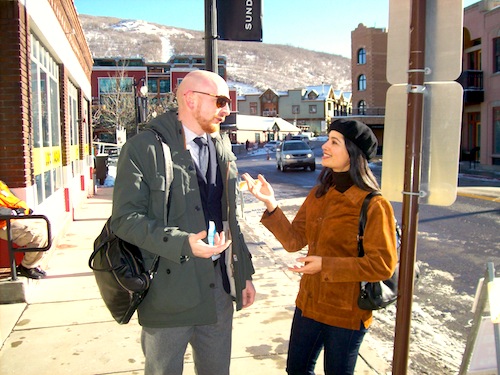
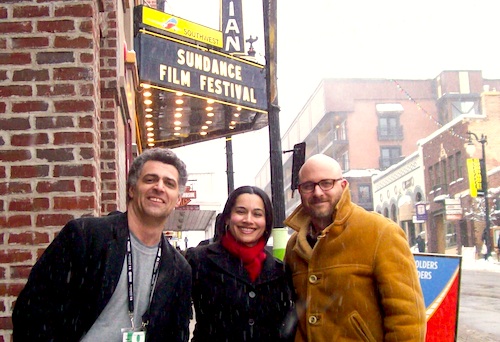
LFM's Joe Bendel, Govindini Murty & Jason Apuzzo at the 2012 Sundance Film Festival.

By Govindini Murty. Sundance sets the tone for the entire film industry in North America. Its spirit of supporting creativity, talent, and scrappy innovation is one we heartily applaud here at Libertas. We also applaud the fact that in recent years Sundance has become a home to so many pro-freedom films. To name just a few, these have included Mads Brügger’s daring expose of North Korean Communism The Red Chapel (2010), Chris Morris’ brilliant satire of Islamic terrorism Four Lions (2010), and Lee Tamahori’s intense anti-Saddam Hussein thriller The Devil’s Double (2011).

The 2012 Sundance Film Festival continued this tradition. Pro-freedom films screened at the festival included: Ai Weiwei: Never Sorry, about dissident Chinese artist Ai Weiwei’s efforts to expose the brutality of the Communist Chinese government; The Other Dream Team, about the Lithuanian basketball team and their struggle to overcome Soviet influence; Putin’s Kiss, about the turn toward authoritarianism amongst the Nashi youth movement in Putin’s Russia; and Mads Brügger’s The Ambassador, a witty and politically-incorrect expose of corruption in central Africa. There were also a host of entertaining and well-made narrative dramas and comedies this year. A few we at Libertas enjoyed included The Raid, Grabbers, and Shadow Dancer.
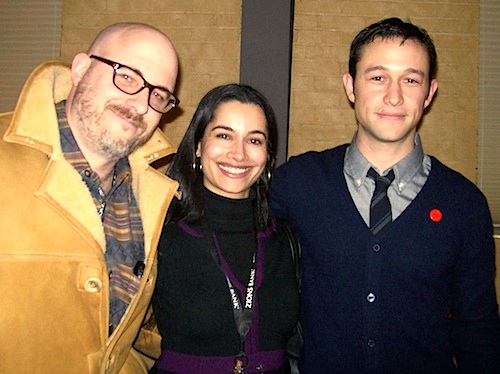
LFM's Jason Apuzzo & Govindini Murty with Joseph Gordon-Levitt at Sundance 2012.

Jason and I arrived at Sundance on Monday, January 23rd. Libertas super-contributor Joe Bendel had already been at the festival since opening night on January 19th, and had managed to fit in an astounding number of films that first weekend. Because we admire the Zen warrior-monk focus Joe brings to writing movie reviews, the first thing we did when we arrived in Park City was meet up with Joe on Main Street – the central artery through which all things Sundance flow. Snow flakes were falling and the lights were twinkling on the picturesque street as we all met up in front of the famed Egyptian Theatre.

Slipping and sliding through the snow and invigorated by the air of good cheer around us, we headed with Joe down the street through the crush of festival goers and filmmakers to plan our film-going strategy. With approximately 180 films showing at Sundance, many playing simultaneously in multiple venues, careful coordination is integral to having a successful Sundance experience. As we hurried down Main Street, we ran into Paul Giamatti (looking avuncular with a fuzzy beard), and Jason spotted Kate Bosworth (there promoting her thriller Black Rock). Jason wanted to ask her whether she did her own surfing in Blue Crush, then thought better of it.

The first Sundance film we had scheduled for that night was an 11:45pm screening of Grabbers – a campy, sci-fi Irish alien-invasion movie. Sundance’s Park City at Midnight screenings are where the festival shows its genre films, and the raucous crowds that attend these screenings often provide a lively show of their own. The screening of Grabbers was great fun, with the mostly drunken crowd hooting and hollering throughout the screening, and we agreed the film had a good chance at getting distribution. In fact, Jason spotted some distribution execs he recognized walking into the theater. We would have stayed for the Q & A with the filmmakers, but it was 2:00am and we were scheduled to attend the coffee chat with Stan Lee at 9:00 the next morning. This was something we would have to get used to at Sundance: sleep deprivation.
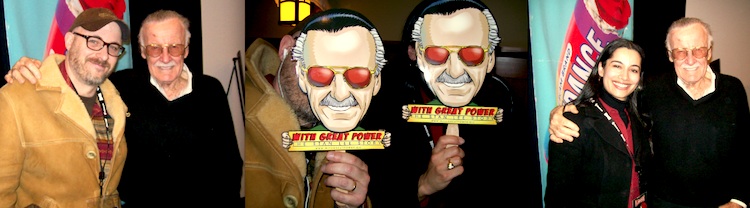
LFM's Jason Apuzzo & Govindini Murty with Stan Lee at the 2012 Slamdance Film Festival.

Tuesday, January 24th’s highlights were most definitely Slamdance’s two-hour coffee chat with Stan Lee in the morning, followed by the screening of his film With Great Power: The Stan Lee Story that afternoon. Slamdance is the fun, ‘alternative’ festival to Sundance, and is really worth a visit.  Jason has already described this wonderful event with Stan Lee in detail, but let me just add how charming, witty, and delightful Stan is in person. He was truly gracious when we met him, with a big smile on his face and a roguish twinkle in his eye. We bonded with him over our mutual love of classic film and all things Errol Flynn, and had fun asking him questions about his work and inspiration during the course of the two-hour master class/coffee chat. We would have loved for Joe to have attended this event with us, but Joe was scheduled to leave Sundance Tuesday morning for New York, so we bid him adieu the night before. Continue reading LFM’s Sundance Diary & Final Thoughts on the Festival

LFM’s Jason Apuzzo & Govindini Murty at The Huffington Post and AOL-Moviefone: The Most Provocative Filmmaker in the World: A Conversation With Mads Brügger on The Ambassador

Filmmaker Mads Brügger, director of "The Ambassador" at the Sundance Film Festival.

[Editor’s Note: The post below appears today on the front page of The Huffington Post and AOL-Moviefone.]

By Jason Apuzzo & Govindini Murty. His documentaries have been among the most provocative films featured in the Sundance Film Festival over the past several years. Bolder even than Sacha Baron Cohen, he’s punk’d both the North Korean communist government and now, in his new film The Ambassador, the Central African Republic and the corrupt diplomatic culture that supports it.

He’s one of Europe’s funniest and most controversial filmmakers, although most Americans haven’t heard of him — yet.

The name of this lanky, cerebral enfant terrible is Mads Brügger.

In Brügger’s previous film The Red Chapel (read the Libertas Film Magazine review of the film here), winner of Sundance’s 2010 World Cinema jury prize for documentaries, the filmmaker pulled off one of the most dangerous and politically provocative stunts in cinema history by infiltrating North Korea as part of a fake socialist comedy group. Operating under the watchful (and vaguely confused) gaze of the North Korean government, Brügger’s cameras proceeded to document the bizarre, Orwellian nether-world of today’s Pyongyang and its frightening cult of the ‘Dear Leader.’

In his new film The Ambassador (read the Libertas Film Magazine review of the film here), which recently screened at Sundance, Brügger now attempts an even more complex and daring stunt by purchasing a Liberian diplomatic title and infiltrating one of the most dangerous places on Earth — the Central African Republic (CAR) — as an ersatz Ambassador. His purpose? To expose the illegal blood diamond trade — and the corrupt world of CAR officials, bogus businessmen and shady European and Asian diplomats that it benefits.

Like a tragicomic version of Conrad’s Heart of Darkness, The Ambassador takes viewers into a rarely-seen world of European influence-peddlers who exploit the African continent — and the amoral retinue of African officials, petty businessmen and hangers-on who are complicit in the exploitation.

Along the way Brügger and his hidden cameras have close encounters with everything from an obese ex-French Legionnaire heading the CAR’s state security (who is assassinated shortly after talking to Brügger), to armed militias in the middle of Africa’s ‘Triangle of Death,’ to a diamond smuggler with a secret child bride and potential terrorist ties, to a tribe of inebriated pygmies organized by Brügger to staff a match factory.

Mads Brügger talks with Jason Apuzzo at Sundance.

It all makes for a potent, carnivalesque and politically incorrect experience — and one that exposes the mutual racism (of Europeans toward Africans, and Africans toward Europeans) that makes central Africa such a hotbed of corruption and violence.

In the midst of all this is Brügger himself — a tall, soft-spoken Danish journalist (and son of two Danish newspaper editors) with an ironic sense of humor and an uncanny ability to transform himself into the kind of diffident European grandee that African officials are accustomed to exploiting — and being exploited by — well into the 21st century.

Along with my Libertas Film Magazine co-editor Govindini Murty, I sat down with Brügger at the Sundance Film Festival to talk about his funny, horrifying and highly controversial new film. With a shaved head, and wearing a skull ring from DC Comics’ The Phantom, Brügger arrived looking very much the part of an experimental European director.

Apuzzo: What got you interested in [corruption in the Central African Republic] as subject matter for a film?

Brügger: I like doing films that divert from their own genre. I wanted to do an Africa documentary without all the usual semiotics and codes of the generic Africa documentary. You know — NGO people, child soldiers, HIV patients, and so on. But also I wanted a film where you would meet all the people you usually don’t get to see – you know, the kingpins, the players, the ministers who live a very secure and comfortable life away from the scrutiny of the media. So I thought that if I could purchase a diplomatic title, I could gain access to this very closed realm of African state affairs and politics. It’s pretty much a ‘let’s-see-what-happens’ project. Once we set off to do this, who will we meet? What kind of people will I run into?

Mads Brügger talks with Govindini Murty at Sundance.

Apuzzo: How did you prepare to become a corrupt European diplomat?

Brügger: [Laughs.] I prepared for almost three years, because I wanted to really go into detail with my persona. I would go to receptions, embassies in Copenhagen, especially the Belgian embassy because they have a lot of African diplomats coming there. I noticed all the telltale signs, the do’s and don’ts of how diplomats behave and carry themselves. For instance, when they’re having cocktails they like to fold their napkin into a triangle and then wrap it around the glass. I think it’s because they don’t want to leave fingerprints, but I don’t know for sure. [Laughs.]

The most popular cigarette amongst African diplomats are red Dunhills. The most popular liquor is Johnny Walker Black Label. You know, things of that order. At the same time, I also wanted my ‘character’ to be packed with various archetypes, and characters from comic books: Dr. Müller in Tintin, Bernard Prince (a Belgian comic book hero), even the Man with The Yellow Hat from Curious George. Continue reading LFM’s Jason Apuzzo & Govindini Murty at The Huffington Post and AOL-Moviefone: The Most Provocative Filmmaker in the World: A Conversation With Mads Brügger on The Ambassador

LFM Reviews the 2012 Oscar Nominated Shorts: Live Action

By Joe Bendel. Last year, Luke Matheny won the best live action short Oscar for God of Love and delivered the best acceptance speech of the night. He had respectable competition for the former but practically none for the latter. This year’s field also looks relatively competitive, but viewers can judge for themselves when the Academy Award nominated live action shorts program opens this Friday in New York at the IFC Center.

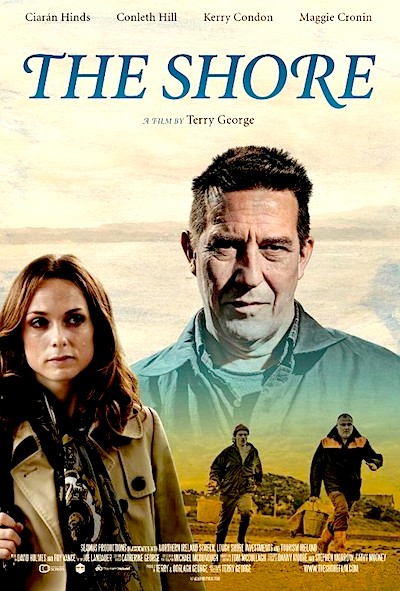
If this year’s Oscar nominated short form animation has a Canadian flavor, the live action shorts have a slight Irish disposition, at least according to some definitions. As it happens, one of the best contenders hails from North Ireland. Regardless of identity issues, Terry George’s The Shore (trailer here) is probably the film to beat. It hardly hurts that George is a highly regarded filmmaker, already twice nominated in screenplay categories. The Shore also stars an actor viewers will recognize: Ciarán Hinds, currently seen in finer theaters as “Soldier” in Tinker, Tailor, Soldier, Spy.

Yes, The Shore addresses the troubles, but not in a polarizing context. Twenty-five years ago, Jim Mahon’s grandfather was spooked by the escalating violence and trundled the young man off to the American relations. He has finally returned with his grown daughter to make peace with his former best friend and the woman he jilted. Although it is more of a drama than a comedy, Shore has a wry, knowing sensibility that should appeal to popular audiences. Rather than dwell on Belfast’s battle scars, George captures the picturesque landscape of Northern Ireland. One of the great actors of our day, Hinds is perfect as the conflicted Mahon and Kerry Condon is appealingly smart and down to earth as his daughter.

Unfortunately, the proper Irish contender is not nearly as rich. An incompetent choir boy is offered a chance to redeem himself in Peter McDonald’s slight Pentecost. However, the big mass plays out as a childish rebellion fantasy at the expense of the mean old Catholic Church.

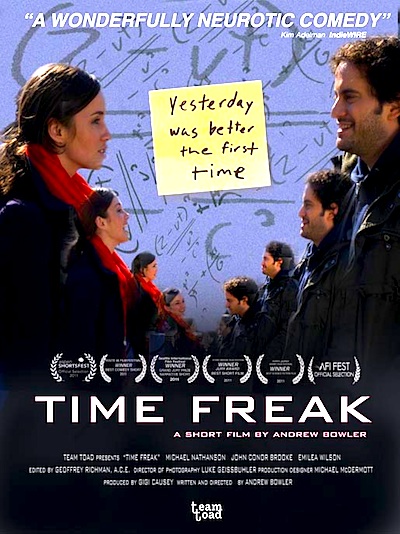
Though also relatively short, Andrew Bowler’s genre comedy Time Freak (trailer here) is easily the most entertaining live action nominee. An obsessive scientist has developed a time machine, but his regular guy best friend is alarmed by the self-defeating ways he has been applying his breakthrough. A very funny film, Freak is similar in tone to some of the original Twilight Zone episodes that played it strictly for laughs.

There are not a lot of laughs in Max Zähle’s Raju (trailer here). There are not a lot of surprises where this international adoption morality play is headed either, but it is executed quite well, especially for a student film. Shortly after Jan and Sarah Fischer adopt the title character, he disappears under mysterious circumstances. However, as the German would-be father searches for Raju, he learns troubling facts about Raju’s circumstances. Filmed on the streets of Kolkata (a.k.a. Calcutta), it conveys a sense of the city’s teeming poverty and sets up the protagonists’ ethical dilemma rather effectively.

Another international award winning student film, Hallvar Witzø’s Tuba Atlantic offers an Academy-friendly blend of quirk and heart-string pulling. Given exactly six days to live, grouchy old Oskar Svenning sets out to contact his estranged brother in America via the monster tuba they constructed on the shore. Although he stubbornly refuses help, a young Evangelical Christian insists on acting as his “angel of death.” While innocent Inger might sound like a hopeless caricature, Ingrid Viken plays her with a fair degree of innocent charm. Granted, it is unabashedly sentimental, but the unrestrained war Svenning wages against the pesky seagulls is frequently quite amusing.

Either Time Freak or The Shore would be deserving Oscar winners. Both are thoroughly engaging and satisfying films. If not at the same level of accomplishment, Raju and Tuba are certainly perfectly respectable, falling somewhere on the spectrum between good and nice. Altogether, the 2012 live action Oscar nominees are a strong group, mostly recommended as films in their own right as well as for their Academy Award interest. They open this Friday (2/10) in New York at the IFC Center as part of the annual showcase of nominated short films.

Posted on February 9th, 2012 at 10:55am.

LFM Reviews 2012 Oscar Nominated Shorts: Animation

By Joe Bendel. The Oscar field for best animated short film has a distinctly Canadian flavor this year. After Cordell Barker’s delightful short-listed Runaway fell short of a nomination in 2010, the National Film Board of Canada returned to Academy Award contention this year, netting two nominations for their short animated productions, bringing their grand total nominations to seventy-two in seventy-three years of operation. Both screen as part of the annual showcase of Academy Award nominated shorts, which opens this Friday in New York at the IFC Center.

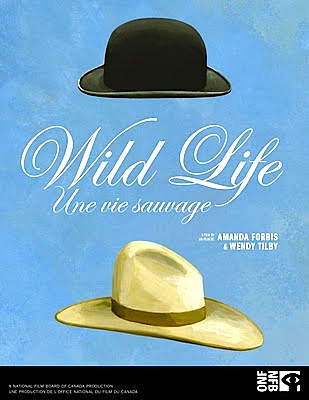
While nature plays a role in Amanda Forbis & Wendy Tilby’s Wild Life, as well as Patrick Doyon’s Diamanche (Sunday), they also share a weird, off-kilter sensibility. One of the strongest nominees, Wild Life is ostensibly a fish out of water tale about one of the many British ne’er do well gentleman who came to Western Canada to seek their fortunes as ranchers. Most of them made poor cowboys and Wild’s protagonist is no exception. While the culture clash themes are cleverly addressed, there is a subtle undercurrent of David Lynchian menace that really distinguishes the film.

Shifting regions, Quebecois Patrick Doyon tells a relatively simply tale of a young boy, once again enduring his family’s Sunday rituals in Dimanche (trailer here). However, it takes a trippy detour involving a bear. It is strange and somewhat sad, just like childhood.

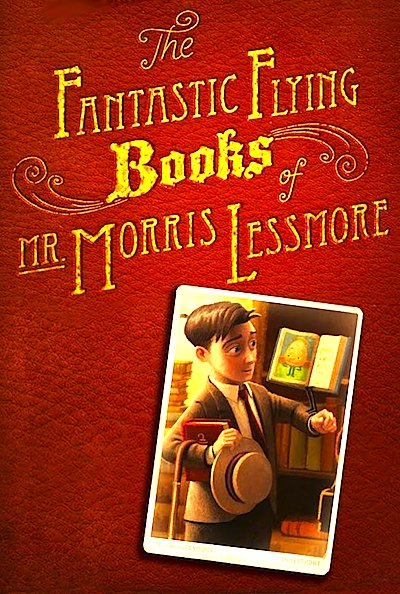
Perhaps the strongest nominee, coincidentally considered the frontrunner, also has a very strong sense of place, but in this case it is Louisiana. Produced entirely within the state, William Joyce & Brandon Oldenburg’s The Fantastic Flying Books of Mr. Morris Lessmore begins in New Orleans with a scene clearly inspired by the recent hurricanes that have wracked the state. Like many New Orleanians, Morris Lessmore takes refuge, finding a new home in a literal world of books. Employing inventive fairy tale imagery, Flying is a sophisticated paean to literature, offering the greatest depth of the animated program.

In contrast, Grant Orchard’s A Morning Stroll (trailer here) is essentially a bit of hipster playfulness, but it is rather funny, depicting the changes wrought on New York City when a chicken takes his titular promenade in 1959, 2009, and 2059. While pleasant, Enrico Casarosa’s La Luna, from Pixar, is a rather standard fable about a young’s boy’s discovery of the family’s fantastical business. Indeed, this just does not seem to be the animation studio’s best year.

Ranging from nice enough to very good, the nominated animated shorts are a solid slate overall, with Flying Books and Wild Life ranking as standouts. In the past, the animated program has been supplemented with several films that made the shortlist, but did not ultimately get one of the five nods. Strangely though, this year instead of shortlisted films, several environmentally themed shorts will play along with the nominees. Frankly, unless the relevant rights were impossible to secure, this dilutes the “Oscar-ness” of the program and diminishes the value of the shortlist status. It also means a visually striking (and viscerally anti-war) film like Damian Nenow’s Paths of Hate was passed over in favor of the clumsily didactic Skylight.

Regardless, films like Flying Books, Wild Life, and Morning Stroll are definitely well worth seeing, especially on a relatively big screen. Recommended for at least four of the real Oscar contenders, the 2012 Academy Award Nominated Short Films open this Friday (2/10) in New York at the IFC Center.

Posted on February 9th, 2012 at 10:51am.

YouTube Jukebox: George Shearing

By David Ross. Devotees of Kerouac will remember his little homage to blind Anglo-American jazz great George Shearing in On the Road:

“Shearing came out, blind, led by the hand to his keyboard. He was a distinguished-looking Englishman with a stiff white collar, slightly beefy, blond, with a delicate English-summer’s-night air about him that came out in the first rippling sweet number he played [……]. And Shearing began to rock; a smile broke over his ecstatic face; he began to rock in the piano seat, back and forth, slowly at first, then the beat went up, and he began rocking fast, his left foot jumped up with every beat, his neck began to rock crookedly, he brought his face down to the keys, he pushed his hair back, his combed hair dissolved, he began to sweat. The music picked up. The bass-player hunched over and socked it in, faster and faster, it seemed faster and faster, that’s all. Shearing began to play his chords; they rolled out of the piano in great rich showers, you’d think the man wouldn’t have time to line them up. They rolled and rolled like the sea. Folks yelled for him to ‘Go!’. Dean was sweating; the sweat poured down his collar. ‘There he is! That’s him! Old God! Old God Shearing! Yes! Yes! Yes!’ [……] When he was gone Dean pointed to the empty piano seat. ‘God’s empty chair,’ he said.”
The above clip, a torrid version of “Lullaby of Birdland,” makes the theological point. Here’s another, very different version of “Lullaby of Birdland,” at once silky and propulsive, with Peggy Lee gamely gliding through Shearing’s harmonic obstacle course.

For more impossible pianism, see Oscar Peterson here.

Posted on Feburary 9th, 2012 at 10:43am.

New Video: Reagan’s Early Struggle Against Communism in Hollywood

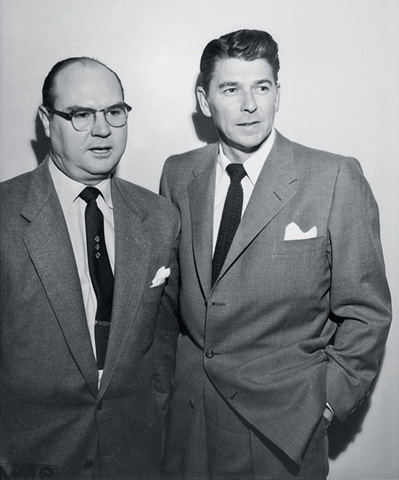
Hollywood labor leaders: Roy Brewer and Ronald Reagan.

By Jason Apuzzo. Ronald Reagan’s 101st birthday was just two days ago on February 6th, and in honor of the occasion journalist and scholar John Meroney recently put together a fascinating new video detailing new discoveries concerning Reagan’s early days combating communism in Hollywood.

The thesis of the video, and of an accompanying piece by Meroney in the latest edition of the Los Angeles Times Magazine, is that Reagan’s early experiences combating communism in Hollywood served as a template for Reagan’s later struggles against the Soviet Union as President.

The video and the article are the result of copious research conducted by Meroney in the private archives of Roy Brewer, a Hollywood labor leader during the 1940s and ’50s and a close colleague of Reagan’s at that time. In the video you will hear audio recordings – unearthed for the first time in over 60 years – of Reagan and Brewer discussing their complex struggles against communist influence in Hollywood’s labor unions.

Meroney refers to these findings and others in Brewer’s archives as “Reagan’s Rosebud” (referring to ‘Rosebud’ from Orson Welles’ Citizen Kane) – i.e., the key to unlocking Reagan’s early transformation from Roosevelt liberal to anti-communist Cold Warrior. Meroney’s compelling thesis, detailed in the full LA Times Magazine article, makes for fascinating reading if you are an admirer of President Reagan’s as I am, or interested in either Cold War or Hollywood history.

I encourage Libertas readers to watch the video and read the full article for context, and we wish John the best with his ongoing efforts to uncover the vital role of Reagan’s early Hollywood experiences in his ultimate defeat of the Soviet system.

Posted on February 8th, 2012 at 12:50pm.