Happy New Year: LFM Reviews All’s Well, Ends Well 2012

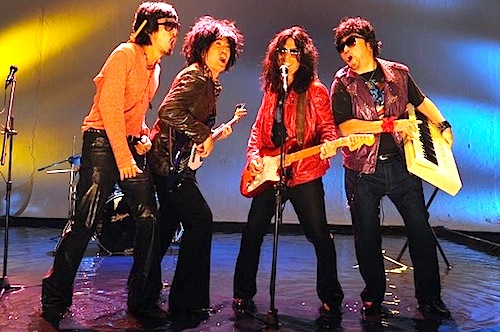
From "All's Well, Ends Well 2012."

By Joe Bendel. It’s Donnie Yen as you’ve never seen him before: singing power ballads. His character might be stuck in the 1980’s, but he can still find love in Chan Hing-ka and Amy Chin’s All’s Well, Ends Well 2012 (trailer here), the sixth film of the popular HK rom-com series, which opened Friday in New York.

A frustrated divorcee creates a Craig’s List to make men useful. The payment for miscellaneous services rendered is supposed to be a simple hug, but things get much more complicated for these couples. Julie Sun, an edgy photographer, hires construction foreman Kin Holland to serve as her nude model, while Hugo, the shaggy romance novelist, agrees to explain love to Charmine, a beautiful but blind dancer. Chelsia, a former teen idol, hires would-be hair band rocker Carl Tam to pretend to be her husband at a difficult reunion dinner. Meanwhile, Richard the hardball divorce attorney acts as a surrogate father for Cecilia, an orphaned heiress, as she evaluates prospective suitors.

Naturally, Holland falls for Sun hard, but her not so much. Hugo falls for Charmine too, but he is painfully stupid when it comes to dealing with her blindness. Of course, once she gets the cornea transplant, he totally freaks. Tam just wants to rock and rebuild Chelsia’s confidence, while the attorney finally acts like the father to Cecilia that his estranged daughter has never allowed him to be.

From "All's Well, Ends Well 2012."

With a title like “All’s Well, Ends Well,” audiences should have a pretty good idea where it is all headed. A thematic series, several cast-members have already found love in previous installments. As an anthology film (whose characters only overlap in the final scene), Well 2012 is somewhat uneven. The best arc features co-producer and Well regular Raymond Wong appealingly co-conspiring with Yang Mi’s poor little rich girl. At the other end of the spectrum, it is a little cringy to see veterans like Donnie Yen and Sandra Ng belting out their cheesy songs as Tam and Chelsia

The other two couples fall somewhere in the middle, freely mixing broad comedy with romantic angst. In fact, Ip Man fans who can handle Yen’s over-the-hill rocker should rather enjoy seeing Lynn Xiong (billed as Lynn Hung when playing Ip’s wife) elevating the novelist and dancer story with her exquisitely fragile turn.

Evidently, the Well series is constantly reconfiguring its romance to comedy ratio. 2012 probably leans too far towards the latter, whereas a bit more of the former would travel better for American audiences. Still, it is a hard film to not have some affection for. The cast is quite attractive, most definitely including Yang Mi, Lynn Xiong, Kelly Chen as Sun, and Magic to Win’s Karena Ng, briefly appearing as Richard’s angry daughter. For the ladies, Louis Koo’s Holland is shirtless a lot (you tell me how impressive that is).

Timed as a Lunar New Year release, Well 2012 is determinedly cheerful, right down to the compulsively happy closing pop song. For fans of the series, it delivers the cute. For hipsters, it shows the sporting nature of its famous cast. For those who like their cinema sugary sweet, it opened yesterday (1/27) in New York at the AMC Empire and in San Francisco at the AMC Metreon, courtesy of China Lion Entertainment.

Posted on January 28th, 2012 at 12:37pm.
Sundance 2012: LFM Reviews Ai Weiwei – Never Sorry

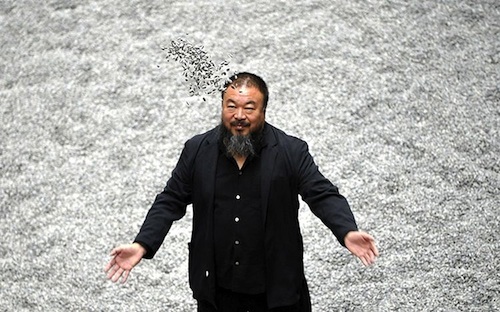
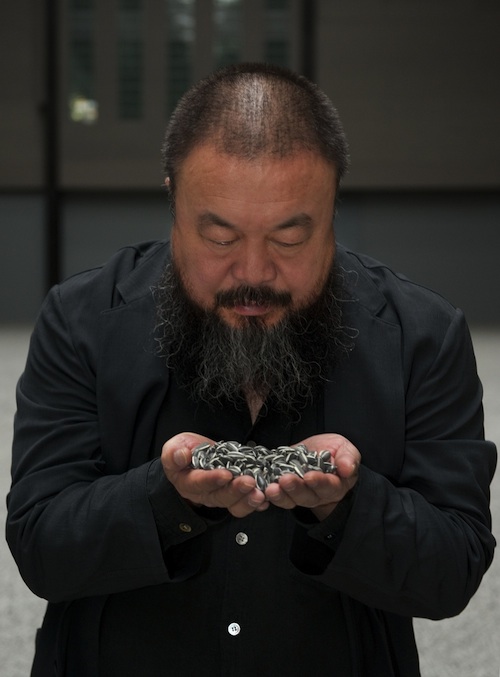
Chinese artist-activist Ai Weiwei.

By Joe Bendel. Ai Weiwei’s distinctive “Bird’s Nest” design for the Beijing National Stadium was one of the defining images of the 2008 Olympics; but Ai sought to redefine the Beijing games, forcefully decrying the tremendous suffering they caused for China’s vulnerable underclass. Choosing the struggle for Chinese human rights over a life of privilege, Ai is arguably the world’s most important activist-artist, whom Alison Klayman profiles in the fascinating and infuriating Ai Weiwei: Never Sorry (trailer here), which screens at the 2012 Sundance Film Festival well underway in Park City.

Considering the recurring middle finger motif in Ai’s work, it’s hardly surprising he is not a favorite of the regime. Yet, there is more to Ai than mere symbolic defiance. Klayman trenchantly traces the roots of Ai’s nonconformist spirit to the suffering his family experienced during the Cultural Revolution. While Ai made some noise when he repudiated the Olympics, few could hear it within China. However, his mastery of social media, specifically Twitter, would change all that. Indeed, Ai and the legions of everyday Chinese citizens he inspired through Tweets ought to put everyone following vacuous celebrities like Ashton Kutcher to shame.

Most Westerners should know that Ai was recently held incommunicado for a long stretch by the police, but the projects that earned the artist the Communist government’s wrath may come as a revelation. Most notable were his efforts to document each name of the thousands of school children who died during the Sichuan earthquake as a result of flimsy “tofu” school construction. In any transparent society, this information would be in the public record, but in China all such efforts were explicitly forbidden.

Ai Weiwei.

There are scores of lessons to be found in Sorry, including the importance of recording such tragedies for history, rather than letting the innocent victims of Sichuan fall through the Communist memory hole. At times, Ai’s public criticisms of the regime are shockingly bold. Clearly his guts are made of steel-reinforced concrete. Although Klayman largely focuses on his activism, she still conveys a vivid sense of Ai’s personality. Partly this comes out through some shrewdly edited interview segments. Yet more fundamentally, Ai just seems to be a what-you-see-is-what-you-get kind of person.

Indeed, Klayman wisely focuses squarely on her subject.  As a documentarian, she is rather blessed that Ai recorded so many of his protests and the subsequent government crackdowns for his social network followers. The word “controversial” should not really apply here. What Ai says has happened – most definitely including a notorious police assault – really did go down. He has the scars and the video to prove it. Aside from some helpful context provided by talking heads and an innocuous score, Sorry is essentially Ai’s show—and appropriately so.

We want to call a film like Sorry “inspiring.” It is a term that undeniably applies to Ai. Unfortunately, though he might be out of immediate physical danger, Ai’s relative freedoms within contemporary China remain harshly curtailed, so viewers are likely to feel several conflicting emotions when the film ends. Anger would be a good one to go with.

This documentary is important, because the international spotlight must shine with far more intensity on his situation if circumstances are ever going to change. Given the Chinese CP’s nasty habit of harassing their critics, Klayman also earns a fair amount of credit for having the guts to tackle this project in the first place. Hopefully, she will have to produce a happy postscript for Sorry sometime in the future, but surely she would not begrudge the extra work.

As it is, the efforts invested in Sorry are considerable. One of two standout documentaries at this year’s Sundance (along with The Other Dream Team), the earnestly recommended Sorry screens again this Thursday (1/26) and Saturday (1/28) in Park City, Friday (1/2/7) in Sundance Resort, and today (1/25) in Salt Lake.

SUNDANCE GRADE: A

Posted on January 25th, 2012 at 7:34pm.

Sundance 2012: LFM Reviews The Other Dream Team

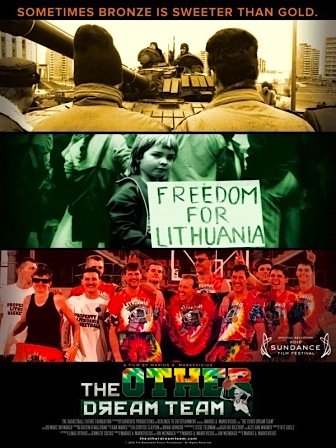
By Joe Bendel. In the late 1930’s, Lithuania twice won the European basketball championship. In 1940, it was invaded and subjugated by the Soviet Union. Yet, the tiny Baltic country’s proud sporting tradition helped sustain it during those painful decades, culminating in the newly free Lithuania’s Olympic victory over the Russian-Unified team in 1992. The incredible history of Lithuania’s break from the Soviet Union and the game that announced their independence to the world is told in Marius Markevicius’s stirring documentary The Other Dream Team, which screens during the 2012 Sundance Film Festival.

America’s 1988 Olympic loss to the Soviets was the impetus for the creation of the so-called “Dream Team” of NBA all-stars, including Michael Jordan and Patrick Ewing. However, four of the Soviet team’s starters were actually Lithuanian. In fact, warriors like Arvydas Sabonis and Šarunas Marčiulionis had dramatically mixed emotions about their 1988 gold. They were proud of their accomplishments, but the Soviet anthem was not the anthem they wanted to hear on the medal stand.

Four years later, much had changed. Sabonis and his colleagues were finally allowed to play in the NBA as a reward for their Olympic glory. At great risk, Lithuania had asserted its independence and held out against invading Soviet forces. The freshly sovereign country could field one of the best basketball teams in the world but had insufficient resources to send them to Barcelona. However, help would come from an unexpected source: the Grateful Dead.

Dream gives roughly equal time to sports and history, but each part is equally uplifting and informative. Indeed, people often forget it was Nobel Peace Laureate Mikhail Gorbachev who sent the tanks into Vilnius. In fact, independence leader Vytautas Landsbergis was just as much a protagonist as Sabonis and his teammates.

Just about all the starters from the 1992 team are heard from in great length throughout Team and each has their share of telling anecdotes. As is so often the case with survivors’ reminiscences of the Communist era, they are often simultaneously funny and sad. Yet, simply considered as a sports doc, Dream is one of the best in years. Even basketball fans who think they know the players well will learn something new here.

This is a great story, smartly constructed with rich details and full historical context. The many Grateful Dead tunes included in the soundtrack are also a nice bonus. For those looking for a movie that celebrates the spirit of freedom, Dream will get you choked-up, in a good way. Legitimately inspiring and hugely entertaining, it is one of two truly standout documentaries at Sundance this year (along with Ai Weiwei: Never Sorry).  Enthusiastically recommended, it screens again today (1/25) and Saturday (1/28) in Park City, as well as this Friday (1/27) in Salt Lake.

SUNDANCE GRADE: A+

Posted on January 25th, 2012 at 6:58pm.

Sundance 2012: LFM Reviews The Raid

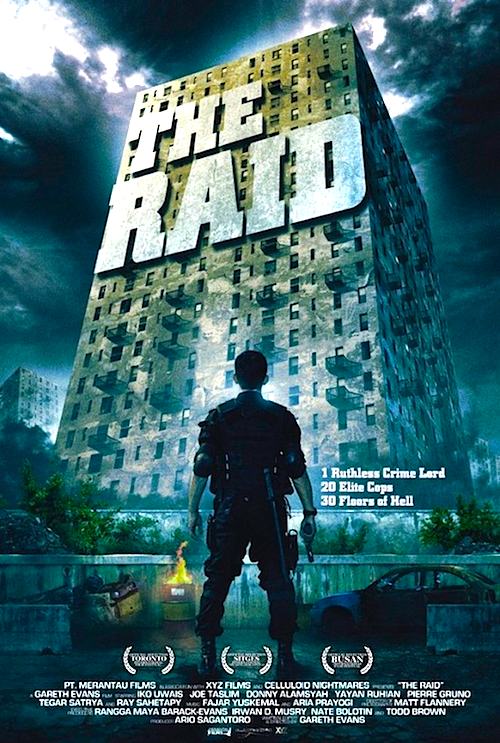
By Joe Bendel. Law enforcement is a noble calling. One rookie SWAT cop will be doing a heck of a lot of enforcing. Unfortunately, he is assigned to a decidedly dodgy mission in Gareth Huw Evans’ spectacularly awesome The Raid (trailer here), which screens as part of the 2012 Sundance Film Festival.

Tama the kingpin rules the Indonesia underworld from atop his high-rise fortress. He rents apartments and immunity from police harassment to any cutthroat willing to pay rent. However, Rama’s squad is supposed to change all that. They are to systematically secure the building and capture Tama. Of course, it turns out Tama has the drop on them. Since no reinforcements will be coming for their off-the-books operation, Rama and a handful of survivors will have to fight their way out in the same manner they came in—floor by machete-wielding floor. Or in other words: Hell, yes.

The Raid is the sort of film that could turn the prim and proper into martial arts fanboys. Evans maintains an absolute breakneck pace and stages some massive action sequences. Yet the film is at its absolute best during its many scenes of extended close quarters combat, choreographed by its breakout lead Iko Uwais and Yayan Ruhian, who co-stars as Tama’s self-explanatory henchman, Mad Dog.

Indeed, The Raid should catapult Uwais to the ranks of international superstardom. As Rama, he does something stilted indie films, didactic imports, and vapid reality shows have failed to do: provide a sympathetic Muslim protagonist with broad cross-cultural appeal. By the same token Ruhian’s Mad Dog is a most satisfyingly ferocious villain.

Many action film trailers just dice up some of their best scenes and spit them out at viewers machine gun style. In contrast, The Raid’s trailer is perfectly representative of the film’s hyper-charged energy (if anything, it is toned down a notch). Evans also shrewdly capitalizes on Tama’s seedy and imposing building, further boosting the tension through the claustrophobic setting. Frankly, the film is somewhat reminiscent of early John Woo, simultaneously gritty and operatic.

The Raid is the real deal. Packed with carnage, it is an old school martial arts shootout, with genuine art-house credibility. Highly recommended, it has been a major crowd-pleaser at this year’s Sundance, where it screens again this Thursday (1/26) in Park City and Saturday (1/27) in Salt Lake.

SUNDANCE GRADE: A+

Posted on January 25th, 2012 at 11:57am.

Sundance 2012: LFM Reviews Lay the Favorite

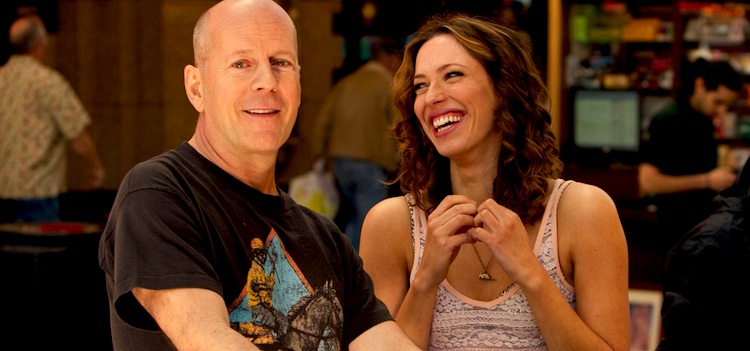
Bruce Willis and Rebecca Hall in "Lay the Favorite."

By Joe Bendel. It is easier to get a job in Vegas messengering about large sums of gambling money than a gig as a cocktail waitress. Fortunately, Beth Raymer has a knack with numbers, leading to a checkered career in the betting business. Raymer’s memoir becomes the stuff of light-hearted dramedy in Stephen Frears’ Lay the Favorite (clip here), which screens during this year’s Sundance Film Festival.

“Lay the Favorite” is one of those old school gambler’s expressions Raymer’s new boss Dink Heimowitz uses. Dink, Inc. is not a bookmaker, it is a betting establishment. Every day Dink and his employees work the phones, placing legal bets around town. As long as he wins fifty-five percent of the time, it’s all good. With Raymer’s arrival, Dink comes out of a losing slump, leading him to conclude the ditz-savant is his good luck charm. This does not sit well with Tulip, Dink’s Bravo reality show worthy wife.

Dink once did time for bookmaking, so now he keep things strictly legit. The emotionally needy Tulip also keeps him on a tight leash, which means the openly flirtatious Raymer has to go. However, Dink becomes increasingly concerned when Raymer gets involved with an outright bookie so sleazy he has to be played by Vince Vaughn.

In a way, Favorite seems an odd fit for Sundance. It is a very commercial but rather pleasant film that ought to be better suited for a studio release than an art house run. It offers some interesting Damon Runyon-esque peaks into the world of legal and illicit sports betting, but this is definitely a women’s film. Breezy with a periodic outburst of angst, it is probably a lot like what One for the Money should have been but most likely isn’t.

However, it is the supporting characters and slightly sleazy milieu that really make Favorite work. Vaughn does his usual shtick well enough, but Bruce Willis really stands out, perfectly suited for Dink. Like his character, he seems to comfortably fit somewhere in between a romantic lead and a father figure. Nearly unrecognizable, Catherine Zeta-Jones plays Tulip to the hilt, with relish. So does Rebecca Hall, but her Raymer often comes across too Erin Brockovichy, which is never good, in any context. At least she isn’t shy.

Favorite is hardly what we would expect from Frears either, but the Dangerous Liaisons helmer has a nice touch with the material, never letting Raymer’s melodrama overwhelm the upbeat vibe. It is not a big important film, but Favorite is an entertaining diversion, featuring some of Willis’s best work in a while. Recommended in that modest spirit, but not an ultra-high priority at Sundance, it screens again this Saturday (1/28) and Sunday (1/29) in Park City.

SUNDANCE GRADE: B

Posted on January 25th, 2012 at 10:25am.

Sundance 2012: LFM Reviews Red Lights

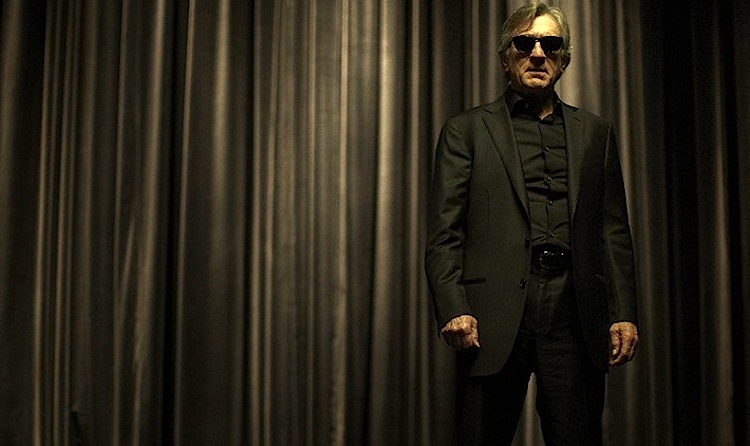
Robert De Niro in "Red Lights."

By Joe Bendel. Sigourney Weaver has gone from ghost-busting to ghost debunking. However, she may have met her match in Simon Silver, a notorious television psychic from the 1970’s, who comes out of retirement for nefarious purposes in Rodrigo Cortés’ Red Lights (trailer here), which screens during the 2012 Sundance Film Festival.

Dr. Margaret Matheson (a Richard Matheson hat tip perhaps?) is the chair of the department of skepticism. Her rival Dr. Paul Shackleton is the chair of the department of believing any spooky thing that might bring in funding. She and her colleague Dr. Tom Buckley expose psychic frauds, while Shackleton plays with his flash cards. Simon Silver was the one that got away. Supposedly vindicated by a flawed laboratory study Matheson refused to sign off on, Silver’s triumph has always been a blot on her reputation.

With the Uri Geller inspired villain back in the public eye, Buckley is spoiling for a fight, but Matheson is gun shy. Even if he does not have psychic powers, Silver is a master of finding his critics’ weak spots and exploiting them. Yet, with all the stuff suddenly going bump in the night, we are led to wonder whether or not the psychic really does command dark forces after all.

The first half of Red is a rather nifty little paranormal investigation procedural, but once Weaver’s Matheson is out of the equation, the film completely craters. Logic is treated with contempt and the indie breakout sensation Elizabeth Olsen is stuck standing around with nothing to do, besides sleep with her T.A. To make matters worse, Buckley’s closing monologue and subsequent voiceover narration invite open mockery. They are so over-the-top, they make the newly rediscovered Ed Wood film sound sharp and focused by comparison.

Weaver brings a reliably smart and mature presence to the film as Matheson and she develops a likable and realistic chemistry with Cillian Murphy’s Buckley. Frankly, the female mentor-male protégé relationship is not often seen in films and it is quite nicely turned here. Unfortunately, all the woo-woo effects get awfully sour very quickly. It is also another depressing reminder of the fall of Robert De Niro, once again playing an icily impassive villain in a dark suit.

Red really can be divided into two distinct parts. One is pretty engaging. The other is ridiculous and utterly clichéd. Sadly, the latter is the somewhat longer concluding piece, which essentially sinks the entire film. Recommended for a severe return trip to the editing bay, Red is ultimately a disappointment at this year’s Sundance, where it screens this Wednesday (1/25) and Saturday (1/25) in Park City and tomorrow (1/24) in Ogden.

SUNDANCE GRADE: C-

Posted on January 25th, 2012 at 10:05am.