Alien Invasion, Spanish Style: Extraterrestrial

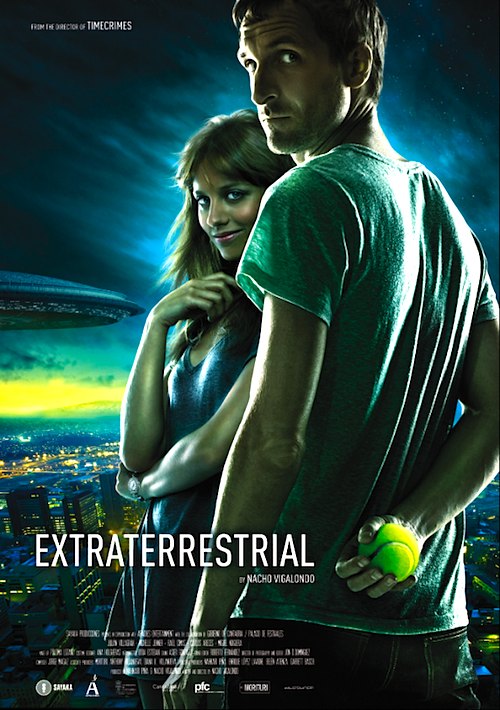
By Joe Bendel. The aliens came and they saw, so now what? That is the question in the back of the minds of the few Madrid residents who did not flee the city. However, they will be mostly preoccupied with their own issues in Extraterrestrial (trailer here), Nacho Vigalondo’s enormously clever take on an alien invasion blockbuster, which opens this year’s Spanish Cinema Now, the Film Society of Lincoln Center’s longest running film series.

Of all the nights Julia could take home a strange man, she picks the eve of the alien invasion. She and Julio are a bit slow rousing themselves in the morning, which is how they miss the military evacuation. Initially she is only worried about her possessive boyfriend, Carlos. However, as soon as she and Julio spy the huge spinning discs in the sky, she lets the smitten Julio stay, settling on a cover story to explain his presence. Before long, they are sharing a wickedly uncomfortable dinner with Carlos, a madman (but not necessarily an abusive one) and Ángel, a creepy torch-bearing neighbor.

The inevitable conflicts of this soiree are obvious, regardless of the alien invasion apparently underway. However, the not-as-dumb-as-he-looks Julio takes advantage of the resulting paranoia. Indeed, what transpires is sheer gleeful lunacy, powered by jealousy, resentment, and all possible shades of love, most certainly including lust.

Granted, Extraterrestrial is not as wildly inventive as Vigalondo’s instant classic Timecrimes (stream it now, thank me later), but it is still toys with and subverts genre conventions in a richly idiosyncratic manner. This is hardly your typical sci-fi programmer. Frankly, Julio, Carlos, and a rogue band of UHF broadcasters do far more damage to the city of Madrid than the armada of aliens. Yet, Vigalondo nurses our V and X-Files honed fear and uncertainty, creating suspense out of whole cloth. The entire film is quite a nifty trick, but not without a heart. Indeed, Extraterrestrial is surprisingly bright and upbeat compared to the seriously noir Timecrimes.
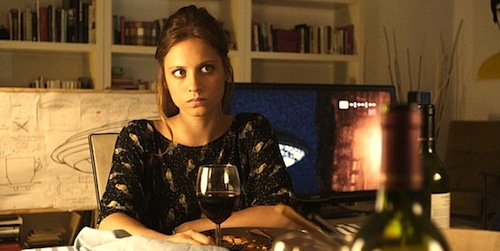
Michelle Jenner in "Extraterrestrial."

Despite the outlandish premise, Michelle Jenner, Julián Villagrán, and Raúl Cimas play their respective sides of the love triangle with absolute conviction. Villagrán is particularly effective, smoothly pulling off each surprise as Julio, the ostensive everyman. Though more broadly comic than his ferocious star turn in The Last Circus, Carlos Areces also still finds some pathos and madness in poor, perennially frustrated Ángel.

As his sophomore feature, Extraterrestrial should firmly establish Vigalondo as an international genre film cult-superstar. It is a truly original way to address some of the oldest themes in recorded storytelling. Highly recommended, it screens this Friday (opening night, 12/9) and the following Thursday (12/15) at the Walter Reade Theater during the 2011 edition of Spanish Cinema Now.

Posted on December 6th, 2011 at 12:03pm.
Trial by Tabloid: LFM Reviews State of Play

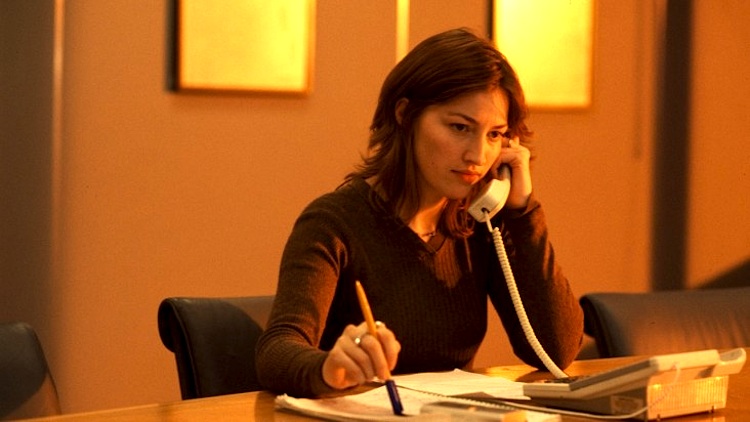
Kelly Macdonald as reporter Della Smith.

By Joe Bendel. It is hard to say who is more unsavory in this morality play: big business, the press, or the Labour Party. For what it is worth, the journalists are the ostensive protagonists of State of Play (promo here), which makes its American broadcast cable debut this Wednesday as part of BBC America’s Dramaville showcase.

This should not be difficult, but viewers must absolutely forget anything they might know about the 2009 Hollywood feature adaptation. The original 2003 BBC series, written by Paul Abbott and directed by David Yates (of Harry no joke Potter fame), is far more intricate, intelligent, and murky. Nobody comes across looking heroic here, except maybe the poor beleaguered coppers.

MP Stephen Collins initially appears to be the Labour Party’s version of the litigious Gary Condit, when the apparent death of Sonia Baker, his staff researcher and mistress, thrusts his private into the headlines. Collins comes from the left wing of his party, though, and is considered an up-and-comer, “tipped” for the next cabinet. Much to the surprise of the Party’s top fixer, the elders duly circle the wagons around Collins rather than cutting him loose.

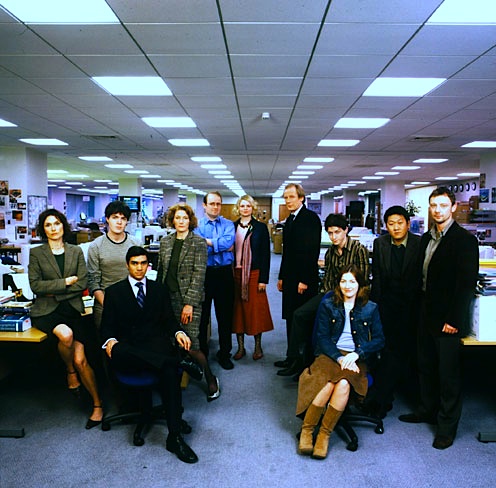
The cast of "State of Play."

Though never very forthcoming, Collins starts talking to Cal McCaffrey, his former campaign manager now working for one of the more reputable tabloids. When Collins links Baker’s death to a street murder previously dismissed as a drug-related crime, he begins to get a sense of the conspiracy’s scope. However, he somewhat jeopardizes the story when he takes up with Collins’ estranged wife, Anne. It is safe to say this displeases his old school editor Cameron Foster, but he is stuck with McCaffrey when the reporter starts connecting top government officials and a giant multinational oil company to the affair.

However, this is not a simple corporate malfeasance story. While we identify with the Herald journalists as our primary POV characters, it is hard to consider them noble crusaders. Frankly, the way they deceive and manipulate many of their sources would be appalling if they were not already so ethically compromised. Yet, Abbott spares Collins least of all with his agonizing drip-drip-drip of revelations. Of course for viewers, this is all juicy salacious fun.

Continue reading Trial by Tabloid: LFM Reviews State of Play

Eastern Europe Double Feature: LFM Reviews Radu Muntean’s The Paper Will Be Blue + Andrzej Zulawski’s Possession

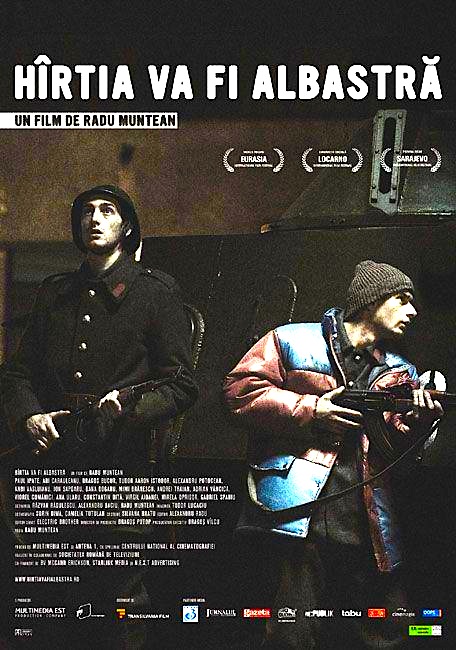
By Joe Bendel. In 1989, the Romanian military received the orders all soldiers serving behind the Iron Curtain dreaded most. They were commanded to fire upon their fellow countrymen. Some did so, to an extent, but many more sided with the Revolution. Radu Muntean captures the chaotic anarchy in the hours immediately following the fall of Ceaușescu in his distinctly anti-heroic The Paper Will Be Blue (trailer here), which screened as part of a Muntean retrospective on the closing night of the Sixth Annual Romanian Film Festival, co-presented by the Romanian Cultural Institute and the Film Society of Lincoln Center.

Blue’s flashback format tells viewers right up front this night will end badly. Muntean then rewinds a few hours to show how events reached this point. Though Ceaușescu has been deposed, the military is not sure what to make of it. The revolutionaries have seized the television studio and many officers and enlisted men have volunteered to defend it from Communist Loyalists – or as the call them, terrorists. If you are wondering how to tell one side from the other, then you have just pinpointed the crux of Blue.

Militia (state copper) Lt. Neagu’s armored squad vehicle has been assigned to patrol a sleepy suburb well away from the action. However, one of his men from a politically connected family, Costi Andronescu, has deserted to join the forces defending the TV station. Fearing he will be disciplined for the actions of his subordinate, Neagu and his men venture into the maelstrom, hoping to bring back Andronescu in time for morning roll call. As they careen through the streets of Bucharest, allegiances become increasingly confused.

With its gritty docudrama-style and Kafkaesque absurdity, Blue bears many of the hallmarks of the so-called Romanian New Wave. However, there is no slack in this picture. It is tight and tense, holding a firm grip on viewers even though they know exactly where it ends. Muntean vividly captures both the claustrophobia within the armored car, and the disorienting commotion unfolding outside. The film also resists easy political labels, revisionist or otherwise, but as is often the case in the Romanian Wave, bureaucracy and authority figures take a real skewering.

Adi Carauleanu is fantastic as the world-weary but compulsively cautious Neagu. Through his fatalism and wariness, the audience gets a sense of the pent-up frustration resulting from decades of service under Communism. Though a bit stiff on-screen, Paul Ipate has some finely turned moments as Andronescu as well. More than anything, though, Blue is about conveying the in-the-moment feeling of a particularly time and place, in all its madness.

Blue is an excellent representative of Romanian film for a number of reasons. It certainly dramatizes a critical moment in recent history, but it also proves that the films of the Romanian New Wave are not necessarily long, slow, or moody. Raw and visceral, Blue packs a punch. Its title also makes perfect sense in retrospect, but to explain why would be telling.  Blue closed the 2011 Romanian Film Festival at the Walter Reade Theater this past Sunday (12/6), with a special post-screening Q&A with Muntean.

Continue reading Eastern Europe Double Feature: LFM Reviews Radu Muntean’s The Paper Will Be Blue + Andrzej Zulawski’s Possession

LFM Review: Buried Secrets

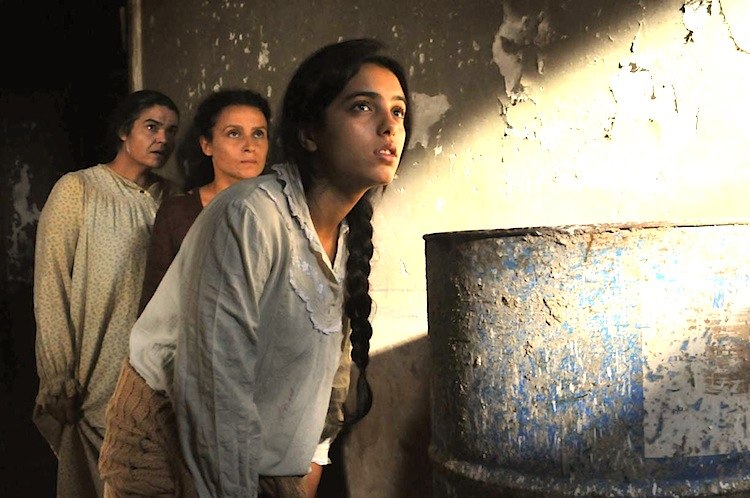
By Joe Bendel. Consider this as Upstairs, Downstairs in its darkest manifestation. In a secluded Tunisian mansion, Aïcha is squatting in the basement servants’ quarters with her domineering mother and world-weary older sister. It is not much of a life, but at least it is quiet, until the original owner’s grandson arrives with his lover. The inadvertent intrusion of differing values and lifestyles profoundly disrupts their dysfunctional family unit in Raja Amari’s Buried Secrets (trailer here), the gala selection of this year’s African Diaspora International Film Festival.

Largely uneducated but devout, Aïcha’s family barely earns a subsistence living through embroidery work. At least their cloistered existence allows Radia and her mother to keep Aïcha under control. They clearly consider her somewhat off, but it is initially unclear whether she really is a tad slow or has simply never had any outside social interaction. When Ali and his girlfriend Selma arrive, she is magnetically attracted to their fashionable clothes and open affection. Needless to say, her mother considers the “interlopers” indecent, but since they have no right to be there, the three women can only surreptitiously cower in the cellar. Inevitably, Selma discovers their presence in the crumbling manse, prompting the older women to take a rash course of action.

Ironically, the downstairs goings-on are considerably more scandalous than anything happening upstairs in Buried. Though viewers might guess at some of Aïcha’s family secrets, their revelation takes the women to some pretty shocking places. Amari clearly suggests the mother’s ultra-traditional Islamic upbringing has a stunting effect on Aïcha’s sexual maturity, but this is not a reassuring tale of female empowerment. What starts as a class-conscious social issue film morphs into a dark fairy tale, before finally settling into a psychodrama. Yet, somehow Amari maintains a consistent mood while keeping the audience off-balance.

The grand old home is wonderfully cinematic (sort of like a Tunisian Grey Gardens), anchoring the film in a specific, strange and isolated place. However, it is Hafsia Herzi’s remarkable performance as Aïcha that makes it all come together. Simultaneously vulnerable and unnerving, it is impossible to take your eyes off her. Arguably though, Rim El Benna’s work is even braver, portraying Selma as a sympathetic, emotionally complex modern woman. Her more revealing scenes also likely generated the predictable disapprobation from Tunisia’s intolerant religious quarters.

Intriguing in many respects, Buried creates an eerie vibe of life in a state of twilight-limbo, implying rather than showing the great repercussions of its accidental clash of cultures. Fittingly, it is another challenging cinematic statement handled by Fortissimo Films, the focus of a recent retrospective at MoMA. Definitely recommended, it screened as part of the ADIFF gala with a regular festival screening to follow next week (12/11).

Posted on December 5th, 2011 at 2:44pm.

LFM Review: Ralph Fiennes & Gerard Butler in Coriolanus

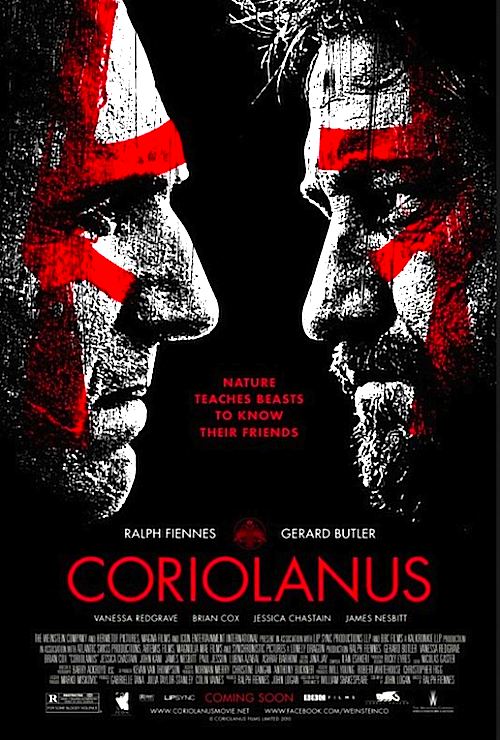
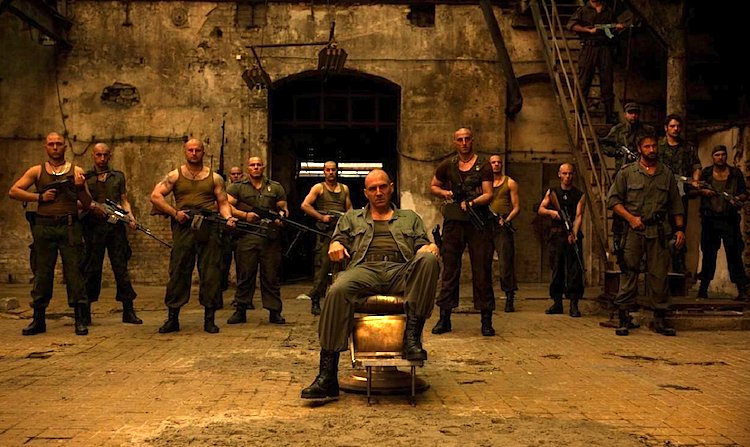
By Joe Bendel. It has long been considered one of Shakespeare’s most divisive tragedies. Though academic appraisals remain quite mixed, Coriolanus always had its champions, including poet T.S. Eliot. As a result, there are few cinematic predecessors against which actor Ralph Fiennes directorial debut might be compared. In the Olivier-Branagh tradition, Fiennes also stars in his contemporary retelling of Coriolanus (trailer here), which begins a one week Oscar qualifying engagement in New York this Friday.

In a Balkan city that “calls itself Rome,” Caius Martius has earned the honorific title “Coriolanus” for his victory over the city-state’s bitter rival, the Volsces. At the behest of his proud mother Volumnia and her ally Senator Menenius, the general consents to campaign for the office of Consul. The approval of the Senate is assured, but Coriolanus’s candidacy must also be accepted by the masses. This is a taller order, especially given the officer’s refusal to pander to the lowest common denominator.

Nonetheless, with Menenius’s help, Coriolanus appears to win over the people. Yet just as quickly, the deceitful senators Brutus and Sicinius turn the crowd against him, with the help of a cadre of professional activists. Venting his outrage, Corilanus’s contempt for the fickle masses leads to his banishment. It also drives him to Volsces, where he makes common cause with his old nemesis, Tullus Aufidius. Dead to everything except his rage, Coriolanus will have his revenge in a manner befitting Shakespearean tragedy.

Given his abruptly shifting loyalties and his un-Shakespearean lack of introspection, Coriolanus is a difficult figure for many to get their heads around. However, Fiennes’ portrayal really unlocks his character. We can understand how his rigid conception of honor compels each action he takes. Despite Corilanus’s reticence, it is a big, seething performance of great physicality that commands viewer attention. Clearly this is a man of action, not given to soliloquizing.

This is definitely Shakespeare at his manliest (no tights or sonnets here, thank you very much). Indeed, Gerard Butler matches Fiennes’ testosterone as Aufidius, while Vanessa Redgrave nearly outdoes them both as Volumnia, the motherly Lady Macbeth. Yet the real soul of the film comes from the great Brian Cox as Menenius, whose humanity leads inexorably to pathos. Though a relatively small part, it is also interesting to see South African actor John Kani, who projects a suitably stately presence as Coriolanus’s former superior officer, General Cominius.

Shakespeare as exercise in machismo.

Though Fiennes’ effectively streamlined the film adaptation, it is also obvious why the original play troubles so many critics, given its scathing depiction of the Roman masses as no more than a weapon to be wielded by the unscrupulous. Frankly, in Coriolanus, “the people” get what they deserve. Indeed, the film comes at a time when it rather inconveniently begs comparison to uninformed masses occupying Zucotti Park.

An impressive directorial debut, Fiennes stages some vivid scenes of warfighting. His resetting of the story works more often than not, though the cable news flashes in Shakespearean English can be a bit jarring. Strikingly cinematic, the Belgrade locales also add the weight of contemporary historical tragedy, heightening the on-screen drama. One of the better recent Shakespearean films (considerably more satisfying than Taymor’s Tempest, for example), the unexpectedly timely Coriolanus is definitely worth seeing. It begins a special one week New York run for Academy Award consideration today (Friday, 12/2) and then opens more widely on January 20th.

Posted on December 2nd, 2011 at 10:56am.

LFM Review: Page One, The New York Times & Modern Media Bias

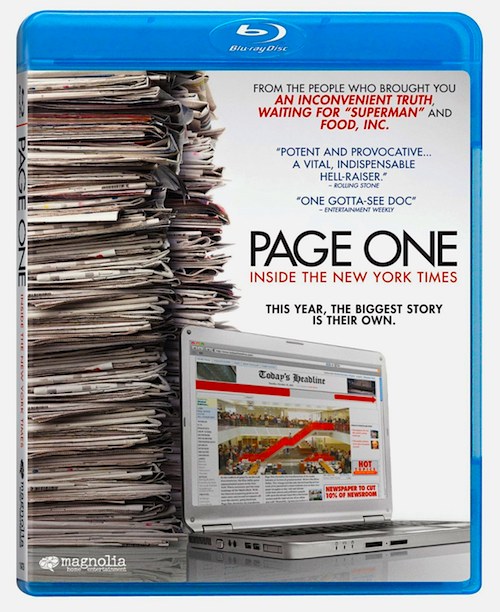
By David Ross. Andrew Rossi’s Page One (2011), a sleek, self-important infomercial for The New York Times, largely involves Times partisans whining that the dinosaur carcass of the Gray Lady is being picked clean by the mammalian swarms of the new media. There are cursory nods to the Jayson Blair and Judith Miller scandals, but essentially nothing in the way of real introspection or self-criticism. The Times‘ complaint largely goes like this: “What kind of world fails to recognize the inherent nobility of our enterprise! O fallen mankind, repent your shallowness!”

Do these apologists have a point? To some extent, yes. As numerous interviewees stress, aggregators, bloggers, and citizen journalists cannot cover certain kinds of news. War zone coverage, international political coverage, and intensive daily coverage of the political process require expertise and institutional funding. These are not part-time callings, nor activities that can be undertaken on the cheap. Those who bay for the demise of the mainstream media have to take seriously that news does not coalesce out of the internet ether, as it seems to. It must be dug up, run down, and eye-witnessed as mortar rounds collapse the available ground cover. This ferreting process is crucially enabled by the kind institutional pressure that only billion-dollar media entities can exert. Foreign potentates and corporate barons do not return phone calls placed by self-proclaimed smart guys in their pajamas (e.g., us). Eliciting a response requires the veiled threat intrinsic to newspapers that are in their own way players on the world stage. News depends on credentialed news people in the traditional sense: this is reality, like it or not.

Michiko Kakutani.

On the other hand, the mainstream media, and the Times in particular, has done everything conceivable to hasten its own demise. The postmodern Times is a cavalcade of inaccuracy, omission, myopia, flagrant political bias, outrageously lousy writing, latent snobbery, and superficial urban sophistication. All the shallowness of the modern elite university has come home to roost at the Times. The worst offenders are surely the editorial sections (prose sinkhole) and the culture sections (lapdog of everything transgressive), but I reserve special ire for fellow Yalie Michiko Kakutani, the Pulitzer-winning book reviewer who’s done much to instantiate a self-important middle-browism as the default mode of the literary culture. The novelist Jonathan Franzen, for one, calls her “the “stupidest person in New York” and an “international embarrassment.” He continues, “Everyone in Europe says to me, “How can The New York Times let a person who is so patently tone deaf, who is so screechy rhetorically, so clearly unequipped to appreciate interesting books or even to enjoy them — how can that person be the lead reviewer?'” Kakutani had the chance to rise to a historical occasion following the suicide of Franzen’s friend David Foster Wallace in 2008. Her ‘appreciation’ (here) is pat and rote by turns, utterly nerveless, utterly unmoved or inspired by the circumstances. “Laugh-out-loud funny”? “Both brainy and visceral”? An opening quote from Robert Plant! Are these sophomoric clichés what the mighty New York Times has come to? Was ever an era’s chief writer so lazily eulogized by an era’s chief reviewer?

Basic points first. The Times is no longer dependable in terms of fact, grammar, or idiom (“whipping post” for “whipping boy” just this past week, as I happened to notice at the supermarket – and on the front page no less). Ponder the Onionesque aspect of this correction from July 22, 2009:

An appraisal on Saturday about Walter Cronkite’s career included a number of errors. In some copies, it misstated the date that the Rev. Dr. Martin Luther King Jr. was killed and referred incorrectly to Mr. Cronkite’s coverage of D-Day. Dr. King was killed on April 4, 1968, not April 30.

Mr. Cronkite covered the D-Day landing from a warplane; he did not storm the beaches. In addition, Neil Armstrong set foot on the moon on July 20, 1969, not July 26. “The CBS Evening News” overtook “The Huntley-Brinkley Report” on NBC in the ratings during the 1967-68 television season, not after Chet Huntley retired in 1970.

A communications satellite used to relay correspondents’ reports from around the world was Telstar, not Telestar. Howard K. Smith was not one of the CBS correspondents Mr. Cronkite would turn to for reports from the field after he became anchor of “The CBS Evening News” in 1962; he left CBS before Mr. Cronkite was the anchor. Because of an editing error, the appraisal also misstated the name of the news agency for which Mr. Cronkite was Moscow bureau chief after World War II. At that time it was United Press, not United Press International.

How do you misstate the dates of the moon landing and MLK’s assassination in a single article? Don’t Times reporters have access to Wikipedia? Was the reporter in a condition of drunken mania? Were the editors? At The New Haven Register, where I spent four years as a cub reporter, three corrections within memory were enough to get one fired. Five-plus corrections in a single article would have been beyond anybody’s worst nightmare. The night desk’s sleepiest, rummiest old coot would have caught at least some of the above errata (MLK, moon landing, Telstar). I had to acknowledge perhaps three or four factual mistakes in my four-year career. Each was a humiliation, entailing a stern lecture and a day or two of frowns.

Continue reading LFM Review: Page One, The New York Times & Modern Media Bias