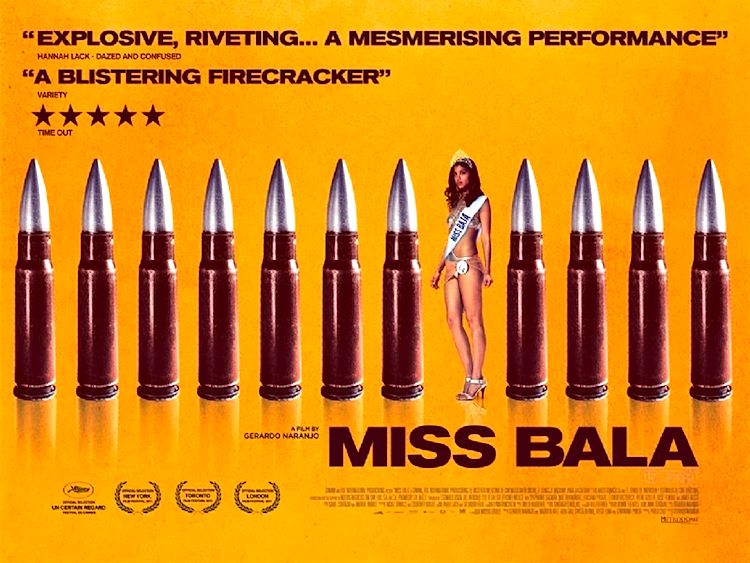
Libertas @ The 2011 New York Film Festival: Miss Bala

By Joe Bendel. Drug cartels are worse than the most controlling stage mothers. One long-shot Mexican beauty pageant contestant learns this the hard way when an embattled drug kingpin champions her cause in Gerardo Naranjo’s Miss Bala (trailer here), which screens this weekend at the 49th New York Film Festival.

There are few opportunities for young people in the city of Baja, even if they are attractive like Laura Guerrero and her friend “Suzu.” That is why they want to take a shot at the upcoming Miss Baja California contest. Looking to pull a few strings with the judges, Suzu drags Guerrero to a sketchy club to party with some crooked DEA agents she knows. Unfortunately, Lino Valdez and his crew arrive to make a bloody statement. Though Guerrero escapes with her life, Valdez comes looking for her when she starts asking questions about Suzu.

Stephanie Sigman in "Miss Bala."

Rather than killing her, Valdez decides to take Guerrero for himself, using her as a mule and clearly signaling what other services she will be expected to perform. He also puts in the fix with the Miss Baja contest, while engaging in open warfare with the police.

Bala (as in bullet) is the sort of film that viewers would need a clicker to keep track of the body count. Yet Naranjo shows very little violence directly on-screen. Instead, it mostly plays out just beyond Guerrero’s POV, as she cowers under beds and in dark corners, listening to the barrage of gunshots and blood curdling shrieks. Still, there is never any question as to the horrific nature of the carnage unfolding around her.

As in many contemporary Mexican films, it is not worth bothering to distinguish the police and government officials from the gangsters like Valdez. It also portrays the local media in rather cynical terms, while depicting U.S. border security as what might charitably be termed porous. In short, it is a work of unremitting realism, but Guerrero’s inspired-by-a-true-story misadventure gives the film the feeling of an urban legend.

As Guerrero, Stephanie Sigman (who has been doing media to promote Bala at NYFF) is on course for international stardom. Watching her sinking deeper into the moral anarchy of Baja is absolutely exhausting, but completely riveting. Noe Hernandez is also pretty scarily convincing as Valdez, projecting all kinds of menace, but romanticizing nothing about his thuggish existence. Though little more than a cameo, American actor James Russo (the ill-fated Mikey Tandino in Beverly Hills Cop) also makes a strong impression as Jimmy, Valdez’s DEA agent on the take.

Bala is an intense film, but not really a thriller per se. Nor is it an effective PR film for the Baja Chamber of Commerce, yet it has been selected as Mexico’s official submission for the best foreign language Academy Award. Rather, it is a bold, gritty look at the narcoterrorism enveloping Mexico and periodically spilling across our border. Recommended for those who take their cinema black, without a chaser, Bala screens this Saturday (10/2) and Sunday (10/3) at Alice Tully Hall, as a Main Slate selection of the 2011 New York Film Festival.

Posted on October 1st, 2011 at 11:38am.
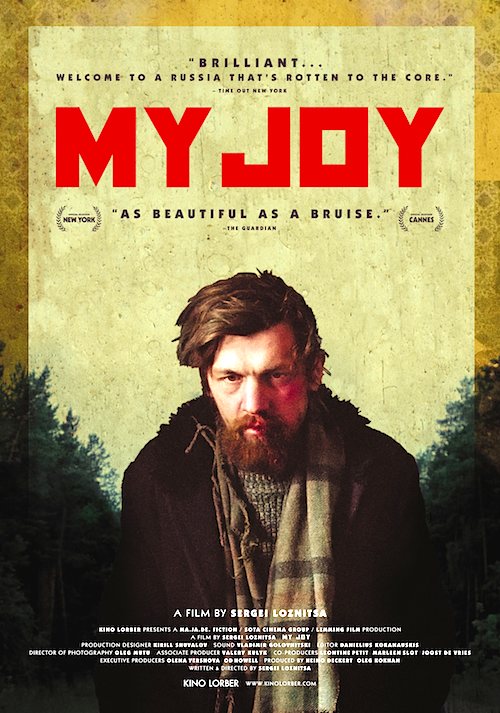
Absurdist Visions of Russia: LFM Reviews My Joy

By Joe Bendel. Like any place, Russia has its share of urban legends, but Russia’s seem to carry the oppressive weight of the country’s tragic history. At least, such seems to be the case with the stories that inspired documentarian Sergei Loznitsa’s narrative feature debut, My Joy (trailer here), which opened yesterday in New York.

Having spent considerable time on the road, truck driver Georgy is no babe in the woods. He is hardly shocked by the venal cops who hassle him or the teenaged (if that) prostitute hustling business when a major accident closes the highway. Still, he tries to help her, but like contemporary Russia, she will have none of it. However, his trip goes seriously awry when he tries to take a detour around the backed-up traffic.

Though not overtly supernatural, the fateful back road takes the driver into a very malevolent place, somewhat in the spirit of Conrad’s Heart of Darkness. Like a horror film written by Beckett, Georgy is sucked into an absurdist village, where predatory behavior is the norm. Time becomes indeterminate in this twilight world, with the tragic past echoing strongly in the corrupt present day.

This is particularly true of an old hitchhiker’s story, easily the film’s strongest mini-arc. According to the mysterious stranger, he had been a heroic Lieutenant during WWII, but when a crooked local Commander robbed and humiliated him, his response permanently relegated the man to the nameless margins of Russian society. One of many discursive interludes, the Lieutenant’s flashback is rather bold because it directly challenges the great patriotic mythos built around the Soviet war years, as do the mutterings of a quite possibly mad veteran, apparently boasting of a Katyn Forest style massacre, heard later in the film.

Loznitsa presents a vision of a country sick in psyche, where those who have served it best are victimized the worst. He does not exactly tell this story in a straight line, bouncing off characters and subplots like a pinball. Frankly, Joy can be a little tricky to follow, but the heavy parts are hard to miss. Continue reading Absurdist Visions of Russia: LFM Reviews My Joy

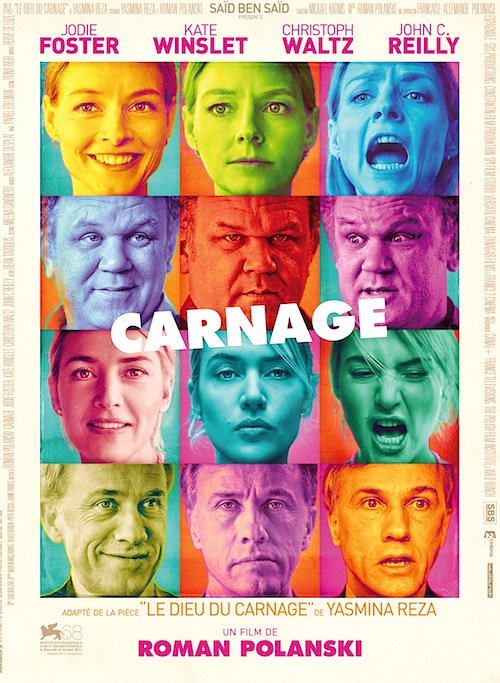
Libertas @ The 2011 New York Film Festival: Carnage

By Joe Bendel. For obvious reasons, Roman Polanski did not appear at the festival press conference, nor will he be participating in post-screening Q&As. However, Carnage (trailer here), the 49th New York Film Festival’s opening night film, was still one of the most eagerly anticipated selections for New York cineastes, who have been packing to capacity the recently concluded Polanski retrospective at the MoMA. A nearly instant sell-out at the NYFF, the film otherwise has its scheduled theatrical opening on December 16th via Sony Pictures Classics.

Penelope and Michael Longstreet are liberals, or at least she is. Alan and Nancy Cowan are conservative, or at least he is. There is no question who wears the pants in each family, but that does not mean Michael and Nancy do not resent their subordinate positions. They have gathered in the Longstreets’ remarkably spacious and stylish Manhattan apartment to address a violent quarrel between their young sons. The Cowan boy (or thug as his father calls him) picked up a handy stick and knocked Master Longstreet alongside the head.

Both sets of parents want to resolve the incident, but clearly differ in their approaches. The Longstreets, meaning Penelope, want to bring the kids together for a healing moment, whereas the Cowans (both of them really) are more down-to-business and practical. At first, everyone wants to show how civilized and rational they can be, but the longer the Cowans reluctantly tarry in that apartment, the more nerves are frayed and simmering hostilities are bluntly expressed.

Cleaving first along family lines and then turning on each other, Carnage spares nobody. Yet arguably the PC hypocrisy of the Longstreets takes it harder on the chin than Alan Cowan’s self-aware social Darwinism. Indeed, the whole premise of the film largely validates his world view.

Adapting Yasmina Reza’s hit Broadway play God of Carnage for the screen, Polanski embraces the staginess of the one-set four character verbal battle royale. Indeed, it is easy to see why it was such a successful star vehicle on stage. All four cast members get a chance to behave badly in the spotlight and chew on some scathing dialogue. Once again, Christopher Waltz does Oscar caliber work as Cowan, making condescending arrogance enormously entertaining. Since John C. Reilly still does not have his own little gold statue, though, he might be the focus of the film’s Academy campaign, even though it is the least showy performance. As for their better halves, Jodie Foster loses her cool outrageously as Penelope-not-Pen, while Kate Winslet is a bit more grounded, slowly breaking through Nancy Cowan’s icy reserve, eventually reaching a virtuoso state of manic aggravation.

In many ways, Polanski is undeniably an appalling human being. In a more just world, he would be sharing a cell with O.J. Simpson in California’s scuzziest prison. Those who want nothing to do with his films have every right to their contempt. However, they will miss a really darn funny film in Carnage. Though smaller in scope and talkier than most of his films, it is pointedly witty, performed with considerable flair by its all-star cast. There were four sold-out screenings last night, divided between the Walter Reade and Alice Tully Hall.

Posted on October 1st, 2011 at 11:35am.

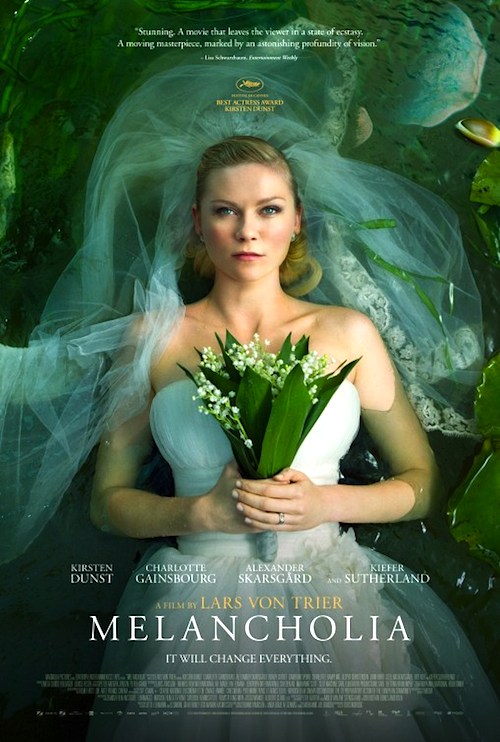
Libertas @ The 2011 New York Film Festival: Melancholia

By Joe Bendel. It is the end of the world or the end of Lars von Trier’s career. Whichever it is, it will finish with a bang. After this year’s Cannes, Melancholia is probably carrying more baggage as well as more laurels than a porter in the Roman Senate. Yet, it is worth considering von Trier’s Melancholia (trailer here) separate and apart from extraneous controversies when it screens during the 49th New York Film Festival.

Frankly, Justine would probably welcome the apocalypse on her wedding day. Hours late to her own reception, family tensions are already boiling over. Her hotelier brother-in-law John resents footing the bill for the lavish shindig when she does not even appear to take it seriously. Her very divorced parents are eager to start clawing at each other again, while her crude boss chooses the ostensibly happy occasion to play a weird round of mind games with his newly promoted employee. Claire, her slightly less highly strung sister, tries to hold the night together, but chaos is inevitable.

As Melancholia’s second part opens, Justine is now a basket case, having driven her adoring new husband Michael away. Through Claire’s insistence, she is staying her sister’s family, acting weird and getting on John’s nerves. In addition to her family drama, Claire is increasingly anxious over doomsday scenarios regarding Melancholia, a hitherto unknown planet projected to cross quite close to the Earth. As an amateur astronomer, John assures her she should not pay attention to such media claptrap, but it is clear viewers should give her concerns credence.

Melancholia has been dubbed Another Earth’s evil doppelganger. To an extent, this is a valid analogy, particularly in the manner both films use science fiction concepts in what are otherwise very personal and intense human dramas. Yet, the comparatively free-wheeling first half of Melancholia feels more closely akin to fellow Dogma 95 filmmaker Thomas Vinterberg’s The Celebration. Indeed, it is a joy (though perhaps a slightly sadistic one) to watch Melancholia’s top shelf cast tear into each other.

The Best Actress winner at Cannes, Kristin Dunst really is quite unsettling as Justine. The term ‘hot mess’ could have been coined with her in mind, yet she is never excessively showy in the role. Charlotte Gainsbourg and Kiefer Sutherland might sound like the most unlikely of couples, but they are quite convincing together as Claire and John (though at times we would not mind watching him open up a can of Jack Bauer on sundry family members). Not surprisingly, the old pros Charlotte Rampling and John Hurt nearly upstage everyone as the bickering exes, luxuriating in their tart sarcastic zingers. They also look perfectly cast as Gainsbourg’s parents (though maybe not so much for Dunst). Yet, the biggest laughs (and they are considerable) come from von Trier regular Udo Kier as the snippy wedding planner.

In the moodier, more impressionistic second part, Gainsbourg and Sutherland largely shoulder the dramatic burden, which they handle quite adroitly. In fact, Sutherland’s nuanced work might be the biggest surprise of the film. The notorious von Trier also stages the end of the world quite inventively, employing a simple but cinematic device to depict the rogue planet’s advancing approach.

Though accessible for general audiences, Melancholia is not the sort of film one can give a pat nutshell response to. Rather, it is the sort of film one studies and revisits over a period of years. A fascinating example of big picture movie-making on an intimate scale, Melancholia is the cineaste event-film of the year. Highly recommended, it screens this coming Monday (10/3) and Thursday (10/6) at Alice Tully Hall as a Main Slate selection of the 2011 New York Film Festival.

Posted on September 29th, 2011 at 1:14pm.

Watch the Premiere Episode of Homeland; Show Debuts on Showtime Sunday, 10/2

By Jason Apuzzo. I mentioned Showtime’s new Homeland series in our first Terror Watch update; Showtime recently made the entire first episode of the series available free on-line and I’ve embedded it above.

Having watched the episode, what I can tell you is that the series appears to be a somewhat clunky updating of The Manchurian Candidate for the era of the War on Terror, with some extraneous melodrama mixed in. Frankly, given the comments the producers have been making about the series of late (see here and here), I was expecting a somewhat more politically aggressive, stridently left-of-center show. There are certainly hints that the show may head in that direction in the future, but so far what we’re getting here instead is something more ambiguous and interesting (whether it’s entertaining is another matter). And, much to my pleasant surprise, the villains of the piece are actually Al Qaeda! Fancy that. I wasn’t sure Showtime had it in them.

Did hubby get brainwashed by Al Qaeda?

Homeland follows the return of an American soldier back to the United States after the soldier’s 8-year captivity at the hands of Al Qaeda. Quirky, non-conformist CIA case officer Claire Danes has reason to believe the soldier may actually have been brainwashed by Al Qaeda for mysterious ends, although the producers of Homeland have hinted that the plotline will involve the soldier’s eventual run for political office. (My suggestion? He should run for Governor of California. We’d never know the difference.) The theme of the show is quite obviously ‘paranoia’ – i.e., when or whether it’s justified in the post-9/11 era. Thus far the answer from this series – one episode in – is a resounding ‘yes.’

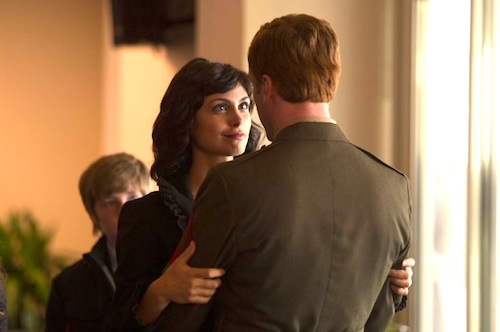
Whether I’ll actually follow this series, of course, is another matter. Homeland thus far looks a little dry and conventional, and Claire Danes (who spends a lot of the first episode popping anti-psychotic pills) doesn’t really excite me very much, although it’s good to see V‘s alien queen Morena Baccarin back in a new series.

What made John Frankenheimer’s original Manchurian Candidate work, of course, was its razor wit, sophistication with respect to its depiction of the Cold War, extraordinary photography from Lionel Lindon – and some extravagant, signature performances from Angela Lansbury, Laurence Harvey and Khigh Dhiegh. It can safely be assumed we won’t be getting anything like that in Homeland, but you may want to give the show a whirl if you have a free hour and wouldn’t otherwise prefer The Playboy Club. Also: feel free to catch this interview conducted by The Wall Street Journal with Claire Danes, whose character in Homeland is apparently based on a real-life CIA officer she was able to meet at Langley.

Posted on September 29th, 2011 at 1:13pm.

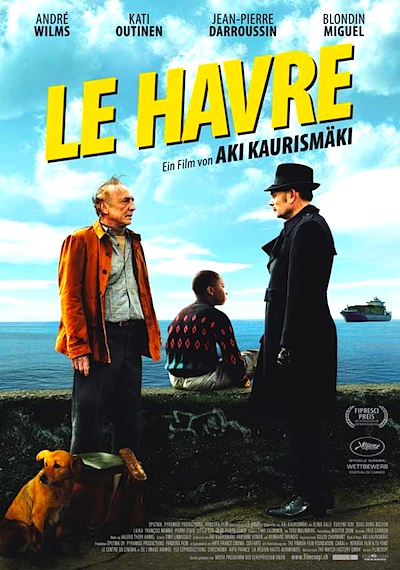
Libertas @ The 2011 New York Film Festival: Le Havre

By Joe Bendel. As the home of smugglers and cutthroats, ports are always the perfect setting for hardboiled crime drama – not, however, Aki Kaurismäki’s Le Havre. It’s nothing like the French film noir cities of Henri-Georges Clouzot, perhaps because Kaurismäki is Finnish. Instead, these marginalized roughnecks of Le Havre inhabit a quietly whimsical and deeply humanistic community in Kaurismäki’s Le Havre (trailer here), which screens during the 49th New York Film Festival.

Marcel Marx works the streets as a shoe-shiner in the tradition of Jacques Tati. He never had much money nor any worries before his beloved wife Arletty is hospitalized. Shielded from her fatal prognosis, he is at loose ends puttering about the waterfront, until he chances across Idrissa, a young illegal African immigrant hoping to be reunited with his parents in England.

Initially, he merely leaves some food for the boy. Then he opens his home to the sad-eyed Idrissa. Before long, Marx (hmm, heavy name, that) and his salt-of-the-earth comrades are working in concert to help their furtive guest elude Monet, the dour flatfoot.

Granted, a thumbnail description of Le Havre probably sounds unappetizingly didactic. However, Kaurismäki astutely employs a light touch with the material, emphasizing the inherent innocence and charm of Marx and Idrissa. Unlike far too many filmmakers, he seems to understand the old adage about catching more flies with honey. He also recognizes and capitalizes on the considerable charisma of his proletarian leads.

The twinkle in André Wilms’ eyes could light up a city block, yet he still invests Marx with a wonderful sense of dignity and a genuine élan. In contrast, Jean-Pierre Darroussin is his near total inverse as Monet, projecting an exquisitely French fatalism. As a bonus, cinematic Francophiles should keep their eyes peeled for Truffaut and Godard regular Jean-Pierre Léaud in a brief but fittingly idiosyncratic cameo.

Yet, it is the look and feel of the city itself that will dominate viewers’ impressions of the film. Cinematographer Timo Salminen gives Le Havre a warm glow that is inviting and nostalgic, while the back alleys rendered by Wouter Zoon’s design team look ideally suited for dancing in the rain.

Though never tackily melodramatic or cloyingly quirky, Le Havre has to be one of the most heartfelt, unabashedly old-fashioned films to carry major festival laurels this year. Regardless of politics, it is hard not to be swept along by its effervescent spirit. Definitely recommended, it screens Sunday (10/2), Monday (10/3), and Wednesday (10/5) as a Main Slate selection of the 2011 New York Film Festival.

Posted on September 29th, 2011 at 1:11pm.