By Jason Apuzzo. It’s probably time to start talking about David Fincher’s forthcoming adaptation of The Girl with the Dragon Tattoo. A ‘pirated’ red band trailer of the film recently ‘leaked’ on-line – or was it actually ‘leaked’ by Sony? – created a lot buzz, and now … as if by magic … the official version of the trailer (above) has been released, along with a new website.
My own thoughts are these: on balance I think this is a good trailer, excellent for a thriller, but Fincher’s films have repeatedly let me down … always somehow promising a great deal more than is actually delivered. A case in point recently was The Social Network, a film that implied it would have a great deal to say about the phenomenon of social networking – but actually said little (other than: ‘nerdy Jewish guy seeks revenge against WASP elites who rejected him by creating non-hierarchical on-line social scene’). So I remain skeptical. Nice Led Zeppelin cover, though …
By David Ross. Over two years, my nearly-six-year-old daughter and I have blown through all of Narnia, all of Harry Potter, and nearly all of Phillip Pullman’s great Dark Materials trilogy. She was attentive to Narnia and delighted by Harry Potter, but Pullman has entranced her to the extent that her face goes long with shock and anguish when I close the book and tell her to shout down the stairs for her nightly cocoa. Our next adventure is The Hobbit and its sequels. After tramping the roads with Frodo for six months, she will be primed for The Odyssey, beyond which lies the great Western sea of literature in all its dimensions of imagination and idea.
This program depends on the strict suppression of competing media (broadcast television, computer games, and web-surfing are verboten) and the realization that kids are by nature imaginative and that all attempts to subordinate the imagination to didactic and activist aims will produce a backlash of reluctance and indifference. Heather has two mommies, you say? This is a curious detail, worth a question or two, but not conducive to make-believe games or ruminations in the dark of bedtime. How much better if one of Heather’s mommies were a reincarnated Egyptian princess or a fairy queen cruelly trapped in a mortal body. This is not a political or literary judgment, merely an observation about developmental psychology.
Barbara Feinberg’s useful memoir of her kids’ reading, Welcome to Lizard Motel: Children, Stories, and the Mystery of Making Things Up,elaborates much the same point. Her basic thesis is that kids resist reading because contemporary books are insufferably pedantic and boring. This assumes that kids still read books at all. These days, schools seem happy enough to replace books with assorted ‘educational materials,’ not realizing or caring that these have all the romantic resonance of the suburban office parks where they were developed.
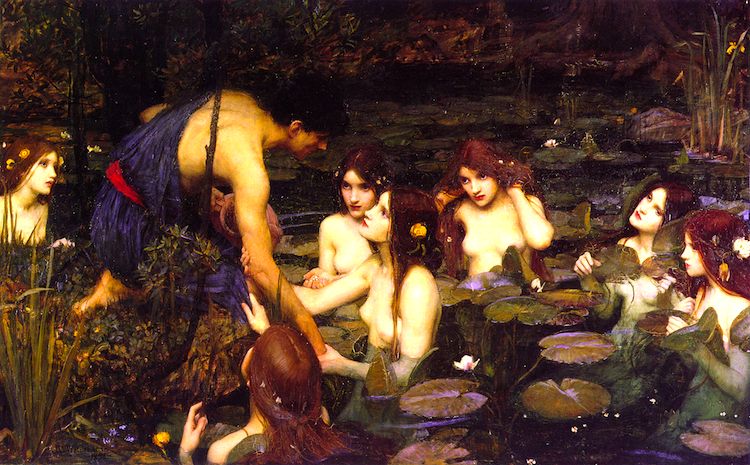
J.W. Waterhouse's "Hylas and the Nymphs" (1896).
With the right bait, the fish is easily hooked. Not long ago my daughter happened to look over my shoulder as I perused a book of paintings by J.W. Waterhouse, the pre-Raphaelite master. She drank in the scowling witch (Circe) and the dead lady in the snow (St. Eulalia) and the beautiful lady in the boat (the Lady of Shalott) and the young man saying hello to the beautiful water fairies (Hylas and the Nymphs). These are images to trigger reactions in recesses of the brain not usually exercised in school, in comparison to which the images of her everyday visual field – all those bright socially aware posters in the hallways, for example – are pablum. She added the Waterhouse book to her “birthday list,” which in our house is the ultimate form of canonization. Continue reading Kids, Imagination & The Arts
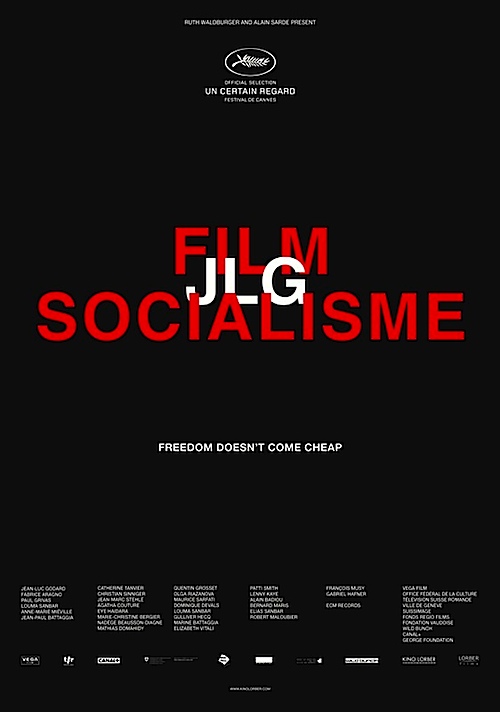
By Joe Bendel. A Mediterranean cruise sounds like a pleasant indulgence, but of course, none of the standard rules apply to Jean-Luc Godard. Certainly narrative and aesthetic conventions will be flaunted, as will polite decorum. Indeed, some might argue Godard’s latest and possibly final film (he has been somewhat coy on the subject) represents the height of self-indulgence. Yet, for hardy cineastes, the arrival of Film Socialisme, Godard’s latest cinematic-essay-provocation is as serious as a heart attack. Needless to say though, there will be plenty of shaking heads in the audience, even amongst the initiated, when Socialisme opens this Friday in New York at the IFC Center.
Dubbed “a symphony in three movements,” Socialisme is not Breathless, which proceeds along a more or less traditional narrative course, despite Godard’s periodic winking subversions. It is closer to his 1987 anti-adaptation of Shakespeare’s KingLear, but even there Godard left enough structural building blocks laying around for viewers to impose their own order. Rather, like his other post-2000 works, Socialisme is largely a cinematic collage providing viewers hints of narrative only for the sake of immediately snatching them back.
As Socialisme’s initial non-setting, the luxury ocean liner offers Godard a vehicle for some striking images and a frequent water motif. Just how the non-characters came to be on this cruise scarcely matters. Though a colorful assemblage – including a French philosopher, a war criminal of undisclosed nationality, a spy of some sort, and a chanteuse (played by Patti Smith) – they are only here to give voice to Godard’s polemical slogans. As he segues into his second and third movements, the film becomes something of a movie mixtape, juxtaposing text and visuals for ideological purposes.
It is not snarky to question just whom Socialisme is meant for, because of Godard’s signature gamesmanship. While the French dialogue is relatively conventional (if stilted), Godard’s subtitles are translated into crude Tarzan-like English, formatted in a style befitting e.e. cummings. Are English audiences seeing Socialisme as it is truly intended, or were the French, for whom it was presumably exhibited sans subs? Perhaps the film is best appreciated by those fluent in both languages, watching outside the francophone world. Is this a film primarily produced for French expats?
Naturally, Godard’s mischief is not limited to subtitles, but extends to soundtrack drop-outs and film-stock adulterations as well. As one would also expect, his extremist politics are also front-and-center, including a preoccupation with the Arab-Israeli conflict and the rather unsettling observation: “strange thing Hollywood Jews invented it.” Continue reading LFM Review: Jean-Luc Godard’s Film Socialisme
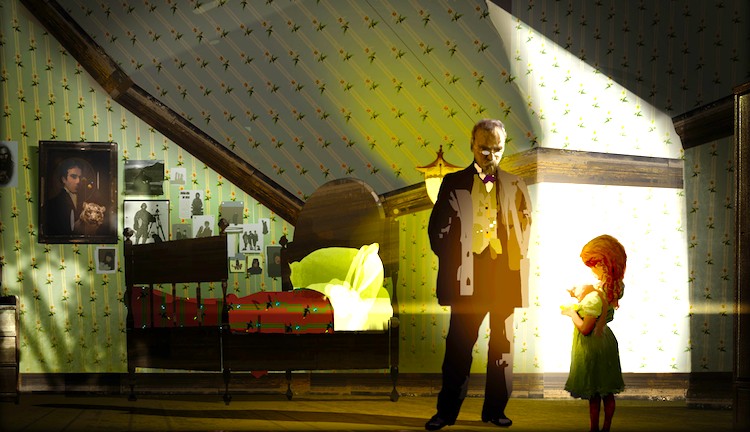
Concept art for "Dominion: Dinosaurs Versus Aliens."
By Jason Apuzzo. • There’s a lot of news on the Alien Invasion Front, but probably the most interesting thing that’s happened recently is that two joint video interviews were released – one featuring Michael Bay talking with James Cameron, the other featuring J.J. Abrams talking with Steven Spielberg. The two films they’re discussing, obviously, are the two big alien invasion thrillers coming down the pike: Bay’s Transformers: Dark of the Moon, and the Abrams/Spielberg Super 8. The interviews are both roughly 15 minutes long, but are otherwise studies in contrast.
The Bay-Cameron interview is very much tech-talk – good tech-talk mind you, intelligent discussion of a subject that many people are familiar with but rarely understand on a sophisticated level: moving stereoscopic (i.e., 3D) imagery. Bay and Cameron deliver one of the more thoughtful discussions I’ve heard on this subject – examining how 3D impacts editing, and how 3D is ‘dynamic’ (i.e., it can be dialed back, when necessary).
You really get a feel in this interview for how smart these guys really are when they’re discussing their own profession, or in pushing the technological envelope in big, mainstream filmmaking. I may disagree with Cameron about a great many things, but I would not want to tangle with him on the subject of stereo-optics, or on the subject of cinema montage in general. He’s certainly impressive, as is Bay. Both understand how the cinema really needs to push forward innovations like 3D in order to give audiences new reasons to go out to the movies, rather than to stay home and watch downloads. I fear for what YouTube and the internet in general are doing to the cinema, but these guys are obviously aware of the problem and developing creative solutions to address it. I found their discussion inspiring, and interesting … but probably best recommended for the more technically inclined readers out there.
Watching Abrams and Spielberg go at it is a completely different ball of wax, altogether! Although I admire Cameron (minus his politics) and Bay, Abrams and Spielberg seem more personable, fun, and you really get a sense of what a sentimental exercise filmmaking is for them. Super 8 is quite obviously intended as a journey back to their childhood, to what inspired their young imaginations and pushed them to become storytellers in the first place.
Both men also have what is clearly an advanced understanding of what generates excitement in audiences, and in how to create an air of mystery and suspense about what they’re doing. You really get a sense of what a personal matter filmmaking is to these guys, how non-technical it is, how filmmaking is something tied up with their everyday lives and emotions – even in their emotional reactions to other peoples’ films.
Anyway, I enjoyed both discussions and found them inspiring for different reasons – and I’m very much looking forward to both films. We’ll be getting Super 8 very shortly …
• On the Transformers: Dark of the Moon front, the film will have its world premiere June 23rd as the opening-night film of the Moscow International Film Festival (probably because the film has a neo-Cold War angle involving the Russians), and the U.S. debut has been bumped up to June 29th. Capone over at Aint It Cool News has already seen the film, and given it a rave review – praising it “not just in terms of its scope, but also in its pacing, performances, and ideas. This one dares to go dark from time to time, and that helped me find the often-lacking component of many Bay films: emotion.” Also: the film’s 3D IMAX trailer is now available on-line (I’ve seen it in a theater; it’s phenomenal); new ads and clips are out; and there’s already an ILM featurette out about the film’s VFX (in particular, it’s old-school use of miniatures).
Yes.
Better still, the best image yet of Rosie Huntington-Whiteley in Transformers has been released (see above), an image suggesting how deeply Michael Bay understands the male imagination (Victoria’s Secret supermodel + Mercedes concept car = automatic ticket purchase). The image also got me thinking: somebody should give Michael Bay the Bond franchise. Can you imagine how great that would be? In any case, you can also watch a clip of Rosie Huntington-Whiteley in the film … and Rosie talks to The HuffPo about her life as a farm girl. According to HuffPo:
She was pretty frank when discussing her shooting of livestock on her parents’ farm. “I know where my food comes from. I don’t get sad ’cause you don’t build relationships with those animals,” Huntington-Whiteley said. “I’m a farm girl; there’s the pigs, that’s the dog that I play with and love, but it’s the pig that’s gonna be in the freezer next month.”
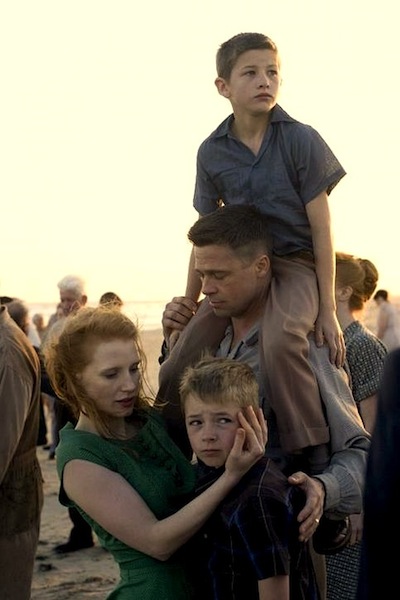
Brad Pitt and Jessica Chastain lead "The Tree of Life."
By Patricia Ducey. Terrence Malick’s latest, The Tree of Life, is a movie of big ideas: the cycle of birth and death, the mystery of suffering, and especially the necessity—and tragic elusiveness—of love. All Malick’s trademark film conventions are present here: the whispered voiceover narration, the elliptical narrative, the preoccupation with what is not said, what cannot be said but only imagined or felt. Malick’s genius has always been how he reveals the ineffable through the most mundane rudiments of everyday life in his characters. As Holly in Badlands seamlessly leaves her murdering boyfriend behind and begins a new life as wife and mother, we realize she is the innocent Malick imagines, never torn from any Eden. Or when Pocahontas at the finale of The New World rises, with a joyous smile of triumph, from her curtsy to the English King, we feel a kindred joy at her discovery of that new world – not as an “other” defined by conventional anti-colonial apologia, but as her own woman.
But in this film, Malick renders explicit, with unmatched visual and aural splendor, his vision of the essential spiritual quest; his characters literally ask God, where are you, why do you make me suffer?Tree of Life is almost an experimental movie, in that it eschews traditional narrative; no alarm bell plot points or expository dialogue here. So the passages of the family’s present life or memories seem more like montage than story; no one is explaining anything or planting clues. Any “real” story thus almost disappears. It is not surprising to read that Malick is an admirer of Kubrick—TreeofLife looks and feels a lot like Kubrick’s 2001: A Space Odyssey. Perhaps Malick at 67 feels ready to travel these same territories.
A saga of an American family.
We first meet the main character, Jack, as a young boy in Texas in the late ‘50s. Jack’s mother (Jessica Chastain), loving and devout, narrates the opening of the film. She tells us that there are two paths in life, one of nature and one of grace, and that we must choose which one we follow. Nature cares only for itself, while grace relies on a sense of oneness with all of existence. News suddenly arrives that Jack’s younger brother has died at age 19. We are not told how or why, but we see how grief and spiritual panic devour the family—and these questions dog Jack for the rest of his days. He grows up resenting his harsh father (Brad Pitt), longing for the love his father cannot or will not give him. Years later, as a successful architect, Jack lives and works in skyscrapers amid a sterile concrete modernity. He is as cold to his own wife and his own father was to him; this coldness is mirrored in the towering glass cities and rippling freeways that stand in stark opposition to nature. The way of the mother or the way of the father? This is Jack’s lifelong insoluble dilemma.
Malick soon interrupts the story of the family and the death of the brother, and embarks on a depiction of his own genesis story, from a cosmic Big Bang to Earth’s volcanic beginnings, to the kill-or-be-killed era of the dinosaur—all with special effects engineered by renowned veteran Douglas Trumbull. When Jack’s story resumes, we see through Malick’s expert direction, and the amazing camera work of cinematographer Emmanuel Lubezki, a childhood of back yards and sprinklers, running boys and budding sexuality—and, finally, all the furious civilizing that parents, knowing the alternative, try to impose. No American director could have evinced the intensity and naturalness of these childhood scenes any better. Jessica Chastain as Jack’s mother and Brad Pitt as his father illuminate their roles – especially Pitt, who artfully subsumes his soft attractiveness into a more severe toughness befitting his man-of-action character. And ever one of our most skilled actors, Sean Penn excels as the spiritually bereft adult Jack.
As always, Malick captures his audience with a whisper, from the mother’s opening narration—prayer, really—to the otherworldly climax. But TreeofLife is not an easy film. It must be seen on the big screen; no other movie this cartoon summer will look or feel anything like it. The soundtrack of largely religious music reminds us that this is a spiritual cri de coeur from someone who feels the autumn chill. When the lights came up in our theater today, the silence lingered—no chit-chat or phones chirping open. And when I turned onto the freeway, I had to click my radio off. The wind rushing by, the hum of the engine pulling me along—it seemed more fitting to turn down the noise and listen, closely for once, as the world in its magnificence flew by.
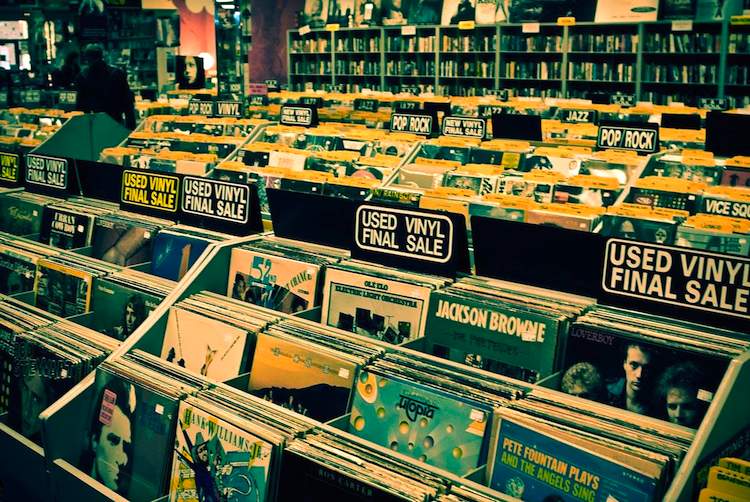
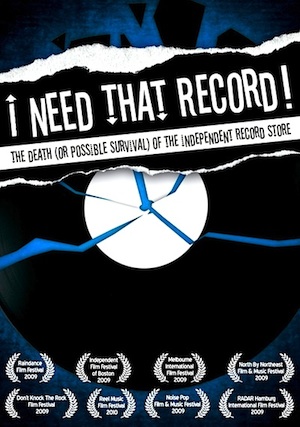
By David Ross. Brendan Toller’s documentary I Need That Record! The Death (or Possible Survival) of the Independent Record Store (2010) brings a good deal of personality and attitude (in the best sense) to the story of the demise of the independent record store, though it might just as well tell the story of the demise of the independent video or book store, all of which are victims of the same forces: box store encroachment followed by on-line revolution, all feeding the bottom lines of large corporations that don’t particularly give a damn about records, or movies, or books. The restaurant business has been similarly decimated. Applebee’s anyone?
"I Need That Record!" on DVD.
I am a fierce advocate of free-market capitalism, and yet I have to agree with Toller that something has gone wrong when Wal-Mart sells 20% of all albums and those albums are largely the work of corporate mannequins like Lady Gaga and Justin Bieber. My mid-sized Southern college town has one remaining used record store and one remaining used book store. Our last independent video store closed in December, and our Borders – which drove out our independent book and record stores – recently got a dose of its own medicine and closed amid a blaze of luridly florescent signage of the kind you associate with particularly tacky used car lots.
I’ll have to explain to my young daughter how likeminded people used to gather – in the flesh – to mingle, swap notions and preferences, and listen to whatever was on the turntable. I will have to recreate the lost world of my youth, and tell how I roamed the second-hand record stores of Boston and Cambridge, spending hours in grungy mouse-holes like Mystery Train (named in honor of the Elvis tune), and how I timidly put my fourteen-year-old inquiries to the superior wisdom of pierced twenty-four-year-olds, who had, in fact, heard everything and evolved a real critical acumen. Between 1988 and 1992, I spent many procrastinative late afternoons at Cutler’s in New Haven (still there!). I once asked the sagacious manager about Moby Grape’s first album, about which I’d read in The Rolling Stone Record Guide (before it annoyingly became the “album guide”). He said that the record was out of print but that he had a copy (of course) and that he’d make me a tape. My tape was waiting for me the next day, as promised. You don’t get that kind of service – that degree or any degree of giving a damn – at Wal-Mart. Continue reading The Lost World of the Indie Record, Book & Video Store