UPDATED: Atlas Shrugged Producer Throws in The Towel, Blames ‘Critics’ for the Demise of the Franchise

"Sorry, Dagny, I'm quitting."

By Jason Apuzzo. After my one-line review of Atlas Shrugged, Part I I’d intended to stop talking about the film, but events keep making that impossible. Today, a mere week after bragging to The Hollywood Reporter about his great marketing plan, Atlas Shrugged, Part I producer John Aglialoro essentially tells the LA Times that he’s throwing in the towel on making Parts II and III. He’s also backing-off plans to expand Part I to 1000 screens.

Here are the LA Times money quotes, in which Aglialoro blames the demise of his incipient franchise on “critics,” rather than on his film:

“Critics, you won … I’m having deep second thoughts on why I should do Part 2. … Why should I put up all of that money if the critics are coming in like lemmings?” Aglialoro said. “I’ll make my money back and I’ll make a profit, but do I wanna go and do two? Maybe I just wanna see my grandkids and go on strike.”

So the critics who disliked his film are “lemmings.” I’m laughing at this because these “lemmings” would apparently include Kurt Loder of Reason Magazine, and a host of other like-minded critics I could name. But why bother? I’m sure we’re all just part of the vast leftist/Looter conspiracy out to get Mr. Aglialoro and his film.
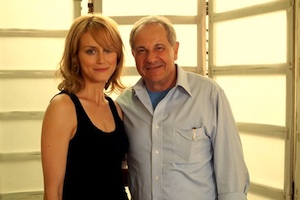
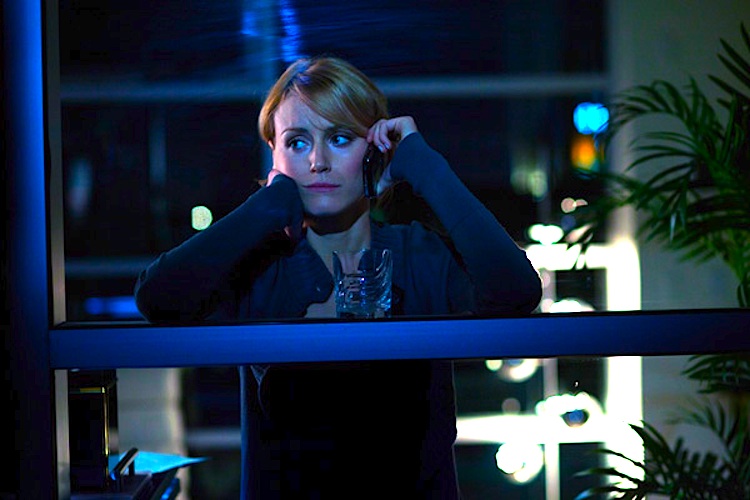
Taylor Schilling with John Aglialoro.

What’s particularly galling here is that in his LA Times interview, Mr. Aglialoro indicated no plans to release the rights to Atlas Shrugged from the purgatory they currently inhabit while in his hands. As Libertas reported recently in our exclusive review of the Randall Wallace-Angelina Jolie Atlas Shrugged screenplay, so much more could’ve been made of this project – but Aglialoro’s intransigence in holding onto the rights is keeping better versions from being made.

What this currently means, of course, is that Atlas Shrugged, Part I will now join Mel Brooks’ History of the World, Part I among other unfinished film franchises – the difference being that Brooks’ was actually intended to be a joke.

[UPDATE 4/28: Now Mr. Aglialoro is telling The Hollywood Reporter that he in fact will make Parts II and III, “even though critics hate the movie and business at movie theaters has fallen off a cliff.” He also continues to claim political persecution on the part of critics. “It was a nihilistic craze,” Aglialoro said. “Not in the history of Hollywood has 16 reviewers said the same low things about a movie. … They’re lemmings,” he said. “What’s their fear of Ayn Rand? They hate this woman. They hate individualism.” Apparently these ‘nihilistic lemmings’ who ‘hate individualism’ would also include Roger L. Simon of Pajamas Media, who referred to the film as a “fiasco.”

What a farce this is. It’s quite obvious that Mr. Aglialoro felt the need to make a public pronouncement as to whether he intends to passively squat on the rights to Atlas Shrugged, now that his first film has tanked. Possibly this was a result of our pressing him on the rights matter here at Libertas, since no one else in the media has brought this up. Who knows? There is a phrase for how Mr. Aglialoro is handling all this, however: amateur hour. Expect that Part II and Part III will not be made, and the rights quietly sold away in months ahead.]

Posted on April 27th, 2011 at 10:49am.
LFM Review: Detective Dee and the Mystery of the Phantom Flame @ Tribeca 2011

By Joe Bendel. He was a legendarily honest and perceptive administrator during the turbulent reign of Wu Zeitan, the first and only woman to rule China in her own right. However, most westerners know him as Judge Dee, the protagonist of Dutch Asian scholar Robert van Gulik’s detective novels. Dee, or more properly Di Renjie’s powers of deduction, are such Wu Zeitan plucks him from prison to ferret out the truth behind a series of grisly deaths threatening to derail her coronation in Tsui Lark’s Detective Dee and the Mystery of the Phantom Flame, which screens during the 2011 Tribeca Film Festival.

One look at the giant Buddha statue under construction outside the Imperial palace (complete with internal staircase and observation deck) should tell viewers something spectacularly disastrous is in the offing. Currently, a former associate of Die Renjie is scrambling to finish construction in time for Wu’s official ascension. Suspiciously, the court architect and lead investigator spontaneously combusted there (presumably after seeing something sinister), setting work slightly behind schedule.

Through his animal avatar, the mysterious Imperial Chaplain tells Wu Zeitan who she’s gonna call: Die Renjie. Dispatched to fetch the imprisoned Die Renjie, the trusted Jing’er finds him fending off a horde of assassins with the help of his blind prison mentor.  There will be plenty more for her blade over the course of their investigation, as well as a considerable helping of sexual tension with the tentatively rehabilitated Die Renjie.

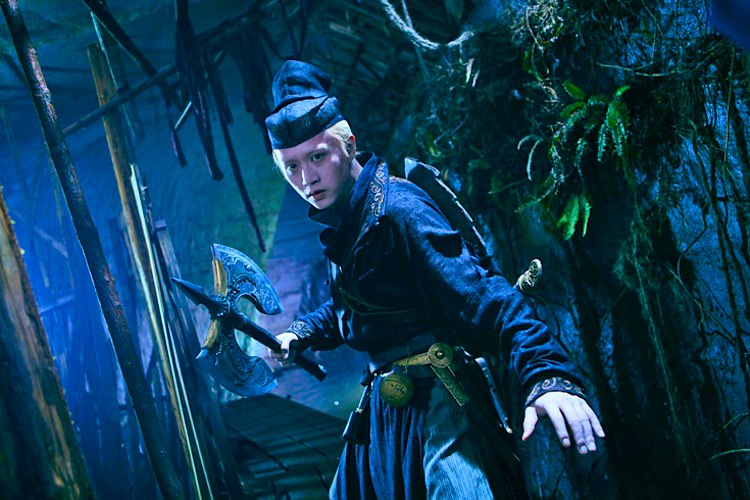
Pei Donglei in "Detective Dee."

Continue reading LFM Review: Detective Dee and the Mystery of the Phantom Flame @ Tribeca 2011

ANNOUNCEMENT: LFM Covers The TCM Classic Movie Festival! + How TCM Changed My Life

By Jennifer Baldwin. From my earliest days as an old movie obsessive (circa, age fourteen), I’ve been obsessed with finding out how young people fall in love with old movies.

For my grandma’s generation, the love is easy to explain: These aren’t “old movies,” these are just THE movies, the ones they spent their lives seeing in the theaters.

For my mom’s generation, these old movies weren’t exactly contemporaries, but they weren’t so old and distant either. When my mom was a kid in the 1960s, the old movie stars were still around and the old movies must have still felt familiar, if a bit musty. It’s a lot like my own generation’s relationship to the movies of the 1980s. My Saturdays were filled with a never-ending supply of popular ‘80s movies on cable TV, just as my mom’s youth was filled with Rita Bell and “Bill Kennedy at the Movies.”

But how do people born in the ‘70s, ‘80s, and ‘90s become old movie buffs? How do Generations X, Y, and Z get into watching movies made in the ‘20s, ‘30s, and ‘40s?

I know how my own old-movie odyssey went, all of the influences and the inspirations. I know I owe a lot to the years 1988 to 1992, when it seemed like every summer another movie came out that was set in a 1940s Never Land – whether it was Who Framed Roger Rabbit? or The Rocketeer or A League of Their Own – and each of these new movies whetted my imagination for the old ones.

I know I owe a lot to my grandparents and their love of jazz, and how that love was transferred to me, so that for three solid years I spent my summers at the Elkhart jazz festival and never at a New Kids on the Block concert. Being a fan of swing jazz and Dixieland made it easier to love other old things, like movies.

I know I owe a lot to my grandmother and my mom, who invited me to watch these strange old movies with them, folding laundry on the couch and falling in love with Cary Grant and Clark Gable, thus beginning my own long, intoxicating affair with old Hollywood.

But how do other people of my age and generation get into the old stuff? What are their paths to classic cinema ecstasy?

I have a feeling that no matter our divergent and differing paths, we have one thing in common: Turner Classic Movies. Continue reading ANNOUNCEMENT: LFM Covers The TCM Classic Movie Festival! + How TCM Changed My Life

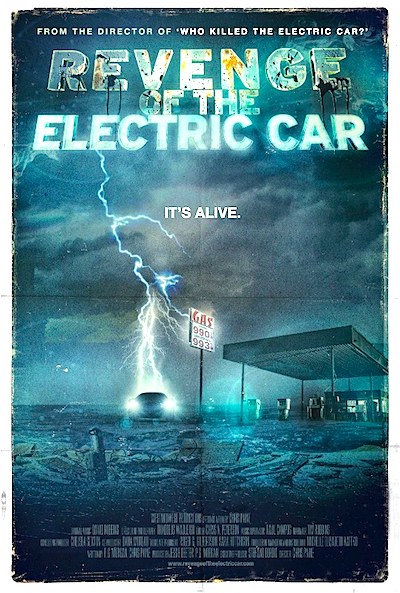
LFM Review: Revenge of the Electric Car @ Tribeca 2011

By Joe BendelIn Terminator 2, the villain of the previous film comes back as the hero of the sequel. Such is also the case with Chris Paine’s latest film, except it is a documentary. The freshly reformed protagonist? General Motors. The times just might be changing after all in Paines’ Revenge of the Electric Car, which premiered recently at the 2011 Tribeca Film Festival.

According to Paine’s Who Killed the Electric Car, despite enthusiastic driver feedback, GM recalled their experimental EV-1, while twisting its mustache and laughing maniacally. Instead, they ramped up production on Hummers. The end, or is it? Fast-forward a few years and meet Bob Lutz, the Vice Chairman of the automotive giant. The car executive’s car executive, Lutz is no tree-hugger. Yet, like Saul on the road to Damascus, Lutz fundamentally changed his mind about the feasibility and desirability of electric cars. Only Lutz has the prestige to put GM back in the electric business and the guts to allow their old nemesis to document it.

Revenge has other protagonists, like Elon Musk, the tech-centric entrepreneur, who made his fortune with Pay Pal before starting Tesla Motors. Sleek and striking, these sports cars are probably too elite to change the world, but they ought to make electric cool. Unfortunately, Musk has trouble filling customer orders (including Paine’s). As more mass market competition, Nissan chairman Carlos Ghosn has “bet the future” of his company on electric, but that shoe has yet to drop.

It is important to note, none of these ventures are the result of government mandates. Indeed, they are highly speculative ventures that might just short circuit careers and fortunes. To his credit, Paine himself gives due credit to the captains of industry and entrepreneurs of Revenge. Though he retracts nothing from his previous film, it is clear he and pre-government takeover GM made a lasting peace.

Of course, Bob Lutz is a major reason why. Although Paine probably has a naturally affinity for the Silicon Valley-based Musk, Lutz’s curmudgeonly charm dominates the film. The camera loves the cigar chomping old school executive far more than the icy Ghosn or the cerebral Musk. (While Revenge eventually addresses the government bail-out, most of the GM segments deal with Lutz’s early championing of the hitherto underwhelming Volt.) Continue reading LFM Review: Revenge of the Electric Car @ Tribeca 2011

LFM Review: Braid (Short) @ Tribeca 2011

By Joe Bendel. Kids focus on the most superficial things. Ting is a sweet-tempered, compassionate little girl, but her classmates zero-in on her sloppy braids. It is not her fault, though. Her grieving father Jie is not used to tying them. Nor does he have the heart to explain her mother’s extended absence in Bian Zi’s short film Braid, which screens as part of the Take As Directed shorts block at the 2011 Tribeca Film Festival.

One day, while being ignored by the kids playing in her neighborhood, Ting finds an abandoned kitten. Empathizing with the motherless feline, she takes it home with her. Her father is trying to care for her as best he can, but he is overwhelmed with grief. Unemployed with few prospects, the death of his wife was also a devastating financial blow. Things look truly bleak for them, but keep an eye on that kitten.

Bian Zi’s fifteen minute Braid is surprisingly moving, particularly for a student film. Sensitively helmed, the Taiwanese filmmaker deftly hints at the metaphysical with the conclusion to what is an otherwise starkly naturalistic work. Unquestionably, though, the key to the film is the remarkably poignant, completely convincing work of Jun-Jie Du as Ting. Scores of viewers will want to adopt her, after only two or three minutes into the film.

Braid might be a simple story, but it is powerful in its honest directness, reaching deeper places than most smugly sentimental indies could ever hope to approach. Featuring truly memorable performances, the well conceived Braid is easily a stand-out among Tribeca’s shorts this year.  Highly recommended, it screens during the Take As Directed program on Thursday (4/28), Saturday (4/30), and Sunday (5/1).

Posted on April 26th, 2011 at 9:37am.