• One of the recently leaked WikiLeaks cables reveals that diplomats from 14 Arab states voted to ban Steven Spielberg’s films in response to his $1 million donation to Israel during Israel’s 2006 confrontation with Lebanon. (As a side note, the Arab League also apparently didn’t like the depiction of Arabs in Raiders of the Lost Ark.)
I’m pressed for time, and would otherwise like to say more about all this, but let me confine my remarks to these: that it is axiomatic, in my opinion, that there will be no peace in certain parts of this world until there is also freedom. In a time of year when thoughts of peace are on everyone’s minds, and justly so, we should never forget that freedom is the vital force that nurtures peace.
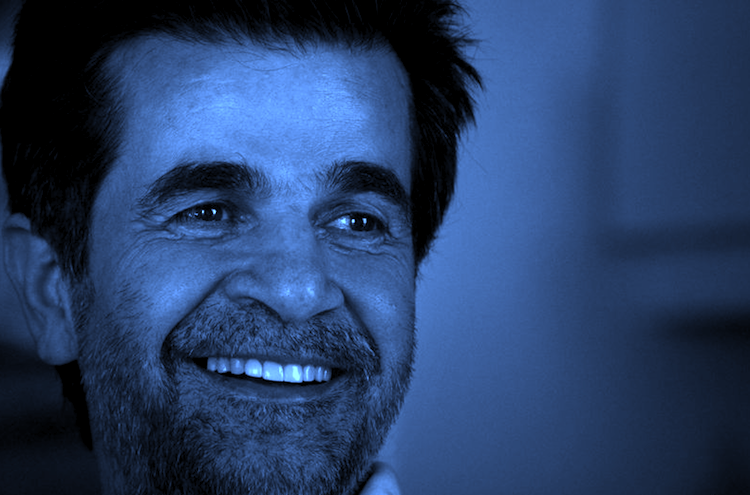
Final note: on the Panahi front, here is his Facebook page, and here is an on-line petition demanding the lifting of his sentence.
By Jason Apuzzo. • One of the most intriguing things I’ve seen recently is the promotional trailer (see above) for director Renny Harlin’s new, $20 million Russian-invasion-of-Georgia thriller 5 Days of August, which is set for release in March.
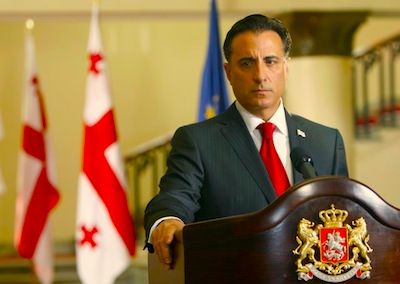
Andy Garcia as Georgian President Mikheil Saakashvili.
The film stars Val Kilmer, Andy Garcia (as Georgian President Mikheil Saakashvili) and Heather Graham among others – and deals with a group of war correspondents caught behind enemy (i.e., Russian) lines when the Russians invaded Georgia back in 2008.
When the journalists videotape a series of horrific Russian war crimes, they have to fight to get the footage out of the country. The film was apparently shot on-location in Tbilisi, with the approval of the Georgian government.
From the look of the promotional trailer (which does not appear to be the final, theatrical trailer), it looks like Harlin is going hard-core in his criticism of the Russians – so this is going to get very interesting come March. Bravo to everyone involved for their courage in doing this, and please do try to avoid assassination.
Harlin (Die Hard 2) also seems to have squeezed a lot out of his $20 million budget, as the scale of the project seems impressive. We’ll be keeping an eye on this project here at Libertas. Val Kilmer really needs to drop some weight, by the way.
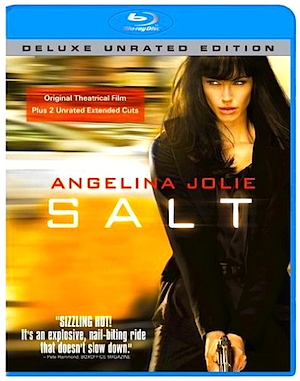
• Angelina Jolie’s The Tourist opened poorly (see the LFM review here), but fortunately there’s always Salt – which just hit Blu-ray and DVD. The new Salt disks apparently contain several different cuts of the film, including an ‘extended’ cut and also a ‘director’s’ cut – the differences between these cuts are explained here – and the cuts actually seem to represent legitimately different visions of the film, particularly with respect to the film’s ending. Without giving anything away about the new scenes, suffice it to say that sequels were definitely on everyone’s mind at the time of the production.
So will there be sequels? It’s too early to say, but director Phillip Noyce – who’s out doing media for the new DVDs – probably won’t be doing them himself (see here) as he seems to have moved on to other ventures.
We liked the retro, commie-hunting vibe of Salt here at Libertas (see our review here), and we’re hoping this film gets its franchise. If it does, it will be noteworthy for having done so without the aid and assistance of the talking heads on either Fox News or talk radio, ironically enough.
• The new Bond film is currently scheduled for a November 2012 release, incidentally.
• Take a few minutes to enjoy this animated short below, called Pigeon: Impossible from Lucas Martell. It’s about a rookie CIA agent who gets into hot water after a pigeon gets trapped inside his nuclear briefcase and sets off an ICBM toward Moscow. It’s a cute little story, and the quality of the animation is quite high.
• … and speaking of Tom Cruise, by the way, some incredible set footage from Mission: Impossible 4emerged recently of Cruise swinging around outside the upper floors of the Burj Khalifa tower in Dubai, where he’s roughly 2,000+ feet up. He even waves and smiles at the tourists watching him. I’ll say this for the guy, he always gives people their money’s worth. One other bit of related news: Ving Rhames may not be back for Mi4 – although, weirdly, he may be returning for the next Piranha film (didn’t he get chewed to pieces?).
• AND IN TODAY’S MOST IMPORTANT NEWS … January Jones – who will be playing Emma Frost in the swingin’ 60s/Cold War-themed X-Men: First Class – just did a series of provocative handbag ads for Versace, which is odd because she herself really doesn’t look like a bag at all.
And that’s what’s happening today in the Cold War!
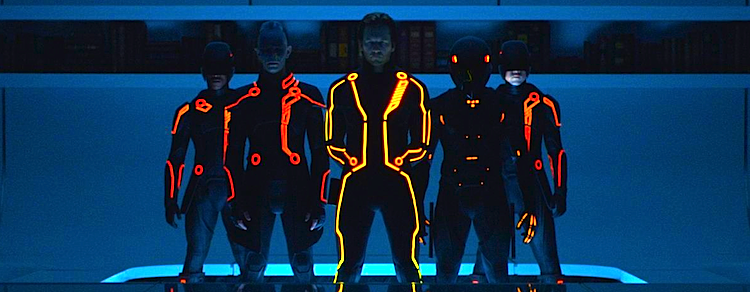
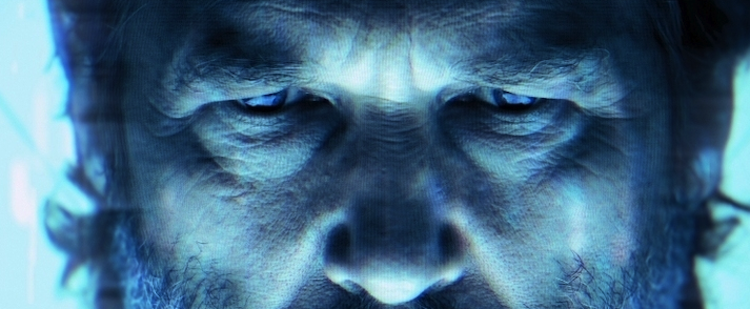
The young/CGI Jeff Bridges as 'Clu,' dictator of The Grid in "Tron: Legacy."
By Jason Apuzzo. There’s a moment late in Ridley Scott’s Blade Runner when Rutger Hauer, playing the doomed replicant ‘Roy Batty,’ turns to Harrison Ford just before dying, and with a mad gleam in his eye ruminates:
“I’ve seen things you people wouldn’t believe. Attack ships on fire off the shoulder of Orion. I watched C-beams glitter in the dark near the Tannhauser Gate. All those moments will be lost in time … like tears in rain.”
It’s a wonderful, sad, poetic, insane moment – the soul of the film, actually, as this fantastic and vaguely Nietzschean character expires with unexpected grace, and in so doing teaches his pursuer (Ford, the titular ‘blade runner’) something about the true nature of ‘humanity.’
In trying to summarize what director Joseph Kosinski’s Tron: Legacy lacks, it’s precisely such moments – or even one such moment. And it’s a shame, because I think that somewhere out there – perhaps still lurking in the interstices of the director’s imagination, or somewhere on his hard drive – there might actually have been a great science fiction film here, something perhaps south of Star Wars but certainly north of The Matrix. But as things stand, greatness was definitely left waiting on the table with respect to Tron: Legacy – this very big, very stylish and ambitious production that unfortunately never really takes flight as it should.
On the face of it, the idea of rebooting Tron was a decent idea, in so far as the cinema technology (CGI, 3D, etc.) currently exists today to flesh-out the basic Tron story in a more visually satisfying manner than was possible back in 1982. And, of course, since the early 80s we’ve obviously developed a much more precise feeling for what ‘cyberspace’ and the internet mean to us, on both a practical and symbolic level. Even just this week we learned, for example, that Facebook’s Mark Zuckerberg is going to be Time’s Man of the Year – and the movie made about him (the weirdly uninvolving The Social Network) is very likely to win Best Picture at the Academy Awards in a few months.
Baby Boomer Jeff Bridges reflects ad ad nauseum on his legacy in "Tron: Legacy."
So on paper, the timing for this project should have been perfect. And yet I’m wondering if maybe it’s the exact opposite: that the timing for this film, in a sense, couldn’t be worse. Worse not because of the subject matter, nor because ‘computing’ has lost some of its romance and speculative luster since the early 80s – Steve Jobs notwithstanding. Continue reading Totalitarianism, Narcissism & Boomer Anxiety; LFM Reviews Tron: Legacy
By David Ross. What sufficed the growing boy suffices the grown man. I read Ayn Rand’s entire oeuvre between the ages of fourteen and eighteen. It made an enormous impression in the usual ways, confirming my nascent conservatism and even more my nascent romanticism, on which paths, political and literary, I remain to this day. Rand led to Victor Hugo and George Sand, which led to my life’s work as a student of literature and circuitously to my permanent preoccupation with a certain romantic and conservative strand in modernism whose great avatar (if James Cameron has not entirely compromised the word) is William Butler Yeats. Rand also helped engender my reverence for the great achievers and achievements of civilization, which is, I believe, my greatest asset as a teacher to this day. Rand might not approve my heroes, but she would approve my penchant for hero worship. I have never sympathized with industrialism as a symbol or model of human creativity, nor desired to remake myself into an unsmiling and inflexible hero of what Rand calls rationalism, nor felt the need to hammer my haphazard libertarianism into consistent and rigid doctrine, but all the same I am her progeny. For better and worse, I have been formed by her in uncountable ineffable ways.
The Obama era was, for me as for so many others, an open invitation to reread Rand, so thoroughly does she seem to diagnose the psychology of our present slide into statism (Obama’s constant rhetoric about sibling-keeping might as well be plucked from the mouth of Wesley Mouch). News that Atlas Shrugged is finally being filmed also helped inch the book to the top of my pile (see Libertas’ interviews with director Paul Johannson here and here).
I was trepidacious, however, not sure to what extent I might have outgrown Rand. I was not concerned about the palatability of her philosophy, to which I have never specifically subscribed, but about her prose and her craftsmanship, which self-congratulatory journalist types constantly deride as second-rate, the kind of thing that only a teenager or cultist could fail to smirk at. This passing reference in a December article in the Weekly Standard is typical:
Atlas Shrugged, while a perennial bestseller and an important artifact of 20th-century culture, is not exactly great literature (stilted dialogue and cardboard characters have ranked among the defects pointed out by critics).
I have now reread the first half of Atlas Shrugged, and I can offer my very educated opinion that itis great literature, not necessarily at the sentence level, but in the unstoppable propulsion of its narrative (has a philosophical novel ever been so engrossing?), in the massive, dauntless sweep of its ideas, and in its enormous imaginative feat of creating a myth of our entire world (Dante and Milton are Rand’s compeers in this limited, formal respect).
Against the leveling instinct.
Even more, Atlas Shrugged is a great work of literature in its comprehensive taxonomy of modern men, in its comprehension of all their hidden springs and insecurities and frustrations and ambitions. Rand fancied herself a political theorist and metaphysician, but she misunderstood herself; she was a psychologist foremost, and Atlas Shrugged is a formidable system of psychology to contraindicate that of Freud. Eschewing the usual bedroom and bathroom preoccupations, Rand grasps that behavior is driven by what she calls ideals, conscious or unconscious structures of value that provide the context for everything we do and everything we are. Freud tends to reduce these structures to underlying psychosexual dynamics, but Rand insists on their primacy and irreducibility, and she illustrates their role as the ceaseless motive forces of life. She is also a particularly shrewd diagnostician of a certain kind of resentment and leveling instinct – James Taggart is the obvious embodiment– and she is nearly alone in realizing that this mindset is no trivial phenomenon but the rotting core of our world, explaining everything from the Soviet world-blight to our failing schools and lousy art.
Rand’s characters are ‘cardboard’ in the sense that they speak for philosophical positions and represent certain types, but each character embodies something slightly different; there is no overlap or redundancy. In the aggregate, they form a spectrum of humanity – a human comedy – that is convincing and powerfully explanatory. Rand is accused of engaging in moral black and white, but this is not entirely fair; while her scheme is moral in logic and purpose, many of her characters – Dr. Stadler for example – represent subtle, equivocal positions. They are not gray, but an intricate admixture of black and white.
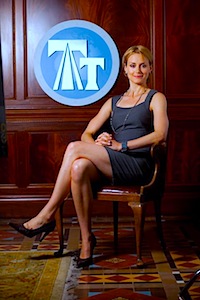
Taylor Schilling as Dagny Taggart.
Rand sketches her characters in only a few clean strokes, but these strokes are rendered so deeply and forcefully as to be ineffaceable. Who can forget Hank Reardon or Dagny Taggart? Who can forget their triumphant inauguration of the John Galt Line? Who can forget their strange, violent lovemaking? What character drafted by Henry James, by contrast, does anything but deliquesce and drift imperceptibly from consciousness, becoming a vague haze of inflection and velleity?
Atlas Shrugged is a great novel, finally, in its astonishing originality. It has no precedent in terms of style, tone, mood, or philosophy, as far as I know. Victor Hugo may account for its sweep and social engagement, and someone like Zamyatin may have influenced its anti-totalitarianiasm and latent dystopianism, but nothing accounts for its strangeness, for everything powerfully eccentric and not infrequently repellent that Rand herself brings to it, everything rooted in the passionate kinks and quirks of her personality. In the end, it belongs in the category of the sui generis along with modern masterpieces like Ulysses, The Castle, and Pale Fire. It does not rival the artistry of these works, but it similarly emerges from a unique and bizarre mind.
Rand’s ultimate strength is her unswayable belief in herself as an arbiter of value and reality, and her passionate self-investment in every page she wrote. Her intent was doctrinaire, but her triumph is romantic.
Addenda:
See Rand on YouTube in all her rebarbative glory: here, here and here.
Whittaker Chamber’s fascinating, fiercely antagonistic, latently Christian review from the December 28, 1957, issue of National Review.
National Review’s contemporary take, likewise antagonistic.
By Jason Apuzzo. Tomorrow brings Tron: Legacy, Disney’s $320 million attempt (including marketing costs) to ‘reboot’ a sci-fi franchise that never was. Naturally we will be reviewing it here at Libertas.
In the meantime, I’m wondering whether Tron will even be as good as this relatively quiet little sci-fi short above, called “Modern Times,” that was apparently made by some UK filmmakers for peanuts. It just arrived on Vimeo about a week ago.
And below, incidentally, I’ve put the Tron-ified Modern Times from Charlie Chaplin that filmmaker Nick Tierce did recently for the AintItCoolNews contest.
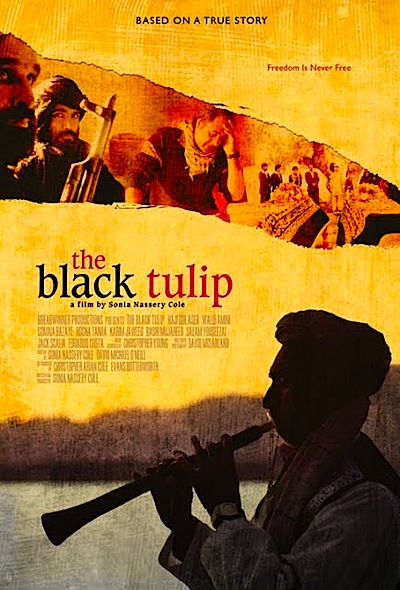
By Joe Bendel. The Taliban are not what you might call big movie buffs. Of course, anything involving free expression is pretty much a non-starter for them. After shutting down Pakistan’s cottage Pashto film industry, for example, they did their best to harass the cast and crew of Sonia Nassery Cole’s The Black Tulip. Yet she persevered, eventually completing the only film produced in Afghanistan this year.
Though duly submitted as the country’s official submission for best foreign language Oscar consideration, the Academy unfortunately disqualified Tulip on grounds that seem highly debatable.
Since Cole and company are presumably working to secure festival slots and theatrical distribution, a review as such would be premature. However, having seen it two weeks ago at a New York Times event, one hopes more people will have a chance to share the experience. As writer, director, producer, and lead actress, Cole was nearly a one man band. Still, she and cinematographer Dave McFarland produced a slickly professional looking film that bears no resemblance to zero-budget Pashto films featured in George Gittoes’ jaw-dropping documentary The Miscreants of Taliwood (trailer below).
Rejected by The Academy on questionable grounds.
In fact, Cole displays a real talent for pacing and shot composition. Conversely, her acting is not exactly at the same level. To be fair, she was reportedly a last minute substitution when the Taliban hacked off the feet of the woman she had originally cast as the protagonist, Farishta. Naturally, the same New York Times has devoted a fair amount of article space to those who dispute this account – largely it seems, because they prefer not to deal with its implications. Had Cole had an actress like the great (and great really is the word) Shohreh Aghdashloo in the lead, the mind reels at what could have been. Perhaps the film’s greatest revelation though, is the consistent quality of the Afghan cast, particularly Haji Ghul Aser as her husband Hadar.
There are many reasons why Tulip is an important film. Indeed, it is truly fearless in its portrayal of the Taliban’s savagery. Even more controversially, it also depicts the American military as a positive presence in Afghanistan, forging links of friendship with average citizens. Yet, the most valuable aspect of Tulip is the window it opens into an Afghan middle class most Americans probably assume does not exist. Tulip shows audiences that not all Afghans are toothless mujahedeen with a Koran in one hand and a Kalashnikov in the other. Rather, there are many people like Farishta and Hadar, who simply want to work hard and raise their family.
Considering the state of filmmaking in the region, one would think the Academy would try to support films like Tulip as best they can. However, they disqualified Tulip from the best foreign language film category – apparently because Cole, an Afghan expatriate working with a largely American crew, were not deemed authentically Afghan enough.
Yet similar issues could be raised regarding the Algerian Oscar submission, Rachid Bouchareb’s Outside the Law. Bouchareb was born in France to a family of Algerian immigrants. And aside from the opening scenes, the film is also set entirely in France – featuring French movie stars, like Roschdy Zem and Jean-Pierre Lorit. Somehow though, this was apparently forgivable to the Academy given that the film is a critique of French colonialism.
Law is an excellent picture that deserves to be in Oscar contention, but if it meets the foreign language division’s criteria, it is hard to understand why Tulip would not. Maybe Cole’s film can still qualify for consideration in the best song category. Natalie Cole (no relation) recorded three originals for the soundtrack, including one legitimately stirring anthem with a popular Farsi vocalist.
Contact your local film festivals and societies about Tulip, because a film like this will need a groundswell of support.