LFM Review: Ralph Fiennes & Gerard Butler in Coriolanus

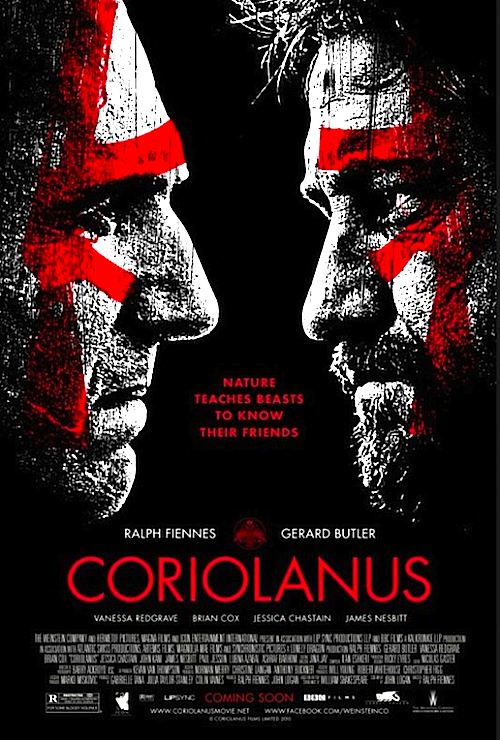
By Joe Bendel. It has long been considered one of Shakespeare’s most divisive tragedies. Though academic appraisals remain quite mixed, Coriolanus always had its champions, including poet T.S. Eliot. As a result, there are few cinematic predecessors against which actor Ralph Fiennes directorial debut might be compared. In the Olivier-Branagh tradition, Fiennes also stars in his contemporary retelling of Coriolanus (trailer here), which begins a one week Oscar qualifying engagement in New York this Friday.

In a Balkan city that “calls itself Rome,” Caius Martius has earned the honorific title “Coriolanus” for his victory over the city-state’s bitter rival, the Volsces. At the behest of his proud mother Volumnia and her ally Senator Menenius, the general consents to campaign for the office of Consul. The approval of the Senate is assured, but Coriolanus’s candidacy must also be accepted by the masses. This is a taller order, especially given the officer’s refusal to pander to the lowest common denominator.

Nonetheless, with Menenius’s help, Coriolanus appears to win over the people. Yet just as quickly, the deceitful senators Brutus and Sicinius turn the crowd against him, with the help of a cadre of professional activists. Venting his outrage, Corilanus’s contempt for the fickle masses leads to his banishment. It also drives him to Volsces, where he makes common cause with his old nemesis, Tullus Aufidius. Dead to everything except his rage, Coriolanus will have his revenge in a manner befitting Shakespearean tragedy.

Given his abruptly shifting loyalties and his un-Shakespearean lack of introspection, Coriolanus is a difficult figure for many to get their heads around. However, Fiennes’ portrayal really unlocks his character. We can understand how his rigid conception of honor compels each action he takes. Despite Corilanus’s reticence, it is a big, seething performance of great physicality that commands viewer attention. Clearly this is a man of action, not given to soliloquizing.

This is definitely Shakespeare at his manliest (no tights or sonnets here, thank you very much). Indeed, Gerard Butler matches Fiennes’ testosterone as Aufidius, while Vanessa Redgrave nearly outdoes them both as Volumnia, the motherly Lady Macbeth. Yet the real soul of the film comes from the great Brian Cox as Menenius, whose humanity leads inexorably to pathos. Though a relatively small part, it is also interesting to see South African actor John Kani, who projects a suitably stately presence as Coriolanus’s former superior officer, General Cominius.
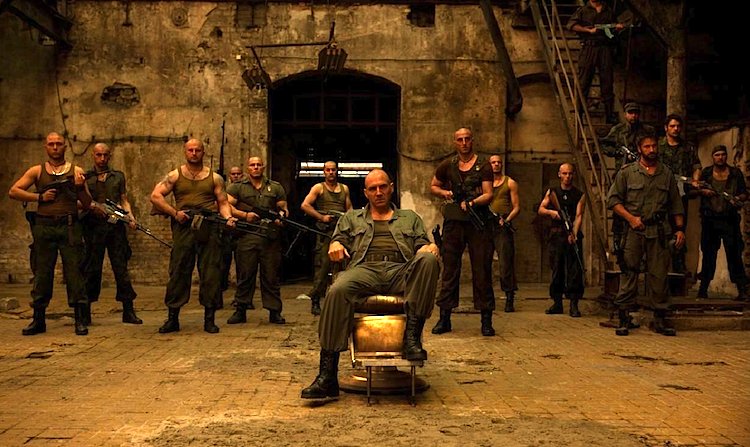
Shakespeare as exercise in machismo.

Though Fiennes’ effectively streamlined the film adaptation, it is also obvious why the original play troubles so many critics, given its scathing depiction of the Roman masses as no more than a weapon to be wielded by the unscrupulous. Frankly, in Coriolanus, “the people” get what they deserve. Indeed, the film comes at a time when it rather inconveniently begs comparison to uninformed masses occupying Zucotti Park.

An impressive directorial debut, Fiennes stages some vivid scenes of warfighting. His resetting of the story works more often than not, though the cable news flashes in Shakespearean English can be a bit jarring. Strikingly cinematic, the Belgrade locales also add the weight of contemporary historical tragedy, heightening the on-screen drama. One of the better recent Shakespearean films (considerably more satisfying than Taymor’s Tempest, for example), the unexpectedly timely Coriolanus is definitely worth seeing. It begins a special one week New York run for Academy Award consideration today (Friday, 12/2) and then opens more widely on January 20th.

Posted on December 2nd, 2011 at 10:56am.

LFM Review: Page One, The New York Times & Modern Media Bias

By David Ross. Andrew Rossi’s Page One (2011), a sleek, self-important infomercial for The New York Times, largely involves Times partisans whining that the dinosaur carcass of the Gray Lady is being picked clean by the mammalian swarms of the new media. There are cursory nods to the Jayson Blair and Judith Miller scandals, but essentially nothing in the way of real introspection or self-criticism. The Times‘ complaint largely goes like this: “What kind of world fails to recognize the inherent nobility of our enterprise! O fallen mankind, repent your shallowness!”

Do these apologists have a point? To some extent, yes. As numerous interviewees stress, aggregators, bloggers, and citizen journalists cannot cover certain kinds of news. War zone coverage, international political coverage, and intensive daily coverage of the political process require expertise and institutional funding. These are not part-time callings, nor activities that can be undertaken on the cheap. Those who bay for the demise of the mainstream media have to take seriously that news does not coalesce out of the internet ether, as it seems to. It must be dug up, run down, and eye-witnessed as mortar rounds collapse the available ground cover. This ferreting process is crucially enabled by the kind institutional pressure that only billion-dollar media entities can exert. Foreign potentates and corporate barons do not return phone calls placed by self-proclaimed smart guys in their pajamas (e.g., us). Eliciting a response requires the veiled threat intrinsic to newspapers that are in their own way players on the world stage. News depends on credentialed news people in the traditional sense: this is reality, like it or not.

Michiko Kakutani.

On the other hand, the mainstream media, and the Times in particular, has done everything conceivable to hasten its own demise. The postmodern Times is a cavalcade of inaccuracy, omission, myopia, flagrant political bias, outrageously lousy writing, latent snobbery, and superficial urban sophistication. All the shallowness of the modern elite university has come home to roost at the Times. The worst offenders are surely the editorial sections (prose sinkhole) and the culture sections (lapdog of everything transgressive), but I reserve special ire for fellow Yalie Michiko Kakutani, the Pulitzer-winning book reviewer who’s done much to instantiate a self-important middle-browism as the default mode of the literary culture. The novelist Jonathan Franzen, for one, calls her “the “stupidest person in New York” and an “international embarrassment.” He continues, “Everyone in Europe says to me, “How can The New York Times let a person who is so patently tone deaf, who is so screechy rhetorically, so clearly unequipped to appreciate interesting books or even to enjoy them — how can that person be the lead reviewer?'” Kakutani had the chance to rise to a historical occasion following the suicide of Franzen’s friend David Foster Wallace in 2008. Her ‘appreciation’ (here) is pat and rote by turns, utterly nerveless, utterly unmoved or inspired by the circumstances. “Laugh-out-loud funny”? “Both brainy and visceral”? An opening quote from Robert Plant! Are these sophomoric clichés what the mighty New York Times has come to? Was ever an era’s chief writer so lazily eulogized by an era’s chief reviewer?

Basic points first. The Times is no longer dependable in terms of fact, grammar, or idiom (“whipping post” for “whipping boy” just this past week, as I happened to notice at the supermarket – and on the front page no less). Ponder the Onionesque aspect of this correction from July 22, 2009:

An appraisal on Saturday about Walter Cronkite’s career included a number of errors. In some copies, it misstated the date that the Rev. Dr. Martin Luther King Jr. was killed and referred incorrectly to Mr. Cronkite’s coverage of D-Day. Dr. King was killed on April 4, 1968, not April 30.

Mr. Cronkite covered the D-Day landing from a warplane; he did not storm the beaches. In addition, Neil Armstrong set foot on the moon on July 20, 1969, not July 26. “The CBS Evening News” overtook “The Huntley-Brinkley Report” on NBC in the ratings during the 1967-68 television season, not after Chet Huntley retired in 1970.

A communications satellite used to relay correspondents’ reports from around the world was Telstar, not Telestar. Howard K. Smith was not one of the CBS correspondents Mr. Cronkite would turn to for reports from the field after he became anchor of “The CBS Evening News” in 1962; he left CBS before Mr. Cronkite was the anchor. Because of an editing error, the appraisal also misstated the name of the news agency for which Mr. Cronkite was Moscow bureau chief after World War II. At that time it was United Press, not United Press International.

How do you misstate the dates of the moon landing and MLK’s assassination in a single article? Don’t Times reporters have access to Wikipedia? Was the reporter in a condition of drunken mania? Were the editors? At The New Haven Register, where I spent four years as a cub reporter, three corrections within memory were enough to get one fired. Five-plus corrections in a single article would have been beyond anybody’s worst nightmare. The night desk’s sleepiest, rummiest old coot would have caught at least some of the above errata (MLK, moon landing, Telstar). I had to acknowledge perhaps three or four factual mistakes in my four-year career. Each was a humiliation, entailing a stern lecture and a day or two of frowns.

Continue reading LFM Review: Page One, The New York Times & Modern Media Bias

Romanian Film Festival 2011: LFM Reviews Red Gloves, Danube Waves, Silent River & Strung Love

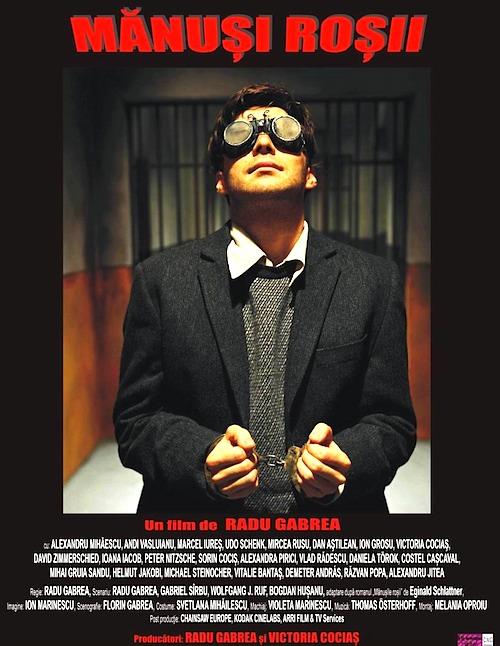
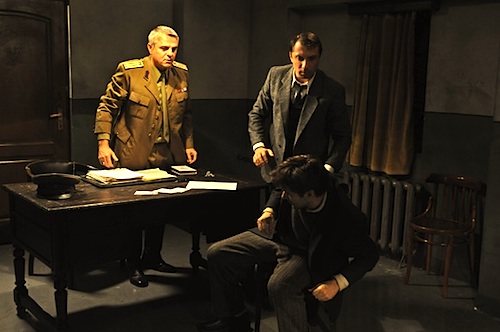
By Joe Bendel. It was hard being part of Romania’s Saxon minority, particularly in the immediate post-war years. Emboldened by the Soviet suppression of the Hungarian Revolution, the Romanian Communists began targeting the German-speaking minority. Though as a group they were disproportionately anti-Communist (and for good reason), this was not the case for young leftwing student Felix Goldschmidt. His lengthy imprisonment, interrogation, and trial testimony are dramatized in Radu Gabrea’s Red Gloves (trailer here), which screens today (Thursday, 12/1) during the 2011 Romanian Film Festival, presented by the Film Society of Lincoln Center and the Romanian Cultural Institute.

Goldschmidt tried to believe the excesses of Romania’s so-called “obsessive decade” were an aberration that would soon give way to true socialism. He also craved acceptance. That would be more than enough for his interrogators to work with. In truth, Goldschmidt’s politics were a little slippery. He had associated with several nonconformist elements, but his relationship with them was somewhat ambiguous. In particular, he claims to resent the now banned author Hugo Huegel for stealing his girlfriend, but viewers witness decidedly intimate scenes shared by the two men.

Frankly, Goldschmidt is fairly wishy-washy, which makes him more vulnerable to the tactics of his captors. He seems especially eager to please the German speaking Major Blau, yet for a time he resists denouncing his friends and colleagues. Still, even a strong personality can only hold out for so long—and Goldschmidt is not such a man.

Based on fact, but adapted from the novel by Enginald Schlattner, a Saxon-Romanian Lutheran pastor, Gloves is a deeply and pervasively tragic film. Arguably, Gabrea has become something akin to Romania’s cinematic conscience, having helmed a adaptation of a previous Schlattner Saxon-Romanian novel – as well as the Holocaust-themed drama Gruber’s Journey – and documentaries about Romania’s Yiddish cultural legacy.

From "Red Gloves."

With Gloves, Gabrea focuses squarely on the interrogation process, vividly portraying the breakdown of Goldschmidt’s soul. Though there are frequent subsidiary flashbacks within the main narrative flashback, it is all a bit stage-like, featuring its cast of characters in a confined setting. Yet it is an effective arena to explore the terrors of Romania’s communist past, particularly through the hard insights offered by a former judge and a priest who briefly share Goldschmidt’s cell.

Though it is essentially by design, Goldschmidt is still a rather hollow figure nonetheless, never really brought to life by Alexandru Mihaescu. In contrast, Udo Schenk is absolutely electric as Blau. He deserves to be an internationally star, but the SS and Communist officers he has played for Gabrea are difficult to embrace, despite the screen charisma he brings to them.

Bitterly ironic and brutally honest, Gabrea’s film is—to use a loaded term from Gloves—a “cathartic” work. It is also a high quality period production that might come as a welcome respite to patrons tiring of the Romanian New Wave aesthetic, even with its grim subject matter. Respectfully recommended, it screens Thursday night (12/1) during the 2011 Romanian Film Festival at the Walter Reade Theater.

•

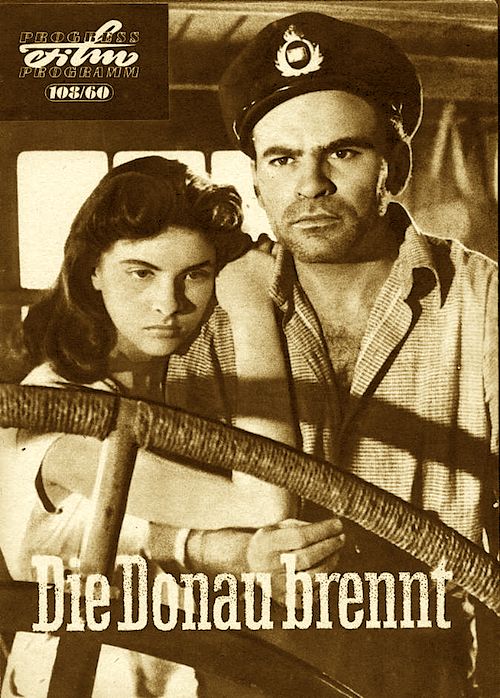
German poster for "Danube Waves."

Given Romania’s shifting positions during WWII, it was a bit tricky setting a Communist-era propaganda film during that time, but the recently deceased Liviu Ciulei managed to do just that. For his second feature, the renowned theater director combined Casablanca with Wages of Fear, adding a pinch of Party propaganda for seasoning. A ripping tale of war and intrigue, Ciulei’s Danube Waves screens as part of the sidebar tribute to the filmmaker at the 2011 Romanian Film Festival, presented by the Film Society of Lincoln Center and the Romanian Cultural Institute.

Mihai is barge captain who does not trouble himself over politics. Nor is he much concerned about the poor substitutes for sailors he forces to sweep for mines. He just wants to get home to his young wife Ana. Though expendable crewmen are getting harder to recruit, the Germans are willing to provide a prisoner for his use. He chooses Toma, because the supposed criminal is certainly able-bodied and claims to have served on a ship before.

However, Ana can tell right away Toma does not know port from starboard, but he is a quick enough study to fool Mihai.  Suspecting he is more than a common thief, a conspicuous sexual tension develops between Toma and Ana that Mihai deals with through heavy drinking as the barge loaded with German arms approaches a known minefield. Continue reading Romanian Film Festival 2011: LFM Reviews Red Gloves, Danube Waves, Silent River & Strung Love

LFM Review: Khodorkovsky

[Editor’s Note: Cyril Tuschi’s Khodorkovsky is available free in its entirety at Vimeo.]

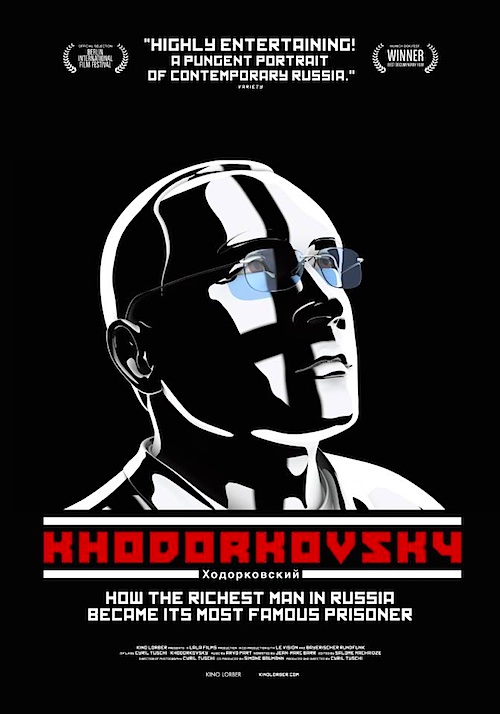
By Joe Bendel. Former German Chancellor Gerhard Schröder is now the chief lobbyist for Russian energy concerns. It may explain his less than vigorous interest in the political persecution of Mikhail Khodokorvsky, the chairman of the Yukos Oil Company and a leading bankroller of Russian opposition parties. It certainly helps explain how the Putin regime does business. Unfortunately, not even eight billion (with a “b”) dollars could protect Khodorkovsky from Kremlin persecution. German filmmaker Cyril Tuschi examines both the man and the dubious case brought against him in Khodorkovsky, which opens tonight in New York at Film Forum.

As any Russia watcher knows, Khodorkovsky is complicated individual. He was once an ardent Communist, which is how he was allowed to take control of Yukos during the fixed privatization process. He was not just an oligarch, he was the worst of the lot by any standard of open corporate governance. At this time, he enjoyed close relations with the Kremlin. Around the turn of the millennium, he radically changed the Yukos corporate culture, embracing openness and capitalism. He also started supporting democratic reformers. He is now serving a prison sentence in Siberia, as the result of what Schröder reportedly called “a thing between men.”

Though fascinating and not a little bit scary, this basic story is all well documented. However, Tuschi uncovers new (or criminally under-reported) information (particularly regarding the suspicious murder of a provincial mayor making trouble for Yukos) and scores legitimate interviews with Khodorkovsky himself, mostly conducted via letters but also hurriedly shot in between sessions of the Siberian kangaroo court. Aside from his subject, Tuschi also talks on camera to almost all of Khodorkovsky’s close associates not currently behind Russian bars, notably including his insightful early business advisor, Christian Michel, as well as a surprising number of Russian officials.

Tuschi’s German perspective hardly burnishes the former Chancellor’s image, but it gives the film an intriguing twist. He also includes dramatic black-and-white animated interludes that unmistakably evoke the Orwellian nature of the Khodorkovsky case. A classy package, Arvo Pärt’s fourth symphony, which he dedicated to Khodorkovsky, serves as the film’s soundtrack. Even Tuschi’s commentary is rather sharp. About all that is missing is a happy ending. Indeed, the documentarian had to know he was onto something when his laptop containing the film’s final edit was “mysteriously” stolen from his home.

Frankly, Tuschi’s documentary is timely beyond the prosecution of Khodorkovsky, reminding audiences wealth cannot provide a lasting defense against a government wielding unchecked power, as the case in neo-Soviet Russia. In fact, the circumstances of his imprisonment are so egregious, Milan Horáček, the German Green Party Human Rights delegate to the European Parliament, adopted his cause, stating unequivocally: “One can’t distinguish between human rights for the young, old, poor or rich.”

More documentaries should aspire to be like Khodorkovsky. Never smug or snarky, it is a bold, and sometimes artful film that truly challenges the powerful,  An important and engrossing work of big-screen journalism, it is highly recommended when it opens tonight (Wednesday, 11/30) in New York at Film Forum, with Tuschi scheduled to attend the 7:50 screening.

Posted on November 30th, 2011 at 11:42am.

New Short Film: The Arab Spring

By Jason Apuzzo. We like to periodically put a spotlight on short films here at Libertas, and this recent short film above called “The Arab Spring” caught my eye over at Vimeo. The film is essentially an abstract representation of the historic events of the Arab Spring, and is quite polished in terms of its graphic design and sound. Take a look. We wish filmmaker Raoul Marks the best with it.

[UPDATE: The filmmaker has made the decision to remove the film from Vimeo. See the comments from filmmaker Raoul Marks in the comments section below.]

[UPDATE #2: The film is now back up, with a minor alteration.]

Posted on November 30th, 2011 at 11:40am.

LFM’s Govindini Murty at The Huffington Post: Charlize Theron’s Young Adult and the Crisis of Narcissism in Our Popular Culture

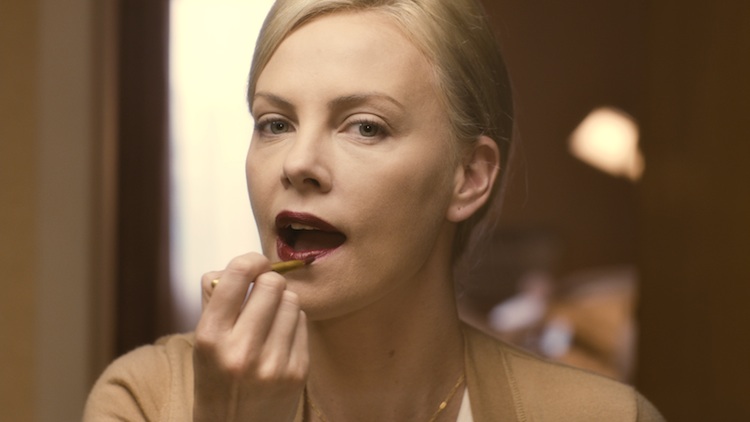
Charlize Theron prepares a new persona for herself in "Young Adult."

[Editor’s Note: the post below appears today on the front page of The Huffington Post.]

By Govindini Murty. Charlize Theron’s new movie Young Adult offers one of the most striking depictions of narcissism to hit movie screens in some time. Directed by Jason Reitman, Young Adult tells the story of Mavis Gary (Theron), a self-absorbed writer of young adult novels who returns to her hometown to steal back her happily-married former boyfriend (played by Patrick Wilson). I had the chance to see Young Adult recently at a screening hosted by The Huffington Post and AOL. HuffPost Founding Editor Roy Sekoff moderated the colorful Q & A that followed at Arianna Huffington’s home with screenwriter Diablo Cody and actor Patton Oswalt. In the most memorable exchange of the evening, actress Sean Young (Blade Runner) asked Diablo Cody why she had decided to explore the subject of narcissism in the film. Cody wryly responded that perhaps it was because Young Adult was the first screenplay she wrote upon moving to LA. This drew a big laugh from the crowd, but the implication seemed more serious: what is the ever-increasing narcissism in Hollywood entertainment doing to our broader culture?

Charlize Theron’s Mavis embodies all the narcissism of modern popular culture. She’s obsessed with reality TV (the Kardashians drone on in the background of several scenes), a medium that has elevated the navel gazing of minor celebrities to the level of major entertainment. Mavis writes young adult novels that are only thinly-disguised relivings of her own high-school glory days, and she’s otherwise obsessed with appearances and shallow celebrity status. The film repeatedly shows Mavis studying herself in the mirror – either in depressed self-loathing after an alcoholic bender, or with vain self-satisfaction as she puts on makeup to impress her former boyfriend.

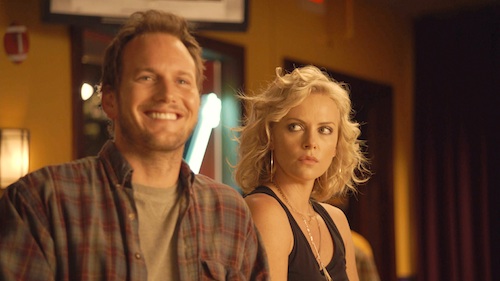
Charlize Theron tries to steal away married man Patrick Wilson in "Young Adult."

In keeping with the instability of identity that goes with modern narcissism, Mavis also adopts different personae as it suits her: at home she plays the dumpy writer in baggy jeans and t-shirts, but when she wants to seduce her old boyfriend she dresses in a low-cut black dress and adopts the manner of a big-city sophisticate. Later when Mavis is invited to a baby’s naming ceremony, she takes on another guise: that of a sober career woman with her hair in a bun, wearing a high-necked dress and conservative spectator pumps. Her various outer guises fail to impress the people of her hometown, though, for Mavis has neglected to develop any sustaining character traits. Mavis is the classic narcissist: cut off from objective reality, lacking any concern for other people, insecure in private but willing in public to ride roughshod over anyone and everything in order to gratify her whims.

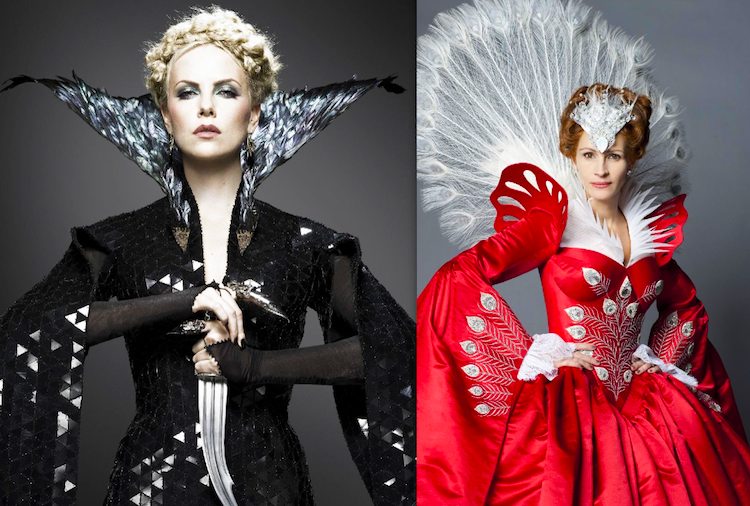
Interestingly enough, Young Adult is one of several upcoming films that explore the dangers of vanity and narcissism. For example, two new adaptations of the Snow White fairy tale, Mirror Mirror and Snow White and the Huntsman, depict vain queens willing to kill to maintain their beauty – with Charlize Theron even playing the villainess in the latter film. In keeping with the original fairy tale, the wicked queen’s obsession with her own appearance in both films is so extreme that she literally has a spirit residing in her mirror that she calls on to affirm her own beauty – this spirit acting as the exterior personification of her own vanity.

In Young Adult, Theron’s Mavis may not literally kill young women in order to remain beautiful, but her narcissism leads her to disregard all moral standards as she attempts to destroy the marriage of her former boyfriend and undermine the happiness of his wife and baby.

Vain Queens: Charlize Theron in "Snow White and The Huntsman" and Julia Roberts in "Mirror Mirror."

Young Adult vividly depicts what happens when self-love crosses the line into monstrous solipsism. This type of narcissism is becoming a defining trait of our modern cinema, and is taking on ever more baroque forms. It extends into the trend of psychological thrillers like Inception, The Ward, Dream House or Sucker Punch that take place almost entirely within the mind of a character, often one who is mentally unstable. Although these thrillers depict elaborate action, they recast this action as being the involuted imagining of a diseased mind – or of someone who has lost the will to live. Indeed, in Inception the hero’s wife becomes so confused between reality and delusion that she commits suicide. Such films are symbols of a culture in decay – like the passive Narcissus of Greek mythology, so intent on gazing inwardly at himself that he loses the will to engage productively with the outside world.

The last time such narcissistic themes appeared en masse in Western culture was during the late 19th century Decadent movement, just before Europe collapsed into the conflagration of World War I. Decadent novels like Oscar Wilde’s The Picture of Dorian Gray portrayed self-absorbed aesthetes who cared only for their external appearances, using them as cover to commit the ugliest of crimes. Dorian Gray’s portrait is the functional equivalent of the “double” seen by Mavis as she stares into her mirror – or of the reflected doubles that feature in Mirror Mirror, Snow White and the Huntsman, or even The Devil’s Double or Black Swan. Like Narcissus gazing at himself in the forest pool, all these reflected doubles signify the modern split psyche – alienated from humanity, from moral values, and from objective reality.

Icon of modern vanity: Kim Kardashian at the mirror.

In the old days this destructive narcissism was known by another word – vanity – and it was considered one of the seven deadly sins. However, in the twentieth century with the rise of photography and the cinema, Western culture has become ever more dominated by the visual image – and vanity has ceased to be stigmatized, instead being outright celebrated. Of course, there is a glorious life-affirmation inherent in appreciating the beauty of the physical. It would be just as perverse to denigrate beauty as to overvalue it. Nonetheless, Western culture has become so over-preoccupied with outward appearances that it is neglecting the important moral and intellectual qualities that give those appearances any larger meaning.

Perhaps dramas like Young Adult represent a healthy effort to deal with the problem of narcissism. After all, the movie shows how Mavis Gary’s self-absorption only leads to heartbreak, as relationships with family and old friends prove more difficult for her to manage than she expected. Reality eventually comes crashing into the hermetically-sealed world of Mavis’ narcissism and she is forced to deal with it.

This is as it should be. We can only evade objective reality for so long before being faced with one of two choices: either retreat into the reflection in the mirror and go mad, or look outside of ourselves and reestablish a healing connection with humanity and the larger world.

Posted on November 29th, 2011 at 10:17am.