By David Ross. The kiddy culture – the culture of sneakers, fast food, and video games – has subsumed the adult culture; or rather adolescents have stopped graduating from one to the other. Thus, as I read in Mark Steyn’s latest tome, the chilling and funerary After America, “males 18 to 34 years old play more video games than kids: according to a 2006 Nielsen survey, 48.2 percent of men in that demographic amused themselves in that way for an average of two hours and forty-three minutes every day – that’s thirteen minutes longer than the 12- to 17-year-olds” (181). Kay Hymowitz provides the definitive account of the new “child-man” in City Journal.
The kiddy world is characterized by impulse; the adult world by purpose. The kiddy world belongs to the playpen of the present moment; the adult world tethers itself to both past and future. The kiddy world passively imitates and downloads; the adult world discriminates and invents.
If I had to offer a living symbol of the “adult world” – its tenderness, stoicism, rigor, mature calm – I would point to Tony Rice’s version of “Shenandoah.” I would say to our thirtysomething sneaker-wearers, this is what it means to be grown up, to carry yourself like a man.
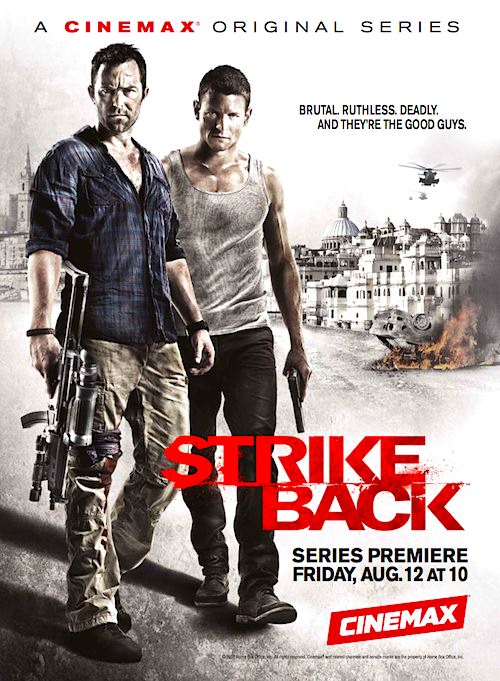
By Joe Bendel. As far as Section 20 is concerned, the only good terrorist is a terrorist getting renditioned to within an inch of their lives. As a result, disgraced former U.S. Delta Force soldier Damien Scott finds he fits in rather well in the double-secret British counter-terrorism unit in Strike Back, which has its series debut tonight on Cinemax.
Like 24 in its Surnow heyday, viewers should not get too attached to reoccurring characters, including John Porter (a lead protagonist from Strike Back’s pre-Cinemax first season on British Sky TV). Captured while investigating a large scale operation code-named Project Dawn, Porter has been captured by terrorists loyal to the Islamist mastermind, “Latif.” Aside from Porter, only his former American counterpart from the early days of Iraq can identify the mysterious Latif. That of course would be Scott, whom Section 20’s Sgt. Stonebridge finds drinking, whoring, and pit-fighting his way through a Southeast Asian redlight district.
Naturally, there is major friction between the Yank and the Brit, but they are all business when the bullets start flying. If the first four installments are representative of the entire season, Strike Back’s wider overarching storyline will be advanced by a succession of two episode mini-arcs. On the micro-level, the show is a breath of fresh air, featuring terrorists who are not simply misguided, but horrifically evil. For instance, Scott spends the balance of episode two protecting an innocent young girl from Islamic terrorists (who are explicitly identified as such), only taking occasional breaks to bed the beautiful women of the hotel taken hostage by the terrorist thugs. Seriously, that’s an apt description.
However, on the macro level, Strike Back’s shadowy meta-conspiracy threatens to be a real buzz kill. Supposedly, Scott was unceremoniously mustered out of service because he caught wind of a plan to plant the WMD stockpiles that would “justify” Operation Iraqi Freedom. Those infamous weapons are now at loose ends, doggedly pursued by Latif for his nefarious purposes. This sort of potential demonization of the American military and intelligence services is exactly what we do not need any more of on television.
It would be a shame if Strike Back’s macro themes continue in this direction, because they could spoil some genuinely rip-rousing television entertainment. As Scott, Sullivan Stapleton is an undeniably likable and engaging hard-nosed bad-attitude protagonist. Though the relatively by-the-book Stonebridge is probably not as fun to play, Philip Winchester displays plenty of square jawed action cred. There are also plenty of James Bond worthy women, like Karen David (sort of geek-famous for Scorpion King 2) as the barmaid Scott protects when the terrorists break up their hook-up. Likewise, the villains are truly villainous, such as the workaholic Liam Cunningham (The Guard, Outcasts, etc), chewing the scenery with relish as IRA enforcer turned mercenary Daniel Connolly.
From "Strike Back" on Cinemax.
At least in episodes one through four, the Indian and South African settings are quite cinematic, while the stunt work and effects are all first class. Scott and Stonebridge deliver quite a bit of vicarious satisfaction, administering on the spot justice to Islamist fanatics and their craven accomplices that should be well worth returning for throughout the show’s run. Yet, if it loses sight of who the real bad guys are, sliding into the sort of moral equivalency frequently peddled by Hollywood, the show will alienate its core viewership – while those sharing such a hostile view of American and British military and intelligence personnel will likely be put off by the Jack Bauer tactics gleefully indulged in throughout each episode.
Strike Back could be flat-out great, so let’s hope it minimizes the clichéd conspiracy themes and plays to its strengths. This week, the totally entertaining first episode is definitely recommended when it debuts tonight (8/12) on Cinemax.
By David Ross. Every so often liberal big leaguers take a whack at Thomas Kinkade, the king of mall and mail-order art, the entrepreneurial painter laureate of what Jed Pearl calls “Wal-Mart America.” His depictions of gingerbread cottages nestled in what seem to be sleepy Cotswold hamlets are beloved by the masses and equally detested by people who consider themselves – by virtue of college degrees and the occasional glass of white wine with dinner – Blue State sophisticates. In 2001, Susan Orlean gave Kinkade the once-over in the New Yorker (see here), though she semi-restrained her snark on the grounds that Kinkade’s buffoonery speaks for itself. Pearl has now followed suit with an inchoate piece of hostility – titled “Bullshit Heaven” no less – in The New Republic. Extending the toilet metaphor, Pearl concludes that Kinkade has “urinated on us all.”
There’s no denying that Kinkade’s art is pure kitsch, a confection of Christmas-card nostalgia derived from Wordsworth at his most fey, Norman Rockwell at his most precious, and whoever first had the idea of painting and mass-producing scenes of beagles playing poker. His cotton-candy shire scenes look as if model trains should be running through them or Hobbits should be peeking from the windows. I would no more hang a Kinkade in my living room than a poster of Ashton Kutcher in the buff.
The blame is usually – okay, always – directed at putative yahoos who clamor for this kind of thing and create demand for what were better handled like dog poo in the street (quick condescending glance, wide berth). Articles about Kinkade are never really about Kinkade; they are about the people who buy Kinkade. Essentially, they license the readers of the New Yorker and The New Republic to look down on “Wal-Mart America” from a standpoint of cultural and aesthetic superiority. Their real substance, in other words, is Blue State-Red State politics.(I wonder, by the way, whether a film like Winter’s Bone doesn’t exploit the same condescension.) Continue reading Kinkade & The Art Establishment
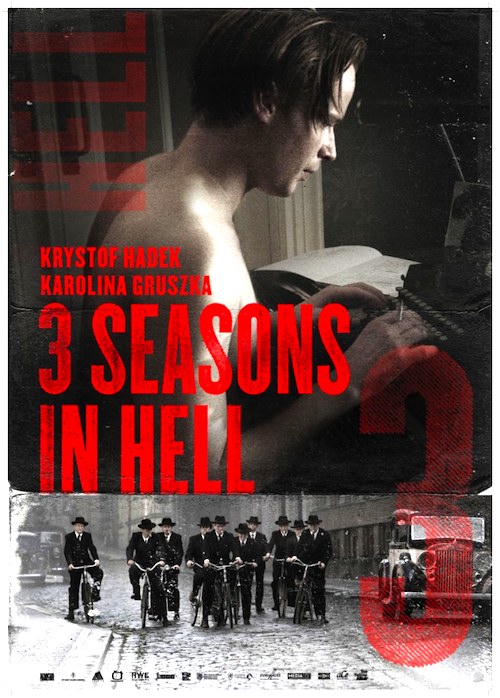
By Joe Bendel. Ivan Heinz is the anti-Zhivago, a terrible poet who naively welcomes the Communist takeover of post-war Czechoslovakia. He soon learns the harsh truth about the Marxist regime. His poetry also dramatically improves over the course of three tumultuous years in Tomás Masín’s 3 Seasons in Hell (trailer here), which screens tonight in D.C. as part of the Avalon Theatre’s Lions of Czech Cinema film series.
Young Heinz has imbibed way too much dada. He harbors idealistic notions of the artist as an absurdist troublemaker that wins him few friends. His avowed Communism also strains his relationship with his painfully middle class father. Heinz is determined to suffer for his art, like his hero Rimbaud. Unfortunately, he will get his chance following the Communist coup.
At first, Heinz is surprised the masses are not celebrating the dawn of socialism on the streets of Prague. Of course, he is even more shocked to learn that the new regime has little use for a parasitic poet of bourgeoisie lineage with a record of anti-social behavior. His notoriously hedonistic lover Jana has scarcely any better standing. Eventually they come to the realization that this worker’s paradise is no place for their unborn child to live. Naturally though, his plans for emigration involve a dangerously dodgy criminal scheme.
Loosely based on the memoirs of Czech writer Egon Bondy, 3 Seasons hardly idealizes Heinz. Frankly, he is rather a petulant pill much of the time, but that never excuses any of the degradations he suffers and witnesses. Likewise, Jana would be quite a problematic figure as well, but together they seem the perfect pair, who deserve (and want) each other. Yet, should viewers ever doubt the film’s sympathies, the exquisite dignity and integrity of Heinz, Sr. serves a pointed corrective to the cruel madness unfolding around him. Continue reading Cold War Double-Feature: 3 Seasons in Hell, At the Edge of Russia
LFM Co-Editor Jason Apuzzo was on Lars Larson’s national radio show Friday talking about Cowboys & Aliens, Captain America, The Devil’s Double and other current releases.
Special thanks, as always, to Lars and his staff for inviting Jason on. He always has fun appearing on Lars’ show.
Lars’ show is broadcast on over 200 stations nationwide, and runs at different times across the country, so to find his show be sure to check out his website here.
By Jennifer Baldwin. A few weeks ago I watched my new Warner Archive DVD of Madam Satan, a 1930s Pre-Code oddity extravaganza that was Cecil B. DeMille’s first and only musical. It’s famous (infamous?) for the wild costumes, Art Deco sets, bizarre musical numbers, and a spectacular finale that includes a zeppelin crash and the sight of parachuting party-goers landing in trees, Turkish baths, and the lion cage at the Central Park Zoo.
But what I really loved about the movie was that it introduced me to Lillian Roth. I didn’t even realize as I was watching it that the sexy, saucy Trixie was played by Lillian Roth of I’ll Cry Tomorrow fame. I knew that Susan Hayward played a woman named “Lillian Roth” in that 1955 biopic, but since I’d never actually seen it, I knew nothing about the real Roth. She must have been someone famous or else they wouldn’t have made a movie about her, but what exactly she was famous for I had no idea.
Well, now I know. The minute Trixie appears on screen in Madam Satan, the film starts to pop. If you want to know what I mean GO HERE TO SEE.
As the indispensable Self-Styled Siren puts it in her review of the film: “When she flings off her rumpled satin robe and twitches her pelvis to the Low Down number, the vaudeville energy of this rather plump, frowsy jazz baby ignites the entire movie.” AND HOW! I remember thinking that Lillian Roth’s Trixie was a million times sexier and spunkier than Kay Johnson’s “Madam,” the supposed “star” of the film.
So, of course, dutiful obsessive that I am, I started scouring YouTube for videos of Lillian Roth’s performances, just to see what else this sassy dame had to offer. Her voice has got the power and verve of Ethel Merman, but with a warmer tone and a bluesier, sexier bend. And she’s got charisma. Whatever that might be defined as, it shows whenever she’s on screen: she lights it up.
Which makes her brief movie career all the more tragic. This is a woman who should have been a bigger movie star, someone who could have been in the sexy/sassy comedienne ranks with Ginger Rogers and Jean Harlow. While her honest and unflinching autobiography is justly credited with raising public awareness about alcoholism and Alcoholics Anonymous, it’s really too bad that she’s more famous for beating her addiction (and having Susan Hayward portray her) than for her talent.
Madam Satan has kicked off a Pre-Code spurt in my movie watching these days (as I write this, Night Nurse, Ladies They Talk About, Two Seconds, and The Divorcee are on my desk waiting to be devoured), so I’m excited to see that Turner Classic Movies is featuring Pre-Code goddesses Ann Dvorak and Joan Blondell in their Summer Under the Stars tributes on August 9th and August 24th, respectively.
On Ann Dvorak day, Scarface and Three on a Match are must-sees, of course, both two of the defining films of the Pre-Code era. Three on a Match, in fact, is still quite shocking, and Dvorak’s performance as a drug addicted woman is stunning and unshakable. I’m also excited for The Crowd Roars (1932), a Howard Hawks film I’ve never seen before, starring Dvorak and Jimmy Cagney as a fearless race car driver. Continue reading Classic Movie Journal: Lillian Roth, Fragments of Lost Films, and a Brand New Silent Movie!
 By David Ross. The kiddy culture – the culture of sneakers, fast food, and video games – has subsumed the adult culture; or rather adolescents have stopped graduating from one to the other. Thus, as I read in Mark Steyn’s latest tome, the chilling and funerary After America, “males 18 to 34 years old play more video games than kids: according to a 2006 Nielsen survey, 48.2 percent of men in that demographic amused themselves in that way for an average of two hours and forty-three minutes every day – that’s thirteen minutes longer than the 12- to 17-year-olds” (181). Kay Hymowitz provides the definitive account of the new “child-man” in City Journal.




 Which makes her brief movie career all the more tragic. This is a woman who should have been a bigger movie star, someone who could have been in the sexy/sassy comedienne ranks with Ginger Rogers and Jean Harlow. While her