LFM Mini-Review: Kung Fu Panda 2

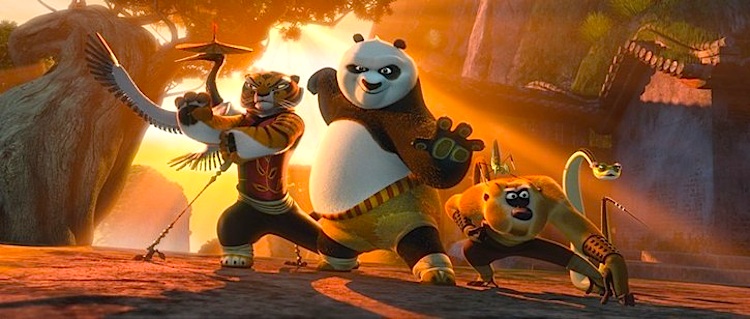
By David Ross. THE PITCH: The Kung Fu Panda is back and bulkier than ever: a blubbery accident in progress, though with some genuine kung fu mojo beginning to control the belly-led momentum that is his comic signature. Po’s antagonist is a Napoleonic peacock who plans to conquer China with the help of a fiendish new invention: canon. So it’s bear vs. bird, with the Middle Kingdom hanging in the balance.

THE SKINNY: The first KFP grossed $630,000,000 worldwide, and DreamWorks naturally declined to fiddle with a lucrative formula. The formula is entertaining enough, and nobody is likely to grumble.

WHAT WORKS:

• Pilferings from Jackie Chan. KFP II is basically a non-stop action sequence that makes hay with props and spaces in the classic Chan mode, and of course Po is a version of Chan in his semi-comic, semi-bumbling guise. Chan himself plays Master Monkey and presumably broke no bones in the process. Kids will love this mid-air mayhem, though parents may worry that the sequel is going to be called Visit to the Emergency Room.

• Pilferings from Zhang Yimou. Even more than the first film, KFP II richly imagines the look of ancient China. For kids, this orgy of Orientalism – gold-fretted pagodas, dragon-carved junks, mist-shrouded mountain pavilions – is bound to be a wonderment.
• Dustin Hoffman’s Master Shifu is a funny little addition to the Yoda lineage, a version of Chief Inspector Dreyfus driven crazy by an ursine Clouseau. Perhaps Shifu will develop a nervous tic in KFP III. Incidentally, my Taiwanese wife says that “Shifu” means “master,” so to call the character “Master Shifu” – “Master Master” – is pretty dumb.

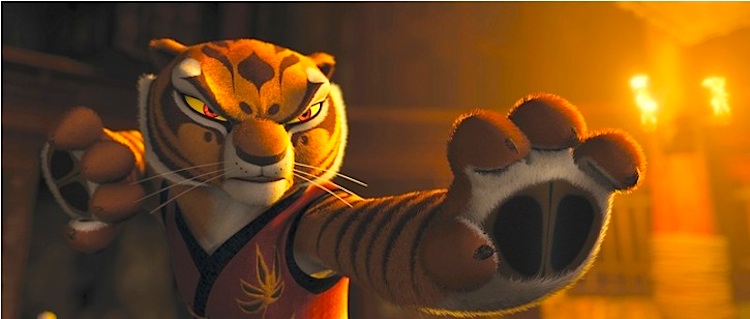
• Angelina Jolie transcends her Tony-the-Tiger suit and ekes out a genuinely sexy performance, her throaty growl picking up where her curves leave off. Her sex appeal is inextinguishable, a constantly conserved force that shifts and inevitably manifests itself.

• The film naturally assumes that ordnance is evil, but it keeps the distracting and irrelevant sermonizing in check. The film is not the tiresome referendum on guns that it might have become. Continue reading LFM Mini-Review: Kung Fu Panda 2
Crouching Banker: LFM Reviews Empire of Silver

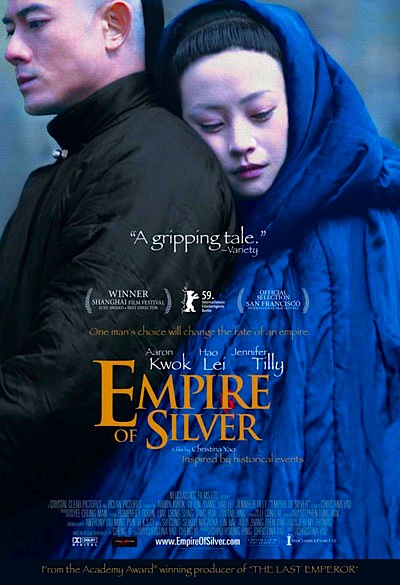
By Joe Bendel. Initially, the late Qing Dynasty’s new paper money is an economic boon, especially helpful facilitating transactions for the lower classes. Unfortunately, when the people come to suspect it is not fully backed by silver, it leads to bank runs. This is an ominous development for Lord Kang’s financial dynasty. Yet he will face even greater tribulations within his own family in Christina Yao’s Empire of Silver, which opens tomorrow in New York.

In 1899, the “piaohao” bankers of Shanxi were like Tom Wolfe’s “Masters of the Universe.” Lord Kang, or “Old Master” as he is often called, assumed four sons would be sufficient to ensure a safe line of succession for his venerable banking company. Of course, as a pious Buddhist deaf-mute, “First Master” never really counted. Unfortunately, when the Second and Fourth Masters are undone by calamity partly of his own making, old Kang is left with the dissolute playboy Third Master. Still, he is probably the most talented of the lot, but he has heretofore squandered his life out of resentment for his father’s Machiavellian management of family affairs. This is Third’s time to chart his ascendance, but it remains unclear whether he wishes to assume the mantle of leadership.

Needless to say, Old and Third Masters have very different management philosophies. However, his relationship to his young stepmother is even more strained. Quickly we come to understand Third and his former teacher had quite a bit of history before she became Madame Kang, which obviously explains much.

Silver is a big historical melodrama, but there is only a spot of actual fighting here and there. Still, the costumes, sets, and sweeping vistas are worthy of epics like Hero and Red Cliff. Jeremy Thomas, the producer of ambitious films like The Last Emperor, Little Buddha, and Merry Christmas Mr. Lawrence, served as executive producer, lending Silver further prestige.

While Silver is indeed a finely crafted period production, Aaron Kwok is surprisingly flat as Third Master. Yes, his character is emotionally damaged, but at some point we should see some signs of life percolating. Still, Hao Lei largely compensates as Madame Kang with her exquisite expressiveness. Frankly it is just nice to see her working, considering she appeared in Lou Ye’s bold Tiananmen Square drama Summer Palace, which was duly banned by the Communist authorities. Silver also boasts a number of rich supporting performances, particularly Ding Zhi Cheng and Lei Zhen Yu as two rival branch managers – one talented but dangerously independent, while the other is deemed controllable by virtue of his mediocrity.

Yao revels in the classical tragedy of her story, but she periodically offers up shrewd nuggets of insight as well. It is intriguing to look at a proud family and their celebrated house of finance – increasingly destabilized by China’s mounting anarchy – but it might well be too restrained and respectable for fanboys. An engaging feature directorial debut for Yao (if not a perfect star vehicle for Kwok), Silver opens today (6/3) in New York at the AMC Empire and AMC Village 7.

Posted on June 3rd, 2011 at 1:37pm.

Say Amen! LFM Reviews Rejoice and Shout

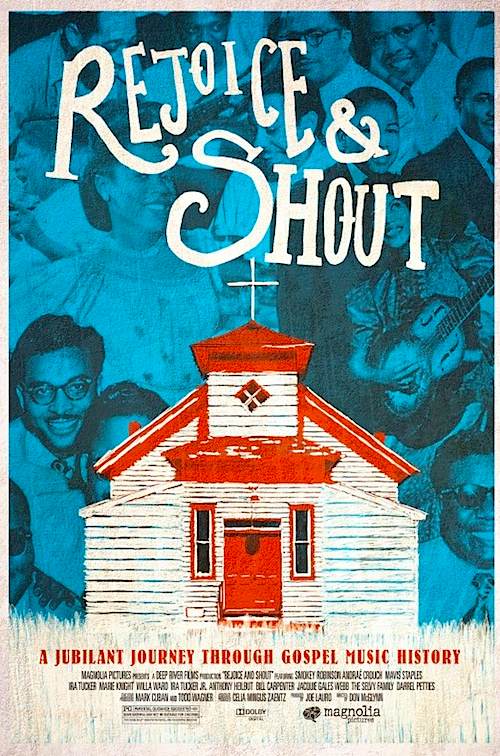
By Joe Bendel. How hip a blues guitarist was Sister Rosetta Tharpe? Well, she was one of the primary influences on a kid from Tupelo, Mississippi named Elvis. Yet she was not really a blues or R&B artist, but a Gospel singer. By profiling trailblazers like Tharpe, director Don McGlynn and producer Joe Lauro celebrate the rich legacy and diversity of American Gospel music in Rejoice and Shout, which opens this Friday in New York at Film Forum.

Rejoice opens on a true high note, as a young member of the Selvy Family of Gospel singers belts out a powerful old-time religion rendition of “Amazing Grace.” The film then proceeds to backpedal, explaining where the music came from. Yes, it is rooted in the plantation experience of African Americans, but the story of Gospel’s development is more complicated, involving entrepreneurial figures like Thomas A. Dorsey. A reformed bluesman, Dorsey penned and promoted scores of Gospel standards, often popularized through performances by the great Mahalia Jackson.

Frankly, it is pleasantly surprising how intelligently Rejoice addresses the actual music. The film is particularly effective illustrating the complexity of the arrangements and the syncopated jazz influences of the vocal ensembles like the Golden Gate Quartet. More to the point, many people will probably be surprised how much fun this legitimately sacred music truly is.

Of course, the music is the thing in Rejoice. To their credit, McGlynn and Lauro unearthed some remarkable rare footage, ranging from sound film that predates Al Jolson in The Jazz Singer to some totally cool video of the Edwin Hawkins Singers performing “Oh Happy Day” during a stadium concert. Still, Rejoice never forgets the music’s raison d’être, allowing former 1970’s Gospel superstar turned everyday preacher Andraé Crouch the time and space to speak eloquently of the glory and power of God. Continue reading Say Amen! LFM Reviews Rejoice and Shout

Tarkovsky, Bach, and God

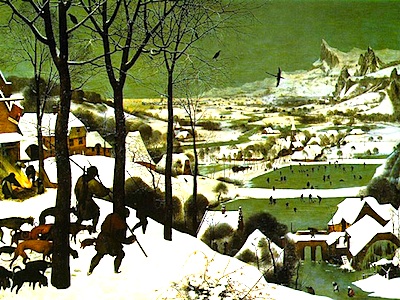
By David Ross. I first heard Bach’s choral prelude Ich ruf zu dir, Herr Jesu Christ (“I call to you, Lord Jesus Christ”) in Tarkovsky’s Solaris (1972). It seems to me one of the world’s most beautiful compositions, and Tarkovsky’s scene, in which the piece harmonizes with the camera as it plays over Brueghel’s Hunters in the Snow (1565), seems to me one of the most solemnly lovely scenes in cinema. The camera scrutinizes the details of Brueghel’s painting, at first coldly (as Kris must see it), but then with a certain wistful sorrow, as if in recognition of our hopeless estrangement from the natural life of the old village. The mournful precision of the piece by Bach (see here for Vladimir Horowitz’ transcendently lovely interpretation) underscores that there is only the beautiful sadness of our estrangement and longing. Kris stirs with new humility and humanity, and he and Hari begin to float, ostensibly in a state of zero gravitation, but actually in a state of grace.

Pieter Bruegel the Elder's "The Hunters in the Snow" (1565).

People often speak of Falconetti’s ecstatic expression in Dreyer’s La passion de Jeanne d’Arc (1928) as film’s most inspired synecdoche of the religious experience, but Tarkovsky, in my opinion, exceeds Dreyer artistically and spiritually. Tarkovsky seems engaged not in a pastiche of an archaic faith, but in the genuine struggle of modern faith, and his dense, intricately coded scene seems to compress everything integral to Western culture in its modern self-bewilderment and tentative hope.

In a 1986 interview, Laurence Cossé asked Tarkovsky whether he considered his films “acts of love towards the Creator.” Tarkovsky responded “I would like to think so. I’m working in it, in any case. The ideal for would be to make this constant gift, this gift that Bach alone, truly, was able to offer God.”

Posted on June 2nd, 2011 at 2:42pm.


The Girl with the Dragon Tattoo Trailer + Poster

By Jason Apuzzo. It’s probably time to start talking about David Fincher’s forthcoming adaptation of The Girl with the Dragon Tattoo. A ‘pirated’ red band trailer of the film recently ‘leaked’ on-line – or was it actually ‘leaked’ by Sony? – created a lot buzz, and now … as if by magic … the official version of the trailer (above) has been released, along with a new website.

I’m curious as to what people think of the trailer – and of the edgy, NSFW new poster featuring Daniel Craig and Rooney Mara. Also: have LFM readers actually read the novels? If so, your comments would be appreciated.

My own thoughts are these: on balance I think this is a good trailer, excellent for a thriller, but Fincher’s films have repeatedly let me down … always somehow promising a great deal more than is actually delivered. A case in point recently was The Social Network, a film that implied it would have a great deal to say about the phenomenon of social networking – but actually said little (other than: ‘nerdy Jewish guy seeks revenge against WASP elites who rejected him by creating non-hierarchical on-line social scene’). So I remain skeptical. Nice Led Zeppelin cover, though …

Posted on June 2nd, 2011 at 2:19pm.

Kids, Imagination & The Arts

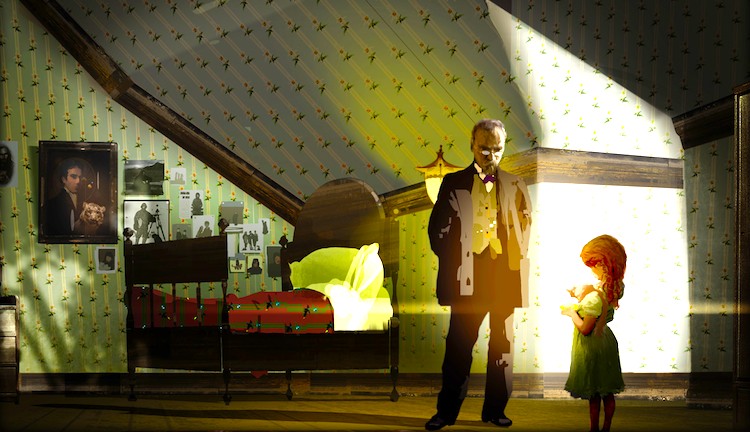
Production art for "The Golden Compass" (2007).

By David Ross. Over two years, my nearly-six-year-old daughter and I have blown through all of Narnia, all of Harry Potter, and nearly all of Phillip Pullman’s great Dark Materials trilogy. She was attentive to Narnia and delighted by Harry Potter, but Pullman has entranced her to the extent that her face goes long with shock and anguish when I close the book and tell her to shout down the stairs for her nightly cocoa. Our next adventure is The Hobbit and its sequels. After tramping the roads with Frodo for six months, she will be primed for The Odyssey, beyond which lies the great Western sea of literature in all its dimensions of imagination and idea.

This program depends on the strict suppression of competing media (broadcast television, computer games, and web-surfing are verboten) and the realization that kids are by nature imaginative and that all attempts to subordinate the imagination to didactic and activist aims will produce a backlash of reluctance and indifference. Heather has two mommies, you say? This is a curious detail, worth a question or two, but not conducive to make-believe games or ruminations in the dark of bedtime. How much better if one of Heather’s mommies were a reincarnated Egyptian princess or a fairy queen cruelly trapped in a mortal body. This is not a political or literary judgment, merely an observation about developmental psychology.

Barbara Feinberg’s useful memoir of her kids’ reading, Welcome to Lizard Motel: Children, Stories, and the Mystery of Making Things Up, elaborates much the same point. Her basic thesis is that kids resist reading because contemporary books are insufferably pedantic and boring. This assumes that kids still read books at all. These days, schools seem happy enough to replace books with assorted ‘educational materials,’ not realizing or caring that these have all the romantic resonance of the suburban office parks where they were developed.

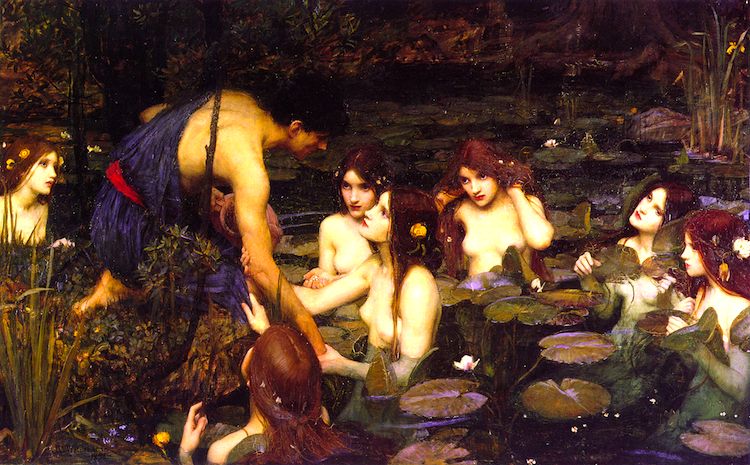
J.W. Waterhouse's "Hylas and the Nymphs" (1896).

With the right bait, the fish is easily hooked. Not long ago my daughter happened to look over my shoulder as I perused a book of paintings by J.W. Waterhouse, the pre-Raphaelite master. She drank in the scowling witch (Circe) and the dead lady in the snow (St. Eulalia) and the beautiful lady in the boat (the Lady of Shalott) and the young man saying hello to the beautiful water fairies (Hylas and the Nymphs). These are images to trigger reactions in recesses of the brain not usually exercised in school, in comparison to which the images of her everyday visual field – all those bright socially aware posters in the hallways, for example – are pablum. She added the Waterhouse book to her “birthday list,” which in our house is the ultimate form of canonization. Continue reading Kids, Imagination & The Arts