LFM Review: Cairo 6,7,8 and Women’s Freedom in Egypt

Poster for "Cairo 6,7,8."

By Joe Bendel. When CBS journalist Lara Logan was assaulted by a gang of rampaging men in Tahrir Square, it became clear that there is a real problem in how a sizeable portion of Egypt’s Islamic male population relates to women. When NPR had to delete scores of hateful comments on the Logan story and issue a scolding reminder to its readers (serviced by our tax dollars) that violence against women is always unacceptable, the western media’s deficiency handling issues like the conditions endured by women in Egypt (and in the wider Muslim world) also became blatantly clear. Now with his directorial debut, Mohamed Diab offers a blistering corrective to his country’s self-serving denial and outright misogyny in Cairo 6,7,8, which screens during the 2011 New Directors/New Films, co-presented by MoMA and the Film Society of Lincoln Center.

Cairo’s buses are a groper’s playground. Fayza understands this only too well. Every time she files onto the titular 6/7/8 line, she is felt up. It is taking a toll on the traditional working class Muslim woman, depleting her spirit and further poisoning her already frosty relations with her boorish husband.

Modern and affluent, Seba was the victim of a large scale sexual assault during a soccer match that eerily parallels the subsequent Logan story. Naturally, her husband blamed her—not directly of course, but through his emotional distance. As part of her own recovery process, Seba begins teaching self-defense and empowerment classes for women, attracting Fayza as a student. Eventually, the two join forces with Nelly, a hip, aspiring stand-up comic who has launched the country’s’ first sexual harassment lawsuit. Continue reading LFM Review: Cairo 6,7,8 and Women’s Freedom in Egypt


LFM SPECIAL: Elizabeth Taylor, Our Time with Jane Russell & Why We Miss the Women of the 1950s

The late, very great Elizabeth Taylor.

By Jason Apuzzo. By some cosmic irony, yesterday was the day I’d finally worked up the fortitude to write about Jane Russell – the warm, glamorous and iconic 50s star whom Govindini and I had the pleasure of spending time with several years ago, before she passed away recently at her home in Santa Maria. I wanted to share with Libertas readers some of the things she’d told us about her life and career, although I would be doing so with a heavy heart as she is now no longer with us.

Then came news yesterday that Elizabeth Taylor had passed away.

This is very sad news, indeed. Although Taylor had been in failing health for some time, and word of her passing was not altogether surprising, I must confess to still being stunned by the news. Elizabeth Taylor had overcome so many crises and health scares in her life that she seemed utterly indomitable – and I had assumed that her recent health scare would, like so many others, pass away into legend as another one of her epic brushes with misfortune. Alas, her many health problems have apparently taken their toll over the years, and so mortality has now folded even over Elizabeth Taylor, the great survivor.

Elizabeth Taylor and Jane Russell both deserve their own posts and remembrances, frankly. Both of them loom large as entertainment personalities of the 20th century, and as people for whom – for different reasons – I’ve developed an affection over the years. At the same time, many of the the things I’d intended to say about Jane can also and should also be said about Liz – and more generally about the women of their generation. We’re all missing these women terribly right now, and missing what they represented. Everything I’m seeing written about Liz at the moment resembles what was said about Jane just a few weeks ago: that women of their sort are no longer with us, and that the women who’ve replaced them in the intervening decades since their heyday haven’t made up for the loss. Fundamentally, we all know this to be true but are so often restricted for various reasons from saying it.

Now is not the time for such restrictions, however. Now is the time to be emotional and passionate about the women on our big screen. So I have a few thoughts today about Elizabeth Taylor – arguably the greatest female star of all time – and also about Jane Russell, the girl-next-door who became an icon of her era. And you’ll forgive me, but I will be wearing my heart way out on my sleeve. These women deserve that. Continue reading LFM SPECIAL: Elizabeth Taylor, Our Time with Jane Russell & Why We Miss the Women of the 1950s

Classic Cinema Obsession: HUMAN DESIRE (Fritz Lang, 1954)

By Jennifer Baldwin. This is about Film Noir, so here’s a flashback …

I went through a bit of a Glenn Ford/Gloria Grahame/THE BIG HEAT phase several years ago. I became obsessed with the movie and those two actors. I was like a junky, watching the movie over and over, memorizing lines, musing over the themes, showing the famous boiling coffee scene to anyone who would watch.

But eventually, no matter how much I loved THE BIG HEAT, it couldn’t withstand the over-obsession. I needed a new drug. I needed something else to give me that Glenn and Gloria fix.

Then I read about HUMAN DESIRE. It was made after THE BIG HEAT, starring Ford and Grahame, another scalding-hot 1950s noir directed by Fritz Lang. As soon as I found out about it, I had to have it. Only problem: it wasn’t on DVD. You couldn’t buy it in the store. It was as good as gone for someone like me out in the Michigan suburbs, with not a repertoire theater in sight.

I went into the shadows. I spent many a midnight hour searching the internet for a copy of the movie. I was bleary-eyed and half crazed with want. And then I found it. One of those online trading post/auction sites. Eight bucks plus shipping and handling and HUMAN DESIRE could be mine. It was someone’s homemade DVD copy, complete with fuzzy picture and bad sound, but buying it made me feel like I was the protagonist in my own film noir, swapping cash with some anonymous stranger on the black market for a “treasure” that was worn out and almost worthless.

But it was worth everything to me. I watched HUMAN DESIRE and loved it more than I had loved THE BIG HEAT. I don’t know if I loved it so much because it took all that effort to finally get a copy, or if I genuinely loved the movie more, but HUMAN DESIRE became one of my secret movie treasures.

Now it’s out on DVD, an official release from Columbia Pictures, with pristine picture and remastered sound, and I still think that it’s tops. I think it’s Gloria Grahame’s masterpiece. I think it’s misunderstood. I think Glenn Ford’s character is the real villain and that far from having a “happy” ending, it has one of the bleakest, most cynical endings in all of noir.

The misinterpretation of the film stems from the assumption that Grahame’s character is a traditional “femme fatale” evil woman type. She’s Gloria Grahame, after all, and she wants Glenn Ford to commit murder for her. But I couldn’t just slot her into the femme fatale role that easily. She might have murder in her heart, but it didn’t come there lightly. Continue reading Classic Cinema Obsession: HUMAN DESIRE (Fritz Lang, 1954)

LFM Review: The Neighbor

From "The Neighbor."

By Joe Bendel. The tragic events still unfolding in Japan even had repercussions at a screening of a Farsi-language feature at a Canadian film festival here in New York City. The producer Amir Naderi, who emigrated from Iran after several of his films were banned by the Islamist government, was in Japan working on his next project when the earthquake and tsunami hit. Clearly he was on the mind of his former editor Naghmeh Shirkhan this past weekend, despite the justly enthusiast reception for her directorial debut, The Neighbor (see the trailer below), at MoMA’s 2011 Canadian Front.

Though of somewhat middle-aged years, Shirin is still a strikingly beautiful woman. She is not particularly interested in men though, particularly the one she has been reluctantly seeing. In truth, there are not a lot of eligible men in Vancouver’s Iranian community. There are not a lot of men, period, and there is a very real phenomenon causing this demographic state. Frequently Iranian men working abroad who are called back on business or personal matters have trouble returning—or so they say. Such is the case for Leila, the attractive young woman who just moved in across the hall from Shirin with her little girl Parisa.

At first, Leila wants nothing to do with the older woman. In time though, she starts exploiting Shirin as an emergency babysitter, much to her concern. It is not that Shirin does not enjoy spending time with Parisa—quite the contrary—but Leila’s erratic parenting is obviously not healthy for her little girl. Continue reading LFM Review: The Neighbor

Provocative New Trailer for The Kennedys; Series Debuts April 3rd

By Jason Apuzzo. A very provocative new trailer is out for The Kennedys, the new eight-part miniseries from 24‘s Joel Surnow that will be appearing on the ReelzChannel beginning April 3rd. I would normally wait to put this trailer in a Cold War Update!, but since I just did one of those on Friday I didn’t want you folks to have to wait.

From "The Kennedys."

The series looks like a lot of frothy fun, and I’m looking forward to it. I’m also understanding why the major networks were so aghast by this series; this is most certainly not the sort of depiction of the Kennedy family we’re accustomed to seeing on TV. Besides potentially out-sexing Mad Men, the series also seems to make Joe Kennedy look like Chancellor Palpatine.

Joel did an interview recently with the LA Times in which he talked about the pressures he thinks the series was under from higher-ups at The History Channel, the series’ original home. We all know what those pressure were, don’t we? Thou Shalt Not Offend the Kennedys, liberalism’s Holy Family. Frankly, you’d think the Kennedys would be glad anyone even remembers them, at this point. Decades of Teddy in the Senate took a lot of lustre off that family’s image, and memories of Camelot are growing old, indeed.

My sense is that the ReelzChannel got themselves a bargain with this series – which may end up putting that channel on the map. I would also expect this series to do excellent DVD business, and potentially revive pill box hats.

Posted on March 21st, 2011 at 11:15am.

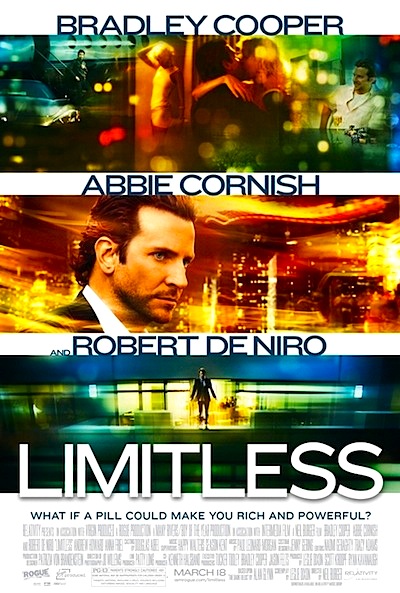
LFM Review: Limitless, Produced with 20% Brain Functionality

By Joe Bendel. What happened to Obama? So ruthlessly effective on the campaign trail, these days he can hardly chose an iron for his approach shots. Maybe he ran out of NZT. A designer drug formulated to tap into the supposed 80% of the brain lying dormant in mere mortals (a myth says Snopes), NZT offers life changing opportunities to one sad sack would-be writer, but it also comes with a mess of trouble in Neil Burger’s Limitless, which took the top spot in this weekend’s box office.

Eddie Morra is a listless under-achiever. His girlfriend Lindy has finally given him the dumping he so richly deserved. Despondent, he mopes around the City until he bumps into his ex-brother-in-law Vernon (no, Lindy is not the first woman to issue Morra his walking papers.). Recognizing his former whatever is a bit glum, Vernon gives him a blue Matrix pill, which the big dummy takes for no good reason. Suddenly, Morra can talk his landlord’s wife into bed, dash off her law school paper on Oliver Wendell Holmes, and then churn out his own novel before calling it a night.

Unfortunately, he wakes up as the same old idiot in the morning, which prompts an emergency visit to his dear old ex-brother-in-law. For some reason, the shadowy cabal developing NZT has entrusted its distribution to a pusher leftover from the glory days of Studio 54. Of course, Vernon’s carelessness gets him killed, but Morra gets his stash. Fueled by smarty-pants pills, Morra takes Wall Street by storm, even attracting the attention of Robert De Niro’s shadowy financier, Thurston W. Focker-Gekko, III, or some such.

Morra might be amped on brainiac drugs, but in Limitless’s world any IQ cracking 100 constitutes genius levels. You would think anyone borrowing money from a loan shark for a quick succession of day trades would make a point of paying that off as soon as possible. Not if you’re a genius, evidently. It would have saved so much trouble, though. Continue reading LFM Review: Limitless, Produced with 20% Brain Functionality