By David Ross. I saw only a few Hollywood films this year. Among Oscar contenders, I caught The Social Network (a well-told tale within narrow parameters), Toy Story 3 (a film our great-grandkids will revere no less than we do), How to Train Your Dragon (Avatar without the brainless politics), and Inception (ludicrous spew of egomaniacal director).
What to say about Inception, a film so self-enamored that it twists itself into knots the better to quaff the fragrance of its own rear end? It’s just bad. Badly acted, badly directed, badly written.
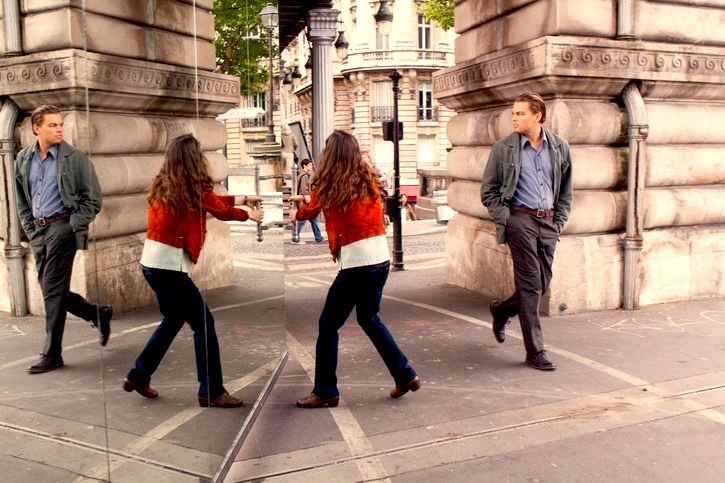
Science fiction is supposed to trace the arc of human possibility and send us postcards from our own future, or at least from a conceivable future. Inception, like the Wachowski brothers’ Matrix and Steven Spielberg’s Minority Report, imagines a factitious technological development and spins a strictly arbitrary tale. There’s no reason to give a damn. Inception is not about the implications of our present reality but about itself. It’s fixated on the superficial dazzle of its own self-enwound idea. Dr. Apuzzo’s review in these pages appeared upside down (see here), but it might equally have appeared in mirrored reverse, to indicate the film’s narcissus gaze.
Fair-haired Golden Boy: Leonardo DiCaprio in "Inception."
And then there is Leonardo DiCaprio, the baby-faced siren who lures directors to their artistic deaths. DiCaprio’s fatal attraction is one of the great mysteries. Do directors remember Titanic and see nine zeros where a performance is supposed to be? He’s lumbering, puffy, and nerveless, genetically closer to Keanu Reeves than to Al Pacino or Robert DeNiro. Christopher Nolan is taken in – okay, we expect as much; but Martin Scorsese four times? DiCaprio has laid waste a whole generation of potentially good films, starting with Danny Boyle’s The Beach. Brad Pitt has also ruined his share of films, but he has not gotten his mitts on nearly as many prestige projects.
Ellen Page is cute enough, and I enjoyed Juno as much as the next nerd who likes to see his own kind hold its own on screen, but no actress is less destined to be the next Sigourney Weaver. She jumps, she runs, she shoots, all the while conveying the sense that she’d much rather be reading Zadie Smith in some nice coffeehouse of the mind or maybe working on her grad school applications.
Same pretzel-logic, with more at stake.
I did see one more Oscar nominee, come to think of it. Exit through the Gift Shop is a strange piece of work: a documentary about an aborted documentary about street art. It follows the director of the aborted documentary, Thierry Guetta, as he evolves from vintage clothing store owner, to illicit street-art videographer, to daredevil street artist called Mr. Brainwash, to celebrity artist in his own right, despite having no training or experience whatsoever. Guetta now sells his Warhol-style lithographs for large sums at the highest strata of the auction world. Complicating matters, there’s speculation – probably correct, if I had to guess – that Exit through the Gift Shop is an elaborate prank perpetrated by its director, the legendary street artist Banksy, and that Guetta is merely a Banksy frontman. The Times of London floats this theory here.
Whether documentary or mockumentary, Exit through the Gift Shop is, at the very least, a postmodern artifact to be reckoned with. It begins by celebrating the authenticity of street-art heroes like Shepard Fairey (creator of the red, white, and blue Obama icon) and Banksy himself; it morphs into a deconstruction of postmodern inauthenticity as the putatively talentless Guetta manufactures a vast body of work in no time and successfully sells himself as the latest phenom to emerge from the streets; it morphs again into a vindication of Banksy on the assumption that Guetta has become rich and famous selling art that is, after all, Banksy’s.
What to make of this? Exit‘s pretzel-logic is no less involved than Inception‘s, but we find ourselves implicated in it; its maze is our maze, and we have a vested interested in finding our way out. Something, for once, is at stake.
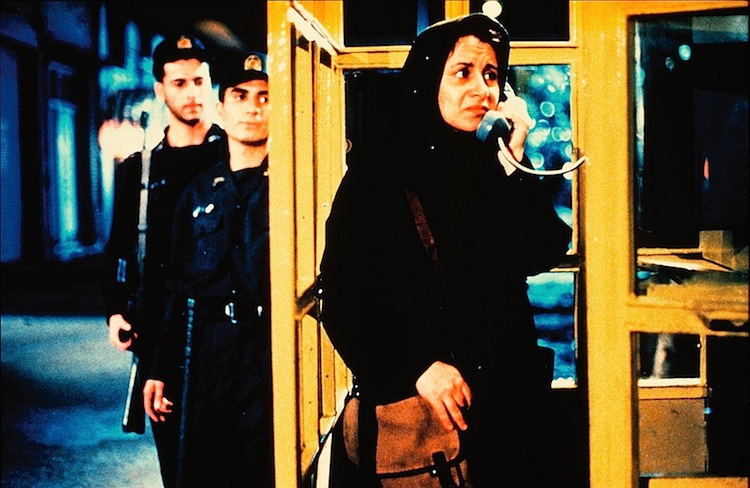
By Joe Bendel. It is good to be a man in Iran, provided you do not care about religious, political, or economic liberty. However, women must endure a profoundly misogynistic and frequently brutal society that regards them as little more than the chattel of men. Jafar Panahi confronted the unjustness of Iran’s treatment of women directly in The Circle, the winner of the 2000 Venice Film Festival’s Golden Lion prize – and a film which was promptly banned in Iran. Not content to stop there, the Iranian government has recently barred Panahi from further filmmaking for the next twenty years and sentenced him to six years in prison. Indeed, Panahi’s circumstances only heighten the poignancy of The Circle, which screens this Friday as the concluding film of the Asia Society’s retrospective-tribute to the persecuted filmmaker.
Solmaz Gholami (remember that name) has just given birth to a healthy baby girl. This should be happy news, but her mother is distraught. The in-laws were expecting a boy and will surely abandon their daughter-in-law and grand-daughter. The obvious high school science fact that it was the husband who failed to supply the Y chromosome is lost on such medieval fundamentalists. As Gholami’s mother seeks help from her family, Circle peels off, focusing on its next set of characters.
Three women have just been released from prison on unspecified “morals” charges. However, the Iranian system sets them up in a perverse Catch-22, kicking them loose without the necessary identification papers should they be stopped once again by the police (who are definitely out hunting for women in their situation). Lacking a male chaperone, sweet-tempered Nargess cannot take the bus trip back to her provincial home. Despondent, she seeks another friend, Pari, an escapee with even greater problems. She is four months pregnant with the child of her executed lover. From Pari, the chain continues, introducing a desperate mother and a woman arrested as a prostitute (perhaps not without some justification in her case), who ultimately brings the story to its symmetrical conclusion.
Sexism is a wholly insufficient term for the abuses Circle dramatizes. A stinging indictment – but also an honest, frequently moving human drama – it is not hard to see how it ran afoul of the state censors. Yet the film is not just a testament to Panahi’s artistic integrity. The cast deserves tremendous credit, especially those playing fallen women while living under a literal-minded fundamentalist theocracy. Though Circle is the only credit listed on IMDB for many of the actresses, their work has a powerful immediacy. They are frighteningly believable. Perhaps most haunting is Nargess Mamizadeh as her namesake. Young and innocent, to paraphrase the tagline of one of Circle’s international posters, she could only be guilty of being a woman.
To be banned by the mullahs might be a greater accolade than the raft of awards Circle won on the international festival circuit. Of course, the repercussions for Panahi have been severe. A truly bold film, Circle has only appreciated in importance and relevance with the regime’s campaign against the filmmaker. Highly recommended, it screens this Friday (3/11) at the Asia Society—and once again, tickets are free.
By Jason Apuzzo. • The most striking news on the Sci-Fi/Alien Invasion front recently was without doubt the announcement from Warner Brothers/Alcon that they’re going to reboot Blade Runner as a franchise of prequels and/or sequels. As electrifying as the news was, I was not altogether surprised to hear it given the current sci-fi craze and mania toward rebooting older franchises.
The big question, of course, is what precisely ‘is’ a Blade Runner franchise without the involvement of Ridley Scott, Harrison Ford or Philip K. Dick – none of whom are currently attached to any of these future ‘Blade Runner’ projects? (Dick being, of course, long deceased and not having furnished any ‘franchisable’ sequels to his original story). The answer, I’m afraid, is that such a ‘franchise’ is worth very little.
Having read several interviews with the Alcon people (see here and here), three points emerge: 1) they haven’t even contacted Ridley Scott yet; 2) they’d apparently like to work with Christopher Nolan (with whom they have a prior relationship), whose work on the Batman franchise represents the “template” they’re working from (i.e., it made a lot of money), and; 3) they apparently have no idea where precisely they want to take the story.
I’m groaning at all of this. It’s looking like the usual sort of thing: an ambitious group of producers grabs a lucrative ‘property’ they like, without a clue of what to do with it. They flail around looking for a ‘visionary’ (i.e., trendy) director to come in and do the actual work of figuring out what to do, because they never bothered to figure that out for themselves. Years get spent in ‘development,’ nothing happens – or worse, something like the 2010 Clash of the Titans remake happens. And memories of something precious get spoiled.
I have my doubts about this project, in other words. Indeed, I have doubts about whether it’s even going to happen. The likelihood is that neither Ridley Scott nor Christopher Nolan will be interested in doing it, and so who are the producers going to go to? Zack Snyder? Bryan Singer? God help us – I’d rather not learn what those guys think ‘The Tannhauser Gate’ really looks like. [Sigh.]
• Speaking of rebooted 80’s franchises, George Miller is assuring everyone that Mad Max: Fury Road will be back up shooting in January 2012, albeit apparently now without I Am Number Four‘s Teresa Palmer. Bummer! I’m otherwise looking forward to that film, which will be photographed in some new Miller-designed form of 3D. Also: a trailer has just been released for Tron: Uprising, an animated series that’s part of Disney’s ongoing Tron reboot. The trailer for this series actually looks better than Tron: Legacy, itself – but that may just be because there’s no Garrett Hedlund in it.
"Star Blazers" concept art.
• Some other big news of late on the Sci-Fi/Alien Invasion front was that Space Battleship Yamato (or Star Blazers, in its American incarnation), the classic Japanese TV series from the 1970’s and an old favorite of mine, is going to be adapted with Christopher McQuarrie writing the screenplay and David Ellison (True Grit; son of Larry Ellison) producing. This is another project, incidentally, that can be filed away as an alien invasion project – as alien invaders are an important part of the storyline. (Btw, Ellison and McQuarrie are currently the main guys behind the potential Top Gun sequel.)
I like the sound of this project – although admittedly it’s seeming a bit like Battleship in outer space – and on an even bigger budget. Here’s the key thing to understand about Battleship Yamato, though: it’s almost a kind of anti-Avatar, featuring blue-skinned aliens (the “Gamilons”) out to destroy human life on Earth (by way of radioactive meteorite bombs) so that they can repopulate the planet themselves. Earth’s forces have to rally around an enormous space cruiser, built out of the hulking wreckage of the original WWII Japanese battleship Yamato – although at this point, they might want to instead use something like Larry Ellison’s yacht. Anyway, my only requests here would be to re-name the “Gamilons” the “Na’vi,” cast Brooklyn Decker or Megan Fox, and otherwise we’re good to go.
• Check out this new trailer for Attack the Block, a cheeky indie alien invasion project from the UK that’s about to unspool at the SXSW Film Festival. The trailer features one of the better taglines in recent memory: “Inner City Versus Outer Space.” Also on the indie alien invasion front: a new film called Invasion of the Alien Bikini recently won the Grand Prix at the 21st Yubari Fantastic Film Festival, in Japan. Now that film I’d like to see … anybody know if it’s in 3D?
• Star Wars Episode I: The Phantom Menace will be coming to theaters in 3D on February 10th, 2012. Killjoys of the world now have something more to complain about; I personally, however, am very much looking forward to seeing Darth Maul, Obi-Wan and Qui-Gon go at it in 3D.
From "Star Wars Episode I: The Phantom Menace."
I thought I would take the opportunity here to share with Libertas readers what I thought about The Phantom Menace: which is that I loved it. Not every aspect of it, perhaps, but on balance it holds up as being a very satisfying epic adventure in the Errol Flynn-swashbuckler mode, with an intriguing storyline that’s like something out of The Fall of the Roman Empire. It also happens to be one of the most visually sumptuous films ever made – sweeping you along from Italy’s Caserta Palace, to the deserts of Tunisia, to the beautiful (digital) cityscapes of Coruscant. The costumes on Natalie Portman are gorgeous, Liam Neeson is really theepitome of what a Jedi Knight should be, John Williams’ score is one of his best … and then, of course, there’s Ray Park’s Darth Maul – easily one of the greatest movie villains of all time, a rival to the best villains ever played by Basil Rathbone in swashbuckler films of this kind.
So with all that, who cares about Jar-Jar Binks, thin dialogue, or a little too much cutesy-pie time with young Anakin? The movie’s a blast – a huge box office hit (adjusted for inflation, it would’ve made about $680 million domestically in 2011) – and you’re all going to be there next February, anyway. So stop whining.
• More to the present, Battle: Los Angeles is coming next week – and I’ll be saying a lot about that in coming days. In the meantime, many new clips of the film have been released on-line (see here), as well as some behind-the-scenes pics (see here), images of the aliens (see here), the film also has a new poster out, and we’re also learning that the film was not, for the most part, shot in Los Angeles – but instead in Louisiana. So I suppose the title Battle: LA has a double meaning. (This reminds me: why do movie aliens always look like seafood these days?)
• AND IN TODAY’S MOST IMPORTANT NEWS … the pretty and slightly strange Jennifer Lawrence is apparently the leading candidate to star in The Hunger Games, which, for brevity’s sake, you can imagine as something like The Running Man for teens – i.e., a sci-fi future dystopia featuring televised gladiatorial-style games. Since the story takes place in a world plagued with food shortages, it seems like perfect Obama-era sci-fi – doesn’t it?
And that’s what’s happening today on the Alien Invasion front!
By Joe Bendel. An old commie hunter, Uncle Boonmee is haunted by spirits. However, his ghosts are largely benevolent, seeking to comfort Boonmee during his final days. Rife with magical realism but deliberately toying with narrative structure, Apichatpong Weerasethakul’s Cannes Palme D’Or winning Uncle Boonmee Who Can Recall His Past Lives is now playing in New York at Film Forum and elsewhere around the country in a limited art house release.
Boonmee is slowly dying from a humiliating kidney dysfunction. He is faithfully attended by his Laotian servant Jai and the ghost of his deceased wife Huay, among others. Even his long lost son Boonsong pays his final respects, despite having transformed into a red glowing-eyed monkey spirit, lurking the dark heart of the jungle with his beastly cohorts.
It has been an eventful life, but it is nothing compared to Boonmee’s visions of his previous incarnations, particularly an episode in which a mystical catfish ravishes a self-esteem-challenged princess. Consistently obscure throughout Recall, Weerasethakul never explicitly spells out Boonmee’s role in this Leda-like tale, but since the lagoon is described as the place where Boonmee’s lives began, it seems safe to assume there is some fishy DNA in his karma.
Though Boonmee ruefully suggests his current bad karma stems from his past anti-Communist military activities, perhaps he should ask the Cambodians about what he helped spare his countrymen (“you did it for your country,” his sister-in-law Jen reminds him). Regardless, Weerasethakul’s somewhat veiled commentary is so deeply buried under multiple layers of symbolic meanings and narrative gamesmanship, it is doubtful Recall will inspire many viewers to spontaneously erupt in a rendition of “The Internationale.” Instead, those so inclined will probably break the film down into the parts they can deal with, whether that might be the animatronic catfish or Buddhist reincarnation themes.
From "Uncle Boonmee Who Can Recall Past Lives."
Of course, there is something problematic about a film’s whole, if it is less than its constituent parts. Between its double-secret allegories, nonlinear forms, and deliberate stylistic shifts, Recall is so busy displaying a self-conscious artiness, the rain forest gets lost for the trees. In fact, Recall along with the experimental companion short Letter to Uncle Boonmee were conceived as part of Weerasethakul’s multi-media, multi-platform project Primitive. Indeed, there are times when the static nature of Recall and particularly the narrative-free Letter seem more closely akin to installation videos than stand-alone films.
Though the late reappearance of characters from Weerasethakul’s past films might be enriching for those in the know, bringing things full circle, it further limits the film’s ability to connect with average well-meaning audiences. Still, Thanapat Saisaymar manages to express something fundamentally and universally human as the dying Boonmee, while Jenjira Pongpas also adds a bit of grace to the proceedings as Jen.
Obviously, Recall is a film for hardcore art-house and festival audiences. It boasts some reasonably nice performances, but it thoroughly confuses the distinction between avant-garde provocation and portentous pretention. A film that does not live up to its festival acclaim, Recall is now playing in New York at Film Forum and elsewhere in limited release.
By Govindini Murty. In honor of Fashion Month, I thought it would be fun to introduce Libertas readers to one of my favorite fashion/street-photography sites, The Sartorialist. Founded in 2005 by Scott Schuman, The Sartorialist is one of the most visually-inspiring sites out there. Schuman has been doing an exceptional job recently covering the New York, London, Milan, and Paris fashion shows. I’ve included a favorite look he captured from the Gucci show here, and other striking shows he’s covered include the Marc Jacobs show and the Altuzarra show in New York. Back in January Schuman also covered the men’s collections in Florence (where Luca Rubinacci epitomized the Italian style) and Milan, where the most elegant presentation was the Bottega Veneta show.
Of course, Schuman covers a lot more than runway shows – his main talent is as a street-style photographer – but we’ll get to that in a moment.
The 2011 Gucci Fall/Winter collection, shot by Scott Schuman of The Sartorialist.
Jason and I often speak about the importance of feeding the visual sense. As filmmakers and creative people, it’s extremely important to think about the image as much as about words, dialogue, and ideological meaning. That is why we here at Libertas make the effort to provide you with a site that is as appealing to look at as it is thought-provoking to read.
I found out about The Sartorialist about a year and a half ago from an article in British Vogue. Scott Schuman started the site in 2005 by posting photos he had taken of the quirky and chic people he encountered on the streets of Manhattan. The Sartorialist attracted more and more admirers, including many fashion industry professionals who turned to the site to see what was happening on the street-level in fashion. Within just a few years Schuman has become a fashion force to be reckoned with. The Sartorialist now receives more than two million unique visitors a month and Schuman’s photos are on the inspiration boards of major fashion houses around the world. Schuman has also been named one of Time Magazine’s Top 100 Design Influencers and he has been profiled in numerous fashion magazines and newspapers (read an LA Times profile here and an article in The London Times). In 2009 Schuman also published a terrific book of his street-style photography. Continue reading The Sartorialist: Feeding the Visual Sense
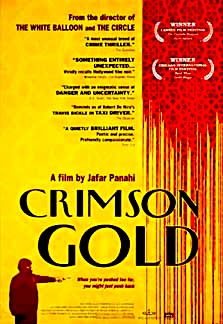
By Joe Bendel. The Iranian government’s record on human rights is certainly lacking, but anything less than a completely equitable distribution of the country’s vast oil revenues must represent the highest form of hypocrisy. Indeed, the Islamic Republic stands so charged in Jafar Panahi’s Crimson Gold, the winner of the Un Certain Regard Jury Prize at the 2003 Cannes Film Festival. Unfortunately, social criticism is a dangerous proposition in Iran. It earned Panahi a six year prison sentence and a twenty-year filmmaking ban. Needless to say, Panahi will not be in attendance when Crimson screens this Friday as part of the Asia Society’s retrospective-tribute to the persecuted filmmaker, but its depiction of a contemporary Iran illiberal in nearly every way speaks volumes.
There is something profoundly unsettling about Hussein. Though he walks through life in a haze, a little like James Franco at the Oscars, there is a great deal of anger and resentment roiling below the surface. We know right from the start, it is not going to work out for him. Through the circular narrative of celebrated Iranian director Abbas Kiarostami’s screenplay, the audience witnesses the events that drove Hussein to his tragic hold-up attempt.
Hussein and Ali, the brother of his fiancé, work as pizza deliverymen and dabble in a bit of purse-snatching. One otherwise unremarkable purse holds a receipt for an extravagantly expensive necklace. Intrigued, they proceed to the high-end jewelry store out of curiosity, only to be turned away as the low class riffraff they so obviously are. Hussein’s resulting umbrage will be his undoing, eventually leading us back to where the film started, but the getting there will be both oppressively naturalistic and at times surreal.
Hussein is one of the Islamic Republic’s disposable people, a psychologically traumatized Iran-Iraq War veteran living in abject squalor. However, the mobility of his job allows him to observe both the glaring disparity between the have’s and the have-not’s, as well as the morals police at work. Crimson truly captures the absurdity of contemporary Iran when Hussein tries to deliver his pies to a scandalous party featuring verboten dancing between the sexes, only to be waylaid by the cops waiting outside to arrest each sinner as they leave. One of Crimson’s inconvenient ironies is the rigid fundamentalism of Hussein himself and his desperately poor neighbors.
Iranian filmmaker Jafar Panahi.
Reportedly, Hussein Emadeddin was a nonprofessional actor living with paranoid schizophrenia when Panahi cast him as Crimson’s protagonist. Unlike the typical Hollywood-indie portrayal of mental illness, Emadeddin is never showy in the role. All his energy seems to be directed inward rather than outward. Beyond convincing, he is frankly eerie to watch lumbering through the margins of Iranian society—a ticking time-bomb waiting to explode.
In America, it is a compliment to call Crimson a challenging film. In the mullahs’ Iran, it constitutes a prison sentence. A pointed attack on hypocrisy and a somewhat more circumspect critique of Iranian social controls, Crimson is also compelling tragedy, deftly executed by Panahi. Worth seeing as a film in its own right, Crimson is only too timely given the circumstances of its director. Highly recommended, it screens this Friday (3/4) at the Asia Society and once again, tickets are free. In addition, the Society will host a panel discussion on Panahi and free expression in Iran (or the lack thereof) that will also be simultaneously webcasted here at AsiaSociety.org/Live.