By Jason Apuzzo. So that you can get a feel for the man, I wanted to share with everybody some interviews that recently appeared on-line featuring my late friend and mentor Irvin Kershner. The interview above, which he did about a year ago, deals with making The Empire Strikes Back. It’s classic Kersh, in full storytelling mode. (You can see Part Two of this interview here.)
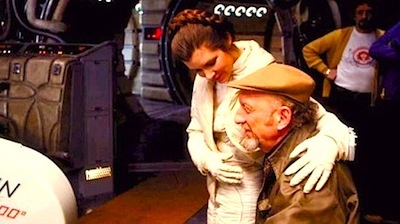
Kersh with Carrie Fisher.
One of the things I should have mentioned in my remarks about Kersh from Monday was his tremendous sense of humor, which you get a flavor of above. His humor was typically of the earthy, Jewish – and occasionally ribald – variety, and it’s what kept you hooked on the man, even if he’d just given you a verbal pounding.
I’ll never forget a time when Govindini and I had been up to his place, and Govindini had accidentally left behind a sweater, a blue cardigan. We asked Kersh later if he still had it. “No,” he said, with a wry grin. “I sold it to the Rag Man when he came by.” Classic Kersh. (With a cheeky grin, and with his typical old World courtliness, he then gently brought forth the sweater – neatly folded.)
Anyway, Kersh (born ‘Isadore’ Kershner) certainly came a long way from his youth in Philadelphia in the 1920s, when his Ukranian father supported the family selling fruits and vegetables from a street cart. It’s nice seeing him finally get his due right now in the media. It would’ve made him feel good, although – ever industrious, ever motivated – he wouldn’t have liked it distracting from his work …
Here are some of the better quotes I’ve seen about Kersh over the past few days:
George Lucas: “I considered him a mentor,” Mr. Lucas said in a statement after Mr. Kershner’s death. “Following ‘Star Wars,’ I knew one thing for sure: I didn’t want to direct the second movie myself. I needed someone I could trust, someone I really admired and whose work had maturity and humor. That was Kersh all over.”
“I didn’t want ‘Empire’ to turn into just another sequel, another episode in a series of space adventures,” he said. “I was trying to build something, and I knew Kersh was the guy to help me do it. He brought so much to the table. I am truly grateful to him.”
Francis Coppola: “We all enjoyed knowing Kersh, learning from him — and admired his creative spirit and indomitable will,” Coppola said in a statement released by Kershner’s publicists. “It was always exciting to talk with him about all aspects of cinema and life.”
Barbra Streisand: “He had the most incredible spirit, an exuberance for life. Always working, always thinking, always writing, amazingly gifted and forever curious. We met doing ‘Up The Sandbox’ in 1972 and remained friends ever since. I loved him,” she said in a statement.
Billy Dee Williams: “[A]n extraordinary mountain of a man with whom I’m proud to have shared the world of art.” “I bet he’s smiling at us right now with that wonderful impish smile,” Williams said in a statement.
Matthew Robbins: “To many, he represented the best in what American film making could do with its enviable resources and catholic traditions,” Robbins said. “He believed in emotion as the basis for all dramatic storytelling. For him, the worst cinematic crime was flatness, or lack of feeling. “Few who encountered Kershner either on the set or in the classroom will forget his almost ruthless pursuit of honesty and recognizable, complex human motivation,” Robbins said.
The interview below, conducted in his wonderful living room – full of artifacts from his many travels – is a more personal interview that deals with his youth, and his development as an artist, covering some of his early period as a painter and a photographer.
Part 2 of this interview can be seen here. I’ll be reviewing The Making of the Empire Strikes Back in coming days.
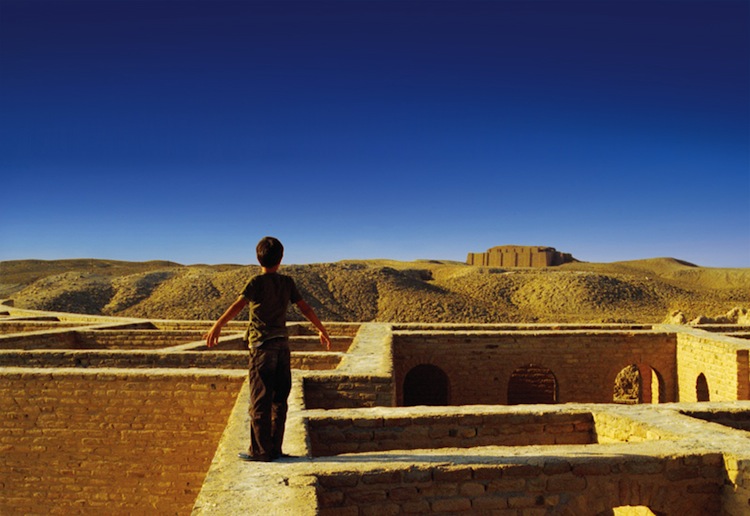
By Jason Apuzzo. The Hollywood Reporter today has an interesting piece on Iraq’s official foreign-language Oscar submission, Mohamed Al-Daradji’s Son of Babylon. It looks like a bit of a tearjerker.
It’s worth noting that there would not, of course, be any official foreign-language Oscar submissions from Iraq if that country were not now free.
Some years back we were honored to show short films from Iraq’s first film festival here in Los Angeles at the Liberty Film Festival. They were small, personal, humble efforts – so I’m very glad to see the artistic fruits of Iraqi freedom now appearing in such ambitious, large-scale form on the big screen.
By Jason Apuzzo. This is a very hard day for me, and a very difficult post to write. My friend and mentor Irvin Kershner passed away this weekend.
Kersh had been ill for some time. Govindini and I talked to him a month ago, and although the fire was still there, he sounded physically weak. We had hoped for the best, of course, but time and age are unforgiving – even for someone as robust and vital as Irvin Kershner.
For those of you who may not be familiar with Kersh, he was an extraordinary director of major Hollywood films – interestingly, the only director ever entrusted with both a Star Wars film (The Empire Strikes Back) and a James Bond film (Never Say Never Again; in fact, Kersh is the only American to have directed a Bond film) – and also of independent, art-house films, little gems like Hoodlum Priest, The Flim-Flam Man, The Luck of Ginger Coffey or A Fine Madness.
Kersh was a consummate actor’s director, who worked with such famous stars as Sean Connery (twice), Robert Shaw, George C. Scott, Barbra Streisand and Faye Dunaway. He also directed what many people still consider to be one of the best made-for-television movies of all time: Raid on Entebbe, about the famous Israeli hostage rescue. And he was furthermore an exceptionally gifted documentarian and fine art photographer, and would likely have made a major name for himself as a still photographer had he not been so talented a filmmaker.
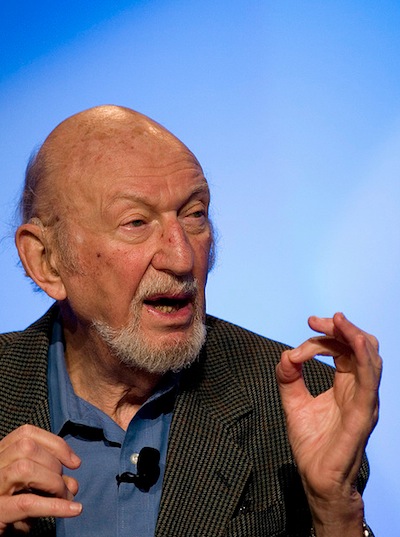
Director Irvin Kershner.
These are some of the details – important, professional details – that you’ll read about Kersh in the articles written about him today (see George Lucas’ reminiscences of Kersh here), particularly with respect to his absolutely perfect direction of The Empire Strikes Back. Nonetheless, I’d like to offer my own, personal observations about the man.
Hollywood – and the filmmaking world generally – are hard, competitive, challenging environments. People are not always kind to one another; what’s worse, these environments do not always bring out the best in people, but very often the worst. It’s for this reason that when you find someone who exhibits qualities of kindness, generosity, open-heartedness, old-fashioned gentlemanliness and wisdom, you hang on to them. Kersh had all of these qualities and more – and so, like a lot of other young people he mentored, I turned to Kersh at a time in my life when I was in acute need of wisdom and guidance.
Because all of us at certain points in our life need mentorship. Mentorship constitutes the bone and sinew of what we are, and so much of what we accomplish.
And when Kersh mentored you, he gave you everything he had. His generosity – his deep desire to encourage and nurture the best in others – was limitless. I can never recall an instance when I called on Kersh for anything and left disappointed. That’s how large-hearted a man he was.
Of course, Kersh seemed to mentor everyone he was around. He’d lived a long, colorful and endlessly fascinating life – but more than that, he’d learned things from his many experiences, things that he was eager to impart to young people willing to listen. I remember spending evenings with him in his home up in the hills over Beverly Hills, a place that became a refuge for me, listening to wild stories about his early days in the Middle East right after World War II, when he retraced the footsteps of Alexander the Great; or his early days in filmmaking, getting his first professional break from Jack Warner; or the time Satyajit Ray almost accidentally burned down his house(!); or the fun he had palling around with Peter Sellers; or absorbing his insights on Buddhism, Christianity and other world religions. I’ll never forget one special evening when Govindini and I had dinner privately with Kersh and Ray Harryhausen, and listened to those two men trade stories back and forth; it was like listening to two men who’d been present at Creation trading secrets on the special luminosity of the dawn. It was that extraordinary.
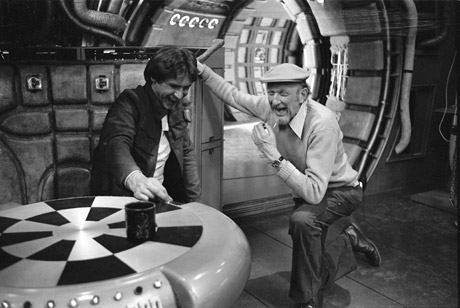
With Harrison Ford, on the set of "Empire."
More difficult were the discussions with Kersh about his family, particularly his ancestors in the Ukraine with whom he’d never been able to have contact. As cosmopolitan as Kersh was, as erudite and well-travelled as he would become, I think a part of him always longed for the staedtle – the humble, small-town world of his Jewish ancestors. Kersh always seemed to me too sophisticated – and too deeply sentimental – to really feel at home in the rootless world of L.A. and Hollywood. Kersh was both a consummate insider in Hollywood – the man who injected humanity into franchises (he directed four different sequels in his career) – yet he was also the consummate outsider … a cerebral, Old World gentlemen and artist in an industry full of illiterates and “traffic cops,” as he liked to put it.
This, ultimately, is why Kersh was such a perfect choice to direct TheEmpire Strikes Back – a movie about a young man (Luke Skywalker) who is offered the keys to the kingdom … but refuses them, because he wants something better for himself. Kersh never quite fit in completely with the industry, even though his immense talent gave him opportunities others could only dream of. Kersh fit in perfectly, however, with the grand and idiosyncratic vision that George Lucas was creating up in northern California, by way of Star Wars. It wasn’t so much Kersh’s film resume, superb as that was, that made him perfect to helm Empire, so much as the size and quality of his heart – which was vast, sensitive and incorruptible.
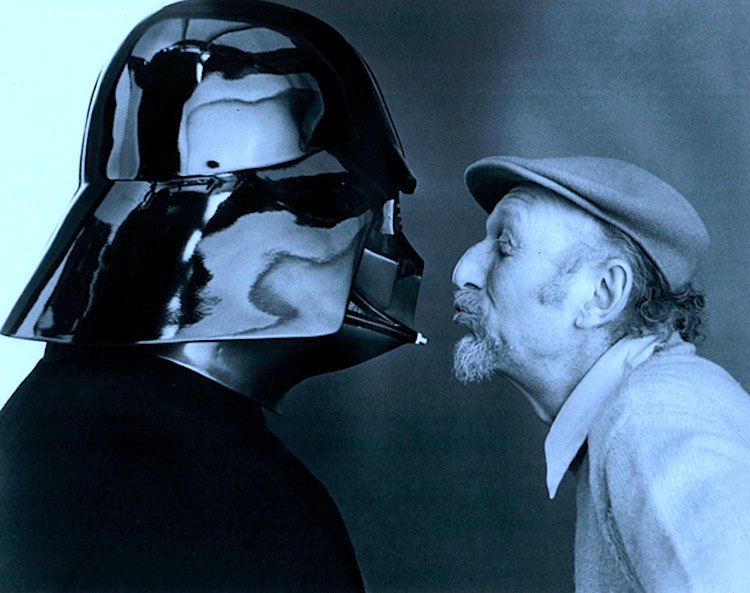
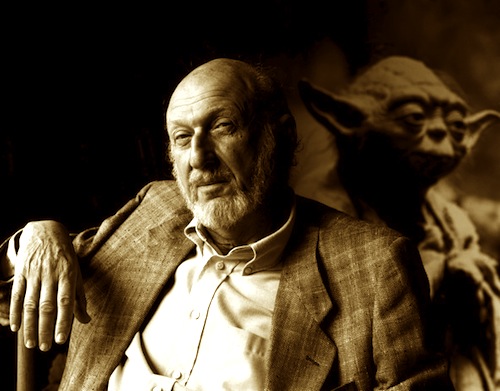
Kersh with Yoda, his alter ego.
Empire is also the film, of course, that introduced us to the character of Yoda. And as many of Kersh’s acquaintances have pointed out – and as I in my small way can attest – Kersh was Yoda. If you want to know what the man was like, simply watch that film. What this means, of course, is that Kersh was a person who cared about his students – while sometimes coming down on them like a ton of bricks. That was how he – and many others of his generation – chose to do it. Kersh was a tough, hard mentor. He demanded the best. Isn’t that what mentors are supposed to do? I don’t remember feeling a lot of ‘self-esteem’ after leaving his house on the many occasions we visited, but I do remember feeling like somebody actually cared about me and gave a damn about what I was doing.
Kersh was part of that older generation who understand that what young people need isn’t ‘self-esteem,’ but self-discipline and training. So that’s what he instilled in young people – or perhaps better put, that’s what he amplified and channelled in young people, provided those qualities were already there. Because if they weren’t there, you’d never even get through the front door with him.
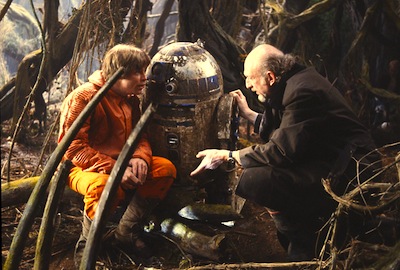
Kersh the mentor at work, with Mark Hamill.
In any case, I’ve lost someone whom I loved and deeply respected, and the world has certainly lost a brilliant filmmaker. He leaves behind him the best legacy imaginable for any mentor: a legacy of individuals, rather than merely acolytes.
If you want to know more about Kersh and how special he was, the best testimony is probably contained in the exceptional new book, The Making of The Empire Strikes Back. That book captures in ways large and small what Kersh did to not only prolong the Star Wars film series – under challenging circumstances – but enrich and deepen the series, as well.
I’d like to say a few words about Kersh’s children, who had been taking such good care of their father for the past several years as Kersh dealt with a series of difficult ailments. Their patience and enduring love for their father were evident to everyone who spent time with Kersh recently, and a father really could not ask for more devotion from his children. Our condolences to them and the rest of his family on this day.
By Jason Apuzzo. Those of us here at Libertas want to wish everyone a Happy Thanksgiving.
If you live in America, in almost any circumstance, you have a great deal to be thankful for – because you’re living in freedom.
Today we wanted to celebrate Thanksgiving by giving everyone the opportunity to watch a great film from 11 years ago from Wim Wenders, called The Buena Vista Social Club. This extraordinary, Oscar-nominated documentary is about a group of artists who did not live in freedom – living, instead, in Castro’s Cuba – yet who refused to let their circumstances dim their spirits, or destroy their art.
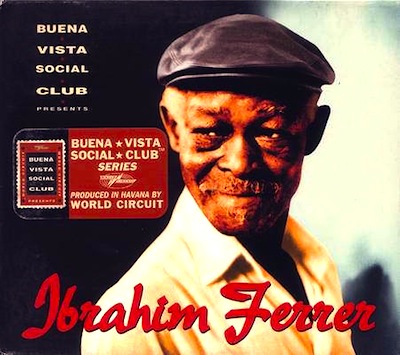
If you’ve never seen this film, take the opportunity over this weekend to watch it – here (through SnagFilms), for free. The music is extraordinary, Ibrahim Ferrer is unforgetable, and you may find yourself shedding a few tears by the end.
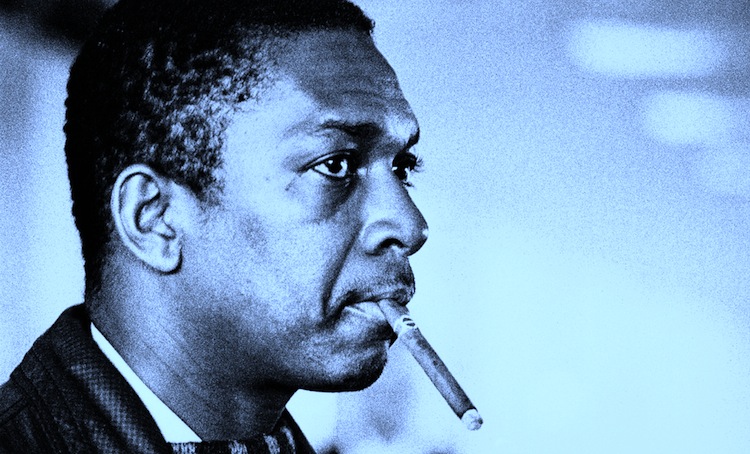
By David Ross. Between 1961 and 1968, Rolling Stone co-founder and music critic Ralph Gleason hosted twenty-eight half-hour episodes of Jazz Casual on public television. There wasn’t much glitz: Gleason would say a few words of introduction and his musical guest would be off to the races. Even so, Jazz Casual was probably the purest dose of cool ever delivered by American TV. In 2006, all twenty-eight episodes – 840 minutes worth – were released as a DVD box set titled The Complete Jazz Casual, but the set is now, alas, unavailable. Netflix offers three episodes – Basie, Gillespie, and Coltrane – on a single disc, as well as discs devoted exclusively to Coltrane, Brubeck, and B.B. King.
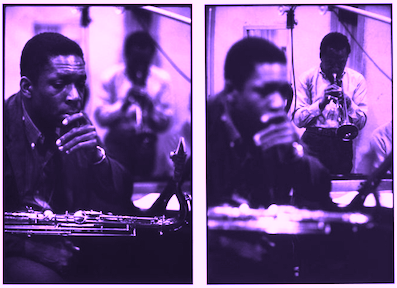
John Coltrane & Miles Davis.
Coltrane, of course, is like some astral event that comes around only once in many lifetimes; to see and hear him is to witness something epochal.
Jazz aficionados should also make a particular point of viewing, via Netflix, Miles Davis: Cool Jazz Sound (2004), a 25-minute dose of the Miles Davis Quintet – Davis, Coltrane, Wynton Kelly, Paul Chambers, Jimmy Cobb – filmed in New York in April 1959. Davis and Coltrane are such spectacularly paired opposites, the former’s angular reserve balancing the latter’s delving, groping virtuosity.
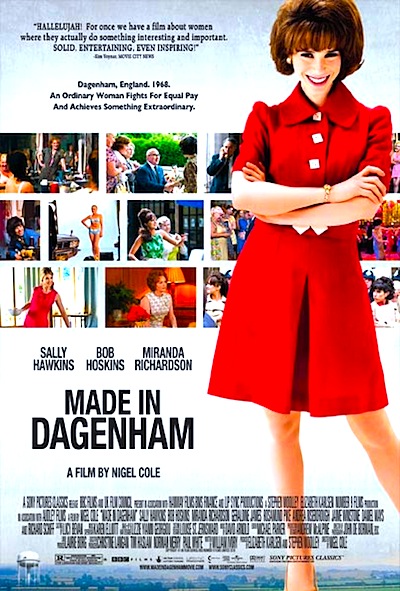
By Joe Bendel. In the late 1960’s United Kingdom, trade unions dominated industrial policy, but did chauvinism trump class warfare? 187 women find out when their strike brings the mighty Ford plant to a standstill in Nigel Cole’s Made in Dagenham, which opened Friday in select theaters nationwide.
In one of the all time penny-wise-pound-foolish decisions, Ford reclassified the seamstresses working at their plant in the London suburb of Dagenham as “unskilled” rather than “semi-skilled” workers. This naturally resulted in a corresponding pay cut for the women. Encouraged by Albert, the factory’s union rep, they vote to authorize a work stoppage if their semi-skilled status is not reinstated. Though not previously active in the union or politics of any sort, Rita O’Grady is selected to attend the negotiations between Ford and their union. She is supposed to sit quietly in the corner, but when Monty Taylor, the feather-bedding head of their Local tries to sell out the Dagenham women, O’Grady gives them a case of what’s what.
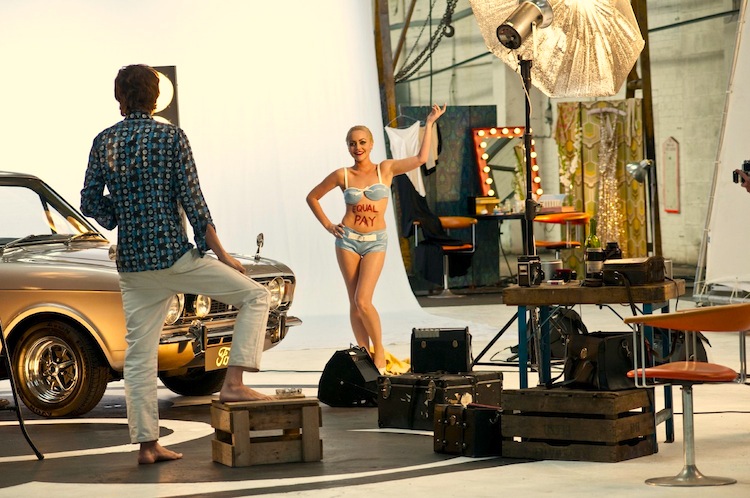
Jaime Winstone disrobes for social justice.
Suddenly, the strike is on. However, the parameters have widened. With the encouragement of Albert, a former military officer raised by his single working mother, the Dagenham women are insisting equal pay for equal work. With 55,000 men now out of work, the union leadership is decidedly unenthusiastic. Ford is not too thrilled either. However, Barbara Castle, Harold Wilson’s minister for labor relations is quite impressed by the Dagenham women, while her boss is rather befuddled by it all.
Dagenham is a mostly harmless, Swinging Sixties Norma Rae, yet it veers awfully close to the patronizing attitudes it takes pains to skewer. We are clearly meant to cheer when O’Grady asserts herself with the sexist old boys around the negotiating table, but why shouldn’t she? William Ivory’s screenplay never actually uses the term “plucky gals,” but one can feel it floating in the air.
While Dagenham frames the issues surrounding the strike in simplistic terms, at least it earns credit for its pointed portrayal of the union leadership – a venal, Marx-quoting lot of chauvinist pigs. Of course, the overall membership is the salt of the earth, who eventually rally to the Dagenham women’s cause. Yet wisely, the film resists the dour naturalism of most union movies. Instead, it gives us Jaime Winstone in a mini-skirt.
Do not get the wrong impression though, Winstone (daughter of Ray) is mere window dressing. Dagenham is clearly intended as a star turn for Sally Hawkins – and certainly she is ‘likable’ enough. Everyone in the film is likable, unless they are management, in which case they are despicable. However, Hawkins’ soft-spoken, twitchy performance makes it hard to understand how she becomes such as a galvanizing force.
Granted Bob Hoskins’ big speech is ridiculously manipulative, but he still sells it, supplying the film’s most heartfelt moments. Though Wilson incisively contrasted himself with his Conservative opponent’s aristocratic background during the 1964 campaign, John Sessions plays him like an upper-class twit, emasculated by a look from Miranda Richardson as Castle – but at least they also supply some dramatic flair.
It might be faint praise, but Dagenham could have been far worse. When in doubt, Cole clearly opted to keep the tone light, which makes the film watchable – even if it is predictable and stilted. It opened Friday in New York, Los Angeles and in select theaters elsewhere.