LFM Reviews The Babadook @ FilmLinc/MoMA’s New Directors/New Films

By Joe Bendel. Whenever a strange book mysteriously turns up, google it before cracking it open for a bedtime story. Like Candyman, the protagonist of a creepy picture book arrives when bidden and there will be no getting rid of him in Jennifer Kent’s The Babadook, which screens during this year’s New Directors/New Films, co-presented by the Film Society of Lincoln Center and MoMA.

Six years ago, Amelia’s husband was killed in a traffic accident as he was rushing her to the hospital. She survived to deliver Samuel, their physically healthy but deeply maladjusted son. Naturally, celebrating his birthday is always an awkward affair. Prone to acting out, Samuel is a real handful. Lately, he is pushing his still grieving mother to her breaking point. Then a rather peculiar picture book titled Mr. Babadook appears.

Since Samuel is fascinated by magic and old school magicians, the hirsute creature in a top hat depicted on the cover initially suggests it might be his cup of tea, but its true nature quickly becomes apparent. Both mother and son are soon plagued by Babadooky nightmares. Before long, the Babadook seems to take corporeal form, constantly lurking in the shadows. Try as they might, they cannot lose or destroy that infernal book and its constant reminder: “you can’t get rid of the Babadook.”

On paper, Babadook might sound like an atypical genre selection for ND/NF, but former Australian TV thesp Kent is indeed a new director. She also takes a stylish approach to the material. Max Schreck’s Nosferatu would feel at home in Amelia’s severely gray, creaky old house. In a nice hat tip, the magically themed films of George Méliès are often seen on television, further setting the mood. Likewise, Alex Juhasz’s Babadook illustrates are creepy and eccentric, recalling the better work of Tim Burton before he lost his edge.
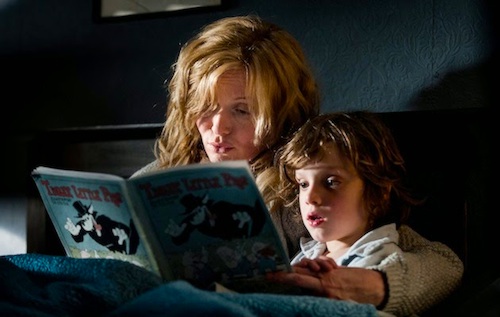
From "The Babadook."

By genre standards, Babadook is an unusually accomplished production, but its two tormented leads really try a viewer’s patience. Admittedly, some serious paranormal skullduggery is afoot, but Essie Davis’s Amelia becomes rather problematically overwrought, flirting with outright melodrama. Usually, moms are the level-headed ones in times of crisis, but not here. Likewise, the clammy bug-eyed presence of her partner in this near two-hander often undercuts the drama.

On the plus side, Kent’s instincts were on spot-on perfect when determining how much of Bobby Duke she would show and in what context. The look and mechanics of the film are quite strong (with considerable credit also due to cinematographer Radek Ladczuk), but viewers might find themselves rooting for the little hobgoblin rather than against him, which is not necessarily a terrible thing. Recommended for horror fans inclined to grant style points, The Babadook screens this Saturday (3/22) at the Walter Reade and Sunday (3/23) at MoMA as part of the 2014 ND/NF.

LFM GRADE: C+

Posted on March 19th, 2014 at 11:10am.
LFM Reviews Jack and the Cuckoo Clock Heart @ The 2014 New York International Children’s Film Festival

By Joe Bendel. Love hurts, yeah, yeah. For young Jack, it can be downright deadly. That is because his ticker literally ticks. Born on Edinburgh’s coldest day ever, Jack’s heart was frozen solid and had to be replaced with the titular timepiece. His adopted mother warns him not to fall in love, lest it overwhelm his cardiac gears, but fate has other ideas in Mathieu Malzieu & Stéphane Berla’s Jack and the Cuckoo Clock Heart, which screens during the 2014 New York International Children’s Film Festival.

It takes a certain kind of woman to successfully replace a heart with a cuckoo clock. Convinced Madeleine, the midwife with a wiccan-ish reputation, will be a better parent to the boy, his overwhelmed birth mother abandons Jack in her care. She subsequently drills the rules of cuckoo clock maintenance into his skull full of mush: don’t touch the hands, don’t lose his temper, and never ever fall in love. However, he nearly loses it when it first sees Miss Acaia, a young flamenco singer, performing in the city square.

For years, Jack must endure the bullying of his romantic rival while separated from his true beloved. However, when trouble forces him to leave Edinburgh, Jack sets off in search of Miss Acaia. He is encouraged and accompanied on this quest by his new friend and heart-tweaker, the tinkering future pioneer of filmmaking, Georges Méliès. Eventually, they find Miss Acaia performing in Andalucía, which is a giant carnival in Malzieu’s macabre world, but unfortunately Jack’s nemesis follows closely behind them.

Based on the concept album and children’s book by Malzieu, the frontman of the surrealist rock band Dionysos, Cuckoo is an odd bird by any objective measure. It is sort of like Hugo reconceived by Edward Gorey, with a dash of The Who’s Tommy mixed in for extra strangeness. Much like “children’s books for adults” (a category of publishing that probably applies to Malzieu’s chapter book), the film version is really a child’s animated parable for adults. Frankly, the film ends on a lyrically poetic note, but it will not be a crowd-pleaser for younger audiences.

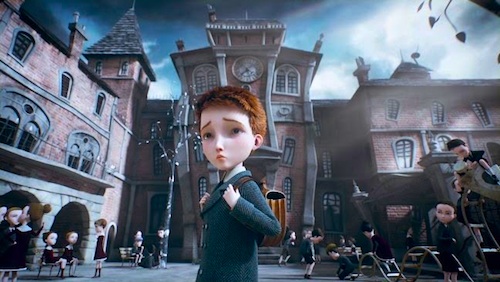
From "Jack and the Cuckoo Clock Heart."

So who is it for? Maybe fans of Méliès, Gorey, Tod Browning, Tim Burton, Charles Adams, Jack the Ripper films (yes, he makes a strange appearance), and Les Miz’s Samantha Barks, who provides Miss Acaia’s voice for the English language soundtrack (and quite nicely so). You know who you are.

Cuckoo’s computer generated animation is quite striking and richly detailed, in a darkly ominous way, and Malzieu’s songs have more substance than one would expect from an animated film (recent Oscar winners not excluded). Nevertheless, parents should fully understand this is a fable, not a fairy tale. Malzieu and Berla fully deliver on their early promise of romantic tragedy.

Cuckoo is an elegant concoction of distinctive music and visuals, but it will be daunting marketing challenge for its American distributor. Recommended for connoisseurs of sophisticated animation, Jack and the Cuckoo Clock Heart screens again next Saturday (3/22) at the SVA Theater, as this year’s NYICFF continues at venues throughout Manhattan.

LFM GRADE: B+

Posted on March 19th, 2014 at 11:04am.

LFM Reviews The Wrath of Vajra, Now Available on Blu-ray/DVD

By Joe Bendel. When a martial arts cult takes its name from the Greek god of the underworld, it is safe to expect major villainy from them. Factor in their commitment to Japan’s Imperial militarism and you know they are in for a bruising in Law Wing-cheong’s The Wrath of Vajra, which released yesterday on DVD and Blu-ray from Well Go USA.

According to Kawao Amano, the founder of the Hades cult, even if the Japanese military conquers territory, they will never defeat the spirit of the Chinese people until they see their regional champions publically humiliated by superior fighters. To accomplish this task, Hades kidnapped young children to be raise as fighting machines. K-29 used to be one of them, but he broke with the Hades cult when it was temporarily disbanded for being way too nuts. With the war going badly, the Emperor eats some crow and gives Hades the go ahead to open up shop again. One of their first orders of business will be challenging K-29, who has taken up robes in a Shaolin temple.

Forced to turn himself in, K-29 finds himself reunited with Bill, another former involuntary Hades inductee, who commands a captured American military unit. The rules of Hades death tournament are simple. K-29 will have to fight his way through a series of cult leaders, starting with the towering Tetsumaku Rai, leader of the Violence Clan, to get to his nemesis, Daisuke Kurashige (a.k.a. K-28). Sure, no problem. Along the way, he will work through his guilt for accidentally killing his brother way back when and reawaken the conscience of Amano’s daughter Eiko, a journalist reporting on Hades tournaments for the Japanese public.

So yeah, guess who wins and guess who loses. Frankly, Vajra is considered subtle anti-Japanese propaganda, because K-29 never gets political. Instead of greater China, he fights for the captive children. For what its worth, Eiko is also a sympathetic figure and the Americans are on the side of the angels. Still, Vajra is not exactly shy about playing to anti-Japanese sentiment.

From "The Wrath of Vajra."

Regardless, Shaolin monk-turned action star Xing Yu (a.k.a. Shi Yanneng) is pretty legit as child assassin-turned Shaolin monk K-29. He has the moves and his everyman presence wears well during the course of the film. Usually a supporting player lending authenticity to films like Ip Man, Shaolin, and Bodyguards and Assassins, it is nice to see him get a turn in the spotlight. Ya Mei (Zhang) also convincingly portrays Eiko’s evolution from militarist to maverick. Jiang Baocheng and “Poppin” Nam Hyun-joon (a Korean hip-hop dancer) certainly have the right looks for Rai and the herky-jerky Crazy Monkey (leader of the Zombie Clan), respectively. In fact, they essentially upstage (Korean American, not Japanese) Steve Yoo’s down-to-business K-28.

It hardly matters, though, if one set of villains are more colorful than another. Law, a Jonnie To protégé (who really made a statement with the To-produced Punished) keeps the energy level up and action director Zhang Peng stages some distinctly camera-friendly, old school fight sequences. Vajra delivers spectacular beatdowns and adds some pleasing Shaolin seasoning. Recommended for martial arts fans looking for red meat, The Wrath of Vajra is now available on DVD and digital platforms from Well Go USA.

LFM GRADE: B

Posted on March 19th, 2014 at 10:59am.

LFM Reviews Tiger & Bunny: The Rising

By Joe Bendel. In the future, superheroes will be a lot like NASCAR drivers. They will fight crime in colorful costumes bedecked in their sponsors’ logos and earn points fighting crime in the televised hero leagues. Our dynamic duo is genuinely committed to doing good, but their prior misadventures have kept them in the second league. However, events will temporarily split up the partners in Yoshitomo Yonetani’s Tiger & Bunny: the Rising, a feature follow-up to the hit anime series, which screens this Saturday and Monday in New York.

Kotetsu T. Kaburagi is an aging but still idealistic superhero, known professionally as Wild Tiger. His younger partner, Barnaby Brooks, Jr. fights crime under his real name, but Kaburagi dubbed him “Bunny” because of the ear-shaped thingies on his uniform. They bicker constantly, but they have been through quite a bit together. Yet, even though Kaburagi helped Brooks solve the murder of his parents, most hero-watchers think he is holding the younger superhero back.  The new boss decides to fix that, promoting Brooks to the first league and partnering him up with Golden Ryan, a preening new superhero with the power to control gravity.

Naturally, just as Wild Tiger returns to civilian life, a wave of super-powered chaos sweeps across the New York-ish Sternbild City, apparently inspired by the ancient legend of an angry goddess who once laid waste to the city ages ago. At least it is good for their ratings.

Viewers walking into Rising completely cold will have little hope of keeping straight the large cast of supporting superheroes, aside from Fire Emblem, their GLBT colleague. Nonetheless, Kaburagi, the widower single father, is an appealing working class protagonist. Arguably, T&B celebrates virtues like courage and loyalty just as much or more than it critiques consumerism. Still, Rising’s most treacherous characters are all media types. In contrast, the actual super villains are kind of cool looking, but are not well developed in terms of who and what they are.

From "Tiger & Bunny: The Rising."

Obviously, Rising was produced specifically with fans in mind, but it is relatively easy to pick up the gist of the Sternbild City world on the fly. It essentially plays like an extended episode, but it is entirely self-contained and moves along pretty briskly. In fact, there are a number of clever bits sprinkled throughout the action. Recommended for the pre-existing fanbase and superhero enthusiasts in need of a quick fix, Tiger & Bunny: The Rising opens today (3/14) in Los Angeles at the Downtown Independent and also screens this Saturday (3/15) and Monday (3/17) in New York at the Village East, with further screenings scheduled in select cities over the coming weeks.

Posted on March 14th, 2014 at 12:47pm.

Trying to Avoid a Big Fat Iranian Wedding: LFM Reviews Shirin in Love

By Joe Bendel. The affluent members of southern California’s Iranian-American community like to drink, dance, and party. They are way more fun than an army of Brooklyn hipsters, but parents still have very specific ideas about who their grown children should marry. One disorganized writer develops very different notions of her own in Ramin Niami’s Shirin in Love, which opens this Friday in New York.

To be honest, Shirin is more of an aspiring writer, but at least she cranks out book reviews for her overbearing mother Maryam’s lifestyle glossy. She also has trouble holding her liquor—something the sensitive brooder William soon learns first hand, by sheer chance. Having seen her at her sloppiest, he is rather surprised when she turns up in Northern California to interview Rachel Harson, his novelist mom. Both mother and son take a shine to the scatterbrained bombshell, but he is reluctant to admit it. As a further complication, she also happens to have a mother-approved fiancé and he has a mousy long-term girlfriend.

Shirin and William are so obviously head-over-heels, they will do all kinds of negligent things to sabotage their budding relationship. Of course, Shirin’s Mother Dearest is not about to stand by and watch her toss away her engagement to a plastic surgeon. Still, the colorful cast of supporting characters will help keep SIL on a standard rom-com trajectory.

Aside from a benign reference to the old country back-when, writer-director Niami never troubles viewers with dire circumstances of post-Revolutionary Iran, which is fair enough. People have to get on with their lives and Shirin’s family is about as far removed from the Islamist state as you can get. However, lead actress Nazanin Boniadi has evidently seen real life hardships of a different sort. According to Vanity Fair allegations supported by Paul Haggis, she was poorly treated by the Scientology machine when they auditioned her to be a certain actor’s sanctioned squeeze.

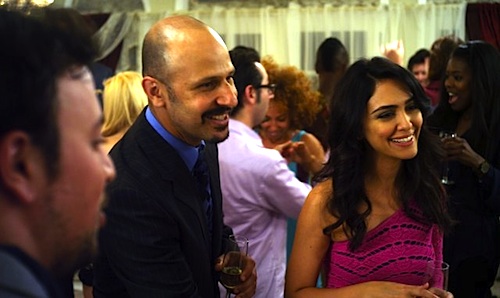
From "Shirin in Love."

Frankly, you can’t question his taste. SIL is pretty conventional stuff, but Boniadi just lights up the screen. On paper, her character’s persistent ditziness would look potentially tiresome, but she plays her with real warmth and charisma. She also has some nice scenes with Marshall Manesh as her hen-pecked father, Nader. Letterman’s old stand-up crony George Wallace similarly makes his shtick work as Officer Washington, the gruff old softie with literary ambitions. Amy Madigan is relentlessly earthy and likable as the mothering Harson, but not to an irredeemably annoying extent. However, Riley Smith’s William is so dour and lifeless it is hard to fathom the attraction, even if characters keep telling each other how good looking he supposedly is.

SIL is sort of like a Beverly Hills reality show or sitcom, with some heart and a promising star turn from Boniadi. It is all very bright and frothy, but never delves too deeply into the human condition. Recommended mostly for those looking for an inclusive, non-taxing date movie, Shirin in Love opens this Friday (3/14) in New York at the AMC Empire.

LFM GRADE: C+

Posted on March 13th, 2014 at 8:05pm.

LFM Reviews Patrick: Evil Awakens

By Joe Bendel. He might not be on the tip of every tongue, but Australia’s favorite telekinetic coma patient is one of the few horror movie villains known affectionately by their first names, like Freddy and Jason. He might look easy to outrun, but he has a long paranormal arm. Mark Hartley gives him a dark and stormy rebooting in Patrick: Evil Awakens, which opens this Friday in select theaters.

When brain trauma nurse Kathy Jacquard arrives at the Roget Clinic (a remote sanatorium for persistent vegetative patients that looks like it was designed by the same architect responsible for Norman Bates’ house), Patrick Thompson apparently just lies about, creeping everybody out. Occasionally, he spits too, but that is one of those involuntary reflexes. Soon though, he begins communicating with the empathetic Jacquard via his powers and the nearby computer terminal. Initially, Jacquard is determined to save Patrick from Dr. Roget’s dubious shock treatments, but she soon starts to suspect her patient is behind all the mysterious mayhem happening around her.

Yes, Patrick is definitely the clingy type. However, Dr. Roget is no saint either, but he is a wizard at coming up with synonyms. His daughter, Matron Cassidy, is not exactly warm and friendly, either. This will be a tough gig for Jacquard, but it will be worse for the men looking to worm their way into her life.

Remaking a cult favorite is always a risky proposition, but probably no filmmaker could tackle Patrick with as much credibility as Hartley, a certifiable expert in Australian (and Filipino) exploitation films as the director of the wildly entertaining Not Quite Hollywood and Machete Maidens Unleashed documentaries. Hartley cranks up the gothic elements, drawing nearly as much from the Hammer Frankenstein franchise as the original source film. It all looks great and gives Charles Dance OBE plenty to chew on as Dr. Roget. While there is an over-reliance on cheap jump scares in the early going, Hartley cuts loose in the second half with some deliriously over the top sequences.

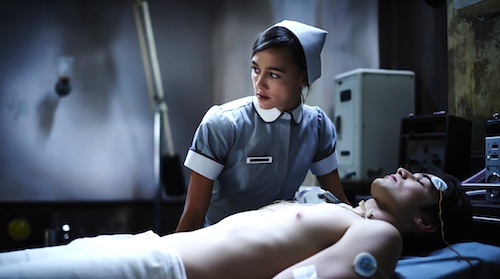
From "Patrick: Evil Awakens."

If not exactly a feminist triumph, the figure of Jacquard is comparatively proactive and You’re Next’s Sharni Vinson’s performance is reasonably assertive. At least she is not sitting around waiting to be a victim. Likewise, former Oscar nominee Rachel Griffiths (for Hilary and Jackie, remember?) pulls off a few well turned character development surprises as the severe Matron Cassidy. As for Jackson Gallagher, you could say he is rather stiff as the title character.

By genre standards, the new Patrick is pretty impressive, featuring a massively moody score composed by Pino Donaggio (probably best known for his work with Brian De Palma and Nicolas Roeg’s Don’t Look Now). Hartley also finds a wickedly funny way to drop in Brian May’s original Patrick theme. It is certainly preposterous at times, but it still works quite well, all things considered. Recommended for horror movie fans and Ozploitation junkies, Patrick: Evil Awakens opens this Friday (3/14) in select theaters.

LFM GRADE: B

Posted on March 13th, 2014 at 7:58pm.