Teddy Roosevelt Gets His Independence Day On: LFM Reviews War of the Worlds: Goliath

By Joe Bendel. You would think if H.G. Wells’ Martians could master space travel and death rays, they could also develop antibiotics. It turns out they have shored up their immunological vulnerabilities and have come back for more in Joe Pearson’s animated feature War of the Worlds: Goliath, which opens in select cities this Friday.

Germs saved our butts in 1899, but the vigilant understand it is only a matter of time before the Martians return for round two. Under the leadership of U.S. Secretary of War Teddy Roosevelt, the multinational A.R.E.S. defense force is formed, employing abandoned Martian technology reverse-engineered by their science advisor, Nikolai Tesla. However, by 1914, tensions in Europe threaten to pull A.R.E.S. apart.

Captain Wells struggles to hold his team together, but he has issues stemming from the first Martian invasion, when he witnessed his parents getting zapped. The IRA also hopes to capitalize on the potential European war, striking the British with advanced weaponry they expect Corporal Patrick O’Brien to steal from A.R.E.S. Obviously, this would be a good time for Mars to attack.

Ordinarily, you do not expect steampunk science fiction with a touch of art deco from a Malaysian animation studio, but here Goliath is, with Teenage Mutant Ninja Turtles co-creator Kevin Eastman on-board as executive producer. While the jaws of its characters could not possibly be any squarer, it creates a surprisingly cool world, where A.R.E.S. battles Martians with era-appropriate biplanes and EVAJaeger-style tripods, the latest model being the titular Goliath, piloted by Captain Wells and his crew.

Frankly, the warfighting scenes are more graphic than you might expect, particularly for those unfortunate enough to get caught in the Martians’ flesh-melting lasers. However, the historical details are sort of clever, including the hotshot Captain Von Richthofen, engaging the Martians’ air support as the ace of A.R.E.S. Wells’ backstory and his relationships with his squad members are a bit clichéd, but Goliath has a real ace in the hole. Any film that features Teddy Roosevelt shooting Martians earns a pass.

Since it exists in an alternate universe, Goliath manages to be both hawkish and internationalist in its galactic world view. The animation might be just a cut above passable (if that), but the world-building details are well thought out. Fans of the Highlander television series will be particularly interested in its voice cast, which includes Adrian Paul, Elizabeth Gracen, and Jim Byrnes (probably best known for Wiseguy), with the latter being a standout as Roosevelt. It is not a classic, but it is fun in an ambitious meathead sort of way. Recommended for fans of H.G. Wells and T.R. looking for an animated distraction, War of the Worlds: Goliath opens this Friday (3/7) in select theaters.

LFM GRADE: B

Posted on March 4th, 2014 at 9:07pm.
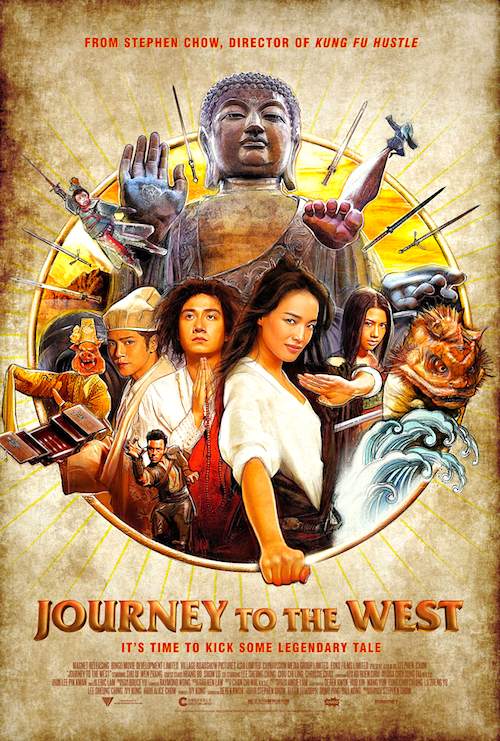
Stephen Chow Unleashes the Monkey King: LFM Reviews Journey to the West

By Joe Bendel. Wu Cheng’en’s classic Ming era novel is a big thick multi-volume work that has inspired many film adaptations drawn from various points throughout its epic time frame. Still, you might not find the exact story of Stephen Chow’s latest comedic spectacle in there, but several of the characters will certainly be familiar. The Monkey King and his fellow demons will tangle with a young and awkward Xuan Zang in Chow & co-director Derek Kwok’s Journey to the West, which opens this Friday in New York.

As a novice demon hunter, Xuan Zang hardly seems likely to reach enlightenment. However, he will do his best to fight the water demon plaguing a provincial fishing village in the go-for-broke opening sequence. While he is more effective than the charlatan that took the first crack at the creature, he is no match for the prowess of Miss Duan, a demon hunter extraordinaire. She does not think much of his use of a collection of nursery rhymes to appeal to the demons’ inner youthful goodness. Nevertheless, she falls for Xuan Zang hard, which confuses the devout Buddhist no end.

While Miss Duan handles the Water Demon with relative ease, KL Hogg (the Pig Demon) turns out to be elusively slippery.  Their pursuit of the latter will bring them into uncomfortably close contact with Sun Wukong, the Monkey King. At this point, all bets are off.

Wen Zhang (recognizable from Ocean Heaven) is appropriately wide-eyed and innocent as Xuan Zang, but the film is completely dominated by Shu Qi. As Miss Duan she shows all kinds of moves and a flair for physical humor we never knew she had in her. Watching her kick demon butt is a sight to behold, but it demonstrates the superior action opportunities for actresses in Chinese language cinema, especially when contrasted with their Hollywood counterpoints.

The prospective Expendabelles film is a case in point, with the embarrassing casting rumors centering around Meryl Streep (all dingos beware). On the other hand, every major Chinese language star takes on action roles throughout their careers, as a matter of course. Recent examples include Gwei Lun Mei in Flying Swords of Dragon Gate, Zhou Xun in the same film, as well as The Great Magician, Michelle Yeoh in nearly all her films, with Reign of Assassins being a recent example, Angelababy in Tai Chi Zero, Ziyi Zhang in The Grandmaster, and Mi Yang in Wu Dang. Now its Shu Qi’s turn and she makes the most of it.

When Shu Qi does her thing, Journey is wildly fun. Nevertheless, Chow did not return to the Monkey King character that made his name and reputation in A Chinese Odyssey just for a quick paycheck. As a reboot/prequel/film-within-the-margins, Journey starts as a massive beatdown and explodes on a cosmic scale, ending with more divine retribution than you will find in the entire Left Behind franchise. The message is simple—do not tick off Buddha.

So you have Shu Qi, a trio of demons, and an apocalyptic showdown. What more could you possibly need?  On the micro level, Ku Huen Chiu’s action choreography is impressively cinematic yet true to Chow’s eccentric aesthetic. On the macro level, Ken Law’s special effects really do not look like anything we have seen before. Plus “pseudo-model”-turned actress Chrissie Chau appears as Miss Duan’s lieutenant, Killer Four, giving her lessons in seduction that go fantastically awry. This is indeed the full assault to the senses Chow’s fans have been waiting for. Recommended with the enthusiasm of a fanboy, Journey to the West opens this Friday (3/7) in New York at the Cinema Village.

LFM GRADE: A-

Posted on March 4th, 2014 at 9:00pm.

LFM’s Jason Apuzzo at The Huffington Post: The Ultimate Southern California Movie: Criterion Restores It’s a Mad, Mad, Mad, Mad World to Its Full Glory

[Editor’s note: the post below appeared yesterday at The Huffington Post.]

By Jason Apuzzo. Sunny southern California rarely gets its due at the movies. Ever since the 1940s, when film noir classics like Double Indemnity and The Big Sleep depicted Los Angeles as a dark urban labyrinth, you might get the feeling that southern California has remained in a permanent Blade Runner nightfall of neon signs, wet streets and detectives pulling fedoras down over their eyes. A world of call girls and corrupt police, of murder and car crashes; a bleak landscape of paparazzi and Black Dahlias, of washed-up actresses and sleazy district attorneys who wear too much aftershave.

It’s a shadowy, sexy and malevolent vision — except that it’s not really the day-to-day SoCal that longtime residents know and (mostly) love. Actually, the place is a lot brighter and more cheerful than that. And a lot goofier.

2014-03-03-MadWorld1.jpg
From "It's a Mad, Mad, Mad, Mad World."

For one thing, southern California is actually huge, wide-open and flat — with endless horizons, whether of the Palm Springs or Redondo Beach variety — instead of the cramped, angular spaces you typically find in crime thrillers. And it’s got color — lots of color, from the saturated blues of the ocean and sky, to the lurid red-and-gold Fatburger signs on Pacific Coast Highway. Whoever dreamt up southern California was clearly dreaming it in 65mm Ultra Panavision Technicolor.

And contrary to popular belief, most people in southern California don’t pack guns or talk like they just stepped out of a Raymond Chandler novel, diverting as that would be. Most SoCal residents are sedate, middle-class people with just a hint of craziness to them — that quiet spark that drove them long ago to pack up and leave the East Coast/Midwest/Deep South to pursue their pot of gold right here in the Golden State.

And this brings us to It’s a Mad, Mad, Mad, Mad World.

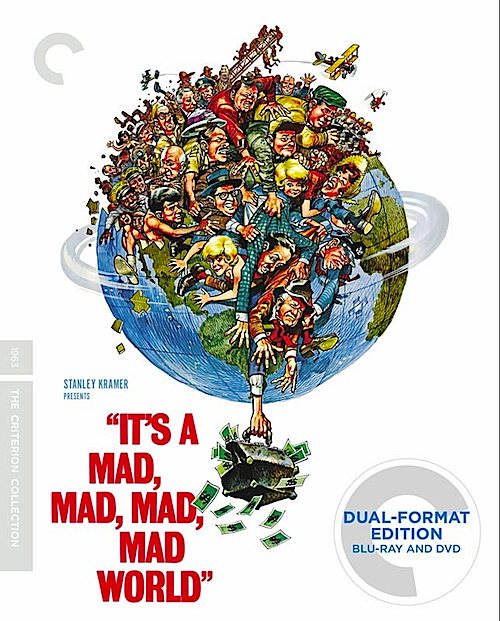
The wonderful folks at Criterion, who are forever saving our cinematic heritage from the ravages of time and neglect, have recently outdone themselves in producing a five-disc set (two Blu-rays + three DVDs) of It’s a Mad, Mad, Mad, Mad World, all built around a pristine 4K transfer of the film and a newly restored 197-minute ‘roadshow’ version of the movie not seen in 50 years. (See a video on the restoration at the bottom of this post.)

And this new, authoritative version of director Stanley Kramer’s beloved epic comedy makes one thing abundantly clear: that It’s a Mad, Mad, Mad, Mad World is the ultimate southern California movie.

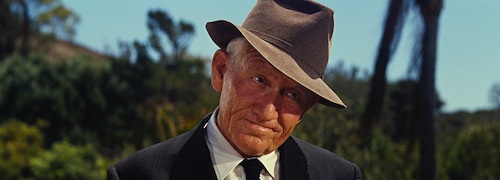
For those unfamiliar with the film, It’s a Mad, Mad, Mad, Mad World depicts a pack of otherwise unremarkable southern Californians unleashed in a frenzy of greed when they learn that a stash of $350,000 in stolen money is waiting for them, ready to be dug-up in a park at Santa Rosita Beach (in real life, Portuguese Bend in Rancho Palos Verdes). Unable to come up with an equitable way of sharing the loot, the group breaks up into separate teams, frantically racing toward their hidden treasure by land and air — comedian Jonathan Winters even rides a girl’s bicycle for a while — all while the Santa Rosita Police, led by Spencer Tracy, tracks their progress.

2014-03-03-MadWorld2.jpg
From "It's a Mad, Mad, Mad, Mad World."

So it’s off to the races, as airplanes smash through billboards (and even a restaurant at one point), cars roar off cliffs and bridges, an entire gas station is demolished, cast members are flung through the air by an out-of-control fire ladder, and every major speed law in southern California is broken. And although the wild conclusion of the film — a Hitchcockian visual effects extravaganza filmed in downtown Long Beach — leaves none of the avaricious group satisfied with their financial arrangement, it does leave everyone with smiles on their faces. (You’ll have to see the movie to find out what that means.)

And that’s really it. The premise of Mad, Mad World — greed — couldn’t be simpler, but it’s enough to power a non-stop, three-plus-hour chase from Yucca Valley to Santa Clarita to Malibu, all filled with dangerous stunts and comic gags performed by the greatest comedians of their time: Milton Berle, the recently passed Sid Caesar, Mickey Rooney, Jonathan Winters, Buddy Hackett, Phil Silvers, Terry-Thomas, Ethel Merman, Peter Falk and Jim Backus, just to name a few. Mad, Mad World also features spot cameos from the likes of Jimmy Durante, Jack Benny, Buster Keaton, Don Knotts, Jerry Lewis, Carl Reiner, The Three Stooges and more comedy talent than you can shake a stick at. Continue reading LFM’s Jason Apuzzo at The Huffington Post: The Ultimate Southern California Movie: Criterion Restores It’s a Mad, Mad, Mad, Mad World to Its Full Glory

LFM’s Govindini Murty & Jason Apuzzo at The Huffington Post: On the Waterfront: Eva Marie Saint and Why the 1954 Best Picture Oscar Winner Is Still a Classic 60 Years Later

[Editor’s Note: The post below appears today at The Huffington Post.]

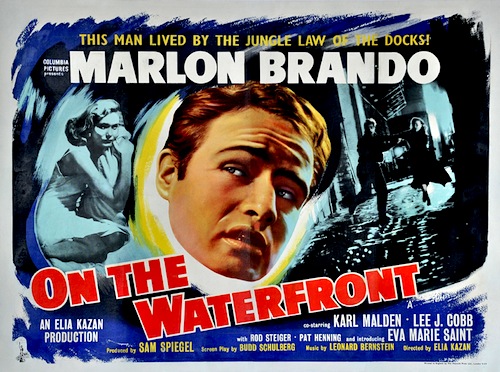
By Govindini Murty & Jason Apuzzo. This year marks the 60th Anniversary of On the Waterfront, the winner of the Best Picture Oscar for 1954. In honor of this weekend’s Oscars, we’re taking a look at what still makes this film such a timeless classic. We had the pleasure of seeing On the Waterfront last year at the TCM Classic Film Festival with star Eva Marie Saint in attendance. It was truly a delight to hear the lovely Ms. Saint talk in person about working with such brilliant talents as Marlon Brando, Elia Kazan, and Karl Malden – and the full interview featuring Ms. Saint’s discussion with Robert Osborne, followed by screenings of three of her films, including On the Waterfront, will air March 31, 2014 on TCM.

For those unfamiliar with the film, On the Waterfront tells the story of Terry Malloy (Brando), an ex-boxer turned longshoreman who struggles with his conscience when a criminal investigation into waterfront crime puts him at odds with a corrupt union boss (Lee J. Cobb) and his own brother (Rod Steiger). Inspired by a tough local priest (Karl Malden), and stirred by a touching, guilt-ridden love affair with Edie Doyle (Eva Marie Saint), Terry eventually turns away from his complicity in waterfront crime and sparks a labor revolt against the corrupt boss.

Embraced by both audiences and critics, the gritty and emotional film was nominated for 12 Academy Awards – eventually winning eight, including the Oscars for Best Picture, Best Actor (Brando), Best Supporting Actress (Saint) and Best Director (Kazan).

Filmed documentary-style in bitter cold on location at the Hoboken docks, On the Waterfront exhibits the kind of earthy realism that many studio-bound productions of the 1950s avoided. As Kazan noted in his autobiography, “[t]he bite of the wind and the temperature did a great thing for the actors’ faces: It made them look like people, not actors – in fact, like people who lived in Hoboken and suffered the cold because they had no choice.”

The film further created a sensation due to parallels between Terry Malloy’s testimony before the film’s waterfront crime commission and Elia Kazan’s controversial appearance before the House Committee on Un-American Activities (HUAC) in 1952, during which he’d been pressured to ‘name names’ of estranged former colleagues alleged to have been communists. Indeed, On the Waterfront in its day not only became a gritty poem of the American working class, but also Kazan’s plea against conformity – both of the communist and McCarthyite variety.

Whatever one thinks of Kazan’s questionable behavior – the true motivation of which remains obscure – the artistry of his film has never been in doubt. Indeed, controversies over the film’s politics have abated in the sixty years since On the Waterfront‘s release, and what remains today is a stark, austere, almost religious masterpiece that derives its strength from the honesty of its emotions – unencumbered by the usual Hollywood trappings of celebrity narcissism, violent action or visual effects.

2014-03-02-OntheWaterfrontposter.jpg

Indeed, seeing On the Waterfront on the Chinese Theatre’s gigantic screen during the TCM Classic Film Festival reminded us again of why simple human truth in storytelling – particularly as conveyed by expressive faces in close-up – is always so compelling. On the Waterfront emerged out of the tradition of documentary realism – standing midway between the Italian Neorealism of films like Rossellini’s Rome, Open City and Fellini’s La Strada that arose out of the ashes of WWII, and the later avant-garde realism of the French New Wave films of Truffaut and Godard. On the Waterfront found the ideal, humanistic point between these two styles, and in the process created its own, uniquely American idiom – one featuring strongly defined, heroic characters, expressive film noir photography, and a poignant clash between group conformity and individual integrity. Continue reading LFM’s Govindini Murty & Jason Apuzzo at The Huffington Post: On the Waterfront: Eva Marie Saint and Why the 1954 Best Picture Oscar Winner Is Still a Classic 60 Years Later

Russians Still Winning, This Time in 3D: LFM Reviews Stalingrad

By Joe Bendel. Those who question Russia’s commitment to sustainability should at least give them credit for recycling their titles. In 1989, Fedor Bondarchuk received one of his earliest acting credits in Yuri Ozerov’s Stalingrad. Twenty-some years later, the thesp-turned-director has helmed Russia’s first film produced entirely in 3D IMAX—and it happens to have the same title. It essentially ends the same way too, but some weird editorial choices distinguish Bondarchuk’s Stalingrad, Russia’s reining box office record holder, which opens today in New York.

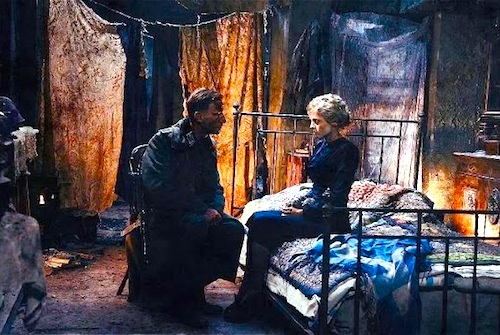
In large measure, Bondarchuk’s Stalingrad is inspired by the heroic exploits of Pavlov’s House, the strategically located apartment complex doggedly defended by Sergeant Pavlov and his men. In this case, it is Captain Gromov and his comrades who have dug into a reinforced tenement right across from pretty much the entire German army. While most civilians have evacuated, the elfin Katia has defiantly remained, to stoke jealousy amongst Pavlov’s men and to give them something personal to fight for.

A few steps away, Captain Peter Kahn is tasked with crushing all pockets of Russian resistance. However, National Socialist war atrocities have dampened the Prussian elitist’s morale. He is more concerned with Masha, another Russian women stuck in the wrong place at the wrong time. In the tradition of bodice rippers, he initially “ravishes” her, but then starts to fall in love with the Russian beauty. She also seems to warm to him as a protector, but fears for the consequences if and when the Soviets expel the Germans.

Perhaps the weirdest element of Bondarchuk’s film is the framing device, in which a Russian emergency responder tells a group of Germans trapped in the rubble of the Tōhoku earthquake how his mother met his five fathers during the siege of Stalingrad, because nothing is more reassuring than episodes from the bloodiest battle in human history. Dude, next time, don’t help. Frankly, the way the film exploits Japan’s 3-11 tragedy would be deeply offensive, if it were not so ludicrous. Seriously, Russian rescue workers digging out Germans in Sendai?

On the plus side, Bondarchuk makes stuff blow-up really well. Obviously, he did not intend to waste his blank check in the IMAX store.  He devises all sorts of dramatic perspectives on the action, while vividly capturing a sense of the claustrophobic nature of close quarters fighting. He is also either surprisingly fair to the Germans or simply lets Thomas Kretschmann run circles around the rest of the cast as the ethically nuanced Kahn.

From "Stalingrad."

Frankly, he represents the film’s most believably complicated character and develops some powerfully ambiguous chemistry with Yanina Studilina’s Masha. In contrast, Gromov and the other four fathers are all either colorless Reds or borderline war criminals. Either way, they make little lasting impression. It almost makes a viewer wonder if Bondarchuk set out to be deliberately subversive.

It seems unfathomable that a Russian WWII epic can make audiences sympathize with the Germans. Yet, if you close your eyes and think of Stalingrad a few days after taking it all in, it will be Krestchmann and Studlina whom the mind’s eye will recall. Nevertheless, Russia duly submitted Stalingrad as its official foreign language Oscar contender. Perhaps it is still preferably in Russia to declare a dubious victory than admit an obvious defeat. Sort of recommended in a confused way for those who appreciate battlefield spectacle, Stalingrad opens nationally today (2/28) including in New York at the AMC Empire and Lincoln Square theaters.

LFM GRADE: B-

Posted on February 28th, 2014 at 11:26am.

Naughty Coffee Klatching: LFM Reviews Venus Talk

By Joe Bendel. Some critics will reflexively compare this Korean relationship drama to that old HBO show that ended its run a decade ago. However, the three stars of this import were secure enough to allow a cameo appearance from BoA, the young and glamorous “Queen of Korean Pop.” In fact, the forty-something cast looks considerably younger than their long-faced American forerunners. They will still inevitably mismanage their private lives in Kwon Chil-in’s Venus Talk, which opens in select theaters today.

Frankly, this trio of friends is not so interested in talking, but they have to do something when they meet for brunch at Hae-young’s coffee shop. She is a single mother with a grown daughter she can’t get out of the house and the best boyfriend of the bunch. Sung-jae is mature, sensitive, and handy around the house, but harbors been-there-done-that feelings about marriage. Mi-yeon appears to be happily married, but her demands will put a strain on her relationship with her Viagra-bootlegging husband, Jae-ho. Shin-hye is more interested in her work as a television producer than any sort of romance, but a drunken fling with Hyun-seung, a much younger colleague, complicates her carefully calibrated career.

Into these lives great turmoil will fall, but they always stick together—after a bit of judgmental cattiness. Sure, you probably suspect where Kwon and screenwriter Lee Soo-a are headed and have a pretty good idea how they will get there, but it must be said Venus is surprisingly fair to the guys. Frankly, the women are at least as responsible for their relationship angst and their partners, if not more so. This is particularly true in the case of Mi-yeon and the woefully cringey Jae-ho.

While never explicit, Venus is rather saucy, especially by the standards of Korean cinema. Not for no reason, most of the more suggestive scenes feature the photogenic Uhm Jung-hwa and Lee Jae-yoon as the impressively fit Shin-hye and Hyun-seung, respectively. They have okay chemistry together and Uhm nicely mixes attitude and professionalism in her straight forward dramatic scenes.

Yet, Cho Min-su once again steels the picture in a complete change of pace from her soul-shattering turn in Kim Ki-duk’s bracing Pieta. As Hae-young, she brings more dignity, forgiveness, and general humanity to Venus than you would ever expect to find in a cougar-ish chick flick. In contrast, Moon So-ri is stuck with the least sympathetic and most over-the-top of the lot, but she fully commits to the voracious Mi-yeon nonetheless.

There have been films like Venus before and there will be plenty more like it to come. Even so, it is a credit to Kwon, Uhm, and Cho how smooth it goes down, especially for those who do not have a strong affinity for the genre. It is well executed, but never pushes the envelope of women-centric relationship dramas. Mostly recommended as a women’s-night-out movie, it opens today (2/28) in Honolulu at the Consolidated Pearlridge and in Vancouver at the Cineplex Silvercity.

LFM GRADE: C+

Posted on February 28th, 2014 at 11:18am.