Koontz’s Cook Finally Makes it to the Big Screen: LFM Reviews Odd Thomas

By Joe Bendel. This Dean Koontz protagonist is not shy when it comes to voice-over narration, but never exactly breaks the fourth wall, per se. He is probably entitled to his own eccentric commentary, considering he has the ability to see ghosts and bodachs, supernatural parasites that feed on fear and suffering. However, his greatest nemesis might be lawyers, given the legal wrangling that long delayed the release of Stephen Sommers’ Odd Thomas, which finally opens in New York this Friday.

Thomas comes from crazy stock and therefore understands the need to keep his dubious gift secret. Only a handful of people know of his power, including Pico Mundo’s chief of police Wyatt Porter, who appreciates the sort of inside information Thomas can provide. His loyal girlfriend Stormy Llewellyn is also in on the truth and a few of their friends vaguely suspect he has the Shine.

Normally, he chases down workaday serial killers before they can murder again, like his former classmate Harlo Landerson from the film’s prologue. However, the alarming number of bodachs converging on Pico Mundo portends a tragedy of grander scale.  They seem particularly interested in “Fungus Bob” Robertson, so dubbed by Thomas and Llewellyn because of his unfortunate grooming habits. Robertson also has an unhealthy interest in Satanism and a couple of mystery friends. Thomas will try to sleuth out Robertson’s plans without alerting the bodachs to his uncanny powers of perception, because they do not take kindly to folks like Thomas.

Frankly, the first half of Odd Thomas feels like a ghost-hunting TV show from the 1980’s, with its quaint small town setting and Thomas’s wholesome courtship of Llewellyn. However, as the stakes and tension start to rise, the film becomes considerably darker. Sommers (best known for The Mummy and G.I. Joe franchises) pulls off some third act sleight-of-hand surprisingly adroitly and the manner in which earthly cults intersect with paranormal malevolence is somewhat intriguing.
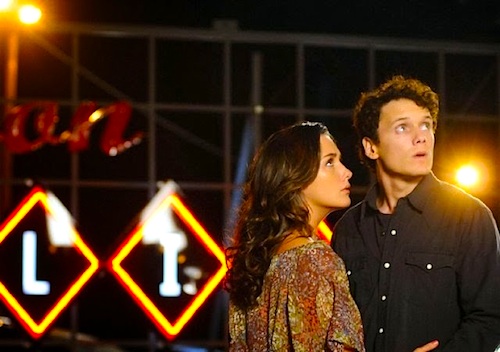
From "Odd Thomas."

Still, Anton Yelchin and Addison Timlin are almost too cute and freshly scrubbed-looking as Thomas and Llewellyn. Frankly, Sarah Michelle Gellar’s Buffy was much edgier, notwithstanding the characters’ dark backstories in the Koontz source novel. Still, Odd Thomas has the distinction of featuring Willem Dafoe as an unqualified good guy, without even the hint of moral compromise, perhaps for the first time since Triumph of the Spirit. He is actually not bad plodding along with all due decency as Chief Porter.

Arguably, the biggest issue for Odd Thomas is the lack of a strong villain. Broadway actor Shuler Hensley is game enough as Robertson, but the character is played more for yucks than scares. Likewise, the bodach effects are serviceable enough, but not especially memorable.

When watching Odd Thomas one can see how it probably works so much better as a novel. There is some pop at the end that presumably has even more kick on the page. Yet, the film as a whole has the feel of an extended pilot that it never shakes off. Better than you might expect, but still better suited to the small screen, Odd Thomas finally opens this Friday (2/28) in New York.

LFM GRADE: B-

Posted on February 25th, 2014 at 10:10pm.
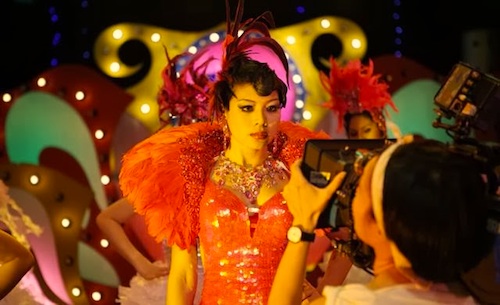
LFM Reviews Karaoke Girl @ The 2014 San Francisco Indie Fest

By Joe Bendel. Before New York’s disgraced former congressmen and governors embark on their next vice tour of Thailand, they ought to give some thought to the women working in Bangkok’s redlight district. Sa is one of them, but the extent of her nightclub work is kept somewhat ambiguous in Visra Vichit-Vadakan’s docu-fiction hybid Karaoke Girl, which screens during the 2014 San Francisco Indie Fest.

Sa Sittijun essentially plays herself, a pure-hearted country girl, who came to the city to provide for her family. Initially, she really did work in a factory, but when it closed she was forced to take a hostess job in a karaoke bar. Of course, her family still thinks she is cracking eggs on the assembly line. It is probably more tiring work at the club, requiring constant maintenance. Due to the late hours, Sa also often has close contact with dodgy sorts. In fact, crime is a very real occupational hazard.

Despite all the hardships she endures, Sa gives alms with great frequency. She also sends money home quite regularly and returns periodically to drag her ailing father to the doctor. In short, she deserves better than the lot she drew in life, most definitely including her unreliable lover, Ton. One can only hope the Thai release for Karaoke and its success on the international film festival circuit will lead to better things for Sittijun.

Clearly, Vichit-Vadakan had up close and personal access to Sittijun’s life (or at least a revealing approximation of it). Yet, since she mostly avoids the lurid aspects of the redlight business, it does not feel as intrusive as it might. Instead, we come to understand “bar girls” must spend time on their laundry and pursue problematic relationships, just like everyone else.

From "Karaoke Girl."

Frankly, Karaoke is the sort of visually arresting docu-straddler These Birds Walk was supposed to be, but fell short of. For one thing, Sa is a far more engaging (and even sympathetic) focal character. Also, the rural backdrops and nocturnal city scenes are considerably more striking than Birds’ visuals. Great credit is due to co-cinematographers Chananum Chotrungroj and the American executive producer, Sandi Sissel (whose credits also include Salam Bombay) for maintaining an intimate focus on Sa, but still capturing a powerful sense of place.

No matter how much of her actual life is reflected on screen, Sittijun expresses a whole lot of emotional truth. Quiet but powerful, with a surprisingly spiritual dimension, Karaoke Girl is recommended for all those concerned with the condition of working women (broadly defined) in the developing world. It screens at the New Parkway Theater (in Oakland) this Thursday (2/20) as part of this year’s SF Indie Fest.

LFM GRADE: B+

Posted on February 18th, 2014 at 9:08pm.

LFM Reviews Beijing Love Story

By Joe Bendel. Beijing is a lot like New York. It is a tough city, but you can still find some wildly romantic backdrops there. Five couples of varying ages and degrees of matchedness will go through love’s ups and downs all over the Chinese capital, as well as during a romantic side-trip to Greece in Chen Sicheng’s Beijing Love Story, which opens tomorrow in New York.

Unlike his married boss Wu Zheng, Chen Feng is a decent enough guy. Unfortunately, he does not have much money or legal Beijing residency. Nonetheless, the outrageously cute Shen Yan still falls for him at a hipster singles’ party. Can their romance survive the pressures of money woes and a surprise pregnancy? Her wealthy ex and the painful in medias res opening say no, but viewers should not put too much stock in either.

Meanwhile, Wu’s tomcatting is about to catch up on him. Somewhat disappointed by his lack of faithfulness, his wife Zhang Lei tries to take a page from his playbook, possibly complicating the life of her boss and platonic friend, Liu Hui in the process. He has an assignation of his own to worry about. He is meeting his mysterious mistress, Jia Ling, for a weekend in Greece. Since the two lovers are played by “Big Tony” Leung Ka Fai and Carina Lau, you would expect things to heat up here and they do.

Liu will play Jia’s games in Greece, but he is always serious about being Liu Xingyang’s father. However, she is rather upset with him, because he will not allow her to appear on a national talent show with her string ensemble. Smitten Song Ge is happy to lend a sympathetic ear and maybe even her transportation money if he can earn enough from after school jobs and maybe borrow some from his grandfather, “Old Wang.” Of course, Wang has his romantic difficulties as well. His cousin keeps fixing him on with blind dates, but his heart is never in it, even with a recently returned expat, who should be well out of his league.

Without question, Beijing works best when it follows the Liu family. Leung and Lau have scorching chemistry and the Greek locale inspires the film’s most visually stylish sequences. In contrast, the innocence and exuberance of Song’s courtship of Liu Xingyang is like a breath of fresh cinematic air. As teenaged Liu and Song, Nana Ou Yang and Liu Haoran come across like good kids at heart, but with massive screen presence.

From "Beijing Love Story."

The other interrelated couples are not necessarily dead weight, but they do not deliver the same satisfaction. Frankly, Yu Nan is absolutely terrific as the wronged Zhang, but her storyline functions more as a transition from Chen & Shen to Liu & Jia than as a fully developed arc in its own right. Wang Qinxiang is also surprisingly moving as Old Wang, but Chen really pulls out the manipulative stops for the closer. He also shows big city Beijingers at their most annoying during the initial tale of his namesake (played by the writer-director). Tong Liya’s Shen has all kinds of charisma, but there is only so much she can do for this underwhelming slacker love story.

It is not often we have a Valentine’s appropriate film to recommend for February 14th, but this year we have one. Based on Chen’s hit television series of the same name, Beijing Love Story hits more ambiguous notes than viewers might expect, but that is a good thing. Ultimately, it is the veteran superstars (Leung and Lau) and the ridiculously young looking stars of the future (Nana Ou Yang and Liu Haoran) who really sell it. Recommended for Valentine viewing, Beijing Love Story opens tomorrow in New York at the AMC Empire, from China Lion Entertainment.

LFM GRADE: B

Posted on February 13th, 2014 at 12:21pm.

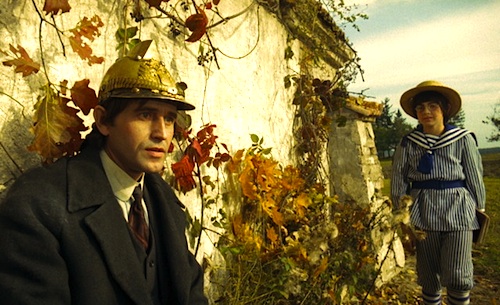
LFM Reviews The Hourglass Sanatorium, Presented by Martin Scorsese

By Joe Bendel. Smuggling a censored film was a trickier proposition in 1973. Instead of a flash drive, you had to schlep cans of film. Nevertheless, Wojciech Has managed to convey his banned, mind-bending prestige production to Cannes, where the jury led by Ingrid Bergman awarded it the Jury Prize. While never explicitly political, it is easy to see why Has’s The Hourglass Sanatorium would be too much for a risk averse Communist apparatchik to countenance when it screens as a handpicked selection of Martin Scorsese Presents: Masterpieces of Polish Cinema, hosted by the Film Society of Lincoln Center.

Based on the novel and short stories of Bruno Schulz, Hourglass is never intimidated by the constraints of narrative. Józef is traveling to a remote sanatorium, where his lower middle class merchant father Jakub is a patient. Actually, his father is already dead everywhere else except the decaying sanatorium. Within the crumbling walls, the randy inattentive staff apparently has the power to roll back time to a point where his father is still living. Through the strange power of the sanatorium, Józef is able to revisit his past through his subconscious (or vice versa) for a series of chaotic encounters with his sort of late father. Or something like that.

You could debate just what Hourglass is until the cows come home, but no way, no how is it Socialist Realism. Meaning that densely ambiguous spells nothing but trouble for a professional censor. To make matters worse, Has chose not to soft pedal the main characters’ Jewish heritage while the Polish Communist Party was still engaged in its campaign of anti-Semitic purges. At times, Has even evokes images of the Holocaust, even though the work of Shulz (himself a fatal victim of National Socialism) predated WWII.

From "The Hourglass Sanatorium."

Good for Berman for digging Hourglass. It will not be to everyone’s tastes. However, it is visually stunning. The depth of vision Has employs with his swooping camera is truly dizzying. It might be heresy to suggest, but Hourglass could be that rare classic worth giving the 3D fixer-upper treatment. Ironically, the film authorities clearly opened the coffers during the production stage. The work of art director Andrzej Halinski is absolutely baroque, even decadent in an evocatively decayed way. Viewers may well wonder if Hourglass was an early influence on a young Tim Burton or Terry Gilliam.

Hourglass is an auteur’s film in just about every way, rather than an actor’s showcase. It is dashed difficult to forge an emotional connection with the audience amid all the trippiness, but at least Jan Nowicki looks convincingly lost as Józef.

Undergarments are rather loose in Hourglass, so parents should be strongly cautioned. More to the point, it is sure to raise questions with no objective answers. This is definitely high-end cult cinema, but those who appreciate extravagant set pieces and dark fantasyscapes will dive into the experience. Recommended for the adventurous and literarily inclined, The Hourglass Sanatorium screens this Friday (2/14) and Sunday (2/16) at the Walter Reade Theater, as part of Martin Scorsese Presents: Masterpieces of Polish Cinema.

LFM GRADE: B+

Posted on February 10th, 2014 at 12:28am.

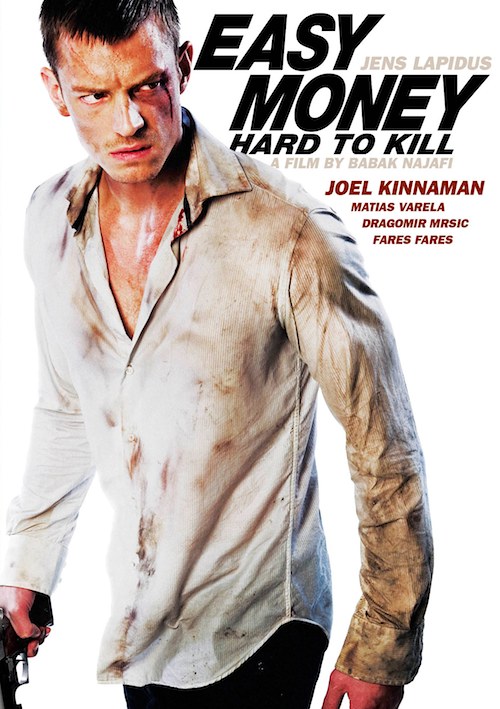
LFM Reviews Easy Money: Hard to Kill

By Joe Bendel. When on work release, convicted cocaine smuggler Johan “JW” Westlund seizes the opportunity to get back to “work.” This was not always his world, but he will find there is no going back to the upright, respectable existence he once led in Babak Najafi’s Easy Money: Hard to Kill, which opens this Friday in New York.

There were a lot of casualties at the end of the first Easy Money film, but somehow Mrado Slovovic survived, despite being run-over by a car and shot at close range by Westlund. One might expect the wheelchair-bound hitman to hold a grudge, but he and Westlund bond when they become cellmates. It must be all that shared history. Once a promising business student, Westlund lent his analytical skills to an up-and-coming coke syndicate to subsidize his extravagant lifestyle. In retrospect, it was not such a great plan for the future. Trying to go straight, Westlund develops a game-changing stock-trading program, only to find during his first furlough his so-called partner has double-crossed him.

Slightly put out, Westlund chucks in the work-release song-and-dance, arranging to break Slovovic out instead. He might be paraplegic, but Slovovic is still one bad cat. He also knows the daily routine of the Serbian mob’s unassuming money launderer. While they work on their hasty caper, small time South American trafficker Jorge and lowly Lebanese enforcer Mahmoud are also making their desperate plays for survival. Naturally all three alumni from the first film will come together in some fashion during the third act.

Viewers should be able to readily follow Hard to Kill even if they did not see the franchise opener, but the constant parade of faces that are supposed to be familiar will be more rewarding to those who have. Regardless, HTK is slick, stylish, and strangely multicultural, but hardly in a way that embraces global fellowship. This is not a film that will have you humming “It’s a Small World,” but it might scare you straight, unless you live in Colorado, where these sorts of things are practically legal.

Joel Kinnaman, the star of AMC’s The Killing and the RoboCop reboot so coincidentally opening just before HTK, is suitably flinty as Westlund, but Dragomir Mrsic out hardnoses everyone as Slovovic, while still expressing his acute disappointment in himself as a father. Likewise, Fares Fares makes a compelling sad sack as the luckless Mahmoud.

Since Easy Money: Life Deluxe has already released in Sweden, it is a safe bet anyone who survives the second cut will be back to try their luck a third time. HTK does not break a lot of new ground, but the intriguing relationship that develops between Westlund and Slovovic elevates it above more routine Scandinavian crime dramas. Recommended for those who enjoy gangster films with healthy doses of violence and irony, Easy Money: Hard to Kill opens this Friday (2/14) in New York at the Cinema Village.

LFM GRADE: B

Posted on February 11th, 2014 at 12:19am.

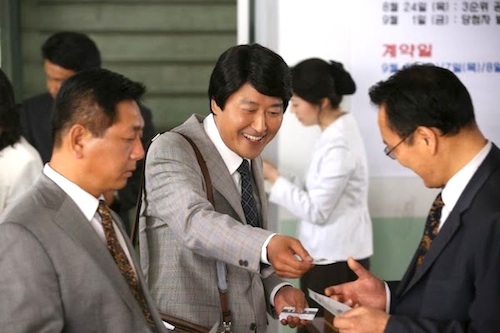
He Also Does Taxes: LFM Reviews The Attorney

By Joe Bendel. Depending on who you ask, the late ROK President Roh Moo-hyun was either a principled idealist or a corrupt demagogue. A new film unequivocally holds to the former view. A thinly fictionalized Roh will argue a life-altering, inspired-by-true-events case in Yang Woo-seok’s The Attorney, which opens today in New York.

Even though he never graduated from high school, Song Woo-seok became a self-taught bar-certified attorney (sort of like Lincoln). He even briefly served as a judge, but resigned to pursue a more lucrative practice, for the sake of his family. Recognizing an early opportunity, Song becomes one of the first to take advantage of a legal change allowing attorneys to register property deeds in place of a notary. At first, the legal establishment is openly contemptuous of the bounder. Then the business starts pouring in.

Eventually, other attorneys started competing for Song’s real estate business, so Song once again makes a shrewd move into a tax practice. Ironically, when the paper-pushing Song finally litigates a case, the fix is in right from the start. In acknowledgement of a debt from his early scuffling years, Song reluctantly agrees to represent Jin-woo, the son of a forgiving noodle shop proprietor. Unfortunately, this is no ordinary criminal case, but a dubious national security prosecution, with confessions already lined up courtesy of the ruthless Captain Cha Dong-young.

When it gets down to political business, The Attorney is certainly not shy about waving the bloody martial law shirt. However, the first half of the film is actually a rather touching story of hard work and sacrifice rewarded, in the tradition of The Pursuit of Happyness. Song Woo-seok (a fusion of the director and star’s names) is an earnest everyman, who earns his piece of the pie the old fashioned (but unfashionable) way.

Of course, once the sainted Soon-ae’s son is arrested, The Attorney shifts into high moral outrage gear. Korean box office superstar Song Kang-ho leaves it all on the field as his half namesake, wringing all the righteous indignation and heroic sincerity he can out of the courtroom cross examinations. At least Yang and co-writer Yoon Hyun-ho step back from the Few Good Men, acknowledging an experienced government employee like Cha will never cop to ordering a “Code Red” on the stand.

From "The Attorney."

Fans of Song Kang-ho, Korea’s top domestic movie star, should probably seek out The Attorney, despite its excesses, because there is no telling how much of him will be left once Harvey Weinstein finishes editing Bong Joon-ho’s Snowpiercer with a hacksaw. Yet, it is veteran actress Kim Young-ae who really instills the film with dignified sensitivity as honorable gravitas as Soon-ae. It is also amusing to see Oh Dal-su (Oldboy’s sleazy private prison warden) do his shtick as Song-Woo-seok’s sitcomish office manager. Unfortunately, Kwak Do-won (a great villain in A Company Man) largely phones in Cha, the cold fish.

In a way, The Attorney sort of confirms the theory that political liberty inevitably follows economic liberty. After all, Song Woo-seok sure is busy with real estate transactions in the early 1980’s. While the performances are mostly quite impressive, it never really captures the telling period details. Without the narrative reference points, viewers might mistake it for a contemporary legal drama. While it is sure to stoke political debate in Korea, The Attorney is only recommended for American viewers with a crack cocaine level addiction to legal table-pounding melodramas when it opens today (2/7) in New York at the AMC Empire.

LFM GRADE: C+

Posted on February 7th, 2014 at 3:28pm.