Vengeance is Shohei Imamura: LFM Reviews Black Rain

By Joe Bendel. These days, fifty-five is a relatively young age to pass, especially for a former pop idol. For the family and fans of Yoshiko Tanaka, it would be a tragic case of symmetry. Justly lauded for her role as a “hibakusha” Hiroshima survivor, Tanaka succumbed to cancer in 2011. Although not exactly the sort of wrong-side-of-the-tracks noir that made his early reputation, Shohei Imamura’s Black Rain made a fitting capstone to the Asia Society’s Vengeance is Imamura retrospective when it screened this past weekend.

Yasuko was not in Hiroshima proper when the bomb was dropped, so she should be unaffected by “the flash.” However, she was caught in the “black rain” during the immediate aftermath. Despite her beauty, that is enough for most parents to put the nix on inquiries from her marriage broker.

Frankly, her matchmaking woes are more painful for her uncle Shigematsu Shizuma and his wife Shigeko. They had taken their niece into their home for safe keeping during the waning days of the war, promising to arrange her betrothal. Her potential old maid status grieves them personally and represents a potentially loss of face with their family and ancestors. Yet, as Yasuko’s prospects dim, she becomes increasingly devoted to the ailing Shizumas.

Imamura served an early apprenticeship with Yasujiro Ozu, so it is not so surprising to see his mentor’s influence imprinted on Rain. Like many of Ozu’s signature films, which focus on fathers and daughters or uncles and nieces, Rain is defined by the relationship between Yasuko and old man Shizuma. The way their bond steadily deepens is absolutely beautiful and agonizing to behold.

From "Black Rain."

As Yasuko, Tanaka is exquisitely beautiful, profoundly moving, and in retrospect, sadly eerie. Likewise, Kazuo Kitamura is a wonderfully complex figure of strength and pathos. Their screen rapport is real and affecting.

Rain is also impressive on a technical level, vividly recreating the chaos and destruction of Hiroshima. Nevertheless, it is a far cry from an Irwin Allen picture. It is also worlds removed from Ridley Scott’s Black Rain, which was also partly set in Japan and released in the same year. However, it makes much of the criticism leveled at The Wind Rises look largely misplaced. While Miyazaki’s animated feature addresses the repressive tactics of the militarist government’s secret police, Black Rain presents the Japanese war experience entirely in terms of passive victimhood. Yet, its overt anti-nuclear sentiments earn it a pass. Regardless, Black Rain is a mature and engrossing work from a master filmmaker. Highly recommended, it concludes the Vengeance is Imamura series tonight (2/1) at the Asia Society.

LFM GRADE: A-

Posted on February 4th, 2014 at 12:36am.
Talking Through the Apocalypse: LFM Reviews After the Dark

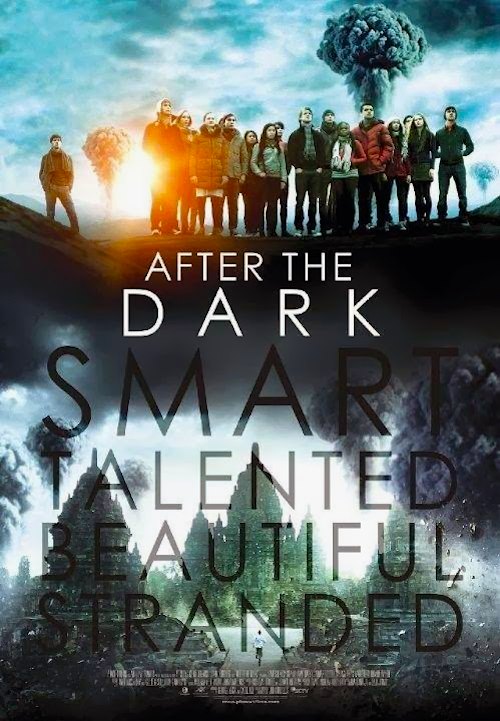
By Joe Bendel. In most lifeboat scenarios, it is women and children first. That is not necessarily the case for the hypotheticals one philosophy class will grapple with. Logic will be the first thing thrown over the side in John Huddles’ After the Dark, which opens this Friday in select theaters.

The elite philosophy class of Jakarta’s western school for wealthy expats is a little put out having to do work on the final day of class, but Mr. Zimit is playing hardball with their grades. They will each draw a profession from his box and then vote on who gets a place in the bomb shelter. There are twenty of them and enough air and provisions in the bunker for ten.

As their “thought experiments” play out, we see the survivors interacting, like rats trapped in a cage, but since they are all just jawing back in their Jakarta classroom, where is all this melodrama coming from? It gets rather puzzling at times as when, for obvious reasons of jealousy, Zimit decrees James, the just-getting-by boyfriend of his prized pupil Petra, shall hence forth be gay. To be true to himself, James subsequently starts sleeping with the class’s token gay Adonis in bunker world. That drives Petra into the bunker-arms of Zimit, which in turn disturbs James because he always had a bad feeling about that guy. Frankly, it would be much more interesting to see how that could possibly come out in a classroom conversation than to sit through the dramatic representation.

Dark’s basic premise is intriguing, but the execution is a logical shipwreck, starting at the top with Mr. Zimit. Supposedly he wants his students to think like philosophers, but it is more like he is training them to be actuaries. You’re a gelato maker—sorry not much earnings potential there. In a running gag, Zimit summarily executes the poor shmuck stuck being the poet before selection even begins, because he so obviously lacks utility. Really, that is what a philosophy teacher thinks of poetry? I put it to you Mr. Zimit, any philosophy instructor who neglects the age old philosophic study of aesthetics is a substandard teacher who therefore must relinquish his role in deciding who will live and who will die.

Regardless, Sophie Lowe is surprisingly good as Petra, the sensitive smartie. The whole class is ridiculously attractive, but the girls generally sound more convincingly like members of a gifted-and-talented class than the meathead guys. Yet, the film’s real trump card is the Indonesian locales who add a distinctively surreal wtf-ness that helps forestall all the questions regarding logical inconsistencies.

Have you ever woken up at night with what feels like a brilliant idea, but thought otherwise once you read your scribbled notes in the morning? That probably happened to Huddles, except he still thought it was a fine notion and proceeded to film it. There is a germ of something here, but he should have given his subconscious more time to kick it around. However, Russian audiences evidently disagreed, making it a surprise box office champion over several studio films, which is impressive considering its relatively sympathetic gay character probably makes it illegal under Putin’s “homosexual propaganda” law. A head-scratcher all the way around, After the Dark releases in select theaters and on VOD this Friday (2/7).

LFM GRADE: C

Posted on February 4th, 2014 at 12:33am.

LFM Reviews 2014 Oscar Nominated Live Action Shorts

By Joe Bendel. If you are looking for a unifying theme among this year’s live action short film Oscar nominees, several address the responsibilities of parents and the extent to which the wider society can complement or replace the family unit. Of course, there is also the ringer that cannot be shoehorned into a handy rubric. All five nominees screen as part of the annual showcase of Academy Award nominated shorts, which opens today at the IFC Center in New York.

Frankly, Sini and Jokke are not bad parents. They are just kind of a mess in Selma Vilhunen’s Do I Have to Take Care of Everything? Nearly over-sleeping an important wedding, they still manage to schlep their two young daughters over to the chapel, despite a series of minor disasters. Everything is pleasant and amusing, but only an inch deep and seven minutes long.

In contrast, Esteban Crespo’s That Wasn’t Me seems to expect a round of applause just for dramatizing the child-soldier issue. Married Spanish doctors have come to an African war zone as part of a humanitarian mission, but their safe passage documents do not impress one warlord. The horrific crimes that follow will be done at his behest by young orphans pressed into his so-called army. Discussing his crimes after the fact, one former child-soldier explains how the guerilla commander exploited their need for a sense of family and belonging.

There are scenes in TWM that are genuinely shocking. While it serves as a timely reminder of the appalling lack of human rights throughout the continent, the film feels rather programmatic, like a calculated statement rather than a fully realized drama in its own right.

When it comes to pulling on heartstrings, none of the shorts can compete with Anders Walter’s Helium, but earns its sentiment through honest hard work and artistry. Alfred’s parents are caring and conscientious, but that cannot change the fact he is dying of a terminal disease. His mother constantly tells him he is going to Heaven, but the harps and white robes do not do much for him. Enzo, the clutzy new janitor, has a better conception.

Reminded of his late kid brother, who also shared a love for zeppelins and Jules Vernish hot air balloons, Enzo starts telling Alfred about the world of Helium, a steampunk-Boy’s Life alternative to Heaven. For a while, Enzo’s vision of Helium lifts the boy’s spirits, but his body soon takes a turn for the worse. Helium’s animated fantasyscapes are quite richly rendered, bringing to mind about the only part of the What Dreams May Come movie that actually worked. However, it is the chemistry between Casper Crump, Pelle Falk Krusbæk, and Marijana Jankovic as Enzo, Alfred, and his understanding nurse that really lowers the boom in Helium. Despite the melodramatic aspects, viewers will feel moved rather than manipulated.

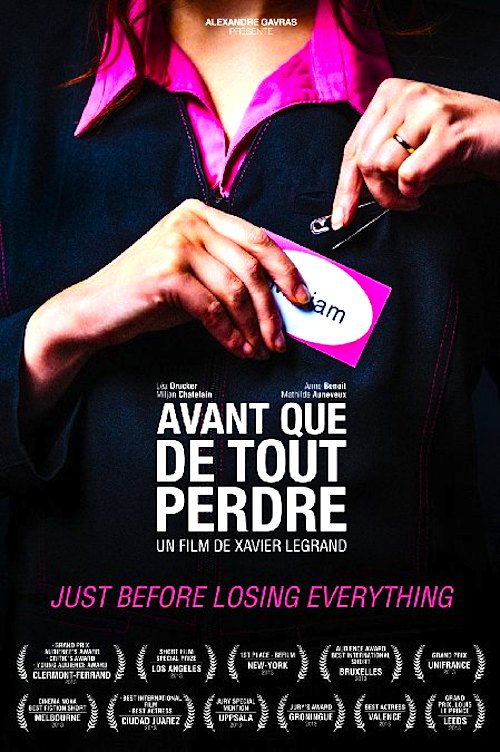
There is also some pretty raw emotion in Xavier Legrand’s Just Before Losing Everything, which is arguably the best of this year’s live action nominees. Miriam is a battered wife, who has finally decided to leave her husband. However, it will not be a simple matter of walking out the door. She must bundle up her kids and collect what money she can from the job she must leave behind. Everyone at her Tesco-like superstore is sympathetic, but uncomfortable and unsure how far they can go to help. Then her husband shows up looking for the checkbook.

If Helium boasts the strongest ensemble of this year’s nominations, Losing features the single strongest performance from Léa Drucker as Miriam. We so get all her fear, vulnerability, and misplaced shame. Instead of yelling “look at me,” it is work that hits you in the gut.

As the odd man out, Mark Gill’s BAFTA nominated The Voorman Problem tells a self-consciously clever tale of an emotionally disturbed prison inmate who thinks he is the almighty and the nebbish shrink sent to evaluate him. There is witty bit of business involving Belgium, but the ironic payoff is forced and perfunctory. Nonetheless, co-star Martin Freeman has helped generate scads of revenue for the industry as Bilbo Baggins in the Hobbit trilogy and Watson in BBC/PBS’s Sherlock, so Voorman might have the inside track with the Academy.

In terms of tone and overall quality, this year’s live action field is less consistent than their animated counterparts. Still, it is well worth seeing for Helium and Just Before Losing Everything, which account for over half the program’s running time. They introduce some international talent worth keeping an eye on. Recommended accordingly, the nominated live action showcase opens today (1/31) at the IFC Center.

Posted on January 31st, 2014 at 2:04pm.

LFM Reviews 2014 Oscar Nominated Animation Shorts

From "Possessions."

By Joe Bendel. Was man free in his original state of nature? Are we enslaved by our stuff? Several of this year’s Oscar nominated animation shorts lend themselves to such Rousseauean questions. There is also a Disney Film (not included in the media screenings) to contend with. Regardless, all five nominees and a few additional short films of note will screen as part of the annual showcase of Academy Award nominated shorts, which opens today at the IFC Center in New York.

Amid the international field, the clear standout is Shuhei Morita’s Possessions, a lush supernatural fable in the tradition of Kwaidan. It is a dark and stormy night in Eighteenth Century Japan. A weary traveler seeks shelter in a shrine, only to find himself in a supernatural repository for broken objects that hold a “grudge.” Fortunately, the man is both handy and spiritually sensitive.

Morita’s richly detailed animation is strikingly elegant, yet it has an appropriate macabre undertone. Possessions evokes scores of classic Japanese movies, but there is also something strangely moving about it. Completely satisfying, it deserves the little gold statuette, but other nominees might be more to the Academy’s tastes.

Clearly, the BBC produced adaptations of Julia Donaldson’s children’s books appeal to many Oscar voters’ sensibilities, since The Gruffalo was nominated in 2011. In the case of Max Lang & Jan Lachauer’s Room on the Broom, a witch’s broomstick and the freedom of movement it represents to a swelling menagerie of forest creatures is the object driving the action. Given its wholesome quality animation and brains-over-brawn themes, Broom is likely to be most parents’ favorite of the showcase. It also boasts the strongest celebrity interest, featuring the voice talent of Gillian Anderson, Rob Brydon, and best supporting actress nominee, Sally Hawkins.

Parenting is a more problematic proposition in Daniel Sousa’s Feral, a dark Kaspar Hauser fable about a boy reintroduced into human society after spending his formative years living with the wolves. Visually, Sousa’s black-and-white animation is starkly powerful, but its extreme stylization keeps viewers at arm’s length emotionally. Nevertheless, it is an accomplished work that should make an impression on animation connoisseurs.

The agoraphobic titular protagonist of Laurent Witz’s Mr. Hublot (co-directed by Alexandre Espigares) might also learn something about nurture. Inspired by Belgian sculptor Stephane Halleux’s figures, Hublot lives in a fantastical industrial world, where the living and the mechanical are partially integrated. One fateful day, he takes in an abandoned robotic puppy, but he never expects it to be such a handful. While Witz’s narrative is pretty straight forward and conventional, he (and Espigares) create a wonderfully distinctive environment, with a real lived-in feel.

Frankly, there are no clunkers among the media-friendly nominees. All four are well crafted films, but Room on the Broom is probably the sweetest and most family-appropriate, whereas Possessions is the most rewarding overall. Recommended for Oscar watchers and animation fans, the nominated short film showcase opens today (1/31) at the IFC Center.

Posted on January 31st, 2014 at 1:58pm.

The Psychic Said What? LFM Reviews The Wait

By Joe Bendel. At least the psychic never asks for money. Maybe that is why Emma believes her. It must be admitted her timing is also spot-on, given she calls, unsolicited, immediately after the death of Emma’s mother. Much to her sister’s frustration, Emma insists it will only be a matter of time before their mother returns to the land of the living, because a stranger told her so in M. Blash’s supernatural-ish drama The Wait, which opens today in New York.

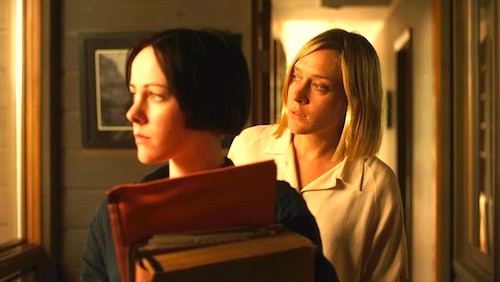
Presumably, Angela is the more responsible sister since she does all the things you are supposed to do when a family member dies. Her older sister is clearly a flake, yet everyone seems to defer to her. Instead of grieving, the family just ambles about in a daze, with the air conditioning cranked up to arctic levels. Angela recognizes cracked behavior when she sees it, but her flirtation with a scruffy hipster neighbor distracts her from pushing the issue.

Blash plays up the verdant eeriness of the Pacific Northwest woods for all its worth, simulating the vibe of Twin Peaks, but lacking the distinctive characters and stuff happening with regularity. Kasper Tuxen’s lush cinematography evokes a sense something uncanny must be going on somewhere, but there are simply too many shots of characters staring off into the distance for Wait to sustain any appreciable momentum.

From "The Wait."

After Tuxen, Jena Malone is probably the film’s MVP. As Angela, she actually supplies a real performance, marked by vulnerability and sensuality. In contrast, Chloë Sevigny’s Emma largely fades into the background, which is surprising given the lively impression she made in Jonathan Caouette’s even more surreal short, All Flowers in Time.

With respects to the natural versus the supernatural question, Wait seems to want to have its cake and eat it, too. Blash offers up sequences to support either alternative down the stretch, but they are all so frustratingly underwhelming. There are interesting bits here and there, like the forest fire raging on the horizon, which everyone assiduously ignores, like revelers in Pompeii. Yes, it is a carefully crafted film, but there will be times viewers will want to hook it up to a car battery and give it a jump. For dedicated Malone fans only, The Wait opens today (1/31) in New York at the Cinema Village.

LFM GRADE: C-

Posted on January 31st, 2014 at 1:51pm.

LFM Reviews Wizard’s Way @ The 2014 Slamdance Film Festival

Wizard’s Way trailer from wizard's way on Vimeo.

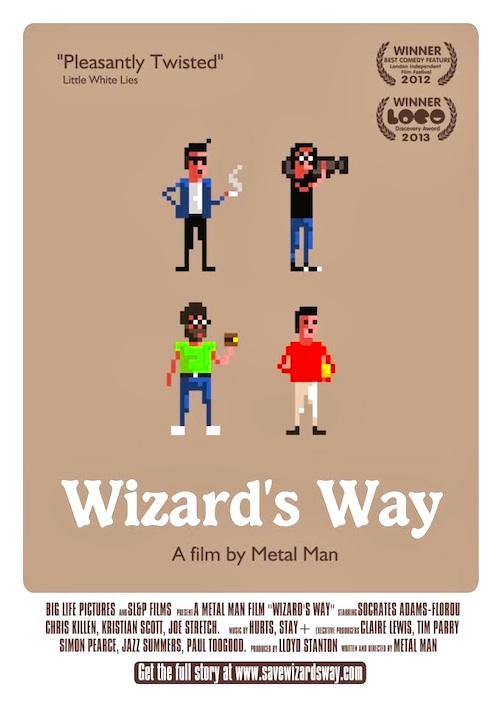
By Joe Bendel. Some legends might stand eternal, but no server lasts forever. When the one hosting one of the earliest surviving fantasy MMO’s is finally decommissioned, it causes great angst for two of the most dedicated players. A pair of snarky documentary filmmakers intend to capture the resulting drama, but the story evolves beyond their control in Metal Man’s Wizard’s Way, which screened at the 2014 Slamdance Film Festival.

Although nothing could upstage Christopher Nolan receiving the inaugural Founder’s Award at this year’s Slamdance, news that Jack Black plans to develop and executive produce the American remake of Way was still pretty big stuff. He could probably star as well, in nearly any of the scruffy roles. Joe Stretch and Chris Killen (played by their namesakes) are recent film school grads, who somehow received early notice of the impending demise of Wizard’s Way. Recognizing a good opportunity for cinematic exploitation, they seek out Julian “Windows” Andrews, a stockroom prole by day, who is the undisputed top gun amongst Wizard’s Way’s dwindling ranks.

As his schlubby roommate Barry Tubbulb explains, Windows is the only player to get married “in-game” to Elin, whom he has never met outside of Wizard’s Way. When the plug gets pulled, Windows is understandably distraught, because he has lost his “wife” along with his life’s passion. Somehow Stretch convinces the gamers to stick with their film, but he has some rather cruel manipulations scripted out for the lads. However, Andrews and Tubbulb might not be as dumb and pathetic as the would-be-documentarians think.

Frankly, Wizard is exactly what Zero Charisma should have been, but wasn’t. There is no question that in the culture war between geeks and hipsters, Metal Man, a.k.a. co-writers Socrates Adams-Florou, Chris Killen & Joe Stretch, line up solidly behind the geeks. Their sympathy for Tubbulb and Andrews is genuine and the eventual comeuppance is satisfying.

As Tubbulb, Adams-Florou lets loose with a fair amount of shtick, but Kristian Scott is surprisingly grounded (and rather reserved) as Windows. While Killen largely avoids the spotlight (which is definitely an issue for his character), Stretch’s slow, creepy evolution into outright villain is frankly quite impressive. This is obviously a zero budget affair, but everyone in front of the camera gamely holds up their end.

You do not often see movies at festivals that tell documentary filmmakers to sod off, which is why Wizard is so refreshing. Similar in tone to Electric Man, David Barras’s affectionate ode to comic readers, Wizard defends geek culture in general, while gently encouraging the addition of an offline component. It all works quite well.Highly recommended for gamers and fans of eccentric British comedies, the news-making Wizard’s Way should have plenty of festival screenings in its future.

LFM GRADE: B+

Posted on January 27th, 2014 at 3:57pm.