LFM Reviews Oshima’s Boy

By Joe Bendel. 2013 sadly marked the passing of two pivotal luminaries of Japanese cinema. Nagisa Oshima was a true maverick auteur, whose films’ frank sexual and political content influenced generations of subsequent filmmakers. Donald Richie was a film historian and critic, as well as an experimental filmmaker in his own right, whose scholarship largely introduced the western world to Japanese cinema. They are exactly the sort of accomplished figures likely to be overlooked by the Oscar broadcast’s perennially controversial in memoriam tribute, in favor of actors from teeny-bopper TV shows with a handful of low budget horror flicks in their filmography. At least Film Forum shows better judgment and memory with their week-long engagement of Boy, which was championed by Richie as “Oshima’s finest film,” beginning yesterday (Friday 1/17).

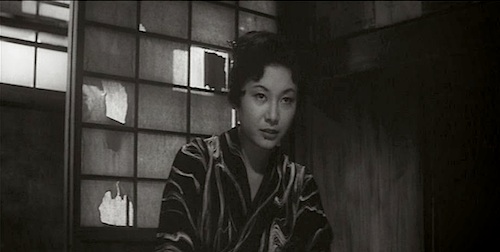
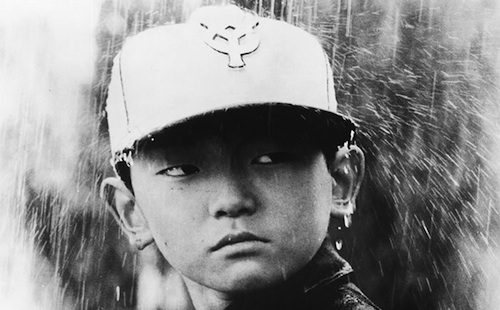
Ten year old Toshio Omura has a school uniform, but he never attends classes. Instead, he travels throughout Japan with his grifter father Takeo and his short-sighted (in both senses) step-mother, Takeko Taniguchi, scamming motorists with fake accidents. It is always him or Taniguchi taking the flops and never the elder Omura. He just shows up later to shakedown a financial settlement. Of course, throwing one’s body in the vicinity of moving vehicles is bound to cause some bruising over time. However, the damage done to Omura’s innocence is irreparable. At times, he rebels, but he ultimately stays for the sake of his little brother, Peewee.

Oshima vividly captures just how sad and profoundly unfair it is when kids are not allowed to be kids. Without question, Master Omura is far more mature than his step-mother, with whom he has an enormously complex relationship. Shot on the streets, run-and-gun style, Oshima shows the audience Japanese society from his young protagonist’s perspective and it is hardly pretty. Nobody wants to get involved, which is why a parasite like his father stays in business so long.
From "Boy."

In the annals of child performances, Tetsuo Abe’s work as Omura should rank in the uppermost echelon. It is an exceptionally disciplined turn, packing a visceral emotional punch. As an added bonus, he displays uncommon screen chemistry with pitch perfect one year old Tsuyoshi Kinoshita as Peewee. They have scenes together that will rip your guts out. Likewise, as Taniguchi, Akiko Koyama (Oshima’s off-screen wife and his frequent co-star in films like the classic Empire of Passion and the under-revived Ceremony) is agonizingly vulnerable and absolutely maddening in equal measure.

In contrast, Fumio Watanabe is largely lost in the shuffle as the pedestrian lout of a father, but this is unquestionably the boy’s film, not his father’s. Frankly, it is rather remarkable Koyama and little Kinoshita register so strongly.

Despite Oshima’s auteurish flourishes, periodically shifting from vivid color to black-and-white or gold tinted stock, the inspired-by-a-true-story Boy always feels uncomfortably real. It is a bracing film, yet it is also deeply humanistic. Cinematographers Seizô Sengen and Yasuhiro Yoshioka frame some striking images and their use of color is often dramatic, but they never overwhelm the film’s vibe of lonely melancholy. Justifiably hailed by the late Richie, Boy is a powerful masterwork, recommended for all serious film lovers as it opens in New York at Film Forum.

LFM GRADE: A

Posted on January 18th, 2014 at 2:52pm.
LFM Reviews Kore-eda’s Like Father, Like Son

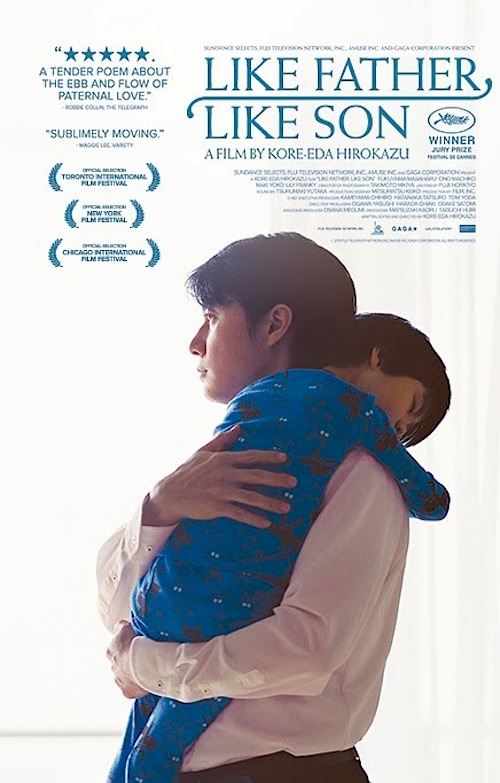
By Joe Bendel. This will be one of the most wrenching O. Henry-esque stories most viewers could ever hope to see. When an over-achieving father learns his six year old son was switched at birth, he assumes biology trumps their parental bond. However, exchanging children proves to be far more complicated than he expects in Hirokazu Kore-eda’s Like Father, Like Son, which opened this Friday in New York.

The driven Ryota Nonomiya has always excelled at everything, except maybe parenting. He always assumed his gentle son Keita simply took after his passive wife, Midori. However, when their maternity hospital announces the mistake (deliberately caused by a mentally disturbed nurse), everything suddenly makes sense to him. Initially, he agrees to meet the Saikis, a big, sloppily affectionate working class family, along with his biological son, Ryusei, ostensibly adopting a wait-and-see attitude. Yet, his wife can tell he has already made up his mind and is constitutionally incapable of protesting.

You might think Ryota Nonomiya and his severe father are vampires, considering their preoccupation with mere blood. Of course, emotional bonds are not so easily severed. To make matters worse, he starts to wonder if the Saikis got the better end of the deal. Frankly, many parents will find it absolutely flummoxing the Nonomiyas could ever let go of a sweet-tempered moppet like Keita, but Kore-eda’s screenplay is examining and to an extent critiquing attitudes rooted in a very specific cultural context (forthcoming DreamWorks remake notwithstanding). Without question, he advocates greater emphasis on nurture over nature, in just about every sense.

As his near namesake, young Keita Ninomiya is a major reason why Like Father is so massively poignant. He is ridiculously cute, but also devastatingly effective in his big dramatic scenes. Likewise, despite Midori’s submissive nature (which might set some western viewers’ teeth on edge), Machiko Ono’s arrestingly sensitive performance is deeply affecting. In contrast, Masaharu Fukuyama is rigorously disciplined as the coolly detached Nonomiya, earning his payoff the hard way. To their credit (and that of Kore-eda), the Saikis are also given real heft and dimension by Lily Franky and Yoko Maki, rather than serving as anti-Nonomiya strawmen.

Again, Kore-eda demonstrates a distinctly wise and forgiving sensibility for family drama as well as an unusual facility for directing children. It might be a cliché, but it is hard not to dub him the natural heir to Ozu based on Like Father and his previous films, like I Wish and Still Walking. A mature work from a contemporary master, Like Father, Like Son is highly recommended for general audiences as it opens in New York at the IFC Center.

LFM GRADE: A-

Posted on January 18th, 2014 at 1:25pm.

Vengeance is Shohei Imamura: LFM Reviews A Man Vanishes

By Joe Bendel. There are not a lot of fact-checkers working in the documentary film industry.  Yet, many people assume anything they saw in a movie billing itself as a doc must be true.  Although it had its initial Japanese release in 1967, Shohei Imamura’s docu-deconstruction A Man Vanishes delivers a timely challenge to such blind faith.  Yet, it is still gritty and noir enough to easily fit within the Asia Society’s mini-retrospective, Vengeance is Shohei Imamura when it screens (for free) today.

As a salaryman with a steady job and a fiancée, Tadashi Oshima initially seems like an aptly unremarkable representative of the reported 91,000 Japanese citizens who vanished without a trace two years prior.  However, as Imamura’s on-camera investigator and Oshima’s intended, Yoshie Hayakawa, his pursue the trail, a very different picture emerges.

Oshima had been caught embezzling company funds and was also carrying on with other women, including perhaps Hayakawa’s sister Sayo, who denies the accusation vociferously.  In fact, the film ostensibly hinges on the question of who is telling the truth: Sayo Hayakawa or the witnesses placing her with Oshima.  It all so disillusions Yoshie Hayakawa, she develops a romantic attachment for the actor playing Imamura’s investigator.

Several times during the course of the third act, Imamura directly states that this film is fictional.  He even literally tears down the backdrops he has assembled midway through the climatic confrontation.  Yet audiences are so programmed to accept the documentary form as fact, we still believe when the actors take their “he said-she said” show out into the streets. It is like we can’t stop being had by Imamura.

From "A Man Vanishes."

In many ways, the dramatized docu-hybrid elements of Vanishes seem decades ahead of their time, especially the trippy sequences involving the shaman advising Hayakawa, whose rituals would not be out of place in a straight up genre picture.  On the other hand, the deliberately desynchronized soundtrack harkens back to the Nouvelle Vague’s trick bag.  By the same token, Kenji Ishigura’s black-and-white cinematography faithfully preserves a street level time capsule of Tokyo in the mid 1960’s.

At one point, one of the witnesses contradicting Sayo Hayakawa protests: “I have no reason to lie.”  Essentially, Imamura’s entire film serves as a rejoinder saying: “yes, but you have no reason to tell the truth either.”  Evidently, Vanishes started out legit, but circumstances forced Imamura’s meta-hybrid hand.  Still, the implications regarding the limits of objective filmmaking remain the same.  Imamura would in fact make several more conventional documentaries, but the less politically charged Vanishes, with its woman (or women) scorned, is more thematically compatible with his hardboiled morality plays.  An enigmatic puzzle every cineaste should enjoy chewing on, A Man Vanishes screens free of charge this Saturday (1/18) at the Asia Society, as part of their new Vengeance is Shohei Imamura film series.

LFM GRADE: B+

Posted on January 18th, 2014 at 1:20pm.

Remembrance and Disillusionment: LFM Reviews Generation War

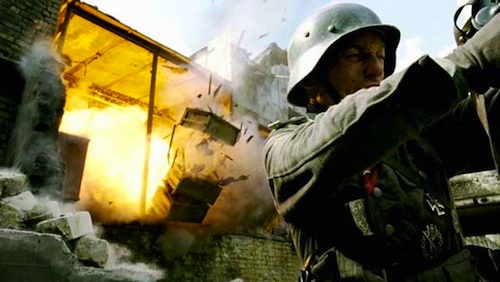
By Joe Bendel. They would have been Germany’s best and brightest. Instead, a generation of future leaders was ground-up and consumed by the National Socialist war machine. It was not a war of their making, but they bought in nonetheless. Like the rest of their contemporaries, five friends expect it all to end quickly, so they vow to reunite in Berlin for Christmas. Of course, WWII will turn out to be much more protracted, painful, and futile than anyone bargains for in Philipp Kadelbach & Stefan Kolditz’s Generation War, a popular but controversial German television mini-series, which screened theatrically in its entirety, starting this past Wednesday at Film Forum.

Lt. Wilhelm Winter has already had a taste of war, returning home decorated. His disappointing brother Friedhelm is not cut from the same soldier cloth. Unfortunately, the younger Winter’s skepticism regarding the war will be vindicated in spades. Before they leave for the Eastern Front, both brothers will spend a final evening with their three closest friends.

Charlotte (or “Charlie”) will also soon leave for the east to serve as a Red Cross nurse, but she is ill prepared to face the grisliness of war, even during the optimistic early months. She not so secretly carries of torch for Wilhelm Winter, but has never found the right moment to confess her ardor. Lt. Winter shares her feelings, but refuses to act on them, believing it would be unfair to her should he fall in battle. In contrast, Gretta Müller and Viktor Goldstein are clearly an item, but they try to keep their affair secret outside their small band of friends. After all, Goldstein is Jewish and Mueller is an aspiring torch singer.

Obviously, all five friends are in serious denial regarding the National Socialist’s racial policies, especially Goldstein. Unfortunately, reality will become inescapable. For mercenary reasons, Müller, now known as Greta DelTorres, also takes up with Dorn, a senior SS officer who guides her career as a Reich-approved songstress. He also promises to arrange safe passage for Goldstein out of the country, but that is not how the SS dealt with romantic rivals. Instead, Goldstein heads east as well, under radically different circumstances.

Screened in two separate parts totaling 319 minutes, Generation is a five headed epic that encompasses roughly five years of tumultuous history. Yet, despite all its characters’ regret and longing, it is hardly a romance in the Doctor Zhivago tradition. First and foremost, it is a gritty war movie, emphasizing naturalistic misery over Saving Private Ryan-style spectacle. It certainly makes the Eastern Front look like the colossally bad idea it was. Tellingly, during the first half, each shift in location is identified by its distance from Moscow, while Berlin becomes the reference point for the second half.

Of course, from an American perspective, the Eastern Front is a convenient location, because none of the primary characters ever fires a shot at a Yankee GI. To their credit, director Kolditz and screenwriter Kadelbach (who also wrote the Dresden miniseries, which is worth revisiting in conjunction with Generation) deal forthrightly with National Socialist war crimes. They never take viewers all the way inside a concentration camp, but they spend time in the trains transporting prisoners there. When the Soviets appear, it is rarely flattering. However, the portrayal of the Polish Home Army is sometimes questionable, never showing the extent to which they were targeted by Stalin’s forces.

From "Generation War."

Regardless, Generation is significant for the extent it engages with the complicity of Germans of diverse social positions in the crimes of the Third Reich (far more so than Dresden). This is considerably closer to a 12 Years a Slave soul search than a whitewash. Terrible things happen during the course of the film for reasons of ideological intolerance and cruelty.

Still, it is also an engaging narrative that balances the circle of friends remarkably well. The five principles completely pull viewers in, convincing even the most resistant to invest in their characters. As Wilhelm Winter (who also serves as narrator), Volker Bruch is arguably the strongest of the ensemble due to the commanding presence and anguished conscience he projects. Tom Shilling nicely plays with and against him as the resentful younger Winter.

Initially, Katharina Schüttler and Miriam Stein seem comparatively light weight as Müller and Nurse Charlie, respectively, but they each have surprisingly powerful moments of disillusionment and emotional defeat throughout part two. Ludwig Trepte slow burns well enough as the naturally withdrawn Goldstein, but Aline Levshin is downright bracing as the Polish fugitive he forms an alliance with.

As befitting a sweeping saga, there are plenty of coincidences and near misses in Generation, but they never feel forced. Throughout, Kadelbach and Kolditz maintain their focus on the war and its dire consequences for the five friends, as well as the wider society. It is a completely involving military drama that trots along briskly. However, Film Forum’s two-for-one admissions for parts one and two can conveniently be applied to different screening dates. Highly recommended, Generation War opens this Wednesday (1/15) in New York.

LFM GRADE: A

Posted on January 18th, 2014 at 12:21pm.

Vengeance is Shohei Imamura: LFM Reviews Endless Desire

By Joe Bendel. Dig that slinky crime jazz. Check out those five strangers sidling up to each other in a train station. Even viewers who are inexplicably resistant to subtitled foreign films will appreciate the post-war noir coolness of Shohei Imamura’s Endless Desire, which screens for free this Friday as the opening film of the Asia Society’s mini-retrospective, Vengeance is Shohei Imamura.

In the waning hours of the war, Major Hashimoto and three co-conspirators buried a barrel of morphine below a field hospital, vowing to reunite ten years later to claim their illicit goods. It was dark and circumstances were chaotic, so nobody really knows what their criminal collaborators look like. They just know to look for Hashimoto and two other men wearing discrete Imperial military pins. Things get tricky right from the start when Shima Hashimoto arrives in the place of her late brother, greeting four prospective accomplices rather than three.

Obviously, plenty of suspicion falls on all five sketchy characters, but nobody wants to walk away from their share of the morphine stash. Shima Hashimoto’s destabilizing sultriness further guarantees future violence. Yet, everybody temporarily buys into the plan to tunnel below the working class neighborhood butcher’s shop unknowingly built over the buried cache. To make matters worse, unforeseen circumstances impose an accelerated deadline on the desperate rogues.

While it is pretty clear this is all heading for a justly disastrous end, Imamura and Suzuki Toshiro’s adaptation of Shinji Fujiwara’s source novel still delivers several nifty twists and turns along the way. However, the subplot involving the rather incompetent assistant forced on the five by their temporary landlord (his disappointed father) mostly just muddies the waters with confusing comic relief. The extent and nature of his slow-wittedness almost seems to vary from scene to scene, but no matter. Shima Hashimoto is a killer femme fatale from start to finish, which is far more important.

From "Endless Desire."

Released in 1958, Desire oozes enough hostile sexual tension to still feel edgy by contemporary standards. Working with a cast of consummate professionals, Imamura crafts a massively sweaty hothouse atmosphere, perfectly accentuated by Shinsaku Himeda’s classically noir black-and-white cinematography. This is a nocturnal world, where there is always an eighty-five percent chance of rain.

There is no denying the sizzle Misako Watanabe adds, out vamping Mae West as Ms. Hashimoto. We can tell she will be trouble right from the first seemingly innocent shot (and she is still making great films, like Japan’s recent foreign language Oscar submission, The Great Passage). Likewise, Taiji Tonoyama serves as a perfect foil to everyone as the bristling, blustering , bull-headed Onuma, while Imamura regular Kô Nishimura provides a nice counterpoint as the more cerebral and calculating Nakada.

Endless Desire is dark, but it is great fun, especially for film noir lovers. It is an excellent way to start wading into the work of Imamura, which includes many serious documentaries and two Cannes Palme D’Or winners. Highly recommended, it screened Friday (1/17), kicking off the Vengeance is Shohei Imamura series at the Asia Society on Park Avenue.

LFM GRADE: A-

Posted on January 18th, 2014 at 12:16pm.

LFM Reviews Commitment

By Joe Bendel. It is hard to get more Zeitgeisty than a film about North Korean purges. You can ask Kim Jong-un’s uncle about it, if you have a Ouija board in your pocket. A teenager recruited out of Yodok prison becomes a pawn in Kim’s brutal succession plan in Park Hong-soo’s Commitment, which screens for free this coming Tuesday in New York, courtesy of the Korean Cultural Service.

Ri Myung-hoon had always done his duty as a sleeper spy, so he expected to return home to his son and daughter, right on schedule. Unfortunately, the Communist regime does not give out gold watches. Instead, they betray Ri’s father and imprison his family. Since he is a real chip chiseled off the old block, a crafty old spymaster offers Ri a chance to save his sister Hye-in. Posing as a defector, he will hunt down the assassin from a rival North Korean spy faction killing members of his sleeper cell.

To maintain his cover, he will also spend some time in high school, where he meets Lee Hye-in. Besides her name, something about her reminds him of his sister. As a disciplined undercover operative, he valiantly resists the urge to lay a beat down on the bullies that torment her, but it is obviously just a matter of time. Likewise, the plots in Pyongyang will soon embroil Ri and nearly every other sleeper.

From "Commitment."

It is easy to see why Commitment’s blend of action and tragic teen angst would be popular with Korean audiences, but it is also a rather astute reflection of the current geopolitical climate. Although Park served as assistant director on Jang Hun’s wishful thinking unification thriller Secret Reunion, Commitment is more closely akin to Ryoo Seung-wan’s neo-Cold War spy drama Berlin File. It clearly implies Kim Jong-un is a ruthless Machiavellian and forthrightly addresses the plight of political prisoners. On the ROK side, the most sympathetic figure is Cha Jung-min, an unreconstructed Cold Warrior, whereas his “keep the lines of communication open” superiors are portrayed as craven opportunists.

Korean rapper T.O.P. (a.k.a. Choi Seung-hyun) is surprisingly credible in his considerable action scenes. When it comes to high school drama, he certainly broods well enough. As Lee Hye-in, Han Ye-ri also projects a somewhat reserved screen presence, so they feel right together, even if they do not burn up the set. Amongst a strong supporting cast, Yoon Je-moon’s Cha hits the right note of rumpled exasperation, while Kim You-jung is arrestingly fragile as sister Hye-in.

Despite several nifty fight scenes, American audiences would probably prefer a higher action to teenage angst ratio. Still, it is probably the best spy film since maybe Berlin File. Often smart and tense, Commitment is a fascinating example of the ever shifting manner the two Koreas are depicted in the cinema of the ROK. Recommended rather highly (especially for free), Commitment screens Tuesday (1/14) at the Tribeca Cinemas, thanks to the Korean Cultural Service in New York.

LFM GRADE: B+

Posted on January 11th, 2014 at 12:31am.