The Anime Rebuild Continues: LFM Reviews Evangelion 3.0

By Joe Bendel. There is nothing like partially destroying the world to cause an existential crisis. Shinji Ikari was always a moody kid, but he is in for the mother of all guilt trips. The franchise that rejuvenated mecha anime returns with the third installment of Hideaki Anno’s feature anime “rebuild” series, Evangelion 3.0 You Can (Not) Redo, which screens this Friday in New York.

If you saw 2.0, you might be somewhat surprised to learn that the climactic battle did not turn out so well, but not as surprised as Ikari. He will have quite a rude awakening from fourteen years of suspended animation. His former protector, Misato Katsuragi, is now the leader of WILLE, an outfit explicitly opposed to his father’s NERV—and she apparently hates his guts. A lot of people do, including his former hotshot comrade-in-arms, Asuka Shikinami. Nobody will spell it out for him, but they are all adamant he should never step inside an EVA battle bot again.

As a result, he is more than willing to desert WILLE for NERV when offered the chance, particularly since the getaway EVA is piloted by Rei, whom Ikari thought he had saved at the end of 2.0. She has changed though, whereas his father is the same old cold Machiavellian. At least Ikari makes a new friend in Kaworu Nagisa, with whom he plays four-handed piano and learns the full devastating extent of the Third Impact he inadvertently hastened.

From "Evangelion 3.0."

Given the fourteen year time jump, 3.0 ought to be a convenient entry point to the series, but it actually feels denser than the previous two outings. It is definitely a middle film, ending more with a lull in the action than any sense of closure. While he was never a barrel of laughs, Ikari’s mopiness becomes almost insufferable. On the plus side, Shikinami really comes into her own as an anime action role model for girls. Listening to her tear into Ikari is good, sort of clean, cathartic anime fun.

As usual, the art of 3.0 remains several cuts above the industry standard. This time out, writer-chief director Anno cranks up the apocalyptic elements something fierce, but somehow the religious overtones do not feel as pronounced. The complete lack resolution will frustrate casual viewers, but fans will dig the metal-on-cosmic metal action (they should also stay for the teaser-stinger). Recommended for anime connoisseurs who appreciate the intricate series mythology and Shikinami’s attitude, Evangelion 3.0 screens this Friday (1/10) at the Big Cinema Manhattan, Saturday (1/11) at the Yonkers Drafthouse, and Saturday (1/11) and next Tuesday (1/14) at the Village East, as well as other select theaters throughout the country.

LFM GRADE: B-

Posted on January 8th, 2014 at 11:41am.
Amnesiac Hitmen in Love: LFM Reviews Key of Life, Now on DVD

By Joe Bendel. All movie lovers know amnesia and romance go together like fish and chips. Yakuza not so much, but they are all part of the mix in screenwriter-director Kenji Uchida’s understated rom-com, Key of Life, which releases today on DVD from Film Movement.

The mysterious Shinichiro Yamazaki (professional handle: Kondo) has just taken out an unfortunate businessman. Despite his protective garb, the hitman has a discrete dab of blood on him. He is also somewhat sweaty, so he heads for a public bath, where he promptly slips on a bar of soap and cracks his head. Seizing the opportunity, suicidal loser-actor Takeshi Sakurai grabs his keys and clothes, while an ambulance whisks him off to the hospital. When Sakurai finally resolves to face up to the well heeled Yamazaki, he finds the man has no memory of his past life. Although he still feels a tiny bit guilty, Sakurai continues impersonating Yamazaki, blissfully unaware of the man’s dangerous line of work.

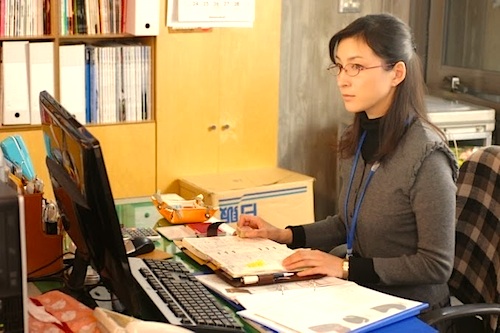
Meanwhile, book publishing executive Kanae Mizushima gives herself a short deadline to find and marry a reasonably respectable man. She has her reasons. Sakurai, as Yamazaki erroneously presumes himself to be, seems like a poor prospect. Yet a chance encounter leads to possible romance for the two meticulous souls. Of course, all sorts of complications are lurking around the corner, many of them involving the Yakuza who has a rather distasteful follow-up gig for Kondo.

From "Key of Life."

On paper, Key sounds like a whizbang screwball comedy, but Uchida’s execution is surprisingly quiet, laidback, and mature. Recognizing a good thing going on, he allows plenty of time for the ambiguously romantic relationship between Mizushima and the real Yamazaki to unfold. He juggles a gracious plenty plot points, yet Key is first and foremost a rom-com that excels at the rom.

Prolific character actor Teruyuki Kagawa is absolutely pitch-perfect as Yamazaki (assuming Sakurai’s identity), conveying all his world weary soulfulness, while still springing all his character’s revelations like the crafty pro he is. Likewise, Ryoko Hirosue (sort of the Japanese Sandra Bullock, probably still best known internationally for her supporting turn in the Oscar winning Departures) is exquisitely demur and sensitive as the reserved Mizushima. Together, they develop some unusually fresh and deep screen chemistry. Unfortunately, Masato Sakai’s real Sakurai looks like quite the weak link in comparison, but at least he delivers one memorable extra-base hit late in the third act.

Even though Uchida maintains an appealingly light and easy-going vibe, Key has far more heft than the average comedy of any sub-genre. It is a film that appreciates the awkward ways people relate to each other. Witty, romantic, and greatly satisfying, Key of Life is highly recommended for general audiences. It is now available on standard DVD from Film Movement.

LFM GRADE: A

Posted on January 7th, 2014 at 8:20pm.

Jet Li Supervises: LFM Reviews Badges of Fury, Now on DVD/Blu-ray

By Joe Bendel. Jet Li’s Huang Fei Hong is sort of the Sergeant Murtaugh of the Hong Kong police. He is definitely getting too old for this sort of thing, but unlike his Lethal Weapon counterpart, he always punches out promptly at 5:00 and disappears for long stretches. That leaves most of the slapstick to his younger colleagues. Seniority has its privileges. Still, whenever Huang returns for a throw down, things perk up dramatically in Wong Tsz-ming’s Badges of Fury, which releases today on DVD and Blu-ray from Well Go USA.

Huang is a crafty old salt who is more interested in his retirement portfolio than office politics. Wang Bu-er thinks he’s all that, but has an uncanny talent for self-sabotage. Their young, insecure team leader has paired them together in the hope some of Huang’s mature risk-aversion will rub off on Wang. So far, it is not taking. Wang just keeps blundering ahead, inadvertently aiding the escape of the wanted criminal Huang nearly captures in the spectacular opening action sequence.

However, Badges is not really about the fugitive Chen Hu. Frankly, it keeps changing its mind, but the preponderance of the narrative involves the investigation of the so-called “Smile Murders.” Each of the victims died with a strange smile plastered across their faces. It turns out they were also all once engaged to low budget starlet Liu Jinshui. Quickly, Liu falls under suspicion, but her half-sister Dai Yiyi appears far more dangerous, given her obvious va-va-voom.

From "Badges of Fury."

When Badges goes for laughs, it can be painful. However, action director Corey Yuen embraces the film’s cartooniness, unleashing his inner Itchy and Scratchy for some absolutely off-the-wall fight scenes. In the big opener and closer, Jet Li shows he still has his mojo. It is too bad there isn’t more of him as the steely Huang. Unfortunately, his Ocean Heaven co-star Wen Zhang kind of stinks up the joint with his shtick. Rising star Michelle Chen (so memorable in Ripples of Desire) is also clearly out of her element as their exasperated superior. At least, Ada Liu vamps it up with gusto as the femme fatale sister.

As if Badges were not inconsistent enough, it also shoehorns in more cameos than the director’s cut of It’s a Mad, Mad, Mad, Mad World. Sometimes it works great, as when action star Wu Jing shows up to rumble as an insurance investigator. Other times, it can be a rather head-scratching distraction for viewers not up on their Hong Kong reality television. Still, it is always pleasant to see Lam Suet, Stephy Tang, Josie Ho, and Grace Huang on-screen.

When it clicks, Badges is a martial arts machine. When it doesn’t, it is usually dabbling in romantic comedy. Still, Jet Li and Wu Jing’s chops, Yuen’s gravity-defying fight choreography, and Liu’s sex appeal should be enough to hold HK action junkies’ interest on DVD. Recommended for fans, but not as a Jet Li entry point, Badges of Fury is now available for home viewing from Well Go USA.

LFM GRADE: C+

Posted on January 7th, 2014 at 8:18pm.

LFM Reviews Friends from France @ The 2014 New York Jewish Film Festival

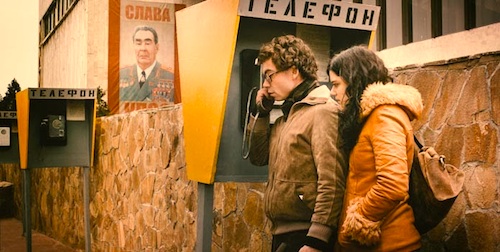
By Joe Bendel. As a matter of policy, the Soviets automatically denied all requests from the so-called “Refuseniks” to immigrate to Israel, often spuriously claiming they were irreplaceable specialists (who were then duly fired from their positions). As it happens, Victor Rybak really is a highly respected authority in the field of physics, much like Sakharov. His uphill battle to join his wife in Israel will profoundly affect two young French cousins in Anne Weil & Philippe Kotlarski’s Friends from France, the opening night selection of the 2014 New York Jewish Film Festival, co-presented by the Jewish Museum and the Film Society of Lincoln Center.

Carole Brikerman is a passionate Zionist, who supports the Refuseniks’ aspirations for Israel. Jérôme Berkowitz is passionate about his cousin Brikerman. Despite his mixed feelings, Berkowitz joins his cousin on a leftist guided tour of Odessa. Pretending to be newlyweds, they will secretly visit Jewish dissidents, bringing smuggled care packages and offering moral support. Berkowitz resents what he considers Brikerman’s Zionist proselytizing, while struggling with his arousal from their intimate proximity. However, when they pay a call on Rybak, Berokwitz meets someone far more cynical than himself.

Rybak has good reason to be jaded. He endured constant torture in a Communist mental hospital, intended to force him to denounce his beloved wife, who had successfully reached Israel ahead of him. While imprisoned, he secretly maintained a diary. Not only did he document the systemized abuse and summary executions, he also included deeply personal passages of erotic longing, meant solely for her eyes.

Even in translated subtitles, the words of Rybak’s diary ring with truth and poetry. They are easily the most compelling element of Weil & Kotlarski’s screenplay. It is easy to understand why Brikerman’s network would want to publish it and why the Soviets would be determined to prevent such an embarrassment. They also open a deep window into the Refusenik physicist’s soul. For all his exterior gruffness, Rybak is a haunted romantic at heart.

Vladimir Fridman is simply extraordinary as Rybak. It is an acutely human and humane portrayal, conveying all his messy complications and understandable bitterness. It is only January, but Fridman’s work should be noted for year-end lists. He instills Friends with power and integrity whenever he is on-screen.

From "Friends From France."

In contrast, Soko and Jérémie Lippmann simply are not in the same league. Still, much like his character, Lippmann slowly sneaks up on viewers, developing a distinct presence and persona down the stretch. Evidently, Soko is France’s current “It Girl,” so it is nice she wants to appear in a film like this. At least she is more engaging than in the grossly over-rated Augustine. She does not undermine any of the proceedings, but it is hard to see her in the way other characters do.

Weil & Kotlarski vividly capture oppressive vibe of Communist era Odessa. At times Friends functions as a surprisingly good Cold War thriller. It probably holds some sort of distinction as a film noticeably critical of both the Soviet Union and the Zionist movement. Yet, its sharpest, most illuminating observations involve the hypocrisy of the leftwing tourists. Ostensibly on a personal mission of solidarity, they are clearly fearful of the Party’s apparatus of control—with very good reason. Smart, literate, and sometimes quite moving, Friends from France is a strong way to open this year’s NYJFF.  Highly recommended, it screens twice this coming Wednesday (1/8) at the Walter Reade Theater.

LFM GRADE: A-

Posted on January 3rd, 2014 at 10:31am.

LFM Reviews Mother, I Love You @ The 2014 Palms Springs International Film Festival

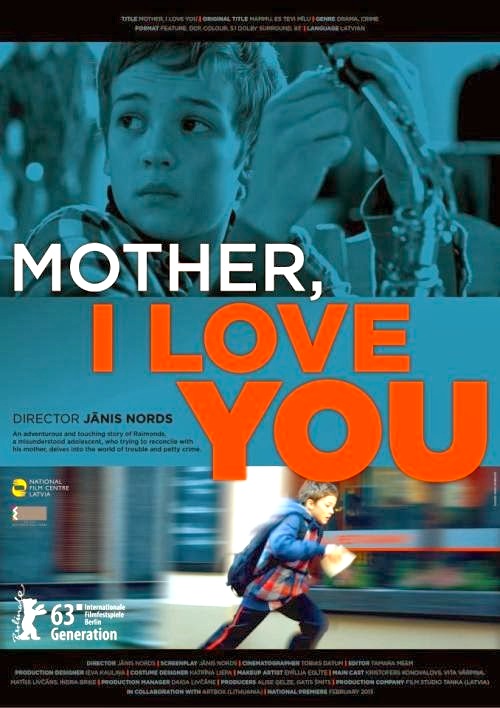
By Joe Bendel. Quality musical instruments are expensive, even for middle class professionals in Riga. That is one reason Raimonds Krasts is reluctant to tell his perennially stressed out OBGYN mother he lost his saxophone, particularly since it happened during a bit of misdemeanor mischief. Each lie and evasion only makes matters worse for Krasts in Jānis Nords’ Mother, I Love You, a Dostoyevskian middle school morality play that screens as part of the 2014 Palm Springs International Film Festival’s focus on official Academy Award submissions for best foreign language film.

There is already tension between Krasts and his single mother, Silvia Krasta. She has been secretly dating a colleague while supposedly working the late shift. Frankly, it is unclear how Krasts feels about this, but there is no question Krasta is displeased with his behavioral issues at school. She is also none too thrilled about his friend from the wrong side of the tracks, Peteris Cepurnieks. The son of a cleaning lady, Cepurnieks has swiped his mother’s key to a dodgy playboy’s often vacant apartment, where they often hang out and steal pocket money.

When things get particularly heated at home, Krasts runs off to the bachelor pad, but cuts short his stay when the owner arrives with a prostitute. Unfortunately, the woman in question filches his saxophone along with several other portable items from the flat. Predictably, his attempts to retrieve it lead to even more serious problems, because Krasts is still just a kid—one with particularly bad judgment.

Even though MILY did not make the Academy’s nine film short list, it was a smart choice for Latvia. As the winner of the Jury Award at this year’s LA Film Festival, it would have had more credibility and perhaps recognition among left coast Academy members than the average submission. Nords’ brand of sensitive naturalism is also perfectly compatible with Academy tastes and preferences. Evidently it was not to be, but it is still an accomplished film. The work of cinematographer Tobias Datum is particularly noteworthy for the way it captures the moody elegance and loneliness of late night Riga.

Front-and-center throughout the film, thirteen year old lead-actor Kristofers Konovalovs holds up to the scrutiny remarkably well. As problematic as Krasts might be, he never comes across as a caricature. Instead, we can understand why he makes each compounding mistake. Never overly showy, he could teach a thing or two to some of this year’s supposed Oscar contenders.

Likewise, the performance of Vita Varpina (one of two established screen actors in MILY) is smartly balanced and acutely believable. Haralds Barzdins, the real life conductor for the Latvian Song and Dance Festival adds some color as Krasts’ band director, but it is debatable whether the film will do much to spur youthful enthusiasm for orchestral music.

There is indeed a lot of messy humanity in MILY. Everyone makes mistakes, but nobody is irredeemable. It should be interesting for festival patrons to watch the film in close dialogue with Kang Yi-kwan’s somewhat thematically related Juvenile Offender. Nords never takes the easy way out, yet his film is still considerably more optimistic. Small but potent, Mother, I Love You is recommended for those who appreciate coming-of-age character studies. It screens this coming Sunday (1/5), Monday (1/6), and the following Saturday (1/11) during the 2014 Palm Springs International Film Festival.

LFM GRADE: B

Posted on January 2nd, 2014 at 11:03pm.

Using Ham as Oscar Bait: LFM Reviews August: Osage County

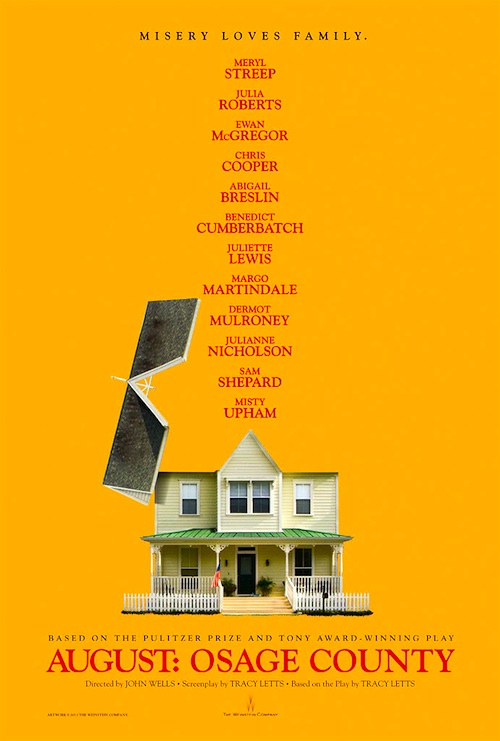
By Joe Bendel. The original Broadway production of Tracy Letts’ August: Osage County dominated the Tonys, netting best play, best lead actress for Deanna Dunagan, best featured actress for Rondi Reed, best director for Anna D. Shapiro, and another lead actress nomination for Amy Morton. Aside from Letts adapting his play for the screen, none of the Tony winners would reprise their roles in the movie version. Instead, it was clearly conceived as an Oscar vehicle for a number of formerly popular stars. Prepare for a lot of yelling and drawling when the John Wells helmed August: Osage County opens today in New York.

Pill-popping Violet Weston was a terrible mother to her grown children and remains a thoroughly rotten human being in her twilight years. Even the onset of mouth cancer has not moderated her nasty temperament. It seems she finally drove her beloved and despised husband Beverly to suicide, but the ambiguous circumstances leave some room for denial. After his funeral, the extended family gathers for a memorial dinner. The main course will be recriminations, followed by bile for desert.

Like it or not, everyone is there. Ivy is the mousey daughter who never got out from under Mother Weston’s thumb. Karen is the family’s Blanche Dubois, who has brought along her next prospective sugar daddy hubby. Barbara Weston is the only daughter Violet ever respected, because she has some backbone and attitude. Unfortunately, her relations are currently strained with her unfaithful husband and their moody tweener daughter. As if that were not enough, Weston’s sister Mattie Fae Aiken (sort of a Violet-lite) will also be in attendance, along with her laidback husband Charlie, and their awkward son Little Charles, upon whom she constantly rains down emotional abuse. The cooking and serving will be done by Johnna Monevata, the Native American domestic Beverly hired shortly before his misadventure. If a fire broke out in the house, she would be the only one you would save.

As the film starts, Sam Shepard’s wonderfully understated near-cameo as Beverly Weston suggests we are in for an acting showcase. Then Meryl Streep shuffles in, like Dwight Frye in a Dracula movie and all hope of subtlety is thrown out the window. Seriously, there has to be a chapter of Overactors Anonymous in Hollywood. Admitting there is a problem is always the first step (I’ve heard there are eleven more after that), but it’s never going to happen until critics and guilds stop hyping every Streep performance just because they’re supposed to. There are times you think Streep will end a scene by loudly proclaiming “Acting!” like Jon Lovitz’s thespian character on Saturday Night Live. The way she masticates the furniture will give audiences indigestion.

Her more-is-never-enough approach sort of works during the big dinner time smackdown. However, Julia Roberts deserves credit for hanging with her without going wildly over the top. Frankly, it looks like she is manhandling Streep for real at one point, which provides a degree of viewer satisfaction. When Roberts and Streep go at it, the movie starts to click. Unfortunately, this natural peak comes about midway through the film. Every predictable family revelation that follows feels like a letdown.

Still, Roberts’ work is consistently strong throughout the film. She also has some fine support from Chris Cooper, Julianne Nicholson, and Misty Upham as Big Charlie, Ivy Weston, and Johnnna Monevata, respectively. It is worth noting that these are quieter, more reflective and nuanced turns. In contrast, Benedict Cumberbatch proves sometimes less really is less, disappearing into the background as poor put-upon Little Charles.

When you see the film version of Osage, it is easy to understand why it was successful on-stage. Perhaps Streep’s unrestrained performance would work better in that venue, if you were hard of hearing and sitting in the back row of the balcony. On film, it is destined to rank alongside Faye Dunaway’s Joan Crawford in Mommie Dearest. (Violet probably doesn’t dig wire hangers, either.) There is a lot of good work in the film version, but ultimately it is structurally unbalanced and fatally overwhelmed by its excess Streepness. Only satisfying for diehard Roberts fans, August: Osage County opens today (12/27) in New York at the Loews Lincoln Square and the Regal Union Square.

LFM GRADE: C-

Posted on December 27th, 2013 at 11:25pm.