Australian Noir: LFM Reviews Swerve

By Joe Bendel. The whole honesty thing does not seem to be working out for an Australian veteran driving cross country for a job interview. He tries to do the right thing with the briefcase full of cash he finds at the site of an accident, but the local cop is a bit on the dodgy side. It turns out he has issues, largely revolving around his wife Jina in Craig Lahiff’s Swerve, which opens this Friday in New York.

Jina will walk away from the crash unscathed, but the other party will be leaving feet first. Considering he had just pulled off his own murder-double cross, karma certainly came back around for the drug dealer quickly. However, it is a safe bet someone will come looking for the case of dirty money Colin, the innocent bystander, turns over to Frank, the local law, after driving the strangely composed Jina home. As a fellow veteran, Frank insists on putting Colin up at his place, which leads to the awkward realization that Jina is the copper’s wife.

Needless to say, it is not a happy marriage. Both husband and wife appear to be hatching schemes against each other that will start to involve the stash of cash in Frank’s jail cell. Colin will try to avoid getting entangled in their drama – but yeah right, good luck with that.
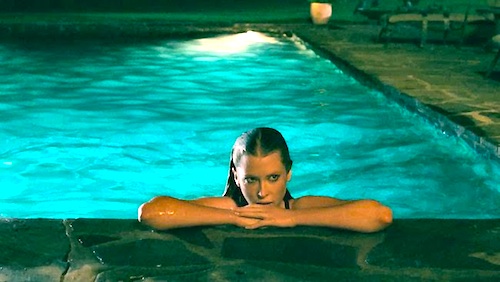
From "Swerve."

Anyone who has seen Body Heat or The Postman Always Rings Twice will have a pretty good idea what twists and turns lay ahead, except Lahiff’s screenplay is relatively demur by the standards of sexually charged thrillers. In fact, it is a modest film in many ways, seemingly mindful it has not reinvented any cinematic conventions. Yet, its thriller mechanics are pretty solid and all three sides of the central noir triangle have above average presence.

While the entire cast (even the smaller supporting figures) is well known in Australia, Jason Clarke will be the most recognizable to American audiences from Zero Dark Thirty. He does the swaggering small town crooked cop well, playing his problematic nature more in terms of erratic recklessness than outright evil. Emma Booth looks more like a girl next door than a femme fatale, but she vamps it up in style. Rounding out the trio, David Lyons makes a reasonably credible everyman and a refreshingly sympathetic on-screen portrayal of an Iraq War veteran (even if Clarke’s Frank is considerably less so).

As if in observance of film noir tradition, Swerve culminates on a night train headed out of town. Trains might not automatically come to mind when you think of Australia, but they have them. It’s a big country, after all. Regardless, Lahiff hits all of the chamber thriller bases, usually with a fair degree of authority. Swerve is the sort of film most viewers will say is “pretty good,” which is not bad at all, considering the rubbish that gets released. It could well have been acquired with the home viewing market in mind, which is exactly where it should have a long and prosperous life. Recommended accordingly (particularly for those who follow Australian cinema), Swerve opens this Friday (12/6) in New York at the AMC Loews Village 7.

LFM GRADE: B

Posted on December 4th, 2013 at 3:21pm.
LFM Reviews Orson Welles’ Newly Discovered Too Much Johnson

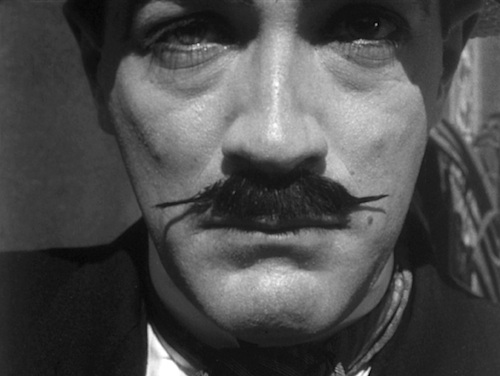
By Joe Bendel. It is not exactly the missing forty minutes of The Magnificent Ambersons, but for Orson Welles fans it is still quite significant. Long considered lost to the ages, the silent short films Welles conceived for an ahead-of-its time stage production have been found (in Italy, as it happens) and restored by the film preservation department of the George Eastman House. Despite their strange genesis, the shorts known collectively as Too Much Johnson perfectly represent the Welles filmography—they are brash, innovative, and unfinished. Always fascinating and sometimes genuinely entertaining, Too Much Johnson, Welles’ first stab at filmmaking, had its long awaited New York premiere last night, courtesy of the Eastman House.

William Gillette’s summer stock staple Too Much Johnson is not revived very often anymore—and the Mercury Theatre’s disastrous production probably deserves its share of the blame. It literally bombed in New Haven. Welles’ original vision was rather ground-breaking. Each act would be preceded by a short silent film in the Max Sennett tradition that would dramatize all the play’s exposition and backstories. Of course, Welles never finished any of the shorts (and it is unclear whether the Stony Creek Theater could have accommodated them anyway), but since he had cut all the presumably redundant background information from the text, the production reportedly baffled critics and patrons alike.

To help contemporary viewers, the Eastman House’s preservation and curatorial staff provided running commentary throughout the New York screening, in addition to the requisite piano accompaniment. Eastman House made no editorial decisions, preserving every frame that came in the can. As a result, there are plenty of gaps, as well as repetitive takes of the same scene. Yet, the finished restoration is a smoother audience experience than it might sound like. Serendipitously, the multiple versions are often madcap hi-jinks that when viewed continuously appear as if the characters are caught in a surreal loop.

From the Orson Welles-Mercury "Too Much Johnson" (1938).

The first act prelude is the most complete and easiest to follow. Joseph Cotten plays a man named Billings, who has been romancing another man’s wife under the assumed name of Johnson. Coming home earlier than expected, the betrayed Dathis chases the man he thinks is Johnson across the future Meatpacking District, eventually ending on the ocean liner that will take both men’s families to Cuba for a dubious vacation. (Once there, Billings looks up an old friend, only to find his plantation is now owned by a man who really is named Johnson. Hilarity no doubt ensues.)

Frankly, Cotten’s prowess for Harold Lloyd comedy is quite impressive. He shimmies across ledges and drags ladders over rooftops like a rubber-boned pro. As if that were not enough, the first short also delivers Welles’ ever indulgent producer, John Houseman, as a bumbling beat cop.

The second and third constituent shorts are much more fragmentary, but there are some striking day-for-night shots of a Hudson Valley quarry, decked out with palm trees to resemble Cuba. Periodically, one gets a glimmer of Welles’ developing eye for composition. Cotten also maintains his energetic good sportsmanship as the caddish anti-hero.

Johnson might be a bunch of odds and ends compared to Welles later masterpieces, but it is strangely compelling to watch the bedlam he unleashes with his co-conspirators. The Eastman program also includes a three minute 16mm film documenting Welles directing Johnson that seems about as chaotic as you would imagine. Yet, there is also something very poignant about the happy-go-lucky but incomplete work, prefiguring Welles later abortive attempts to produce his Don Quixote.

Too Much Johnson is enormously important as cinematic history but also a good deal of fun. The Eastman House intends to hold future screenings with live commentary, so cineastes should definitely keep an eye on their website. They also hope to stage Welles’ adaptation of the stage play incorporating excerpts of the shorts, which is impressively ambitious.

Posted on November 29th, 2013 at 9:04pm.

Internet Age Anxiety: LFM Reviews Chen Kaige’s Caught in the Web

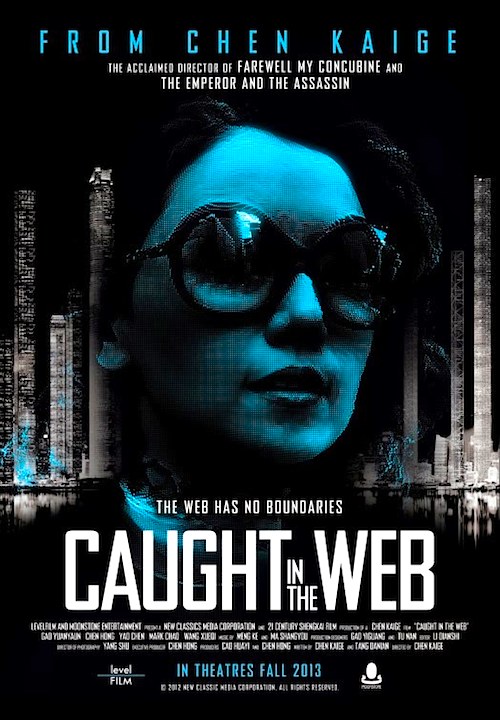
By Joe Bendel. It is the age of the internet troll. Abetted by the tabloid press, anonymous malcontents offer a steady stream of bullying invective aimed at impulsively chosen targets. In this case, the locale is central China, but it could happen here, too. One woman is tragically ensnared in a joint new media-old/media feeding frenzy at the start of Chen Kaige’s of-the-moment contemporary drama Caught in the Web, which opened this week in New York.

During a routine check-up, Ye Lanqiu receives some devastating news: advanced lymphatic cancer, requiring immediate treatment she cannot afford. Dazed, she returns to work on the bus, not noticing the old man coveting her seat. When he complains, she tells him where to get off. Unfortunately, it was all captured on the smart-phone of Yang Jiaqi, who is interning at a television station with her cousin’s ambitious girlfriend, Chen Ruoxi. By the end of the day, Chen will make Ye notorious as “Sunglasses Girl.”

However, Ye’s problems are only getting starting. Seeking a loan and an emergency leave from her industrialist boss, Shen Liushu, Ye breaks down before she can fully explain her dire circumstances. At the worst possible moment, Shen’s high maintenance wife Mo Xiaoyu walks in on them, naturally misconstruing the intimate scene. As Ye becomes a public pariah, Mo pours gasoline on the fire, antagonizing her husband and jeopardizing his big deal with an American firm. While Shen and Mo wage their cold war and Chen bottom feeds, Ye goes into hiding, hiring her nemesis’s increasingly disillusioned boyfriend Yang Shoucheng as her bodyguard.

Whew, end of set-up. From there things get complicated. Chen and his co-screenwriter Tang Danian have scripted the closest thing to a Chinese Tom Wolfe story you will find, chocked to the brim with intertwined characters and loads of zeitgeisty angst. At times, they flirt dangerously with shameless melodrama, but the quiet dignity of Gao Yuanyuan’s lead performance saves their bacon every time. It is a reserved, but deeply tragic turn, nicely matched by the restraint of the Taiwanese-Canadian Mark Chao as her reluctant protector, Yang Shoucheng.

In contrast, Chen’s frequent collaborator Wang Xuegi and his actress-producer-wife Chen Hong produce some spectacular fireworks as the crafty old Shen and his impulsive wife. Perhaps fittingly, Chen Ruoxi is played by Yao Chen, who holds the distinction of having the most followers on China’s micro-blogging service, Sina Weibo. She has also “Weiboed” on behalf of journalists challenging official state censorship, which makes her massively cool as well as popular. She really digs into the character, portraying both her ruthless ambition and her deep-seated insecurities. It is award caliber work that truly makes the film.

Cinematographer Yang Shu (an alumnus of Chen’s Sacrifice) gives it a slick, austere polish that well suits the in-the-know class conscious morality tale. It is a relatively rare contemporary piece from Chen Kaige, but he adroitly manages the large ensemble and keeps the complex proceedings moving along at a healthy clip. Thanks to Yao and Gao, Caught has real dramatic force, as well as a real message. As long as the media focuses on the next “Sunglasses Girl,” they will ignore more inconvenient stories for the powers that be. (That applies beyond China too—just compare the coverage granted the Kardashians to analysis warning of the millions of individual insurance policies that will be canceled under Obamacare.) Highly recommended both for fans of Chinese films and those who appreciate shrewdly observed social cinema, Caught in the Web opens today (11/27) in New York at the Village East.

LFM GRADE: A-

Posted on November 29th, 2013 at 8:53pm.

Just Passing Through: LFM Reviews Shotokan Man, Now Available on DVD

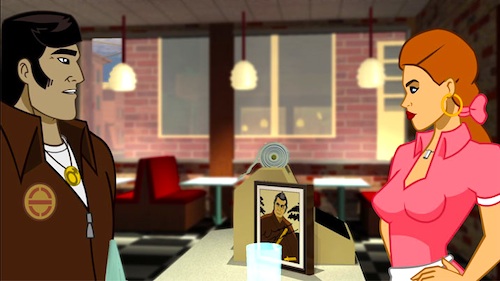
By Joe Bendel. Redneck bullies never learn. If a trouble-making martial arts hardnose says he’s “just passing through,” you’ll never run him off with the typical strong-arm stuff. Instead, tell him to consider settling down. Needless to say, reverse psychology is not the style of the thuggish proprietor of the local Double Death Dojo. Get ready to rumble Roadhouse style with the DVD release of Bob Clark’s animated feature, Shotokan Man (a.k.a. Dixie Dynamite), now available from FilmWorks Entertainment.

Wandering the Earth in search of his absconded American serviceman father has taken the taciturn Dirk to many small towns, but never anywhere quite like Westabooga, Alabama. Thanks to the influence of the Nipponophile Sheriff Fuquay, Westabooga has largely adopted Japanese cuisine and culture, but their necks are still pretty red. The Japanese raised Amerasian drifter does not feel as comfortable as you might expect, though. He has issues with his Japanese heritage, particularly his experiences with his missing father’s dojo.

His Zen-like approach to life and martial arts is quite attractive to single mother Rose Stewart, the owner of the Westabooga Sushi Café and on-again-off-again girlfriend of Dewey, Jr., the narcoleptic sheriff’s entitled son and the leader of the Double Death. It logically follows that Dirk is in for a massive beat down at the hands of Dewey’s students, but the backcountry Possum Master will help him recharge his karma, giving the spiritual conventions of kung fu movies a sly, chicken fried twist.

From "Shotokan Man."

Any film that uses the word didgeridoo more than three times earns points for something. It is Dirk’s instrument of choice and also sometimes a handy club. We do not hear much of it played throughout the film, but there is a nifty arrangement of “Free Bird” featuring shamisen and electric bass. The combination of greasy grits-and-gravy southern living married to higher forms of Japanese art and philosophy ought to produce some outrageous gags, but Shotokan never escalates beyond the level of pleasantly amusing. There is a respect for both traditions, but not a lot of transcendent inspiration.

Still, voice actor George Faughnan has a way of delivering Dirk’s limited dialogue that maximizes the comedic effect. The renderings of Stewart and her waitress Tula Mae should also appeal to junior high school boys, bringing to mind the ladies of Twin Peaks’ Double R Diner for older hipsters.

Frankly, Clark (not to be confused with the Bob Clark who directed A Christmas Story and Porky’s) and co-writer-associate producer Mimi Gentry are surprisingly forgiving in their portrayal of 1979 Alabama. They eschew cheap shots and score settling, only resorting to cliché with the loutish but unremarkable villain, Dewey, Jr. Genre fans raised on a steady diet of Billy Jack movies will find it agreeable but not essential viewing. Of course, all the kids are caught up in Shotokan Man fever these days, making it a hot Christmas item. Recommended for mild chuckles as a stocking stuffer, Shotokan Man is now available on DVD from FilmWorks Entertainment.

LFM GRADE: B-

Posted on November 29th, 2013 at 8:50pm.

StoryCorps for Thanksgiving: LFM Reviews Listening is an Act of Love

By Joe Bendel. Think of it as the less noir version of Naked City with its eight million stories. Dave Isay founded StoryCorps in the belief that there were real life stories out there from everyday people that deserved to be recorded for posterity. For ten years, StoryCorps crews have collected oral histories across the country. Sometimes the stories were funny and sometimes poignant, but their inherent drama has become a source of constant inspiration for the Rauch Brothers. Their short animated adaptations of StoryCorps transcripts have become staples of short film festivals and have regularly been peppered throughout seasons of POV. Fittingly for Thanksgiving and the first day of Hanukkah, POV will premiere its first ever animated special, Mike & Tim Rauch’s Listening is an Act of Love on PBS stations nationwide.

As a wrap-around framing device, Isay’s young nephew Benji interviews his uncle to find out just why he does all this anyway. He has a memorable answer that nicely establishes the theme of Listening: family. The POV special includes four new stories, but begins and ends with two old favorites—and it is not hard to understand why those two struck such a chord with audiences. In the gleefully funny Miss Devine, two cousins swap memories of the titular Sunday School teacher who was a stern, unyielding presence during their summer vacations. Both James Ransom and Cherie Johnson are natural storytellers and the way they crack each other up is appealingly infectious.

Things get more serious and more family-focused during Listening’s debuts, starting with Making It, a simple but inspiring story of the American dream. On the eve of becoming the first in his family to go to college, Noe Rueda reflects on the difficult jobs he held to help his single mother make ends meet. It is probably the most touching segment of the POV segment, even if it is somewhat open-ended. The following Marking the Distance tells the story of a brain tumor survivor, who lost her short term memory, but has since become an accomplished marathoner thanks to the support of a boyfriend. It is a nice, feel-good story, but perhaps the least distinctive of the special.

Arguably, The Road Home gives Listening its greatest emotional pop. Eddie Lanier tells his story of how he went from being the privileged son of a prominent North Carolina mayor to a skid row drunk, until a good Christian Samaritan took him into his home. Wider in scope than the rest of the special, Lanier’s unabashedly redemptive story would be perfect for a Hallmark original film. There is also unexpected power in the twist to the tale Jackie Miller tells her adopted son Scott in Me & You, which has something for pro-life viewers and fans of Modern Family, alike.

Listening concludes with an encore appearance of No More Questions! Kay Wang was not one to suffer fools gladly, but her son Cheng and granddaughter Chen had learned to appreciate her forceful personality. Somehow, they managed to get her to sit for a StoryCorps session, laughing their way through her uncooperative responses that so aptly reflected her personality. In fact, they are probably rather glad it turned out that way in retrospect, judging from the bittersweet postscript.

The Rauch Brothers have a real facility for matching the expressions of their animated figures to the recorded interviews. In fact, they have been known to nail the likenesses and mannerisms of the speakers without having anything to model them on, besides their spoken words. Frankly, it is always reassuring to see a StoryCorps film in a festival’s shorts programming block, because of the Rauch Brothers’ commitment to quality. Recommended for post-turkey family viewing, Listening is an Act of Love airs on most PBS outlets this Thursday night (11/28) as part of the current season of POV.

LFM GRADE: B

Posted on November 26th, 2013 at 2:31pm.

Korea Takes a Stab at Time Travel: LFM Reviews 11 AM

By Joe Bendel. Woo-seok’s shady Russian oligarch patron named his prospective time machine “Trotsky” in the belief history would have turned out radically better if he had bested Stalin in their power struggle. They should have called “Ice-Pick,” considering the mayhem it will cause Woo-seok’s research team. They will struggle to cheat fate in Kim Hyun-seok’s 11 A.M., which opens this Thanksgiving Thursday in Los Angeles.

Everyone knows Woo-seok’s obsession with time travel stems from the untimely death of his wife, regardless of what Hawking says about it. Likewise, many suspect his protégé Young-eun hopes to meet her late theoretical physicist father in the future. His chief deputy Ji-wan is more skeptical. Nonetheless, their wheelchair-bound benefactor ponied up the funds for their undersea facility for his own personal reasons. Unfortunately, the financial spigot will be cut-off unless Woo-seok produces results fast. Against Ji-wan’s advice, he and Young-eun embark on a journey to tomorrow, at 11:00 a.m.

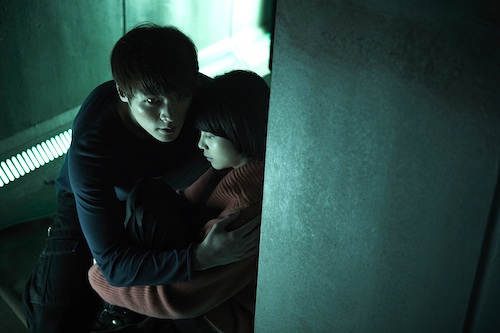
The good news is Trotsky works. The bad news is they discover the lab has been (or will be) destroyed by a series of explosions. As they investigate, Woo-seok is attacked by a mysterious assailant. Whisked back to the previous (current) day without Young-eun, Woo-seok and his crew must determine the source of the impending disaster, as the clock ticks down.

As time travel films go, 11 AM’s internal logic holds together fairly well, explaining its big head-scratching twists in due time. It also has a patina of credibility in the way it acknowledges Hawking’s event horizon. Yet, despite the sci-fi MacGuffin, it is human nature rather than science that poses the gravest danger in Park Su-jin’s screenplay.

From "11AM."

Frankly, Korean film fans will be surprised to discover Kim Hyun-seok, previously a specialist in jaunty rom-coms like Cyrano Agency, had this in him. He nicely balances the more macabre Final Departure-Then There Were None elements with the cerebral scientific speculation. Production designer Kim Minio’s team also creates a credible sci-fi environment, before it all gets blown to smithereens.

The cast goes to piece rather effectively, as well. As Woo-seok, Jung Jae-young is wound wickedly tight, while still exhibiting the intellectual facilities of a man of science. Likewise Kim Ok-bin makes the most of Young-eun’s big revelation scenes, the likes of which actors only get in genre films.

Nacho Vigalondo’s Timecrimes is still probably the gold standard of contemporary time travel movies, but 11 A.M. is a smart and grabby addition to the sub-genre canon. Sort of a SF chamber drama, but with first rate production values, 11 A.M. is recommended pretty enthusiastically for time travel fans when it opens this Thanksgiving (11/28) in Los Angeles at the CGV Cinemas.

LFM GRADE: B+

Posted on November 26th, 2013 at 2:27pm.