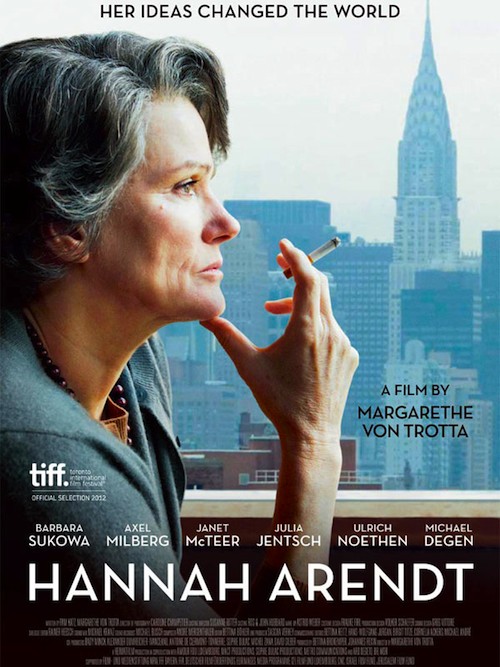
The Philosopher Reports: LFM Reviews Hannah Arendt; Now on Blu-ray/DVD

By Joe Bendel. In her landmark book The Origins of Totalitarianism, Hannah Arendt examined the close kinship between Stalinism and National Socialism. Surprisingly, it did not cost her many friendships amongst the intelligentsia. Of course, her think-piece reporting on the Eichmann trial in Jerusalem would be a different matter entirely. The defining controversy of the philosopher’s career is logically the focus of Margarethe von Trotta’s Hannah Arendt, which just released on DVD and Blu-ray from Zeitgeist Films.

As the film opens, Arendt has settled into a relatively comfortable life as a naturalized citizen, teaching at the New School and tolerating her husband Heinrich Blücher’s discrete infidelities. The Mossad has just captured Adolf Eichmann—news that electrifies Arendt’s Jewish colleagues. Intrigued by the implications of the trial, Arendt offers her services to New Yorker editor William Shawn as a correspondent, which he accepts because she is Hannah Arendt.
To the bafflement of old friends, the frustrated Arendt becomes preoccupied with Eichmann’s bureaucratic blandness and his willingness to surrender his status as an individual. It seems rather strange how divisive her resulting theory of the “banality of evil” was at the time, considering how thoroughly it now informs our collective impression of Eichmann and other war criminals of his ilk. Perhaps even more contentious, her critical observations regarding the miscalculations of some National Socialist appointed “Jewish Councils” to engage in some forms of temporary tactical acquiesce are not as widely held, but they are far from uncommon complaints today.

Von Trotta’s Arendt captures the intellectual swagger of Arendt and her circle, as well as the still relatively buttoned down tenor of the very early 1960’s. The New School still looks much the same from the outside, but chain-smoking is most likely frowned upon in lecture halls. It is a quality period production that looks true to the era during the scenes in both New York and Israel.

Frankly, von Trotta and co-writer Pamela Katz are not above playing favorites, portraying Norman Podhoretz as a knee-jerk hyper-ventilator, whereas Mary McCarthy is faultlessly down-to-earth and sympathetic. Still, the depiction of Arendt, as written by von Trotta & Katz and played by Barbara Sukowa, is remarkably complex and even-handed. Viewers fully understand just how thoroughly Arendt’s emotions are subservient to her intellect. What was once a defense mechanism becomes problematic, preventing her from anticipating the furor stemming from her articles. Von Trotta shrewdly resists the lure of an easy ending, ending the film on a decidedly ambiguous note.

Sukowa is admirably restrained as Arendt, to a degree approaching the tragic. Yet, she has some deeply human moments, particularly with Klaus Pohl as her disgraced former mentor-lover, Martin Heidegger. Cerebral and literate, yet rather forgiving of human foibles, Hannah Arendt is a compelling portrait of a difficult figure to do justice on-screen. Respectfully recommended for those who appreciate intellectual history, Hannah Arendt is now available for home viewing from Zeitgeist Films.

LFM GRADE: B

Posted on November 21st, 2013 at 2:18pm.
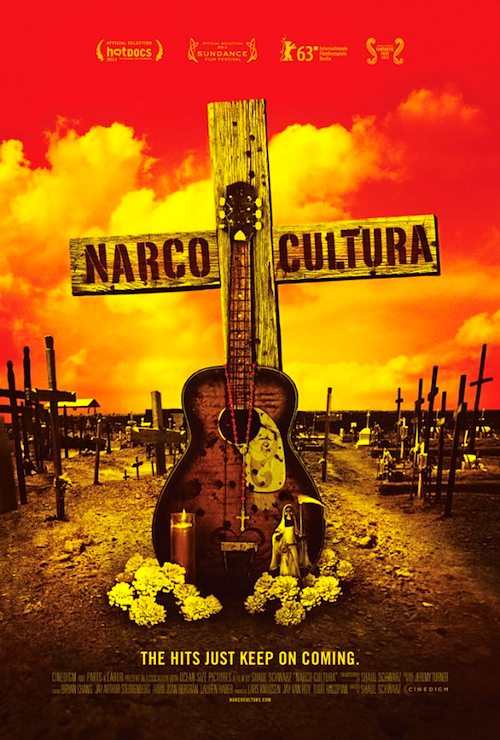
Violent Accordion Music: LFM Reviews Narco Cultura

By Joe Bendel. It makes gangster rap sound polite and progressive. Narcocorrido is a virulent cousin of cajunto, lionizing the drug traffickers and assassins terrorizing Mexico. Banned in their home country, narcocorridos are largely based in American border cities and do a brisk business through legitimate American retailers. (Indeed, Sam Walton would not be happy to hear what his stores now carry.) Shaul Schwartz observes the state of underground narcocorrido culture and the violence it celebrates in Narco Cultura, which opens this Friday in New York.

Raised in Los Angeles, Edgar Quintero fetishizes narcoterrorism on stage as the front man of up-and-coming narcocorrido band BuKnas de Culiacan. Riccardo Soto sees the fruits of narcocorrido culture every night as a crime scene investigator. On the plus side, Soto’s skills are in high demand. Unfortunately, he and his colleagues must wear balaclavas to protect their identity when responding to a call. For obvious reasons, the dedicated family had tendered his resignation, but his sense of duty compelled him to return six months later.

Almost entirely observational in his approach, Schwartz never asks Soto for a review of Quintero’s latest CD. Nor does he confront Quintero with crime scene photos of the latest innocent bystanders cut down by his idols. Presumably, Schwartz was concerned about preserving his subjects’ trust and access, as well as maintaining a consistent tone. However, this obvious avenue of inquiry forgone casts a long, distracting shadow over the film.

At one point, Schwartz revisits the blinged-out cemeteries previously seen in Natalia Almada’s El Velador, but Cultura has considerably more get-up-and-go than its defiantly oblique predecessor. Things definitely happen in Schwartz’s film, but it is dominated by the bloody aftermaths of the cartels’ ruthless business rather than action per se.

The picture that emerges of a Mexico plagued by bloodshed and corruption is not pretty. Frankly, it would have been an important wake-up call, but it may have come too late. Watching the reckless aggression of the narcos, clearly abetted by crooked government officials, it appears Mexico is teetering on the brink of becoming a failed state. Schwartz never bothers to seek any elusive solutions. Who knows, maybe France can re-install the heir of Emperor Maximilian.

Narco Cultura is fully stocked with dramatic images, many of which approach the threshold of outright shocking. Yet, the film is essentially a cinematic shrug, taking it all in, but never delving too deeply into the dysfunctional pop culture it documents. Far superior to El Velador, but not nearly as emotionally engaging as Bernardo Ruiz’s Reportero, Narco Cultura is still eye opening stuff, recommended for Lou Dobbs watchers when it opens this Friday (11/22) in New York at the AMC Empire.

LFM GRADE: B-

Posted on November 21st, 2013 at 2:15pm.

Faith and Fraud in Provincial Korea: LFM Reviews The Fake

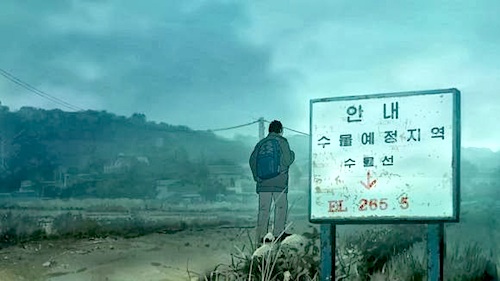
By Joe Bendel. Pastor Sung is sort of a Korean Elmer Gantry, except he is the closest thing to a good guy in this dark, animated examination of human nature. He had the profound misfortune to become entangled with a ruthless con artist, but the man out to expose them is the worst of the lot in Yeon Sang-ho’s The Fake, which just started a week-long Oscar-qualifying run in Los Angeles.

The best part of absentee father Min-chul has been his absence. Physically and emotionally abusive, his homecoming is far from a happy event for his meek wife and daughter, the long suffering Young-sun. Plundering Young-sun’s college savings for gambling money, Min-chul inadvertently drives her into the arms of the local faith-healing church—the very sort of outfit he most despises.

Devastated by a prior scandal, the gentle Pastor Sung has fallen for the false promises of “Elder” Choi, a wanted con man. Through drunken happenstance (and a night in lock-up), Min-chul learns the truth about Choi, but nobody will listen to the obnoxious cretin. A savage war commences between Min-chul and Choi’s henchmen, while the shadowy crook pressures Pastor Sung to finish fleecing his flock.

Fake is nothing like what you probably expect, beyond its pitch black portrayal of human nature. Its depiction of blind faith might be unflattering, but nothing is more miserable than the abject lack of a higher meaning in one’s life. Min-chul is not an anti-hero. He is a vile brute driven by rage and contempt for his fellow man—and he is unquestionably the face of atheism throughout the film. In a variation on Chesterton, Min-chul suggests those who believe in nothing, hate everything.

From "Fake."

With its acrid irony and complete lack of sentimentality, Fake is not likely to be embraced by Christian audiences. Yet, it is a deeply moral film. It is also unremittingly pessimistic, perhaps setting the world’s record for the most grimly naturalistic animated feature ever. Frankly, Yeon’s figures are not very expressive, perhaps showing slightly less definition than those in his feature debut, The King of Pigs. However, his characters very definitely have something to say. Set in a provincial small town scheduled to be demolished for the sake of a massive public works project, the film also has a distinctive, vaguely apocalyptic vibe that is hard to shake.

Parents should note, Fake is completely inappropriate for children. In addition to its very complex themes, there is considerable violence, harsh language, and all kinds of inhumanity directed at man and beast alike. However, the mature audiences for whom it is intended should find it a visceral, but surprisingly thoughtful film. Highly recommended for those who appreciate challenging adult animation (and Academy members), The Fake is now showing at the CGV Cinemas in Los Angeles.

LFM GRADE: A-

Posted on November 19th, 2013 at 11:46am.

LFM’s Jason Apuzzo & Govindini Murty at The Huffington Post: Young Man on the Run: Catching Up with Shia LaBeouf and Charlie Countryman

[Editor’s Note: the post below appears today at The Huffington Post.]

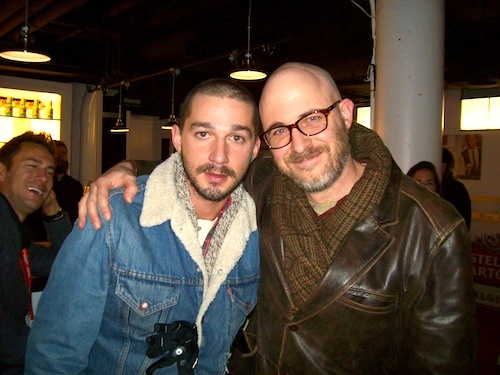
By Jason Apuzzo & Govindini Murty. Shia LaBeouf can’t keep still.

That’s what stands out when you meet the voluble 27 year-old star of the new indie thriller-romance Charlie Countryman, which opens in limited theatrical release and on VOD this Friday, November 15th. The hustling young man we’ve gotten to know in the Transformers and Indiana Jones movies – the fast-talking, nebbishy tough guy with a big heart, always improvising, always on the move – is very much the same guy in person.

Charlie Countryman premiered at Sundance earlier this year (back when it was called The Necessary Death of Charlie Countryman), where we talked to LaBeouf, co-star Evan Rachel Wood, and director Fredrik Bond at the film’s press day.

Govindini Murty and Shia LaBoeuf at Sundance 2013.

Charlie Countryman takes LaBeouf in a direction familiar to anyone who remembers him playing impulsive teenager Sam Witwicky in 2007’s Transformers: that of a sentimental hot-head on a hopeless quest for a girl, comedically improvising his way into and out of one scrape after another.

“It’s not a humongous departure from my real life,” LaBeouf said at the press day. “This is a guy who thinks with his heart, rather than his mind … and who doesn’t show a lot of caution toward consequences, which isn’t far from who I am.”

Charlie Countryman follows LaBeouf on a wild, hallucinogenic vision-quest through post-communist Bucharest as he pursues a world-weary femme fatale cellist named Gabi (Evan Rachel Wood), while battling over her with a pair of unhinged Euro-mobsters (Mads Mikkelsen and Til Schweiger). Infused with heart-on-your-sleeve sentimentality by director Fredrik Bond, the film is both a coming-of-age story for Charlie and a picaresque, ‘everyman’-style thriller reminiscent of the novels of Eric Ambler (The Mask of Dimitrios, Journey into Fear).

Rounding out the film’s impressive cast are Rupert Grint as one of Charlie’s drug-crazed buddies, Vincent D’Onofrio as Charlie’s depressive brother, and Melissa Leo as Charlie’s hippyish mother – with LaBeouf’s Indiana Jones co-star John Hurt providing narration.

Charlie Countryman‘s biggest star, however, may be Bucharest itself – which the film presents as an exotic, old world blend of high culture and low-life gangsterism, still adjusting to the post-Cold War world. LaBeouf’s nocturnal adventures in Bucharest – a darkly glamorous city that somehow seems trapped in a 1990s time warp – often feel like an MTV version of Joseph Cotton’s nighttime journeys through crime-ridden, post-War Vienna in Carol Reed’s The Third Man.

Shia LaBeouf and Jason Apuzzo at Sundance 2013.

LaBeouf lights up on the subject of Bucharest, gesticulating and going into one of his typical, animated riffs. “I arrived quite ignorant, you know – I’m an ignorant American,” he quips. “I haven’t really done much traveling beyond my work life. I never really picked up a Romanian book, or decided to study Romanian.

“But you get there, and you hear about [former Romanian communist leader Nicolae] Ceaușescu, you get to the [Revolution] Square, you see where the blood fell, talk to these people – you know, some people who still want communism, who are upset that it’s gone – and you don’t quite understand what that‘s about …

“I’ve heard people say that we have dated villains [in Charlie Countryman] – that’s because … Romania is dated – it’s 10 years behind. They’re still playing the ‘Thong Song’ in clubs,” he cracks. “It’s no joke, so this is part of the world of these dudes [the film’s gangster villains]. It’s not artificial – this is what we ran into.

“And it’s very sexy,” he smiles. Continue reading LFM’s Jason Apuzzo & Govindini Murty at The Huffington Post: Young Man on the Run: Catching Up with Shia LaBeouf and Charlie Countryman

La Dolce Vita: LFM Reviews The Great Beauty, Italy’s Oscar Submission

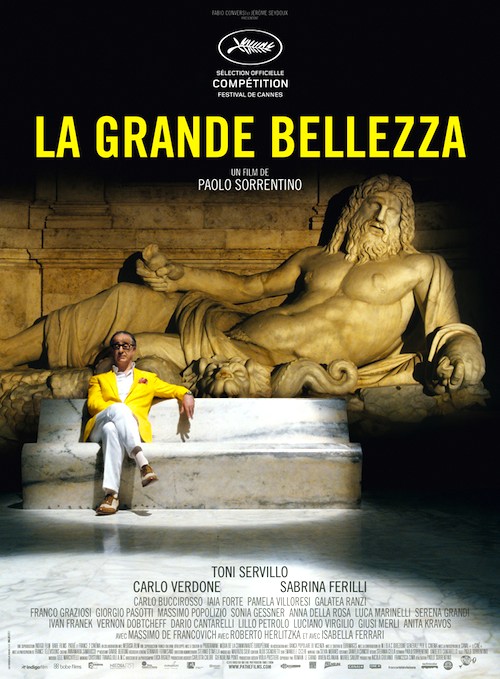
By Joe Bendel. Writers write, that’s what they do. Jep Gambardella still qualifies, just barely. After the publication of his acclaimed first novel, he chose to spend the rest of his career penning Vanity Fair-style celebrity profiles. It was much easier, but far less satisfying. Gambardella belatedly realizes this holds true for all aspects of his life in Paolo Sorrentino’s The Great Beauty, Italy’s official foreign language Oscar submission, which opens this Friday in New York.

It is Garbardella’s sixty-fifth birthday and his social circle is ready to party like they are really his friends. The magazine writer is in his element. However, he turns uncharacteristically pensive when he learns his great lost lover has passed away, perhaps still harboring undiminished feelings for him. Hoping to experience a similar passion, Gambardella commences a relationship with Ramona, the daughter of his old strip-club owner crony, who still works in the family business at the impressive age of forty-two. Perhaps there is some substance to their affair, but at the very least, her presence on his arm thoroughly scandalizes Rome’s high society.

A rapturous viewing experience, Great Beauty must be the most elegant looking and sounding film since Luca Guadagnino’s I am Love. Frankly, it takes considerable guts to make a film that so perilously invites comparison to Fellini’s La Dolce Vita, but Sorrentino has boldly gone there nonetheless. He masterfully maintains a mood that is palpably seductive and elegiac. Indeed, Great Beauty is likely to induce a midlife crisis in viewers, regardless of their age or accomplishments. Yet, it is an elusive cinematic statement that slips through your fingers whenever you try to analyze it.

Sorrentino’s frequent collaborator Toni Servillo gives the career performance of an accomplished career as Gambardella. Wonderfully urbane and devilishly witty, he nonetheless acutely expresses Gambardella’s each and every regret. This is Academy Award caliber work, but Great Beauty is so refined and mature it will probably be lucky just to make the foreign language cut.

Of course, Servillo is not laboring alone. As Ramona, Sabrina Ferilli’s earthy vulnerability perfectly complements Servillo’s cerebral angst, while the manic melancholy of Carlo Vendone as Gambardella’s writer-associate further heightens the Fellini-esque vibe, whereas Giovanna Vignola is simply incomparable as his acerbic editor, the diminutive Dadana.

Clearly, nobody shoots statuary and architectural edifices like cinematographer Luca Bigazzi. Similarly, the themes composed by Lele Marchitelli, as well as several shrewdly licensed selections from the likes of Arvo Pärt, provide a rich feast for the ears. Altogether, Great Beauty is a powerful and assured film on every level. Very highly recommended (especially to Academy members), it opens this Friday (11/15) in New York at the Lincoln Plaza Cinemas.

LFM GRADE: A

Posted on November 11th, 2013 at 2:48pm.

LFM’s Jason Apuzzo at The Huffington Post: Putting Computers in Their Place: Computer Chess & The Nerd Origins of Today’s Technopoly


[Editor’s Note: the post below appears today at The Huffington Post.]

By Jason Apuzzo. Computers need to be put in their place. They really do.

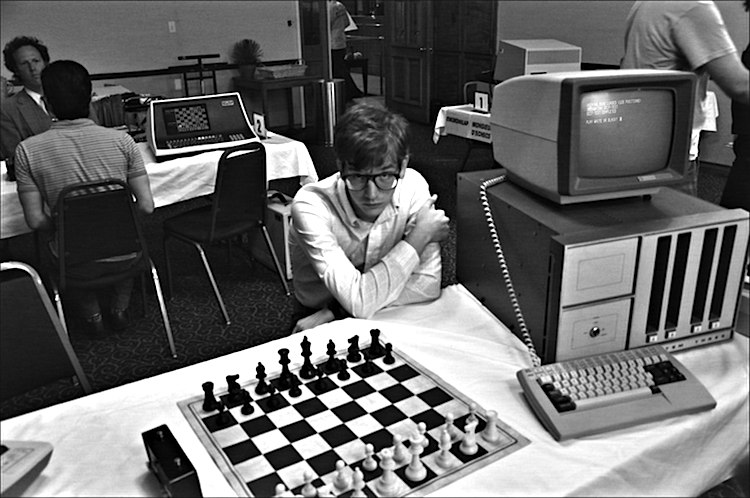
That’s why I’ve been looking forward to the DVD release this week of Andrew Bujalski’s cult Sundance hit Computer Chess. Computer Chess finally spills the beans about where these little monsters came from in the first place.

Every time I pick up a newspaper these days – I’m one of the twelve people left who still read physical newspapers – I read about how computers are spying on us, destroying jobs, or infuriating health insurance customers. Like a hungry Rottweiler off its leash, computers are getting out of control and tearing up the neighborhood.

If you believe what you read, computers are also in the process of wrecking the book publishing and music industries, eliminating celluloid photography – and just this week computers claimed their latest victim, one near and dear to my heart: the local video store, as Blockbuster finally succumbed to laptops, smartphones and tablets as the preferred ways of renting all those movies you couldn’t afford to see (or were too embarrassed to see) when they were in theaters.

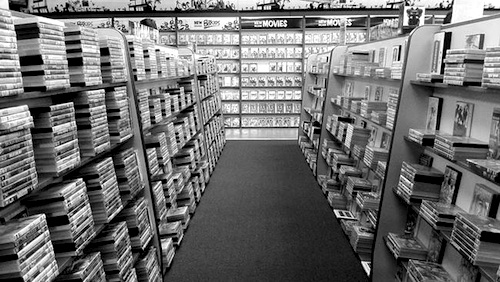
2013-11-08-VideoStoreaisle.jpg
The demise of the American video store.

No more video stores – who would’ve believed it, even just ten years ago? That means no more pimply teenagers to recommend midnight horror movies to me (“Sir, I definitely recommend C.H.U.D. over TerrorVision“), no more aimless browsing or listening to neighbors argue over which Steven Seagal movie to rent, no more cheap licorice sticks at the checkout counter.

I never thought I’d miss those things so much – but suddenly I do. And it’s all because of our ‘friend’ the computer. Computers are becoming like the Yankees during the ’90s: gobbling up everybody else’s talent, then telling us how good it is for baseball.

The propaganda over the wonders that computers supposedly bring to our lives is getting out of hand. In the very least, it’s out of proportion to the destruction computers are simultaneously causing – that ‘disruptive’ effect Silicon Valley gurus salivate over, like vampires at a blood drive.

So as Twitter – the company currently reducing our public discourse to snarky, 140-character outbursts – celebrates its gaudy IPO right now, I’d like to recommend a new movie out on DVD this week that casts digital technology in a very different light: Computer Chess. Continue reading LFM’s Jason Apuzzo at The Huffington Post: Putting Computers in Their Place: Computer Chess & The Nerd Origins of Today’s Technopoly