The Long Shadow of the Holocaust: LFM Reviews Aftermath

By Joe Bendel. It is a fact that there were more righteous gentiles from Poland than any other country. It is also a fact that many Polish survivors refused to return to the homeland after the war. There is a certain defensiveness that manifests itself when the Polish Holocaust experience is discussed. Using the term “Polish concentration camps” is sure to bring objections that these were German death camps they just happened to build in occupied Poland for reasons of logistics. This is a fair point. Nonetheless, it was a complicated period of history that Polish cinema has rarely addressed so defiantly forthrightly as writer-director Władysław Pasikowski has with Aftermath, which opens this Friday in New York.

The fate of Jewish Poles simply was not acknowledged during the old regime, so there was no cause to worry about potential consequences for past injustices. However, this was no longer necessarily the case after the fall of Communism. Such issues could not be further from Franek Kalina’s thought when he finally returned to the ostensibly sleepy hamlet of his birth. The elder Kalina brother immigrated on the eve of Martial Law and never looked back, until his sister-in-law unexpectedly arrived in Chicago. Evidently, something was wrong on the homefront, but her silence forced him to back his long deferred homecoming journey.
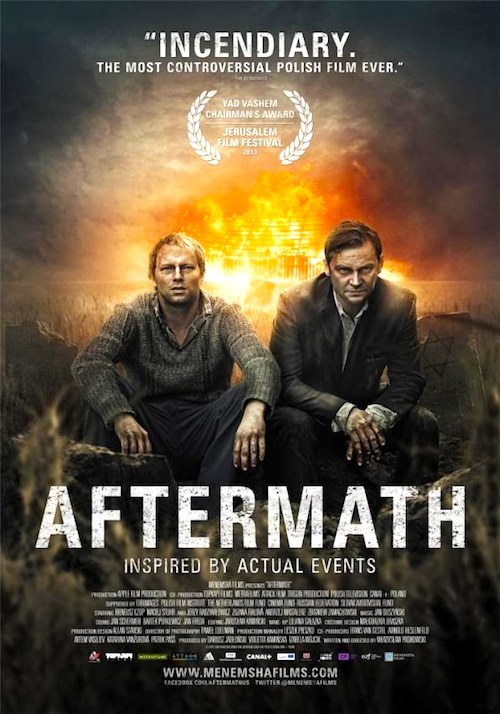
It is an awkward reunion to say the least. His brother Jozek is not especially talkative either, but Kalina eventually discovers why they have been shunned by the town. His brother has systematically collected the Jewish grave markers the National Socialists had used to pave a local thoroughfare and patch up certain municipal works, erecting a makeshift cemetery in a corner of the family field. This is not appreciated by their neighbors. Initially, the Kalinas assume they merely resent the unpleasant memories. However, the slowly discover the town’s damning hidden history.

For the well educated, Aftermath’s revelations probably do not sound so stunning on paper, but Pasikowski’s slow drip-by-drip revelations are brutally effective. This is the sort of film where viewers will find themselves surprised to be surprised. It is a bracing film that pulls no punches, yet there is redemption amid the denial and intolerance it depicts. In fact, there is something particularly moving about the rough hewn Jozek Kalina, compelled to seek out and restore the headstones out of a humanist impulse he is incapable of verbalizing.

Ireneusz Czop and Maciej Stuhr (the son of actor-director Jerzy Stuhr, renowned for his work with Krzysztof Kieślowski) convincingly look and act like brothers. Their fraternal rivalry takes on Biblical proportions, yet they clearly convey that instinctive bond. Aftermath is their shared dominion, but they receive some distinctive support, particularly from Danuta Szaflarska and Maria Garbowska, as elderly villagers who perhaps partly know the dark truths the Kalina Brothers seek.

Considering the great Andrzej Wajda (who co-wrote Katyn with Pasikowski) has heartily endorsed Aftermath, it should not be considered anti-Polish by any stretch. It is a tough, uncompromising film, but a little bit of soul-searching is a healthy exercise. In America, agonizing over our past sins is practically a national pastime. In contrast, European nations seem far more inclined to consign less than edifying historical episodes to the collective memory hole. There probably ought to be a happier medium. Aftermath absolutely does its part in that regard. Despite a ragged dramatic edge here or there, it is viscerally powerful as a whole. Recommended for those who appreciate outspoken contemporary dramas with a keen sense of history, Aftermath opens this Friday (11/1) in New York at the Cinema Village.

LFM GRADE: B+

Posted on October 30th, 2013 at 5:12pm.
LFM Reviews Soul @ The San Francisco Film Society’s Taiwan Film Days

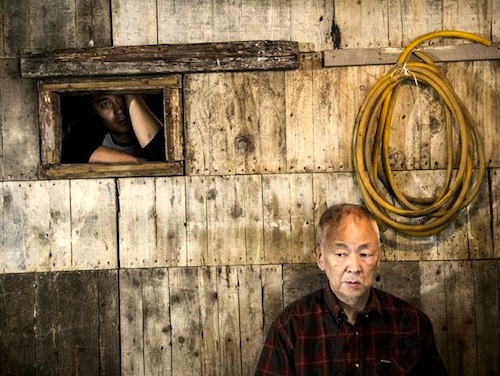
By Joe Bendel. Plato, Aristotle, St. Augustine, and St. Thomas Aquinas all labored to define the soul. Unfortunately, their scholarship will be of little practical use to Old Wang. Rather instinctively, he protects his son A-chuan’s body, so it will be available for his soul to re-enter. Just who or what is currently inhabiting that vessel is one of the great mysteries of Chung Mong-hong’s Soul, which screens during this year’s edition of the San Francisco Film Society’s Taiwan Film Days.

A-chuan works as an assistant cook in a Taipei sushi restaurant—or at least he did until he passed out at work. With the help of two co-workers, his sister Hsiao Yun shuttles him back to their father’s rustic mountain home, where the old man raises orchids and apples. Beyond mere sickness, A-chuan does not seem to be himself. Suspecting something is profoundly wrong, Hsiao Yun starts to raise her reservations to Old Wang, only to be murdered by A-chuan (or rather A-chuan’s body) shortly thereafter.

At this point, Old Wang springs into full cover-up mode, locking A-chuan (or whoever) into his utility shed. Soon he and the whatever are speaking openly of the situation. Supposedly he/it moved in when A-chuan temporarily vacated his body. He cannot really say why A-chuan left, but Old Wang eventually concludes it all has something to do with some painful family history. Regardless, he is willing to dispatch whomever he must to keep this incident under wraps.

Is he protecting A-chuan’s bodily interests or the new soul, whom he comes to know rather well? That is one of the rich ambiguities of Soul. It features a good deal of traditional genre trappings and a massively atmospheric setting, but it is hard to define it in pat terms. However, all cult film fans need to know is Jimmy Wong of One-Armed Swordsman fame stars as the conflicted Old Wang.

From "Soul."

Wong perfectly matches the film’s subtlety and understatement, keeping the audience completely off-balance yet totally invested in the domestic horrors his character is caught up in. Likewise, Joseph Chang’s quiet turn as A-chuan (and his possessor) stealthily sneaks up on you. Vincent Liang also thoroughly subverts and surpasses expectations as Little Wu, A-chuan’s former schoolmate now working as put-upon patrolman.

Soul is an unflaggingly naturalistic yet unusually philosophical film. Taut rather than terrifying, Chung maintains a pace that is patient but never pokey. Serving as his own cinematographer under the open pseudonym of Nakashima Nagao, he captures some striking images of the dark, verdant woods, creating a vivid sense of place.

It is an accomplished film and a timely selection, given the fact Taiwan has officially chosen it as its Foreign Language Oscar submission. On paper it does not sound like a good fit for the Academy’s tastes and preferences, but who knows? Frankly, Soul could be thought as the sort of film Uncle Boonmee was supposed to be but fell short of. Eerie and engrossing, Soul is recommended for fans of headier genre fare when it screens this Saturday (11/2) at the Vogue Theatre as part of the SFFS’s Taiwan Film Days.

LFM GRADE: A

Posted on October 30th, 2013 at 5:05pm.

LFM Reviews Apolitical Romance @ The San Francisco Film Society’s Taiwan Film Days

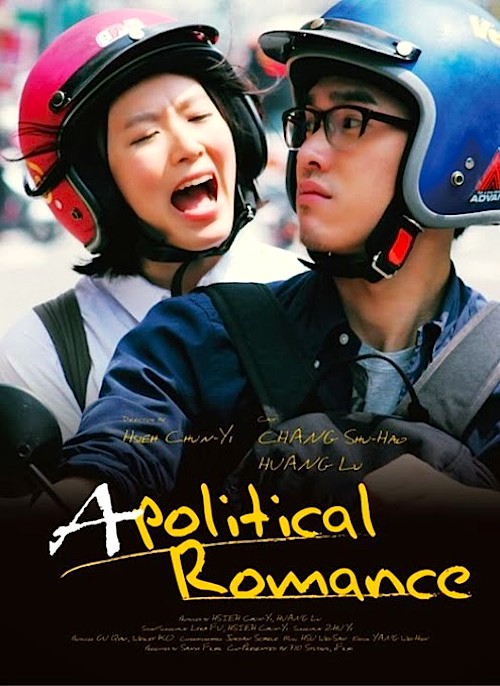
By Joe Bendel. She takes her cue from government propaganda, whereas he takes inspiration from Gundam. Advantage: his. They will bicker constantly as a mutual attraction slowly but steadily develops in Hsieh Chun-yi’s cross-border rom-com Apolitcal Romance, which screens during the San Francisco Film Society’s annual Taiwan Film Days.

Like any self-respecting slacker, Chen Yu-zheng (a.k.a. A-Zheng) took a government job. Normally, it is not terribly demanding, but his boss is on his case over a report on various differences of etiquette for the mainland and Taiwan. He has a week to fix it, but he has no clue when it comes to the PRC. As fate would dictate, Qin Lang is in Taipei for a week, hoping to track down Chen Guang, her grandmother Li Huan’s fondly remembered lover from sixty years back. They will sort of come to an arrangement.

Loud and argumentative, Qin Lang will not get very far on her own, but Chen was born to navigate Taiwan’s bureaucracy. Before you can say “red tape” he has a list of Nationalist veterans born in Li Huan’s home province. As they follow-up each lead, the sparks start to fly, but never past a certain point. Apolitical is all about possibilities rather than consummations. By rom-com standards, Hsieh’s film is wildly ambiguous, but that is its real charm. We cannot even say definitely whether they ever will be a proper couple, but they clearly are in each other’s heads.

Apolitical also offers a fascinating look into the perceived differences between the Republic and mainland China, presenting the Beijinger as reflexively jingoistic and the Taiwanese Chen as a meek geek. However, Hsieh never really delves into specific ideological differences. Instead, he aims for nostalgic romanticism with every story of separated love Chen and Qin Ling hear in their quest for Chen Guang.

Bryan Chang and Huang Lu are ridiculously attractive would-be/maybe lovers, but they never get too cute or cloying. They get some rather sensitive support from many of the Chen Guangs, particularly Chien Te-men as number four. Not surprisingly, there is an episodic quality to the film that mostly works quite well, but Hsieh pushes his luck with a flawed subplot involving Qin Ling’s former lover. In contrast, Chen’s visit to his disgraced father packs some quiet power precisely because it is not over written or over played.

Apolitical is never as achingly emotional as Hsieh’s exquisitely poignant short Braid, but its restraint is a virtue. It is a rom-com, more or less, but it is also a wistful commentary on the absurdly arbitrary things that separate people, like borders, ideologies, and health exchanges. Recommended for those who prefer curve ball movie romances rather than a happily-ever-after fastball over the plate, Apolitical Romance screens this Sunday (11/3) at the Vogue Theatre as part of this year’s installment of the SFFS’s Taiwan Film Days.

LFM GRADE: B

Posted on October 30th, 2013 at 5:02pm.

Keanu Reeves & Tiger Chen Show Their Chops: LFM Reviews Man of Tai Chi

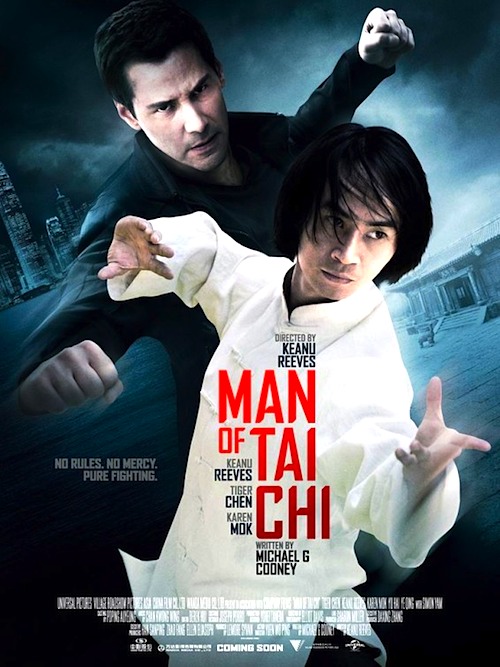
By Joe Bendel. It was Tiger Chen who really knew kung fu. He was the stuntman responsible for Keanu Reeves’ martial arts training during the production of the Matrix trilogy and he made quite an impression. For his directorial debut, Reeves introduces Chen to the world with his old school beatdown, Man of Tai Chi, which opens this Friday in New York.

“Tiger” Chen Lin-hu is the last student of Master Yang, a great Ling Kong Tai Chi teacher. In contemporary Beijing, Tai Chi is mostly associated with old men doing their “soft” qigong in the park. However, Chen is starting to get noticed in the above board MMA world for his traditional “hard” practice of the ancient discipline. He also catches the eye of the shadowy Donaka Mark. When shady developers conveniently threaten to condemn his master’s temple, the lowly deliveryman becomes easy prey for Mark’s overtures.

Initially, Chen truly does not understand what he is getting involved in. However, as he notches victories in Mark’s underground fight circuit, Chen starts to enjoy the money and adrenaline. Unfortunately, the matches make him more aggressive, jeopardizing his relationships with his master and Qingsha, the cute-as-a-button paralegal helping him save the temple. Nonetheless, he cannot help noticing the stakes escalate with each bout.

Hong Kong police captain Sun Jing-si knows where it all leads: fights to the death broadcast over secure online connections for Mark’s exclusive clientele. Always a step behind the malevolent mastermind, she needs an informant to take the place of the one Mark just killed – someone like Chen, if she can find him.

With Tai Chi, Reeves had the good sense to make a film he would enjoy for his maiden directorial outing. Frankly, he shows serious action helmer chops, staging fight sequences that are crystal clear and easy to follow. There are no barrages of close-ups here. Reeves gives us the full Fred Astaire body shots, precisely so we can appreciate the technique of his main man, Chen.

The results are convincing. While Tai Chi is not the most original narrative under the sun, it deliberately harkens back to the gritty low budgets classics that launched the careers of legends. Chen maybe is not the most expressive actor you will ever see (after all, Reeves is his thesp-mentor), but his earnest gee-whiz persona works well in the context of the film. Oddly enough, Reeves is a bit of a surprise here, making a dynamite villain with his piercing stare and apparently insatiable appetite for the scenery around him.

Karen Mok is also seriously hardnosed as Sun, bringing real supporting heft to the film. Simon Yam adds further HK action cred as Superintendent Wong, her suspiciously unhelpful superior. Qing Ye is not exactly a natural on-screen either, but she still represents Chen’s lost innocence rather effectively. Yet for genre fans, nobody tops Shaolin veteran Yu Hai, doing his thing with stately gravitas as Master Yang. Bizarrely though, The Raid’s Iko Uwais is completely wasted in a mere tease of a cameo.

Reeves might not be Clint Eastwood’s successor as the next great actor-director, but Tai Chi is a pretty slick calling card. If need be, he should easily find a second career as a straight-to-DVD action director, which is considerably higher praise than it sounds (those cats actually have to be good). Likewise, Chen might not be the next Daniel Day-Lewis, but watching him kicking butt is hugely entertaining. Way better than you think, Man of Tai Chi is recommended for martial arts fans and Karen Mok admirers when it opens this Friday (11/1) in New York.

LFM GRADE: B

Posted on October 28th, 2013 at 9:58pm.

Strange Things Happen in Utah: LFM Reviews Skinwalker Ranch

By Joe Bendel. It is an area notorious for weird happenings, but this is northern Utah, so they can’t be blamed on drunken misperceptions. In fact, a private paranormal research team could probably use a stiff shot when things start going bump in the night in Devin McGinn’s Skinwalker Ranch, which launches on VOD and screens in select cities this Wednesday.

Some locals believe the home video purportedly showing a young boy whisked away by supernatural forces is legitimate, while some suspect it is a hoax concocted by his father. Desperate to find his son, distraught rancher Hoyt Miller welcomes a team of scientists from Modern Defense Enterprises and a journalist recruited to serve as a neutral observer, hoping they can supply some answers. They wire the house and surrounding property with motion sensor cameras and settle in, but they will not have long to wait. An unearthly high pitched tone rudely awakens them their first night in the field, with subsequent uncanny events preventing them from getting much sleep thereafter.

Although not entirely found footage, a great deal of Skinwalker unfolds from the perspective of the surveillance cameras. By genre standards, McGinn shows admirable patience in the early going, nicely setting the scene and establishing the ranch’s atmospheric nooks and crannies. For a while, it is surprisingly creepy, thanks to his skillful use of suggestion and mystery to build the tension. Unfortunately, the conclusion seems rather rushed, but with horror movies, a good set-up often compensates for a weak ending.

Although the helmer directing himself is usually a red flag, McGinn is actually quite respectable as Cameron Murphy, the semi-skeptical journalist. Jon Gries is also better than average as the poor, suffering Miller. Frankly, Skinwalker earns a recommendation just for casting the eternally cool Michael Horse (a cult favorite from Twin Peaks) as Ahote, a vaguely shaman-esque figure who offers the helpful advice to get the good golly out of there.

Skinwalker’s fusion of the horror and alien abduction genres is hardly original, but the execution exceeds expectations. After all, for a low budget programmer, not bad is pretty good. Recommended for a Halloween outing with like-minded viewers, Skinwalker Ranch screens this Wednesday (10/30), Devil’s Night, in theaters throughout Texas, Florida, and Alabama.

LFM GRADE: B-

Posted on October 28th, 2013 at 9:51pm.

Her Father’s Voice: LFM Reviews Blood and Ties

By Joe Bendel. The so-called “Hwaseong Murders” were South Korea’s first recorded serial killings, but the statute of limitations expired before the murderer was uncovered. The case’s impact can still be discerned in Korean cinema’s fascination with serial killers and the ticking prosecutorial clock. Bong Joon-ho’s Memories of Murder was transparently based on the Hwaseong killings and it is easy to see its influence on Jung Byoung-gil’s Confession of Murder. The notorious crimes also directly inspired Kook Dong-seok’s Blood and Ties, which opens this Friday in Los Angeles.

Jung Da-eun’s working class father Soon-man never had much, but he made sure she never lacked for anything. Now a grown adult, she still lives at home with the ever dedicated single parent. All her grad school friends adore dear old dad too, but after watching a lurid new documentary, they cannot help noticing how similar his voice sounds to that of a notorious child abductor. The unknown perpetrator was only recorded during a brief ransom call, but he even uses one the senior Jung’s favorite catch phrases.

Thoroughly confused and suspicious, Jung’s daughter starts poking around. The sudden appearance of Shim Yoon-young further amplifies her anxiety. He is obviously an unsavory character, but seems to share some murky history with her father. As the media trumpets the imminent expiration of the statute of limitations, Jung Da-eun struggles with her doubts and loyalties.

From "Blood and Ties."

B&T is a wicked high concept thriller with ample opportunity for high tragedy, but it does not guard its secret closely enough. The set-up is downright sinister and the top-shelf primary cast maintains the intensity, but viewers will always have a pretty good idea where it is all headed.

Son Ye-jin comes apart at the emotional seams quite convincingly as Da-eun, but it is Kim Kap-soo who commands the film as her father. Somehow he projects steely malevolence and pained sensitivity simultaneously, thereby providing both sides of his character’s Rorschach. Without Kim’s perfectly modulated performance, B&T would not work to any extent. While the supporting cast is mostly adequate, Lim Hyung-joon is also distinctly slimy as the all kinds of bad news Shim.

Based on a story by Kook’s mentor, filmmaker Park Jin-pyo, B&T taps into some deep-seated anxieties, but it is driven by the work of Kim, Son, and Li. Recommended for thriller fans looking for a blend of Mary Higgins Clark and James Patterson, Blood and Ties opens this Friday (11/1) at the CGV Theater in Los Angeles and next Friday (11/8) at AMC Bay Terrace in Flushing, Queens.

LFM GRADE: B-

Posted on October 28th, 2013 at 9:48pm.