LFM Reviews Blind Detective @ The San Francisco Film Society’s Hong Kong Cinema Series

By Joe Bendel. He is sort of a consulting detective, whose bedside manner is about as warm and friendly as Holmes at his chilliest. Chong “Johnston” Si-teun has a sizeable ego and an even larger chip on his shoulder, but he is not without empathy—for the dead. Somehow, he still might find love with a far less deductive copper (his personal Lestrade) in Johnnie To’s genre blender, Blind Detective, which screens on the opening night of the 2013 edition of the San Francisco Film Society’s annual Hong Kong Cinema series.

Johnston’s sudden onset of blindness forced him to retire as police detective, but he still solves crimes for a living. He now relies on reward bounties, particularly those still valid for cold cases. Impressed by his results, Inspector Ho Ka-tung retains his services to find her long missing high school friend, Minnie. She has always been good with firearms and martial arts, but the cerebral side of detective work has always troubled her. Promising to teach her his methods, Johnston moves into her spacious pad, but immediately back-burners Minnie’s case in favor of several expiring bounties.

The half-annoyed Ho indulges Johnston for a while, eventually embracing his extreme re-enactment techniques. Blind arguably reaches its zenith when Johnston and Ho recreate a grisly murder conveniently set in a morgue, strapping on helmets and whacking each other over the head with hammers. If you ever wanted to see the Three Stooges remakes Silence of the Lambs, To delivers the next closest thing. Of course, their search for Minnie soon percolates back to the surface, when Johnston starts to suspect she fell victim to a serial killer preying on broken-hearted young women.
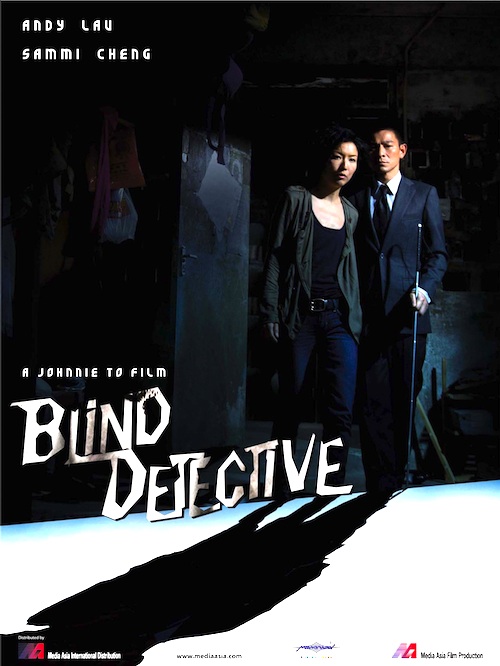
Much like the old cliché about the weather, if you don’t like the tone of Blind Detective, just wait five minutes, because it will change. You do not see many films incorporating elements of romantic comedy, slapstick farce, and dark serial killer thrillers, probably for good reason. To gives roughly equal weight to all three, yet it all hangs together better than one might expect.

Sammi Cheng is a major reason Blind works to the extent that it does. It is great to see her Inspector Ho act as the film’s primary action figure and her radiant presence lights up the screen. She develops decent chemistry with Andy Lau’s Johnston, but he looks profoundly uncomfortable in the intuitive curmudgeon’s skin. However, To fans will be relieved to hear Lam Suet duly turns up as a fugitive gambler hiding out in Macao.

To also delivers plenty of bang for the audience’s bucks in the third act. There are some distinctly creepy bits and a fair amount of suspense. On the other hand, a drawn out subplot involving Johnston’s long held crush on a dance instructor chews up plenty of time but serves little purpose except to telegraph the feelings beginning to stir between the odd couple detectives.

Thanks to two well executed showdowns, Cheng’s winning performance, and some evocative Hong Kong locales, Blind Detective chugs along steadily enough for a while and picks up mucho momentum down the stretch. Recommended for To fans and those with a taste for comedic mysteries, Blind Detective screens this Friday night (10/4) at the Vogue Theatre as part of the SFFS’s 2013 Hong Kong Cinema series. Action aficionados should also check out Chow Yun-fat’s massive return to form in Wong Jing’s The Last Tycoon screening Saturday (10/5) and Sunday (10/6) at the same venue.

LFM GRADE: B-

Posted on September 30th, 2013 at 5:37pm.
LFM Reviews The Wind Rises @ The New York Film Festival

By Joe Bendel. Jiro Horikoshi is a Studio Ghibli character Tony Stark would approve of. He was the engineer responsible for designing Imperial Japan’s Model Zero fighters, but he was a dreamer rather than an ideologue. At least, that is how Hayao Miyazaki re-imagined Horikoshi’s private persona in his fictionalized manga, which he has now adapted as his final film as a director. Spanning decades of Japan’s tumultuous pre-war history, Miyazaki’s The Wind Rises is also a deeply personal film that screens as a main slate selection of the 51st New York Film Festival.

As a young student, Horikoshi yearns to fly, but he realizes his spectacles make it nearly impossible for him to become a pilot. Borrowing an aviation magazine from an encouraging teacher opens up a new path for the earnest lad. Through its pages he learns of Italian aircraft designer Gianni Caproni, who becomes his inspiration. Setting his sights on an engineering career, Horikoshi regularly meets Caproni in his dreams and reveries, where they share their mutual passion for flight.

Circumstances of history will conspire to make Horikoshi’s life eventful. His first day as a university student is marked by the catastrophic earthquake of 1923, which will resonate profoundly with contemporary viewers. Yet, out of that tragedy, Hirokoshi meets and temporarily loses the great love of his life.

Despite his intelligence, Japan’s stagnant economy offers few opportunities for Horikoshi when he graduates. He joins Mitsubishi at a time when the company appears to be on its last legs. Gambling its future on military contracts, the company sends Horikoshi to Germany, hoping he can help them reverse-engineer whatever the Junkers will let him see. Of course, he will be able to raise their game substantially.

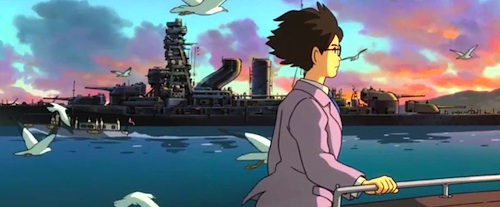
From "The Wind Rises."

In no way, shape, or manner does Miyazaki justify Japan’s militarist era, but he has still taken flak from both sides of the divide over Wind. Frankly, it presents a gentle but firm critique of the Imperial war machine. At one point, Horikoshi is even forced into hiding, designing the military’s fighter planes while he evades the government’s thought police. Indeed, such is a common experience for the best and the brightest living under oppressive regimes. Yet, Miyazaki is just as interested in Horikoshi’s grandly tragic romance with Naoko, a beautiful artist sadly suffering from tuberculosis. Horikoshi makes a number of choices throughout the film, every one of which the audience can well understand.

Given its elegiac vibe, Wind makes a fitting summation film for Miyazaki. Covering the immediate pre-war decades, it compliments and engages in a wistful dialogue with Gorō Miyazaki’s post-war coming of age tale From Up on Poppy Hill (co-written by the elder Miyazaki). One can also see and hear echoes of master filmmakers past, such as Ozu and Fellini, throughout the film. Any cinema scholar surveying Miyazaki’s work will have to deal with it at length, but it still happens to be a genuinely touching film.

After watching Wind, viewers will hope the real Horikoshi was a lot like Miyazaki’s (and the same goes for Caproni). Miyazaki seriously examines the dilemmas faced by his protagonist while telling a lyrical love story. Visually, the quality of Studio Ghibli’s animation remains undiminished, but the clean lines of Horikoshi’s planes and the blue open skies lend themselves to simpler images than some of his richly detailed classics. Regardless, The Wind Rises is an unusually accomplished film that transcends the animation genre. Highly recommended for all ages and interests, it screens this Saturday (9/28) and next Friday (10/4) at Alice Tully Hall (stand-by only), as part of the 2013 NYFF.

LFM GRADE: A

Posted on September 24th, 2013 at 1:42pm.

LFM Reviews The Wedding Palace

By Joe Bendel. Stop me if you’ve heard this one before. You’ve got a big ethnic family and perhaps a wedding. Wait, there’s also a curse. Frankly, Jason Kim might be better off with a gruesome death than the women his mother tries to fix him up with. However, hope might be arriving from Korea in Christine Yoo’s The Wedding Palace, which opens this Friday in New York.

Thanks to the scandalous behavior of a bridegroom hundreds of years again, a painful fate befalls all the men in Kim’s family who are not married before they turn thirty. At least, so he has always been told. He is twenty-nine and his fiancée, Jinnie Park, just jilted him at the altar. It is embarrassing for Kim, especially since his parents are convinced he is now doomed.

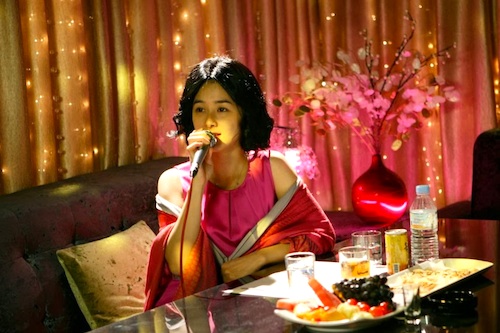
Even when traveling to Seoul on business, Kim cannot escape his mother’s Hail Mary blind dates. Yet, one particularly miserable attempt in a karaoke club brings Kim face-to-face with Song Na-young, a very attractive colleague who can sing like an angel. Despite their halting start, the two commence a passionate, long distance love affair. Soon he Skypes the question and she accepts. Yet as soon as she lands in L.A., he discovers something about her that will provide him and his family the opportunity to act like first-rate jackasses. Will true love rebound? Should the stunning Song even allow him a second chance? Have you seen a romantic comedy before?

From "The Wedding Palace."

Palace might be formulaic, but most red-blooded viewers will fall head over handlebars for Song during their karaoke sequence. Old Boy star Kang Hye-jung sounds about as comfortable with English as most of us would performing Shakespeare translated into Esperanto, but she has presence—that “it” factor.

As Kim, co-producer Brian Tee (the corrupt prosecutor in The Wolverine) makes a likable enough straight man and a convincing heel. Mad-TV’s Bobby Lee contributes a few laughs and a good measure of energy as Kim’s best friend Kevin. Unfortunately, Margaret Cho is not any funnier in her cameo as a shaman than she ever has been before. Perhaps more frustrating, Joy Osmanski, who was so charming in Dave Boyle’s White on Rice, is largely wasted in the thankless role of Park.

For an indie rom-com, Palace is quite a nicely put together package, featuring some handsome cinematography (most notable during the Korean scenes) and an upbeat score composed by David Benoit. Even though we have more or less seen it all before, Kang makes it hard not to like. Pleasant but predictable, The Wedding Palace is recommended as a date movie for committed couples when it opens this Friday (9/27) in New York at the AMC Empire.

LFM GRADE: B-/C+

Posted on September 24th, 2013 at 1:36pm.

LFM Reviews A Touch of Sin @ The New York Film Festival

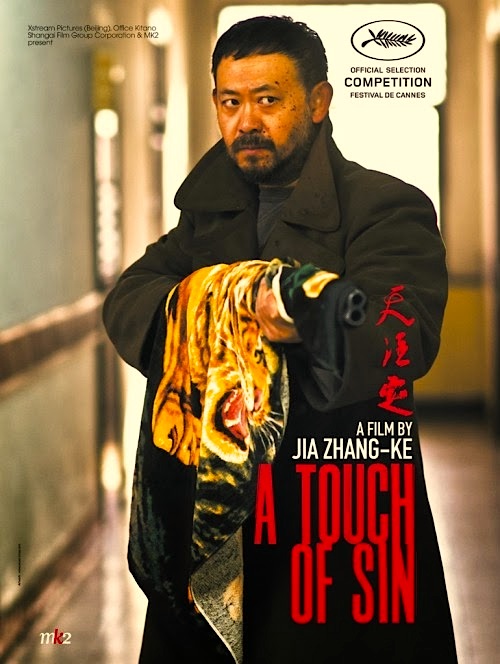
By Joe Bendel. It is hard to imagine Jia Zhangke releasing a wuxia martial arts epic. Despite the hat-tips to King Hu (who directed A Touch of Zen), it would be more accurate to describe his latest film as a meditation on violence, offering a challenging glimpse into the heart of a lawless contemporary China. American partisans on either side of the gun control debate could find themselves squirming at its morally ambiguous portrayal of a lone shooter, as well. Of course, Jia has never displayed a compulsive need to make things easy. Nonetheless, A Touch of Sin may yet prove to be one of his most accessible films when it screens as a main slate selection of the 51st New York Film Festival.

Right from the opening sequence, viewers will know they are in a different sort of Jia Zhangke film—one with a body count. The mystery motorcyclist will reappear later. Instead we will follow Dahai, a disillusioned labor leader, who returns home to stir up trouble for the corrupt village party boss and the new fat cat factory owner greasing his wheels. Instead, it is Dahai who is beaten and humiliated. Eventually, the mockery he endures pushes Dahai to the edge.

Without question, Sin’s first arc is its most unnerving. Much like Rafi Pitts’ criminally under-appreciated The Hunter, Sin openly invites viewers to condone or at least mitigate a shocking act of violence. Yet, the consistently contrarian Jia further complicates our emotional response by implying that some of Dahai’s rage might be tragically misplaced. It is keenly disturbing filmmaking, perfectly served Wu Jiang’s tightly wound performance.

Jia then shifts his attention to Zhou San, the sociopathic wanderer who started the film with a bang. He has returned to Chongqing, but his family is not too sure how they feel about seeing him again. Zhou’s story holds considerable potential, given the sense of danger that follows the drifter wherever he goes, but it is not nearly as well developed as those that immediately precede and follow it.

The presence of Zhao Tao, Jia’s longtime muse and now wife, promises and duly delivers a return to form. Zhao’s Zheng Xiaoyu is the receptionist at a half-sleazy sauna in Hubei, carrying on a long distance affair with Zhang Youliang, a factory manager in Guangzhou. Unfortunately, the family of the betrayed wife discovers their furtive relationship, sending goons to rough up Zheng. It will not be the only incident of injustice she witnesses first hand. When an abusive sauna client tries to force himself on her, she finally responds in much the same manner as Dahai.

For the concluding segment, Jia shifts to Guangdong, where a rootless migrant worker takes a series of jobs, including assembly line work in Zhang’s factory. However, it is Xiaohui’s experiences in the local luxury hotel-brothel that will be his emotional undoing. Luo Lanshan and Li Meng are quite engaging, developing some touching chemistry together as Xiaohui and the young working girl he courts. However, their storyline feels rather rushed (something you would never expect in Jia’s films), hustled to its untimely conclusion before all the necessary psychological bases have been touched.

Granted, A Touch of Sin is uneven, but it is a major cinematic statement, spanning class and geography. Without question, it is Jiang Wu and Zhao Tao who administer the arsenic with their fearless, visceral performances. In fact, with her work in Sin, one can make the case Zhao is the definitive and defining actress of our day and age. Don’t even counter with Streep. Unlike her Rich Little impersonations that consistently pull you out of the movie, Zhao always draws viewers into her films and characters. She is beautiful, but chameleon-like, playing parts that are emblematic of globalism (as in The World) and Chinese social alienation (a la 24 City). Yet, she is also achingly moving in a straight forward chamber drama like Jia’s short Cry Me a River.

It is hard to miss the implications of Sin. Jia unequivocally takes the Chinese state bureaucracy and their corporate cronies to task for their pervasive corruption. He also casts a disapproving eye on the burgeoning sex industry. For all its trenchant criticism, Sin is arguably somewhat encouraging—simply because Jia was able to complete it as he intended. Given his perpetually half pregnant state as a former independent filmmaker partially and uneasily incorporated into the state system, one always wonders if he will still be allowed to make his films according to his aesthetic and ethical principles. A Touch of Sin might be something of a stylistic departure, but it is very definitely a Jia Zhangke film, which is happy news indeed.

Even with its odd imperfections here and there, A Touch of Sin packs a whopper of a punch. Highly recommended for China watchers and fans of social issue cinema, Sin screens this Saturday (9/28) at Alice Tully Hall and the following Wednesday (10/2) at the Beale, as part of this year’s NYFF, with a regular theatrical opening to follow next Friday (10/4) at the IFC Center.

LFM GRADE: A-

Posted on September 23rd, 2013 at 4:53pm.

LFM’s Govindini Murty at The Huffington Post: Finding Movie Inspiration in NASA’s Real Science: The Case Study of Europa Report

[Editor’s Note: the post below appears today at The Huffington Post.]

By Govindini Murty. Hollywood is in the midst of a science-fiction boom, yet few of its sci-fi movies are based on real science. That’s a shame, because the scientific discoveries emerging from NASA these days are as exciting as any Hollywood blockbuster. Whether it’s the stunning images from the Mars Curiosity rover, or the Hubble and Spitzer Space Telescopes’ observations of a dazzling array of exoplanets, or the announcement that Voyager 1 has become the first human-made object to leave the solar system, NASA is daily generating storylines that provoke the imagination and expand our horizons.

What makes these developments intriguing for adaptation into sci-fi movies is that they are real. At a time when audiences are increasingly jaded by computer special effects, there’s something fresh and engaging about a sci-fi movie that might actually have some basis in reality. Isn’t it time that we see more sci-fi films that explore the real mysteries of the universe all around us?

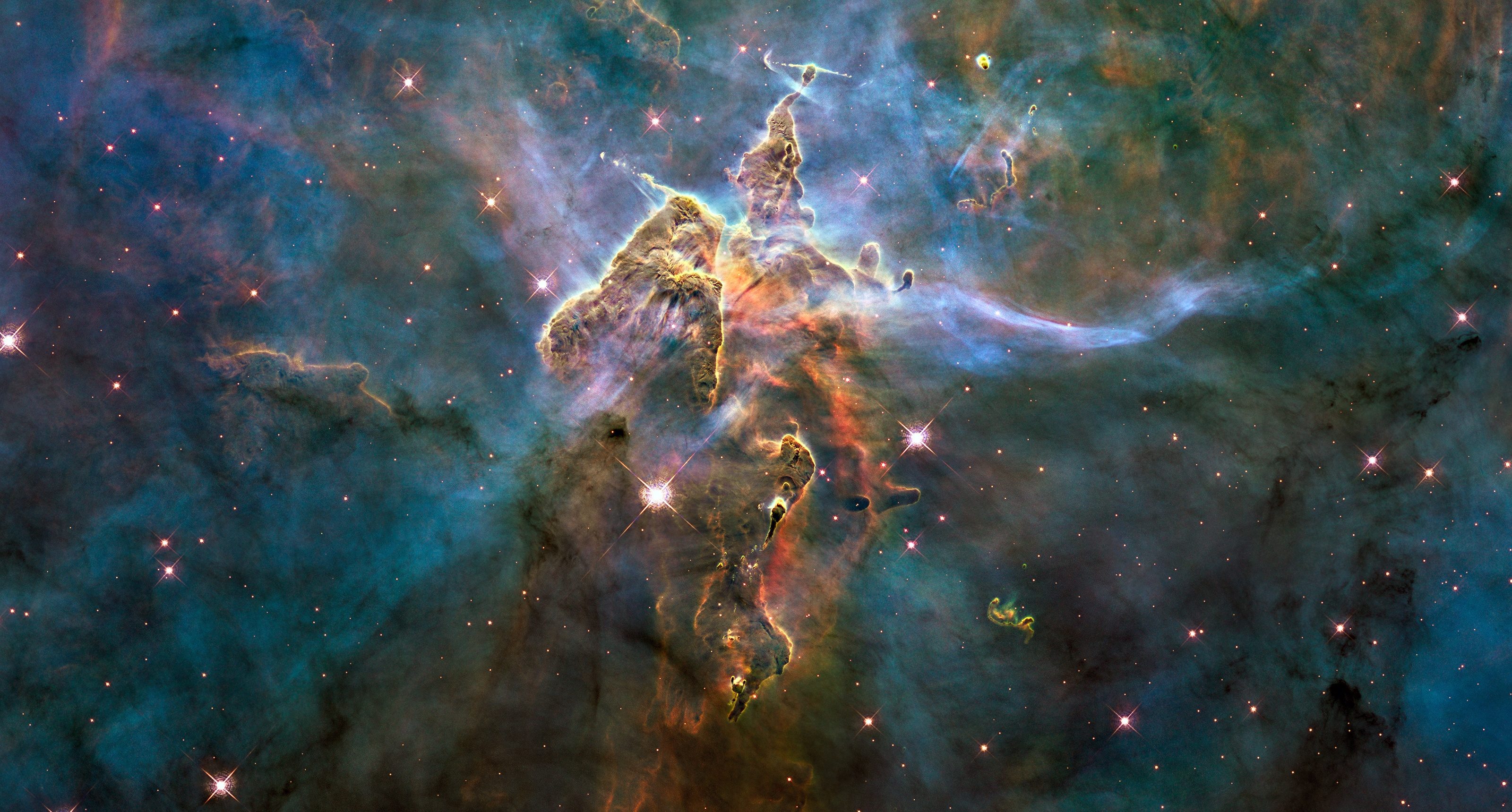
2013-09-21-Picture_by_Hubble_Space_Telescope_crop.jpg
NASA deep-space imaging.

As a case study for a sci-fi movie inspired by NASA science, I recommend that people take a look at Sebastian Cordero’s Europa Report. With a cast that includes Sharlto Copley, Anamaria Marinca, and Michael Nyqvist, Europa Report is currently playing in select theaters and on VOD, and will be available on iTunes starting October 8th. The movie is one of the few sci-fi films in recent years to offer a realistic depiction of a manned mission to outer space – in this case, to search for life on Jupiter’s moon Europa.

I chatted with NASA- JPL astrobiologist Steve Vance, one of the science advisors on Europa Report, at the film’s LA Film Festival premiere. Vance expressed to me his enthusiasm about the movie:

“I’m just thrilled that I got to be part of something that is bringing Europa more into the public eye. I’m really excited about how this movie captures the passion of exploration and also the science.”

Europa has been the focus of much attention in recent years because it may harbor life in the liquid water ocean that is theorized to exist under its icy crust. Vance, who studies the interiors of icy moons like Europa and who is acting staff scientist on NASA’s Europa Project, told me that he and his colleagues are “pre-formulating a mission that we hope will fly to Europa to address the same kind of questions that were addressed in the movie.” The most pressing of these questions is whether life independently developed on another body within our solar system.

2013-09-21-NASApia17043640.jpg
Concept image of Europa.

Although Vance noted that a manned mission to Europa isn’t currently feasible, due to the difficulties of even sending a human as far as Mars, he explained that NASA is assessing plans to send a robotic spacecraft to Europa (see NASA artist’s concept above): “The mission we’re looking at right now is [that] we’ll do multiple flybys to orbit Jupiter, and do thirty or more flybys of Europa and completely map the surface.” (See this paper in the August issue of Astrobiology on future missions to Europa, co-authored by Vance).

And this brings me to a larger point: whether it’s robotic spacecraft taking photos of the surfaces of distant moons like Europa – or movies that draw on that imagery to dramatize outer-space exploration – visual representation plays a crucial role in bringing science to life.

For example, the photos taken by the Galileo space probe as it orbited Jupiter and its moons from 1995 to 2003 gave the public the most detailed images yet of mysterious Europa and its icy, cracked outer shell. These photos (see below) then inspired the filmmakers of Europa Report. In turn, NASA scientists like Vance hope that movies like Europa Report will inspire public support for future missions back to Europa. In short, art and science play a surprisingly reciprocal role today.

2013-09-21-europagalileodoubleimage.jpg
NASA images of Europa.

Given how important photos and imagery have been to NASA, I was amazed to read in a recent NASA blog post that in the 1960s, NASA debated whether to even put cameras on board spacecraft. Fortunately, with the Mariner 4 mission that brought back the first close-up photos of Mars in 1965, the agency realized how crucial images were to advancing scientific knowledge and inspiring the public. Continue reading LFM’s Govindini Murty at The Huffington Post: Finding Movie Inspiration in NASA’s Real Science: The Case Study of Europa Report

Shakespeare’s Henriad: LFM Reviews Hollow Crown on PBS

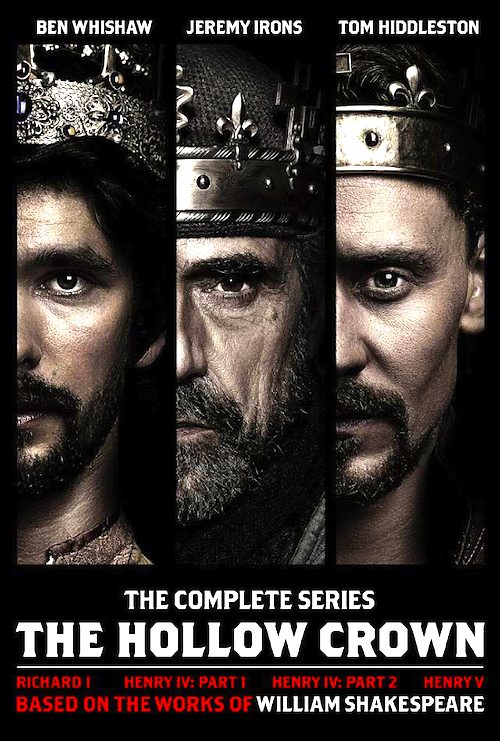
By Joe Bendel. The House of Plantagenet had a good run, but their dynasty would not last forever. You can blame Richard II. His fall and the rise of his Lancaster cousins provided ample inspiration for Shakespeare’s three king-four play cycle known as the Henriad. Executive producer Sam Mendes and three of Britain’s leading stage directors adapted the Richard and Henry plays for television as The Hollow Crown, which premieres on PBS this Friday as part of the current season of Great Performances.

Richard II begins with the title monarch on the throne, but that may soon change. Callous and erratic, Richard is a sad excuse for king. Nonetheless, the nobility has maintained their loyalty. Richard’s own actions will drive many lords into rebellion, starting with the precipitous banishment of Henry Bolingbroke. When the King confiscates the estate of his late uncle, Bolingbroke’s father, John of Gaunt, he pushes the Earl of Northumberland and his associates into rebellious conspiracy.

A bit of a slow starter, Richard II might be the weakest link of the Crown. However, it exceeds viewer expectations for one of the marquee Henriad highlights, when Patrick Stewart knocks John of Gaunt’s “This England” soliloquy out of the park. The stout Rory Kinnear and David Morrissey also bring an appropriately Shakespearean physicality to Bolingbroke and Northumberland, respectively. Unfortunately, Ben Whishaw’s sickly, petulant presence poorly serves the villainous Richard. Even more problematic is Richard II director Rupert Goold’s depiction of the deposed tyrant through Christ-like imagery.

Bolingbroke is now Henry IV, but he plays more of a supporting role in the two plays that bear his name: Henry IV Parts 1 and 2. The King has an heir to succeed him, but has little confidence in the free-spirited Prince Hal. The future Henry V would rather carouse with the disreputable Sir John Falstaff than worry about affairs of state.

Succeeding Kinnear as Henry IV, Jeremy Irons gives one of his best performances in years, acutely conveying the burdens of guilt, command, and fatherhood. Likewise, Tom Hiddleston relishes the roguishness of Prince Hal, while also convincingly growing in stature once Henry V ascends the throne. As director of both parts of Henry IV, Richard Eyre makes amends for misfiring with The Other Man. He seems to love Falstaff even more than Welles did, but Simon Russell Beale looks so haggard and dissipated as the jolly fellow, viewers will fear he might keel over well before his character’s spirit is broken.

Renouncing his wild past, Henry V turns his attention towards France in the Henriad’s conclusion, which should particularly interest Francophiles because of the presence of Lambert Wilson as the King of France and Mélanie Thierry as his daughter, Princess Katherine. Hiddleston’s courtship scene with Thierry has considerable charm, but Henry V director Thea Sharrock strangely underplays the St. Crispin’s Day speech, perhaps hoping to avoid comparison with Branagh’s rendition.

Shot on some notably picturesque locations, Hollow Crown opens up Shakespeare quite cinematically. While there is a considerable editorial hand at work, the language is never dumbed down. It is a smart way to present the Bard on television, with discrete productions that still have the continuity of a mini-series. The all-star cast should be of particular interest to fans of Downton Abbey (due to the too-briefly seen Michelle Dockery and Iain Glen). It is a great looking period piece, buttressed by a number of fine performances. Recommended for patrons of classical theater and fans of British television, The Hollow begins tonight (9/20) and continues for the next three Fridays on most PBS outlets nationwide.

LFM GRADE: A-

Posted on September 20th, 2013 at 1:25pm.