Love in the Time of Typewriters: LFM Reviews Populaire

By Joe Bendel. It was a simpler, analog time when assistants were called secretaries. They were always women, but they were considered “modern” women. Régis Roinsard pays tribute to the women in the late 1950’s workforce and the romantic comedies of their era with Populaire, which opens today in New York.

Rose Pamphyle longs to leave her sleepy provincial village for a big city job as a sophisticated secretary. She makes it as far as Lisieux, the nearest sizable city, for an interview with Louis Échard’s small but respectable insurance company. Frankly, she lacks most of the skills required for the position, except typing—sort of. Even with two fingers she is a speed demon.

Recognizing Pamphyle’s raw talent, Échard decides to forgo her dubious clerical assistance so he can train her full time as a competitive speed typist. Échard is considerably more intense as a coach than Pamphyle is as his protégée. She has other concerns, inevitably developing strong feelings of attraction for the suave former resistance fighter. Of course, he seems to have a hard time recognizing his perfect rom-com match.

Fully stocked with stylish circa-1959 trappings, Populaire is bound to be compared to Mad Men, but it largely replaces the zeitgeisty angst with old fashioned romance. Still, it also provides a mostly affectionate time capsule look at a time when Pamphyle was considered rather bold for pursuing an office career and smoking in the office was no big deal. Just seeing the cross-the-body manual return is a vivid reminder how much has changed in the last fifty-some years. Frankly, for some younger viewers, Pamphyle might as well be chiseling in stone.
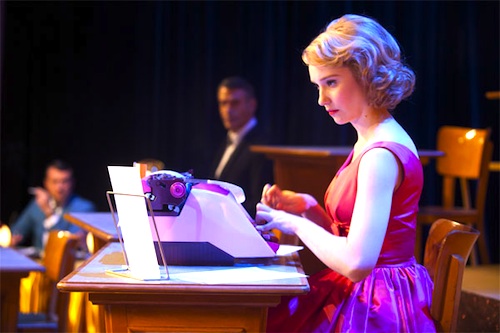
From "Populaire."

While Populaire is a bright and colorful period piece (thanks to first rate contributions from cinematographer Guilaume Schiffman, production designer Sylvie Olivé, and costume designer Charlotte David), but it has some real heart beneath the froth. Déborah François brings an acute sensitivity to Pamphye. Her romantic chemistry with Romain Duris’s Échard is believably awkward but still smolders. Yet, perhaps the most emotionally resonate moments involve his scenes with The Artist’s Bérénice Béjo as Marie Taylor, the lover he pushed away during the war for reasons of self denial. She is an unexpectedly deep character, fully brought to life by Béjo in her comparatively limited screen time.

Populaire is pleasing to the eye and the ear, including some charming cha-cha-chas about typing, as well as timeless standards from the likes of Ella Fitzgerald. It is not a big picture in any sense, but it goes down smooth and leaves audiences satisfied. Recommended for a fans of French cinema and retro romantic comedies, Populaire opens today (9/6) in New York at the Village East.

LFM GRADE: B

Posted on September 6th, 2013 at 1:34pm.
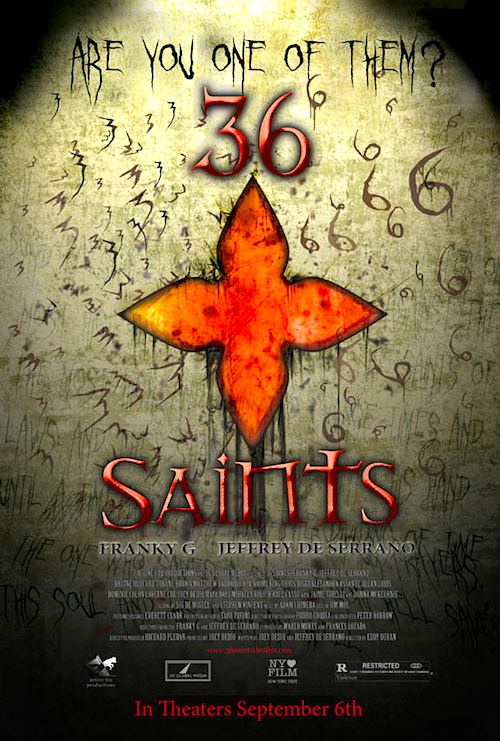
The End of Days in Washington Heights: LFM Reviews 36 Saints

By Joe Bendel. According to mystical Judaic teachings, the Tzadik are thirty-six righteous men with no desire to sin, whom G*d loves so much, he spares the rest of the sinful world for solely for their sake. Technically, they are not part of the Christian tradition, but Lilith is still out to get them. If her minions murder each of the thirty-six in the manner their name saints were martyred, it will bring about the victory of darkness over light. However, it seems she could use a remedial theology course for her attempt to bring on a boneheaded apocalypse in Eddy Duran’s 36 Saints, which opens this Friday in New York.

There have been some rather disturbing murders in Washington Heights. Father Esteban is bludgeoned to death in the subway around the same time young Jesus Ochoa is crucified in his parish church. It quickly becomes apparent the victims are connected to an ill-fated youth group that perished in an airline accident (quick, name the twenty-some saints who were martyred in plane crashes). Ochoa and a handful of his friends survived that day, because they chose to attend an award ceremony honoring their public service instead. A year later, Lilith is finally mopping up loose ends.

Evidently, poor Mother Theresa was just wasting her time with all that ministering to the sick rigmarole. Merely patronizing the hipster nightclubs of Washington Heights is sufficiently saintly for the survivors of Ochoa’s youth group. Two cops will try to protect the Holy Club Kids, but Joseph and Michael are distinctly passive investigators, spending most of the film drinking coffee as they wait for more bodies to be discovered.

In terms of narrative, 36 Saints is beyond messy. Its third act has the sort of logical cohesion one typically sees when faded big name stars die while filming ultra low budget movies and the producers hack together the shards of a story around the scenes they managed to complete. Particularly problematic is the manner one of Lilith’s “shocking” sleeper servants recklessly kills people in very public ways that surely would reveal his identity, yet he somehow maintains his cover. Seriously, he isn’t even using a silencer.

When it comes to theology, 36 Saints is also a train wreck. Strictly speaking, Eve is not a saint and she certainly was not martyred by eating a poisoned you-know-what. Perhaps screenwriters Jeffrey De Serrano and Joey Dedio had her confused with Snow White, who is not a saint either. Or maybe they were thinking of Eva Marie Saint, who is not a saint in the sacred sense (as least not yet), or even an “Eve,” but she made vastly better movies than 36 Saints.

Regardless, considering the breadth of the Catholic world (growing by leaps and bounds in China and Africa), it seems rather puzzling each and every saint would be hidden in Washington Heights. Talk about gentrification. This definitely constitutes a case of putting all the world’s eggs in one basket. At least stash a few in Inwood. There is no way Lilith would ever go up there—it just takes forever on the A train.

For some reason, Donna McKechnie, the original Cassie in A Chorus Line, appears in 36 as the club kids’ teacher, Ms. El (a suspiciously made-up looking name, if ever there was one), lending some presence to the otherwise drab film. It just does not seem right to call out the young cast for not bringing their empty characters to life, but that does not leave viewers much to work with. 36 probably sounds kind of cool, like the sort of religiously themed horror films Max von Sydow or Jürgen Prochnow used to turn up in, but it is a profound disappointment. Not recommended for anyone, 36 Saints opens this Friday (9/6) in New York at the AMC Empire.

LFM GRADE: F

Posted on September 3rd, 2013 at 12:10pm.

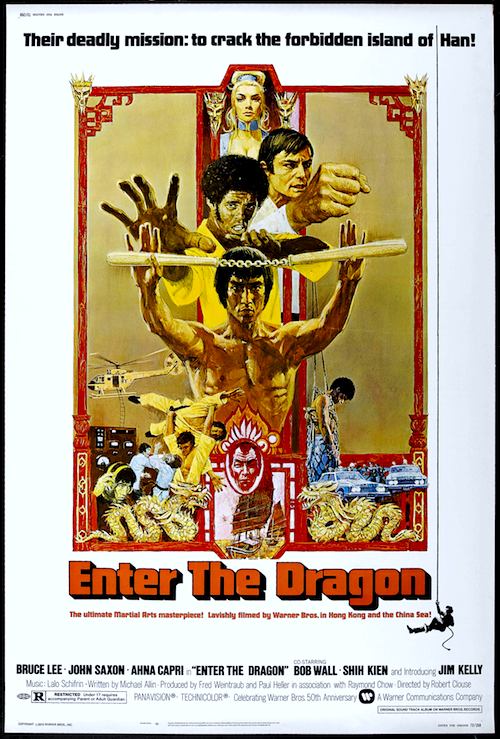
LFM Reviews The Newly Restored Enter the Dragon @ BAM Cinematek’s Wing Chun Classic Film Series

By Joe Bendel. It is the first true martial arts film selected for the Library of Congress’s National Film Registry. Bruce Lee’s first Hollywood star vehicle and his final fully completed film represents kung fu cinema at its most cross-overiest, yet it is still legit to the bone. In honor of Ip Man and Wong Kar Wai’s The Grandmaster, Bruce Lee & director Robert Clouse’s Enter the Dragon begins a week of restored DCP screenings today, as part of BAM Cinematek’s Wing Chun classic film series.

Lee’s namesake is a Hong Kong Shaolin standard bearer knocking on the door of complete martial arts enlightenment. While glory in the ring hardly interests him, he agrees to compete in the triannual martial arts tournament sponsored by Han, an international vice lord and general megalomaniac. Sent in by British Intelligence sans back-up, Lee is to reconnoiter around Han’s pleasure palace and hopefully fight his way out of any trouble he might encounter. It is not much of a plan, but it will suffice.

The stakes turn out to be unexpectedly personal for Lee. Shortly before embarking, he learns Han’s thugs were responsible for the death of his sister, Su Lin. As one might expect of Lee’s kin, she put up a heck of a fight. Han’s chief enforcer O’Hara still bears his scars from the encounter. He is due for some more pain. However, Lee will meet some friendly Americans en route, such as the well heeled Roper, who is looking to hustle some action to pay off his gambling debts, like a kung fu Fast Eddie Felson. In contrast, Roper’s former Army buddy Williams seems more interested in hedonistic pleasures supplied nightly to the fighters.

Enter might not sound earthshakingly original, but that is partly a function of how widely imitated it has been, especially the iconic hall of mirrors climax. Scores of movies have copied its general template of the ostensibly upright kumite going on above ground, while armies of henchmen in color-coded gis labor towards nefarious ends below. Without it, there is no way we would have guilty pleasures like the Steve Chase beatdown, Kill and Kill Again, which is a thoroughly depressing thought to contemplate.

All the elements come together, but there is still no question this is Lee’s show. Almost supernaturally intense and charismatic, Lee was clearly at the peak of his powers throughout Enter. It is a massively physical performance (featuring some impressive acrobatic feats), yet Lee still takes care to convey the philosophical side of Wing Chun. The restored print includes more scenes of Lee as a spiritual teacher that work quite well.

Even with Lee’s overpowering presence, Enter is the film that really put Jim “Black Belt Jones” Kelly on the map. As Williams, he contributes attitude and energy that further distinguished Enter from its genre predecessors. In fact, the cast is loaded with notables, including John Saxon, hamming it up with relish as Roper. Fans often wonder why so little was subsequently heard of Betty Chung, but she has some nice rapport with Lee as Mei Ling, a fellow undercover operative.

There are also plenty of established and future action stars, most notably Angela Mao absolutely crushing Su Lin’s brief but pivotal flashback scene. Bolo Yeung also appears in exactly the sort of role that would make him famous. Sammo Hung has a briefer turn as a Shaolin martial artist who fairs poorly against Lee—but not nearly as badly as blink-and-you-missed-him Jackie Chan, whose meat-for-the-grinder henchman gets his neck snapped by our hero.

But wait there’s more, including a classic funky eastern fusion soundtrack by Lalo Schifrin that opened up a lot of ears up to the Argentinean composer and former Dizzy Gillespie sideman. Without question, this is a historically and culturally significant film, well worthy of being selected for the National Film Registry. Logically, it anchors BAM’s Wing Chun series in honor of Lee’s revered master, Ip Man. Highly recommended beyond martial arts enthusiasts, Enter the Dragon begins a week long run (8/30-9/5) today at the BAM Rose Cinemas.

LFM GRADE: A

Posted on August 30th, 2013 at 1:24pm.

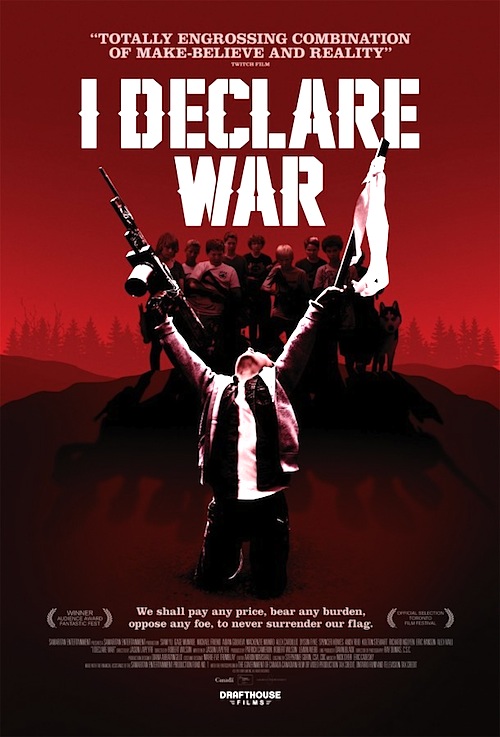
Wargames: LFM Reviews I Declare War

By Joe Bendel. War—what is it good for? At least it gets these brats out of the house. That will be a blessing for their parents. Unfortunately, the youngsters will have to endure the ridiculously simplistic tactics of allegorical cinema in Jason Lapeyre & Robert Wilson’s I Declare War, which opens today at the Alamo Drafthouse Yonkers.

Completely free of adult supervision, a group of kids play regular capture the flag war games in the forest near their exurban homes. PK is a young war movie junkie who has always commanded his troops to victory. He finally thinks he has met a worthy opponent in Quinn, who clearly shares PK’s understanding of military strategy, until the promising general is fragged by his own troops. Having captured PK’s best friend Kwon, the resentful Skinner is not about to squander an opportunity for some score-settling.

Initially, we see the kids trudging about with crude makeshift stick-and-twine guns, but soon they are replaced with very real looking assault weaponry. They sound like the real deal too, but no actual blood is shed during their skirmishes, aside from their grenades (balloons filled with red paint). However, there is nothing imaginary about the pain Skinner inflicts on Kwon.

Yes, it is jarring to watch young kids toting assault rifles and blasting away at each other, allowing fantasies to intrude on ostensive reality, but after half an hour or so, we just so get the point already. Frustratingly, the film does not really have anything left in reserve after these initial shocks. Arguably, it might have been a more engaging film if Lapeyre and Wilson had embraced the story of a truly epic capture the flag contest rather than tried to remake Lord of the Flies again.

To their credit, Declare’s young ensemble is completely credible and fully committed to their roles. On the downside, their characters are never very well fleshed out. Basically, we have PK, the slight of stature general with a Napoleon complex, Kwon, the loyal best friend, their resentful loser nemesis, as well as the scheming chick, the annoying kid, the other annoying kid, and the other other annoying kid.

Declare is a compelling example of detailed world building at the child’s eye level. It sort of resembles what it might look like if Full Metal Jacket broke out in the middle of Moonrise Kingdom. Despite the strength of its ground game, the film is still saddled by the clunkiness of its teaching moments and the blandness of most of its characters. For those intrigued by the provocative imagery, I Declare War opens today (8/30) at select Alamo Drafthouses nationwide, including Yonkers in New York and Littleton in Colorado.

LFM GRADE: C

Posted on August 30th, 2013 at 1:21pm.

A Shy, Quiet Brand of Urban Fantasy: LFM Reviews Abigail Harm

By Joe Bendel. Visitors come to New York from nearly everywhere, perhaps even including the fairy realm, or some such place. One mousy New Yorker will open her home and perhaps her heart to a decidedly foreign visitor when the Korean fable of the Woodcutter and the Nymph (that shares common elements with the Swan Maiden and Selkie myths) gets a quietly modern makeover in Lee Isaac Chung’s Abigail Harm, opening this Friday in New York.

Shy and retiring, Abigail Harm reads to the blind because she does not like to be seen. Her garrulous father was also a storyteller, but her relationship to the old man was complicated in ways we will never understand. One fateful night, she shelters a strange fugitive, who seems to believe he is a mystical being trapped in our world because someone stole his robe. To thank Harm, he gives her directions on where to similarly entrap one of his fellow visitors, who will become her faithful lover as long as she keeps his stolen garment in her possession.

While Harm is ordinarily quite taciturn, she is rather talkative compared to the strange visitor she ensnares. Yet, a romantic relationship duly develops between them. Nonetheless, questions regarding the sustainability and legitimacy of it all seem to nag at Harm’s subconscious.

Born to play misfits, Amanda Plummer (who is currently appearing on the New York stage in an excellent staging of Tennessee Williams’ eerie Two Character Play) suggests a lifetime of angst and insecurity without revealing any of Harm’s secrets. She stirs viewer empathy, but subtly suggests there is something damaged and maybe a little bit off about her.

From "Abigail Harm."

As her visitor, Tetsuo Kuramochi expresses much without dialogue, but his character still largely remains a cipher during the course of the film. However, Will Patton makes the most of his brief appearance as Harm’s agitated visitor, giving the film its most substantial jolt of energy, as well as performing the narration, which elegantly evokes a sense of once-upon-a-time.

There is no getting around the film’s deliberately paced artiness and its defiantly unsatisfying third act. Nonetheless, it remains one of the smartest urban fantasies of the year. It gracefully hints at cosmic goings on, lurking in plain sight on the streets and subways we use every day (the Union Square station, in this case), without cribbing the adolescent melodrama of the Buffy and Twilight franchises. Adults will find it a welcome antidote to Mortal Instruments and similar copies of copies.

Although it is headed to a very different destination, Abigail Harm would be an appropriate companion film to John Sayles’ Secret of Roan Inish. Strangely, it is also thematically compatible with The Two Character Play, a surreal two-hander about alienation and confinement. Recommended for those who appreciate more demanding manifestations of the fantastic, Abigail Harm opens this Friday (8/30) in New York at the Quad Cinema.

LFM GRADE: B

Posted on August 26th, 2013 at 12:44pm.

Cuba, Unvarnished: LFM Reviews Una Noche

By Joe Bendel. There are two Cuba’s: one for well-heeled Euro tourists, and one for Cubans. When the two worlds mix, it often means trouble for the locals. One Cuban teen understands that only too well. Indeed, he has all kinds of reasons to flee the police state on a ramshackle raft and a hurried prayer. Shot on location in Cuba, yet somehow still reflecting the country’s tragic real life circumstances, Lucy Mulloy’s Una Noche will transport audiences to the island dictatorship when it opens tomorrow in New York.

Raul is more or less a delinquent, but it is hard to judge him harshly once you know his backstory. After years of servicing the tourist trade, his aging prostitute mother has contracted AIDS. Despite all that great free healthcare, Raul is still forced to buy her medicine on the black market. Always skirting the law, he has finally attracted serious police attention. He and his mate Elio had planned to try their luck with the Florida Straights in due time, but Raul’s wanted status compels him to move up the timetable.

It will be hard for them both to leave Lila. Elio has always had an unusually close and supportive relationship with his younger sister. In contrast, Raul hardly knows her, but he has carried a torch for the Tae Kwon Do student from afar. Nevertheless, they are prepared to depart by themselves, until the intuitive teen crashes their party.

Una Noche could be considered a case of life imitating art imitating life. The narrative was inspired by the story of a harrowing attempted crossing that would be spoilery to relate in detail. Subsequently, two of Mulloy’s three diamond-in-the-rough principles eventually defected to America while en route to participate in Una Noche’s Tribeca press junket. It is not hard to see why, from Mulloy’s documentary-like street scenes.

It is not just the generally decrepit and unsanitary conditions of life outside the tourist enclaves that is so oppressive in Una Noche. Mulloy captures the secret police at work, conveying all the fear and anxiety they generate. When asked at a special screening why the Cuban government would allow permits for such an honest and unflattering production, she speculated they were perversely pleased with the tragic ending, seeing it as a tool to promote submission to state authority. It is hard to argue with her line of reasoning, especially given the extent of her first hand experience.

Mulloy, a legitimately independent filmmaker, guides her earnest young cast through some first rate performances. Perhaps Dariel Arechaga (the one who showed up on time at Tribeca) makes the strongest, edgiest impression as Raul, the nervy live wire. Although it is a more tightly controlled performance, Anailín de la Rúa de la Torre is not far behind him as the slow burning Lila. Convincingly repressed, Javier Núñez Florián’s Elio is perfectly solid in the more subservient, less showy role of the trio.

Do not be put off by the “Spike Lee Presents” business. Mulloy admirably holds up a mirror to the reality of Cuba today. Unfortunately, she risks undermining the film with some creepy sexual matter that might come across like overkill to some viewers, whereas others might consider it a strange attempt to fetishize the characters’ desperate poverty. As a result, Una Noche can only be recommended for mature adults. However, those who can handle an occasional bit of grossness should definitely check it out. Intense and forthright, Una Noche opens tomorrow (8/23) in New York at the IFC Center.

LFM GRADE: B

Posted on August 22nd, 2013 at 10:50am.