An Animated Fable That Shines: LFM Reviews Moon Man; Now Available on Tribeca VOD

By Joe Bendel. This has to be the most endearing dystopia you will ever see. One can understand why the Man in the Moon came down for a visit, but he will need a little getting home in Stephan Schesch’s animated feature, Moon Man, which launches Tuesday on Tribeca Films’ VOD platform.

The President (presumably for life) has finally conquered the last little island on Earth free of his control. Yet, it hardly seems to matter to one little girl and her father. They are following their regular routine—a drive-in movie, followed by burgers from a 1950’s style drive-through. Then her father cruises home with the top down while she curls up in the back seat with a blanket and the loyal family pooch.

Tonight, though, something is amiss. The Moon Man is not looking down at her as he should be. Like other children around the world, she is usually reassured by the sight of him up there. (However, grown-ups somehow grow oblivious to him.) Getting a bit bored, the Moon Man hitched a ride on a comet, but it was a one-way ticket. To get back, he seeks the help of Bunsen van der Dunkel, a Rip Van Winkle scientist who has slept through the President’s rise to glory. As it happens, the President also seeks the legendary inventor’s help in developing a rocket to facilitate his conquest of the moon. You get the idea.

First of all, Moon Man is basically right in line with what would be my approach to parenting, if only there were more drive-in movie theaters. Based on Tomi Ungerer’s children’s book, Schesch’s adaptation is unflaggingly sweet and gentle, but one can pick up on the author’s sly sensibilities. Indeed, the constant lampooning of the pompous President definitely follows in the tradition of Chaplin’s Great Dictator and subsequent satires.
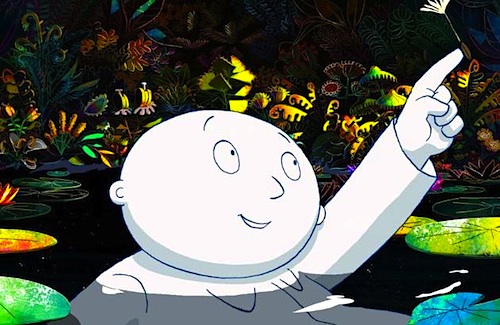
From "Moon Man."

Happily, he has not really gotten down to oppressive business yet. This is a bright, vibrant world, filled with flowers and vintage convertibles. In fact, the hand-drawn animation is like a breath of fresh air compared to the computer-generated-focus-grouped tent-poles released by the studios. It looks great and it perfectly suits the secondary theme of adults learning to see the world as kids again.

Frankly, the weakest link in Moon Man is the Moon Man. The innocent, Ziggy-looking fellow does not have much personality, but the world around him compensates for him. There are some clever bits involving the President and van der Dunkel and the soundtrack is inspired, including Louis Armstrong’s rendition of “Moon River.”

Moon Man has a healthy supply of idealism with the right subversive garnish. Schesch keeps the mood light and airy, even when the chips are down, maintaining a pleasant medium-up-tempo pace. Good fun recommended for eyes and ears of all ages, Moon Man is now available on VOD from Tribeca Films.

LFM GRADE: B+

Posted on July 22nd, 2013 at 11:30pm.
Christian Slater Maintains Protocol: LFM Reviews Stranded

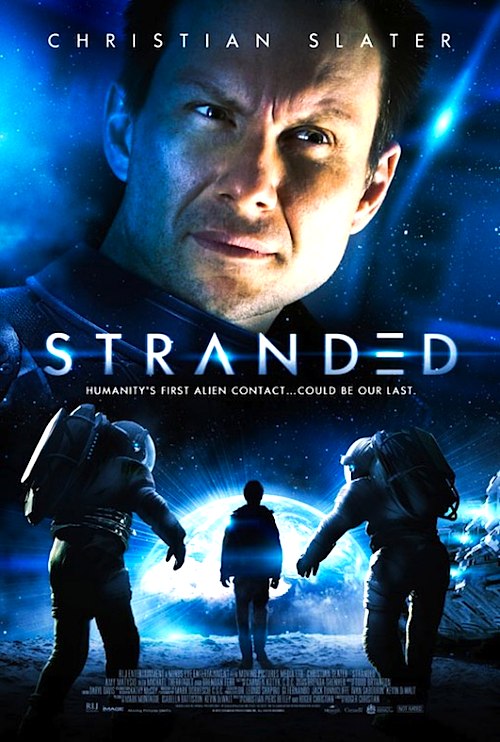
By Joe Bendel. In space, no one can hear you getting chewed out. Frankly, this crew has it coming. You might think scientists would be careful about contagions, but evidently not. Perhaps the semi-competency of their military commander will keep some of them alive in Roger Christian’s Stranded, which opens this Friday in New York.

A small four-person moon-base is a terrible place to be surprised by a meteor shower. That much we can buy. Suffering damage to their power generators and life support systems, Col. Gerard Brauchman’s crew hastens to make repairs. While outside the station, Eva Cameron notices strange glowing spores covering the meteors, so naturally she carries one back inside, in gross violation of station protocol and basic common sense. While she and Dr. Lance Krause analyze it, one of the test tubes breaks in their centrifuge, so naturally she starts digging around in there with her finger. Before you know it, she is spectacularly pregnant with the alien demon spawn—and then just as suddenly she is not.

Cameron and Bruce Johns, the station engineer and resident drunk, know her alien offspring is out there, wreaking havoc. Yet Brauchman and Krause dismiss their warnings, assuming they are just suffering from CO² induced hallucinations. Indeed, Stranded repeatedly explains the symptoms of carbon monoxide poisoning with impressive thoroughness, so at least it fulfills its public service mandate. Despite all the flak Brauchman takes for sticking by the book, the film also suggests that breaking protocol is a really bad idea.

If Stranded sounds like an Alien wannabe, take into consideration the fact that Christian was nominated for an Academy Award for his art direction on Ridley Scott’s beloved sci-fi horror classic, so maybe he has the right to rip himself off. Christian had previously won an Oscar as an art director on Star Wars (before it was known as A New Hope). His short film The Dollar Bottom also won an Oscar and his previous fantasy short Black Angel screened before The Empire Strikes Back during its initial run in the UK and Australia. To temper your growing optimism, bear in mind Christian also directed the notorious Battlefield Earth.

That is some career, but with Stranded, he lights out into clear-cut b-movie territory. Christian makes a virtue of necessity, emphasizing the claustrophobia of his limited set and the mounting tension within his small ensemble. To an extent, the quartet’s constant bickering and back-biting gives the film a bit of character. Still, there is no getting around the conspicuous carelessness of their actions and the cardboard dimensions of their characterizations.

Frankly, Christian Slater is not bad as Col. Brauchman, largely avoiding his typical tics and shtick. Brendan Fehr comes across reasonably credibly as Dr. Krause. However, it is hard to believe a basket case like Michael Therriault’s Johns could ever pass muster for a mission like this. As Cameron, Amy Matysio is similarly stuck with a problematic character, solely distinguished by head-scratching acts of stupidity.

If Stranded were playing at an old school drive-in, it would be easy to recommend. On some level, dumb mayhem is always diverting, but Manhattan movie ticket prices demand considerably more than that. Those who might be interested solely because of Christian’s past work should note his long presumably lost Black Angel has been found and some sort of online distribution is expected in the near future. That is probably the film to wait for. Basically a time killer for woozy weekend viewing, Stranded opens this Friday (7/26) in New York at the AMC Empire and will also be available on iTunes.

LFM GRADE: C-

Posted on July 22nd, 2013 at 11:29pm.

LFM Reviews Keye Luke, More Than a Face in the Crowd @ The Asian American International Film Festival

By Joe Bendel. Joe Dante’s Gremlins has a strange significance at this year’s Asian American International Film Festival. Two docu-shorts profile actors who worked on the film. In a way, Keye Luke and Jane Chung represent opposite sides of the same coin. Both did their best to navigate the studio system at a time when Hollywood was not particularly hospitable to Asian American talent. While Chung worked steadily but anonymously in small roles, Luke became famous as Kato and Charlie Chan’s Number One Son. Timothy Tau allows Luke to speak for himself in his short docudrama, Keye Luke, which screens as part of the Into the Penumbra short film program at this year’s Asian American International Film Festival (AAIFF).

Reflecting on his life, Luke addresses the audience in a manner akin to a stage play. As he reminisces, we see episodes of his life, starting with his early home life, progressing through the double-edged Charlie Chan films, his continuing sidekick-gigging as Kato to the Green Hornet, finally reaching his first starring role in the final Mr. Wong film. Mixing irony and realism, distinctly Anglo actors portray Warner Oland and Sidney Toler, the Swede and the Scot who portrayed Charlie Chan. However, Tau does not hate on the Honolulu detective, acknowledging the franchise represented an opportunity for Asian actors like Luke and his older brother Edwin, albeit a flawed one.

Essentially, Tau argues that Luke did what he could with what the system would give him, eventually becoming a widely respected and recognized character actor, whose credits include quality films like Woody Allen’s Alice. It is quite a reasonable, pragmatic perspective, under-pinning a film that revels in the goofy idiosyncrasies of 1940’s b-movies and serials (the Secret Agent X-9 scene is particularly inspired). Keye Luke also boasts a surprisingly big name cast by short film standards, including ER’s Archie Kao and Bang Bang’s Jessika Van, who all clearly enjoy the retro tribute to the late great Luke.

Fame always eluded filmmaker Sami Chan’s great aunt Jane Chung, but she still enjoyed the business according to those who speak fondly of her in More Than a Face in the Crowd, also screening as part of the Penumbra block. Chung had walk-on or small speaking parts on probably more films and television shows than Michael Caine, but finding her in the frame is usually a challenge. Supposedly, she had a shouting match with Ricky Ricardo, but her family can never find it during their I Love Lucy marathons.

Again, Chan describes how Chung made lemonade out of lemons, finding extra work much more entertaining and rewarding than the sort of part time jobs available to most homemakers in the 1960’s. With credits that include Chinatown, Funny Girl, Flower Drum Song, and When Harry Met Sally, she was a small part of many cinematic milestones.

Although still alive during the production of Crowd, the circumstances of old age prevented her from participating. It is too bad she could not enjoy a taste of wider recognition during her lifetime, but Chan’s short doc is a fitting tribute that also covers some under-examined cinema history with economy and authority. Clocking in just under half an hour, Crowd would be an appropriate programming choice for PBS sometime down the road. For now, it is quite a shrewd selection for AAIFF, especially considering the way it speaks in dialogue with Tau’s Keye Luke. Recommended for movie lovers, More Than a Face in the Crowd and Keye Luke screen this Thursday (7/25) at the Anthology Film Archives during the 2013 AAIFF.

LFM GRADES: B+, B+

Posted on July 22nd, 2013 at 11:26pm.

LFM Reviews Only God Forgives

By Joe Bendel. Evidently, expat Julian Thompson had a spot of legal trouble back home. He and his drug-running brother Billy now assume Bangkok is their oyster and act accordingly. However, Thompson might just miss those coppers with their due process. The family business will get ugly in Nicolas Winding Refn’s Only God Forgives, which opens today in New York.

Julian is the sensitive Thompson brother. He runs the legit side of their Muay Thai boxing club front and keeps his regular prostitute Mai on-call, even though he never fully avails himself of her services, if you get the drift. Billy Thompson was always his mother’s favorite. Unfortunately, he is now dead, but he sure had it coming.

After raping and killing an under-aged prostitute, the elder Thompson brother was locked in a room with her guilt ridden father, who knew what to do. Chang was the one who told him to. The mysterious retired police officer still seems to call all the shots on the Bangkok force. Although he sometimes appears eerily bad-assed, Chang is probably just a metaphorical “Angel of Death.” Of course, Thompson is just as dead either way.

Given the circumstances of his brother’s death, little Julian has trouble ginning-up sufficient outrage to seek vengeance. This is not the case for their Oedipus Complex-on-wheels mother, Crystal. She blows into town like a hurricane, determined to avenge her preferred son. Crystal will also take every opportunity to mess with Julian’s head, while re-asserting control of her far-flung illicit businesses. Killing a cop is no big deal to her, but Chang is no ordinary flatfoot.

For what it’s worth, Only is nowhere near the train wreck Cannes reviewers made it out to be. The film has its memorable moments and performances. Yet there is no denying Winding Refn’s approach is rather self-indulgent. There are so many long slow David Lynchian shots of empty hallways, viewers will half expect a giant and a dwarf to eventually pop out of a door. There is also an oppressively misogynistic vibe to the film. Thai actress Ratha Phongam is a lovely woman, who does what she can with Mai’s pencil thin character, but the way the Thompsons treat her is rather appalling—and she gets off easy compared to others.

From "Only God Forgives."

Of course, some might call Crystal Thompson a strong female character. That is certainly true, but a foul mouthed, sexually manipulative, woman-hating, sociopathic mommy-monster should not exactly constitute a feminist role model. Kristin Scott Thomas is rather awe-inspiring in the role, hardening her tart-tongued imperious image in a forge of hellfire.

To the film’s credit, it finally finds Ryan Gosling’s comfort range: sullen and emasculated. The film also delivers vicarious payback during Julian’s massive beatdown scene. Audiences will start to cheer in their heads “that was for the interminable Blue Valentine and that was for the pretentious The Place Beyond the Pines, and that was for its ridiculously awkward title.”

Frankly though, Vithaya Pansringarm is the star of the film, following-up his breakout performance as the murder-solving Buddhist monk in Tom Waller’s Mindfulness and Murder. An intensely righteous screen presence, his Chang is like a Dirty Harry with a divine mandate. As the president of the Thailand Kendo Club, he also swings a sword with authority.

Throughout Only, Winding Refn’s directorial hand is so heavy it nearly crushes everyone on screen, except KST and Pansringarm—they never wilt. Too laborious and too stylized, it still serves as a dramatic showcase for its fine supporting players. Only recommended as a curiosity piece for cult film veterans, Only God Forgives opens today (7/19) in New York at the Angelika Film Center.

LFM GRADE: C

Posted on July 19th, 2013 at 11:34am.

LFM Reviews I Have to Buy New Shoes @ The 2013 Japan Cuts

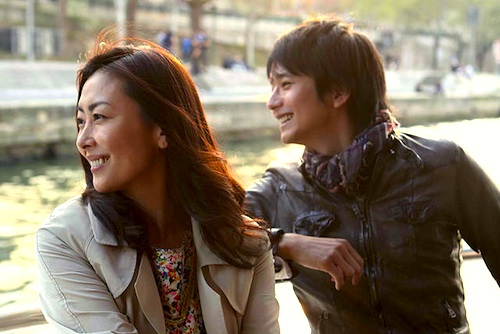
By Joe Bendel. A young photographer finds romance where he least expects it: Paris. Sure, it is the City of Lights, but he assumed his short sight-seeing trip would only entail some brotherly chaperoning. Instead, he spends some ambiguous quality time with an attractive older Japanese woman in Eriko Kitagawa’s I Have to Buy New Shoes, which screens tonight as part of the 2013 Japan Cuts: The New York Festival of Contemporary Japanese Cinema.

Sen Yagami only came to Paris at the insistence of his younger sister, Suzume. However, she contrives a way to ditch her indulgent brother along the banks of the Seine before they even reach their hotel. She has plans of her own, involving her long-distance artist boyfriend. This is rather inconvenient for Yagami, since he does not even have their hotel information. Fortunately, a broken heel precipitates a meet-cute with expat magazine editor Aoi Teshigahara, at the expense of his ground-up passport.

Initially, Teshigahara helps him navigate Paris as a friendly fellow countryman abroad, but a mutual attraction slowly grows between them. Surprised and confused by their feelings, Teshigahra and Yagami engage in a halting courtship dance that is refreshingly chaste compared to most films. Nonetheless, Yagami will not see much of his hotel, wherever it might be.

Following in the tradition of Brief Encounter, Shoes has already been widely compared to Linklater’s Before trilogy as well as the 1990’s Japanese television work of Kitagawa and producer Shunji Iwai. Yet, this is a much quieter film, saying more with a look than a page self-consciously clever dialogue. The title may sound like chic lit, but Kitagawa maintains a vibe of mature sadness that is anything but.

From "I Have To Buy New Shoes."

It is impossible to overstate what Miho Nakayama brings to the film as Teshigahara. A long time Paris resident herself, she is a smart, sophisticated, and beautiful presence throughout the film. Yet, when she lowers the dramatic boom, it is simply devastating. Poor Osamu Mukai’s Yagami is just no match for her, even though he has some nice moments expressing the younger man’s very real disappointments in life. He is no boy toy, not by any stretch. Mirei Kiritani also brings unexpected depth to seemingly coquettish Suzume late in the third act.

Just about every scene of Shoes has a subtle surprise, yet invariably rings true. It is a classy package, capitalizing on the Parisian backdrops and sparingly incorporating Ryûichi Sakamoto’s evocative piano themes in just the right moments. Above all else, it is a stunning showcase for Nakayama that would elevate her to the absolute top tier of international stardom in a more just world. Very highly recommended for those who appreciate intelligent, grown-up relationship films, I Have To Buy New Shows screens tonight (7/18) as this year’s Japan Cuts continues at the Japan Society.

LFM GRADE: A

Posted on July 18th, 2013 at 1:19pm.

Analog Dreams of a Digital Future: LFM Reviews Computer Chess

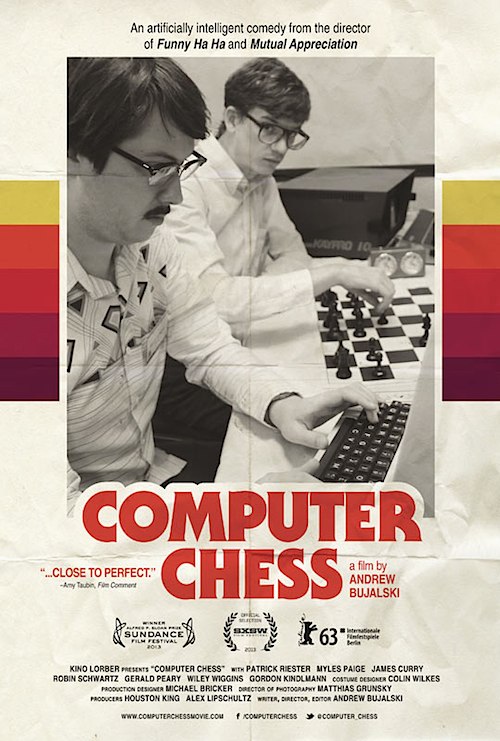
By Joe Bendel. In 1980, all music was analog. So was just about everything else. Computers were generally recognized as the coming thing, but they were still too large, bulky, and slow to be a part of most peoples’ daily lives. However, these zero-point-zero generation computers could be programmed to play chess. A motley assortment of early computer pioneers will pit their chess programs against each other in Andrew Bujalski’s retro Computer Chess, which opens this Wednesday at Film Forum.

In a tacky suburban chain motel, some of computer science’s shabbily dressed elite have come together for a computer chess tournament. The winner will face off against the arrogant human host, Pat Henderson, who has never lost a match to a machine—at least not yet. He and his opening night panel predict that will end by 1984, a year rife with significance. The defending champs from Cal Tech are still the presumed favorites, but their TSAR program is acting decidedly buggy. It is so bad, the project director, geek superstar Dr. Tom Schoesser, hastens his arrival for an emergency diagnostic session.

Things seem to be going well for the MIT contingent, with Shelly Flintic receiving an inordinate amount of attention as the first woman team-member in the competition. In contrast, nobody wants to deal with the prickly, borderline homeless Michael Pappageorge, even if he is a mad genius.

Bujalski fully embraces the technology of the era, shooting Chess in black-and-white, on now archaic late 1970’s video cameras. The film is even rougher and grainier than viewers will expect, yet Bujalski’s nostalgic vision will win them over. Indeed, it is clear throughout the inspired first four-fifths of Chess that the game of chess is really just a stand-in for innumerable AI applications to come. We can also recognize Pappageorge as the sort of social drop-out who either became the Bill Gateses of the world, or more likely remained marginal figures, haunting tech clearance auctions, buying bizarre obsolete hardware to continue building their mad visions.

Myles Paige arguably deserves award consideration as Pappageorge, finding pathos in his obnoxious behavior. Texas-based film editor Robin Schwartz also gives Chess some soul as Flintic, one of the few competitors with any facility to make human connections. University of Chicago professor Gordon Kindlmann’s Schoesser has a knack for making his theory-heavy dialogue sound smart and accessible, while in his on-screen debut, film critic Gerald Peary chews the scenery nicely as the pompous Henderson.

Considered one of the godfathers of Mumblecore, Bujalski now demonstrates how handy it is to have some plot and an underlying concept supporting a film. Still, he overplays his hand in some respects. Initially, the hippie-dippy encounter group sharing the motel is a rather brilliant piece of era-appropriate cultural satire that could have been lifted from 1980’s uber-zeitgeisty Serial. However, whenever Bujalski contrives ways for the two groups to intersect, the forced comedy falls flat. Likewise, the genre payoffs he offers late in the third act are head-scratchers that make little sense in the film’s overall context.

Frankly, Chess works best when suggesting TSAR might just be the not so distant ancestor of WarGames’ Joshua and 2001’s HAL 9000. Nonetheless, Bujalski presents a consistently compelling time-capsule that captures the innocent fascination and single-minded commitment to innovation that drove the digital revolution. A sly period production with a keen understanding of early computing, Computer Chess is recommended for Wired readers when it opens this Wednesday (7/17) at New York’s Film Forum.

LFM GRADE: B

Posted on July 16th, 2013 at 10:58pm.