LFM Reviews Drug War @ The 2013 New York Asian Film Festival

By Joe Bendel. Divide-and-conquer and playing one opponent against another might sound like shrewd Art of War strategies, but they can land you in the midst a crossfire. Frankly, there is no safe place to be in Johnnie To’s Drug War. The HK action auteur’s lean, mean return to form screens today at the 2013 New York Asian Film Festival just ahead of its July 26th New York opening, courtesy of Well Go USA, the intrepid distributor getting a special shout-out at this year’s festival with their own special programming spotlight.

“I’m a cop—I didn’t betray you, I busted you.” Captain Zhang Lei’s choice words for the somewhat disappointed drug courier he just collared will echo throughout To’s first gangster throwdown set and co-produced in Mainland China. Zhang also reeled in a bigger fish: Timmy Choi, a meth lab proprietor and trusted liaison between various criminal factions.

Facing the death penalty, Choi agrees to play ball with Zhang. He will introduce Zhang to Brother Haha, a distribution kingpin looking for product and the representative of a shadowy supply consortium. At each meeting, Zhang pretends to be the opposite gangster, in hopes of taking down both operations simultaneously. He is not absolutely, positively sure he can trust Choi, but it is too good an opportunity to pass up.
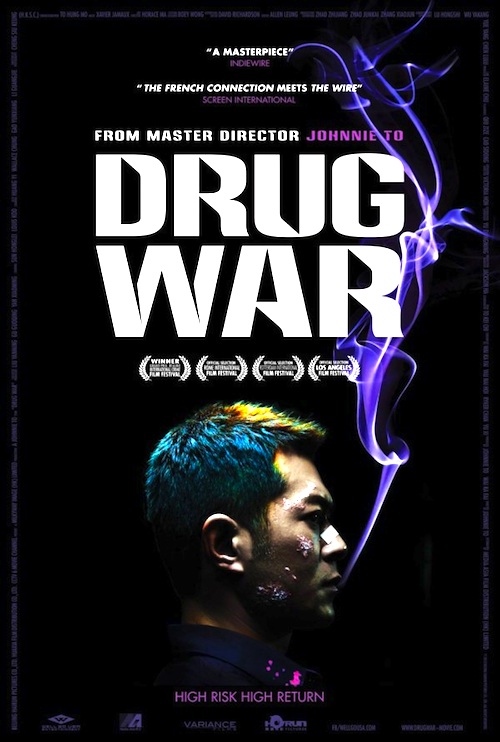
Unusually gritty compared to the operatic Vengeance and Exiled, the first two acts of Drug War are essentially street-level procedurals, but darn good ones. To shows us the nuts and bolts of the Tianjin drug squad at work, as well as the extreme lengths Zhang will go to take down his targets. However, when it is finally go time, Drug War erupts into cold, hard, violent bedlam.

As Zhang, Sun Honglei is the absolute essence of hard-nosed steeliness. Initially, it is rather jarring to hear him giggling in the guise of Haha, put he pulls that off too. Likewise, Louis Koo will make viewers forget all about his recent leading man rom-com roles in his coldest, weasliest performance in years, even if he was dubbed for Mandarin speaking audiences. His Choi is truly a survivor, like a cockroach.

To fans will also being relieved to hear Lam Suet eventually turns up, as a criminal mastermind, no less. Aside from a bit of comic relief here and there, the soldier-like supporting cast sets the right tone, particularly the glammed-down, nonsense Crystal Huang as Zhang’s colleague, Yang Xiabei.

The massively cool Drug War does not just pack a punch. It is more like a body slam. Critics and fans were concerned whether To’s hardboiled brand of crime drama would fly in China, but somehow he slipped this pitch black gem past the Party goalie. A case of a master filmmaker and an all-star cast working at the tops of their respective games, Drug War is very highly recommended for action and gangster movie enthusiasts. It screens today (7/5) at the Walter Reade Theater as part of this year’s NYAFF and opens its regular IFC Center engagement for the Fest feted Well Go USA on Friday the 26th.

LFM GRADE: A

Posted on July 5th, 2013 at 2:35pm.
LFM Reviews The Last Tycoon @ The 2013 New York Asian Film Festival

By Joe Bendel. There are explosions, talk of independence, and a villain named Mao. What more could you ask for in a Fourth of July screening?  Shanghai’s most prominent gangster and his two very different mentors will choose up sides amid the turmoil of Republican era China in Wong Jing’s The Last Tycoon, which screens today during the 2013 New York Asian Film Festival.

Cheng Daqi is very loosely based on the real life historical figure, Du Yuesheng, a high-ranking Shanghai mobster, who supported the Nationalists out of anti-Communist and anti-Japanese sentiments. As a young man, Cheng always intended to make a name for himself in the big city, but a scrape with a corrupt cop forced his hand. It also introduced him to his temporary cellmate, Mao Zai, an army officer serving as an unofficial liaison to the underworld. When Mao’s men spring them from prison, Cheng follows them to Shanghai.

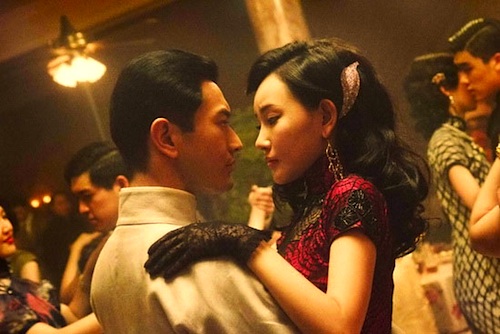
Cheng quickly rises through the ranks, apprenticing under the top gangster, Hong Shouting. However, he still remembers his great love, Ye Zhiqui. She has also fulfilled her ambition to become the toast of Beijing’s opera, eventually marrying Cheng Zhaimei, a scholar and clandestine operative in the revolutionary underground. Of all the nightclubs in Shanghai, Ye and her husband walk into Cheng Daqi’s, because it is the biggest and most ostentatious.

From "The Last Tycoon."

There are echoes of Casablanca throughout Tycoon, but Wong never slavishly parallels the Bogart classic. He also departs considerably from the established facts of Du’s life. However, he clearly plays to the strengths of his star, Chow Yun-fat, giving him plenty of opportunity to blast away two-handed while dressed to the nines. Although The Assassins was pretty good, Tycoon is really the sort of film his fans have been waiting years for.

Chow does his stone cold cool thing and it still works like a charm. Sammo Hung also brings all kinds of gravitas and good karma as his patriotic master, Hong. Clearly enjoying the heavy role, Francis Ng is charismatically villainous as the turncoat Mao Zai (not Zedong, but close enough for the 4th). While his Mao is not exactly analogous to Claude Rains’ Captain Renault, Monica Mok really throws a wrench in the Casablanca works as Cheng Daqi’s wife, Bao. Sensitive but strong and resilient, she rather walks away with the audience’s sympathies.

Produced by special festival guest Andrew Lau, Tycoon is the sort of sprawling gangster/war epic that HK cinema does so well. It is a quality period production, boasting quite a few get-your-money’s-worth action sequences. Sure to satisfy fans of the all-star cast and of martial arts shoot-outs, The Last Tycoon screened last night (7/4) at the Walter Reade Theater, as part of the 2013 New York Asian Film Festival.  Happy 4th of July.

LFM GRADE: B+

Posted on July 5th, 2013 at 2:34pm.

LFM Reviews Comrade Kim Goes Flying @ The 2013 New York Asian Film Festival

By Joe Bendel. The North Korean film authorities must love training montages. You will find conspicuous examples in Pak Chong-song’s Centre Forward as well as this strange new North Korean-European co-production. Granted, that is not a very large sampling, but it is not like there is room for much aesthetic diversity with the powers-that-be. The production values have improved, but the dialogue is as stilted as ever in Kim Gwang-hun, Nicholas Bonner, and Anja Daelemans’ Comrade Kim Goes Flying, which screens today during the 2013 New York Asian Film Festival.

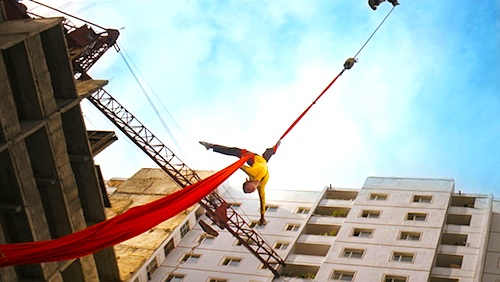
Viewers will quickly realize Flying is a fantasy because characters constantly sit down to big traditional meals. In between smashing daily production quotas, coalminer Kim Yong-mi dreams of being an acrobat in the Pyongyang Circus. Her gruff father sounds a little like Casey Kasem, telling her to “keep her feet on the ground and her head out of the clouds.” However, when Comrade Kim is temporarily transferred to the Pyongyang construction brigade, she jumps at a chance to audition for the Circus School.

Unfortunately, the circus elites do not appreciate her raw talent and enthusiasm. Initially deflated, her spirit rebounds when Commander Sok Gun, the kindly foreman, enlists her to train a troupe of construction worker-acrobats. Witnessing the salt-of-the-earth workers’ performance, Pak Jang-phil, the stuck-up trapeze strongman, realizes how much he and the circus need her. When she finally gets her shot, will Comrade Kim be able to endure the rigorous training and make the final cut?

Obviously, Flying is an odd film, particularly given the open portrayal of class conflict between the scrappy workers and the snobby circus performers. You might have thought the DPRK was a unified workers’ paradise, but evidently not. In that case, just what have the Great Leader, the Dear Leader, and the Great Successor been doing all this time?

On the plus side, Flying is a much more polished film than Centre Forward. Hwang Jin-sok’s candy-colored cinematography is rather appealing and the battery of co-directors keeps the action moving along quite spritely. The brief animated sequences, adapted from old school North Korean socialist realist wood-cuts (of which co-director Bonner is considered the world’s leading collector) are also quite striking. Nevertheless, the propaganda-laden dialogue, brimming with worker solidarity rhetoric and praise for the Party, just clunks along like an old jalopy.

From "Comrade Kim Goes Flying."

Having recently reviewed Marc Wiese’s harrowing Camp 14—Total Control Zone, one hesitates to single out any of the cast for praise, in the fear it might somehow be used against them. After all, any bourgeoisie association can be lethal in the DPRK police state. In general terms, many of the cast members are veterans of the Pyongyang Circus, who have real credibility in their acrobatic scenes and transition fairly well into dramatic acting. Those who really must be charming for the film to work are indeed quite winning and attractive. One of several cast and crew members officially designated a “People’s Artist,” Ri Yong-ho is a particularly strong and engaging presence as the sensitive hardhat, Sok Gun.

Evidently, women’s stories are largely under-represented in North Korean cinema, so Comrade Kim can be considered progressive on that front. It is always nice to see an underdog triumph over adversity, especially when it is rendered with energy and bright colors.

Indeed, it is good for North Korea watchers to get a gander at the film, like old Kremlinologists leafing through an issue of Soviet Life. However, presenting it without a reality check is a tad problematic. In contrast, the 2011 Korean American Film Festival offered a more robust and informed picture of the notoriously closed country by programming Centre Forward on a double bill with Mads Brügger’s mind-blowing comedic expose Red ChapelComrade Kim Goes Flying boasts a fresh-faced, highly likable cast, but the didactic script often undermines their efforts. Recommended for curious audiences experienced in parsing propaganda, it screens this afternoon (7/5) at the Walter Reade, as part of this year’s NYAFF.

Posted on July 5th, 2013 at 2:34pm.

More Found Footage of a Cabin in the Woods: LFM Reviews Absence

By Joe Bendel. It is always weird to watch horror movies that kind of, sort of carry pro-life implications. After all, it is never the “fetus” terrorized pregnant mothers worry about, but their “baby.” Poor Liz has already lost her daughter and it wasn’t the dingos that took her. Somehow her seven month old baby just vanished from within. Unfortunately, the unknown responsible party probably still has her on their radar in Jimmy Loweree’s Absence, which opens this Friday in New York.

Not only have Liz and Rick lost their unborn child, everyone in their hometown assumes she is just an attention-seeking Susan Smith. To get away from the pressure, they head to Rick’s isolated family cabin in the mountains. For reasons that escape Rick, they also take along Liz’s immature brother Evan. He intends to document their getaway for his film school thesis, hoping it will show the world who the real Liz really is. Okay, good plan. That hardly sounds exploitative at all. Thanks to Evan, it is time once again for viewers to get their found footage on.

Of course, the audience quickly suspects there is something not quite right going on in the background. However, Evan is real slow on the up-take and evidently never reviews the footage he shoots while in the process of passing out.

From "Absence."

To their credit, Loweree and co-writer Jake Moreno really try to take the time to establish their characters, unlike most found footage formula grinders. It is a nice instinct, but they overcompensate. As a result, Absence feels like it is about 92% percent set-up and 8% getting down to genre business.

Eric Matheny brings a strong presence to the film as the protective Rick and he develops a decent screen rapport with Erin Way’s convincingly fragile Liz. However, as Evan, Ryan Smale cranks up the shtick to the point viewers will become nostalgic for Jaime Kennedy in the Scream franchise.

Ultimately, Absence’s restraint becomes too much of a good thing. The fact that Evan is our primary POV figure also works against the film. At least Loweree sets the scene nicely and never cops out with cheap gotcha scares. There is a cookout scene too, so maybe that makes it fit diehard horror fans’ 4th of July weekend plans. Rather middling overall but competently produced, Absence opens this Friday (7/5) in New York at the Quad Cinema and at the Gateway Film Center in Columbus.

LFM GRADE: C-

Posted on July 5th, 2013 at 2:31pm.

LFM Reviews Confession of Murder @ The 2013 New York Asian Film Festival

By Joe Bendel. It is the kind of capricious perversity of the legal system that a Victorian novelist would admire. After the statute of limitations expires for his crimes, a serial killer comes forward—ostensibly to repent. However, the cop in charge of the investigation doubts both his sincerity and his veracity in Jung Byoung-gil’s Confession of Murder, which screens today during the 2013 New York Asian Film Festival.

Det. Choi Hyung-goo still bears the scar from his close encounter with a masked serial killer. The case became personal for him—real personal. When Lee Doo-suk steps forward claiming to be the serial killer he is not impressed. Neither are the families of his victims. In marked contrast, the public eats up his phony contrition act, turning Lee into a media phenomenon. Unfortunately, there is little Choi can do, but the families are not so passive.

Directed by Jung, who is best known to NYAFF patrons for Action Boys, his documentary about Korean stuntmen, Confession has its share of big, adrenaline charged chases and fight scenes. However, it is not the stunt work bacchanal one might expect. Instead, Confession plumbs some murky psychological depths. Rather than an action thrill ride, it compares more closely to Kim Jee-woon’s I Saw the Devil.

From "Confession of Murder."

Jung maintains the stark tension throughout the film, but he unleashes a barrage of revelations in the third act. Indeed, viewers might kick themselves for not guessing a few, but Confession serves as an object lesson in how not to telegraph your big twists by keeping everyone distracting with breakneck pacing. This is a really well constructed film, but it is not for those with delicate sensibilities. Yes, there is a fair amount of physical conflict, but the emotional violence is far more unsettling.

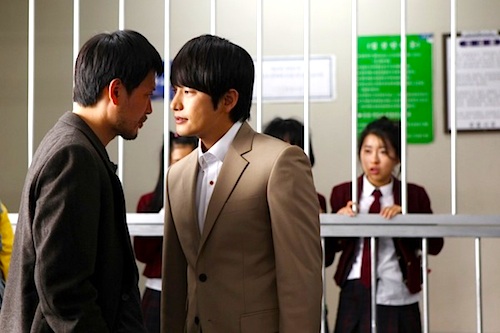
Jung Jae-young is all kinds of hardnosed as Det. Choi, yet he also perfectly conveys the damaged cop’s tragic nature. Television star Park Si-hoo is suitably cold and creepy as the serial killer-teen idol. Their scenes together have serious zing, but they are also backed-up by a strong supporting cast that really helps sell the twists and turns.

Presumably most viewers will not be experts in South Korean criminal law, so it is easy to suspend disbelief over its initial MacGuffin. While in America the statute of limitations never expires for murder, Confessions is such a nifty, high concept thriller, it seems ripe for a Hollywood remake nonetheless. (Perhaps a liberal judge in the Dirty Harry tradition could issue a preemptive ruling granting the killer impunity.) Regardless, Confession of Murder is a muscular thriller that ventures into some unusually dark places. Very highly recommended, it screens this afternoon (7/3) at the Walter Reade Theater, as part of the 2013 New York Asian Film Festival.

LFM GRADE: A-

Posted on July 3rd, 2013 at 1:17pm.

LFM Reviews Ip Man: The Final Fight @ The 2013 New York Asian Film Festival

By Joe Bendel. Ip Man was such a powerful kung fu master, he could actually warp time. Fans can only assume as much if they wish to justify the conflicting timelines of the various Ip Man films released in recent years. The dates and places might change, but Ip Man remains the grandmaster of masters. Herman Yau dramatizes his twilight years in Ip Man—the Final Flight, which was a hot ticket last night at the 2013 New York Asian Film Festival.

In the 1950’s and 1960’s, Hong Kong’s go-go economy had yet to blast off. Master Ip earns little more than a subsistence living teaching his Wing Chun style of kung fu to students. Well known throughout the city, Master Ip could probably do a brisker business were it not for his own self-imposed restrictions. Kung fu is a way of life for him—not a commodity to be commercialized.

In a way, The Final Flight is a bit Gumpish, casting Master Ip as an observer of two decades of Hong Kong’s growing pains, including the rise of trade unionism and the rampant gangsterism within the Walled City. However, when it finally gets down to fighting, Final delivers some spectacular street melees.

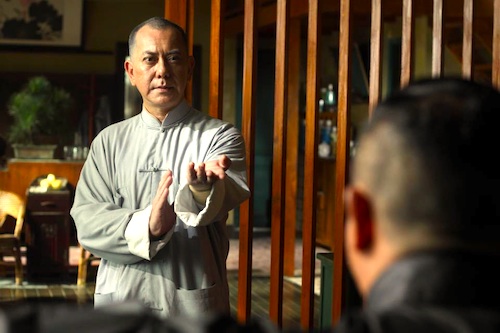
While produced independently of Wilson Yip’s Ip Man films, Anthony Wong is not a bad likeness for Donnie Yen in his AARP years. Wong might not look particularly spry, but he is a steely old cat, so it is easy to buy into him as the veteran martial artist. After all, the genre has a long history of butt-kicking greybeards.

Anthony Wong in "Ip Man: The Final Fight."

Indeed, Wong’s Zen-like gravitas is perfect for the venerable Ip. He also develops some appealingly ambiguous chemistry with Zhou Chu Chu, playing a scandalous nightclub singer attracted to his old bad self. However, the film is overstuffed with Ip’s disciples. You would think half the city was studying under him. Regardless, Jordan Chan adds real hardboiled heft to the film as Tang Shing, a not completely corrupt copper and former student of Ip’s. He creates a spinoff-worthy character should the filmmakers wish to further complicate the Ip Man universe.

Festival special guest Yau should satisfy fans with his gritty street action and humanistic portrayal of the Ip family. In fact, Ip’s son, Ip Chun, served as a technical advisor and appears in a small supporting role. Final Fight is also bolder than its predecessor films in depicting Ip’s most famous student, Bruce Lee. Although never named as such, it is hard to miss the implication when Master Ip meets with a former student turned famous actor, whom the audience only sees from behind, sporting conspicuous sunglasses.

It was the apostolic connection to Bruce Lee that launched the Ip Man filmmaking craze to begin with, but the Master has since taken on a media life of his own. Nicely choreographed with a wistful vibe that sets it apart from the pack, Yau’s latest Ip Man is a worthy addition to the Ip canon. Recommended for martial arts fans with a strong appreciation of tradition, Ip Man—the Final Fight screened last night (6/30) as part of the 2013 New York Asian Film Festival.

LFM GRADE: B+

Posted on July 1st, 2013 at 11:22am.