John Guare’s Separation Anxiety: LFM Reviews 3 Kinds of Exile

By Joe Bendel. It is an insidious tool used to control dissent, yet sometimes it comes as a relief. Whether voluntary or forced, separation from one’s homeland is a difficult proposition to face. Playwright John Guare explores the phenomenon in his new theatrical hybrid triptych, 3 Kinds of Exile, which officially opened this week at the Atlantic Theater Company’s Linda Gross Theater.

Exile’s first segment, Karel, quickly establishes the minimalist tone through a brief but captivating monologue. An unnamed actor relates the experiences of his friend, a former kindertransport refugee. Despite the success he found as an adult, the first exile’s guilt eventually manifests itself in a rather macabre fashion. While the Kafka influence here is inescapable, it is still an intriguing tale. Martin Moran (who has appeared in several of his own one-man shows) tells it with confidence, nicely conveying the drama and angst of his friend’s situation as a second-hand reporter.

The middle piece of Exile will likely generate the most attention in the theater world, because it represents the first time the playwright has performed in his own play. In fact, Elzbieta Erased is all about stage and screen history, telling the mostly sad history of Elzbieta Czyzewska. Once one of Poland’s most acclaimed thespians, Czyzewska marriage to American journalist David Halberstam directly led to her exile and a sometimes brilliant but decidedly erratic career Off-Broadway, well before Off-Broadway was cool.

Essentially, Erased is a dramatic A-V presentation adapted from a previous Guare one-act, featuring the writer and Polish actor Omar Sangare detailing the trials and tribulations of Czyzewska’s life. However, it takes on unexpectedly heavy significance when both men start to reveal their connections to Czyzewska. In fact, it is hard to imagine a production of Exile without them. Sangare is an electric stage presence and Guare is the veritable personification of erudite sophistication. Hearing their tribute to Czyzewska is completely absorbing and genuinely moving, even with the pseudo-lecture hall staging.

Exile ends with a spot of musical theater, albeit of a somewhat absurdist variety. Inspired by his work, Funiage turns the spotlight on the Polish novelist Witold Gombrowicz. Not particularly well regarded at home, Gombrowicz accepts an offer to lecture Argentina’s Polish expatriate community on the greatness of proper Polish literature, on the eve of World War II. The expats did not think much of him either, but at least there were women to carouse with on the ship.

From "3 Kinds of Exile."

Ironically, Funiage is the most upbeat segment of Exile, even though it deliberately echoes Weil & Brecht’s productions. Indeed, Gombrowicz is an attractive figure, who was evidently largely satisfied working as a Buenos Aires bank clerk by day and writing in relative obscurity at night. David Pittu (who played Brecht in the Broadway musical LoveMusic) is wildly charismatic as Gombrowicz, while also expressing a sad, world weary earnestness.

Of course, Guare is best known as the writer of Six Degrees of Separation, which factors prominently in Elzbieta Erased3 Kinds of Exile is more avant-garde in form than his signature work, but the stories are still easily accessible and immediately engaging. There are some deep truths in each piece, as well as several dynamic performances.  Recommended for slightly adventurous patrons, it runs through June 23rd at the Linda Gross Theater.

Posted on June 13th, 2013 at 3:49pm.
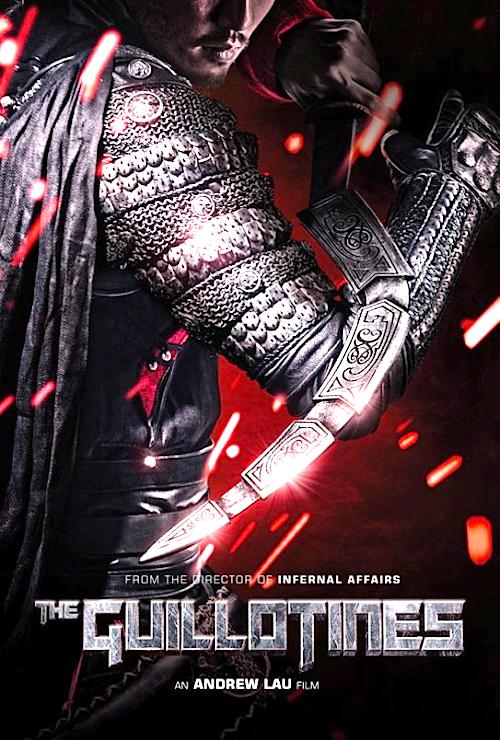
Heads Up: LFM Reviews The Guillotines

By Joe Bendel. Widely feared for their decapitation weapons, the Guillotines consider themselves the Emperor’s A-team for sensitive missions. Unfortunately, they find out they are simply expendable crewmen in Andrew Lau’s The Guillotines, which opens this Friday in New York.

Wolf is the ironically named leader of the rebellious shepherd gang, who seems to think his fate is connected to that of Leng, the Guillotines’ trusted squad leader. With Wolf imprisoned and scheduled for execution, Leng pays little heed to his captive’s mumbo jumbo. Unfortunately, a daring rescue operation frees Wolf, in the process taking prisoner Musen, their comrade and daughter of their revered commander.

Obviously, this is a black eye for the Guillotines, but it gets worse. The emperor has decided to sacrifice the Guillotines on an ostensive clean-up mission. As it happens, Leng is well acquainted with the man charged with his team’s destruction. He and Agent Du were recruited as young children to faithfully serve the emperor. While Du remains unswervingly committed to the royal sovereign, Leng feels a stronger kinship with his team. Ironically, he finds temporary shelter with his old nemesis, Wolf.

Considering the wicked, Krull-like weapons sported by the Guillotines, this pseudo-Shaw Brothers remake is surprisingly stingy with the martial arts throwdowns. Frustratingly, most of the action consists of large set piece massacres of Wolf’s ragtag contingent, which are really not much fun at all.

Indeed, The Guillotines follows in a long line of historical dramas that not so subtly suggest a strong centralizing authority is in the national interest because it provides stability. Of course, this is an attractive argument if you happen to be part of that centralized power structure. Still, the film incorporates the traditional Han and Manchu conflict in intriguing ways.

As Leng and Du, Ethan Juan and Shawn Yue develop a nice Cain-and-Abel tension, while Li Yuchun convincingly renders Musen’s awakening of conscience. In contrast, the rest of the Guillotines, though introduced individually in the cool credit sequence, are not meaningfully delineated as characters.

Frankly, there are just too many scenes of terrified peasants fleeing the Imperial war machine, followed-up with precious little payoff. It is a quality period production, but there is too much message and not enough old school entertainment. A disappointment for martial arts fans, The Guillotines opens this Friday (6/14) in New York at the IFC Center.

LFM GRADE: D+

Posted on June 13th, 2013 at 3:48pm.

Giallo Madness: LFM Reviews Berberian Sound Studio

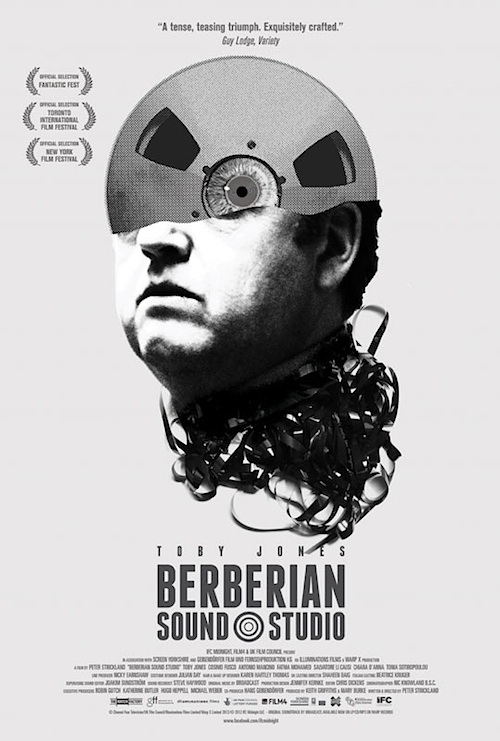
By Joe Bendel. This might be the most anti-horror movie genre freak-out, perhaps ever. Do not tell the hapless sound engineer in question he is just working on a movie, or that the violent images he sees are no big deal. The vintage-era Italian giallo will profoundly disturb the nebbish Brit throughout Peter Strickland’s Berberian Sound Studio, which opens this Friday in New York.

Poor Gilderoy assumed he had been hired to engineer the sort of nature documentary that has been his specialty. Unfortunately, The Equestrian Vortex is anything but. This will be the latest gore fest from the notorious giallo auteur, Santini (who does that name remind you of?). The film opens with a girl on a horse, but she will soon find herself in a bacchanal of witchcraft and graphic, sexually charged violence. Gilderoy is not prepared for this material, but nobody refuses Santini.

Right from the start, Santini and the staff of the grimy 1970’s sound studio torment Gilderoy with mind games. The engineer’s mental and emotional health quickly deteriorates as he records the smashing pumpkins and other foley effects that accompany the on-screen tortures. On the plus side, there are elegant Mediterranean bombshells coming in out of the studio to record their screams, but only Silvia, the fading starlet, shows him any kindness. Of course, she is no match for the notorious Santini, or his Mephistophelean producer Francesco.

The fresh produce sacrificed to make Berberian could have made a month of salads for the Italian army, but it all has the desired impact. In a more just world, Berberian should be an Oscar shoe-in for the sound categories. However, the Academy will probably be far too uncomfortable with the film’s premise and implications.

Indeed, Berberian is unusually forthright questioning the cumulative impact of desensitizing imagery, far surpassing Cronenberg’s somewhat thematically related Videodrome. Shrewdly, Strickland never shows the audience the Equestrian horrors slowly boring their way into Gilderoy’s brain. It is far more unsettling to hear them take shape in the studio and to watch the engineer’s pained responses. This is an artfully creepy film that skillfully builds the claustrophobic tension, up until the third act collapses into surreal reality-problematizing bedlam.

Who knew Toby Jones had this in him? As Gilderoy, he quietly but rather spectacularly portrays a shy, reserved man coming apart at the seams, in a marked departure from his supercilious type-casting. As his polar opposite, Cosimo Fusco’s Francesco is a malevolent sleazebag worthy of the giallo tradition.

Yet, the real stars of Berberian are the technical crew who so perfectly recreate the look, sound, and general vibe of the genre. Listening to Broadcast’s original score, one could easily believe it came off a rare vinyl soundtrack (that’s a good thing). Similarly, production designer Jennifer Kernke’s painstaking attention to period detail makes the analog studio feel like a truly real (and really awful) place to work.

This is a superior midnight-genre film that might just challenge regular midnight-genre patrons. Oddly enough, it also happens to be one of the year’s best period productions. Highly recommended for open-minded cult movie fans, Berberian Sound Studio opens this Friday (6/14) at the IFC Center.

LFM GRADE: A

Posted on June 11th, 2013 at 3:19pm.

LFM Reviews Steve Chong Finds Out that Suicide is a Bad Idea @ The 2013 Dances With Films

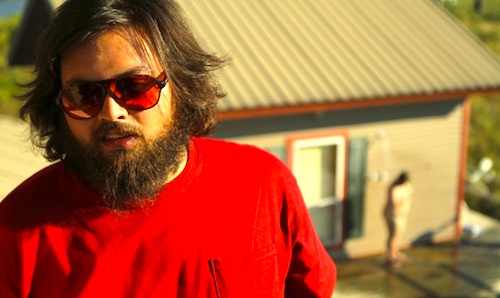
By Joe Bendel. Why is Steve Chong so depressed? Maybe it is due to feelings of inadequate facial hair. If so, he probably picked the wrong friends. Nevertheless, the bearded slackers will do their best to prevent their buddy from taking the final exit in Charlie LaVoy’s Steve Chong Finds Out that Suicide is a Bad Idea, which screened this past Friday during Dances With Films at the TCL Chinese Theatres (where the marquee is long enough to fit that title).

Chong was never really suited to his job as a sushi chef, but getting fired hardly helps his mental outlook. When his extreme shyness sabotages what might have been his last best shot with Alice, the waitress he has long carried a torch for, Chong is pretty much ready to cash in his chips. However, he will first invite over his goofball friends for a weekend at his parents’ lake house. Unable to hold his booze like they can, the stink-faced Chong lets his plans slip during a drinking game. The next morning, he does not seem to remember the episode, but his friends do.

Frankly, some of the cleverest bits of SCFOTSIABI involve their attempts to child-proof the lake house. LaVoy and screenwriter-co-star Owen Hornstein III probably could have mined the suicide prevention efforts for more dark physical humor. One cannot help wondering what Jacques Tati’s evil twin could have done with this premise. Rather, LaVoy and his cast of filmmaking collaborators are more interested with exploring themes of friendship and loyalty. That is all very nice, but it could have been funnier.

From "Steve Chong Finds Out that Suicide is a Bad Idea."

Still, there is no question SCFOTSIABI connects with the economic anxiety that has plagued the country (especially recent college graduates) for the last six years or so. Chong may yet find out about suicide, but he understands the reality of a “soft recovery” all too well. Wisely, the film never overplays its hand with fleetingly topical references, focusing instead on perennials bummers – like crummy jobs, difficult bosses, and estranged friends.

Stanley Wong (who also edited SCFOTSIABI) is appropriately awkward and tightly wound as Chong and develops some convincing chemistry with the grizzly trio. Viewers will believe they all have some long, complicated history together. While Hornstein and Tyler Russell’s constant feuding gets a bit tiresome, standout Joe Sökmen has some memorable moments of honesty as John, who passes for the mature one in this Rat Pack.

Speaking of lake houses, if Chong had recently seen the Keanu Reeves-Sandra Bullock remake, it would also explain his suicidal impulses. To the credit of the co-producing cast, they largely avoid such sentimental excesses. While seemingly tailor made for Hangover comparisons, SCFOTSIABI is really more about avoiding a truly awful morning after. A nice, intermittently amusing film about friendship, Steve Chong Finds Out that Suicide is a Bad Idea screened as part of the “Sweet Sixteen” Dances With Films in Hollywood.

LFM GRADE: C+

Posted on June 11th, 2013 at 3:18pm.

Collaboration Anxiety: LFM Reviews In the Fog

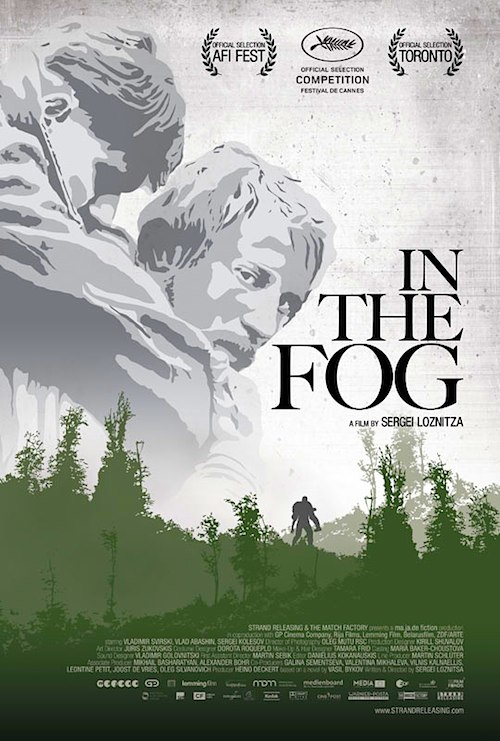
By Joe Bendel. Some people are born to curry favor with successive regimes, regardless of changing ideologies. There are also those who are constitutionally incapable of ingratiating themselves with the powers that be. Sushenya is definitely the latter sort, but through a cruel twist, he finds himself suspected of collaboration in Sergei Loznitsa’s WWII drama, In the Fog, which opens this Friday in New York.

When Burov knocks on his door late one night, Sushenya knows the partisan has come to execute him. Burov would have done the deed right there and then, were it not for the presence of the condemned man’s son. Instead, he and his squirrely comrade Voitek march Sushenya out into the Belorussian forest. However, German patrols are out in force this particular night, drastically altering the course of Burov’s score-settling mission.

For the three main characters, backstory is truly destiny. Through extended flashbacks, Loznitsa shows the audience the ironic events that inevitably led the trio into the fateful forest. There is an inescapably absurdist character to In the Fog, as its characters doggedly tramp through the woods, evading the Germans as best they can, despite the awkward circumstances that brought them together.

Yet, In the Fog is also closely akin to Jean-Pierre Melville’s Army of Shadows. Loznitsa’s adaptation of Vasil Bykov’s novel hardly idolizes the Communist partisans. Frankly, it suggests they are more interested in suspected turncoats like Sushenya than taking the war to the Germans. Neither Sushenya nor Burov are Party people, so to speak. Voitek is not exactly a true believer either, but his craven nature is more compatible with his fellow comrades. Indeed, during Sushenya’s flashback, one of his railroad co-workers observes how their former Communist tormentor had so quickly aligned himself with the new National Socialist occupiers.

Vladimir Svirskiy looks profoundly miserable as Sushenya. It is a performance of striking physicality, perfectly suited to Loznitsa’s taciturn film. As Voitek, Sergei Kolesov also taps into just about every unedifying aspect of human nature, without overplaying any of them. Even with his dramatic origin story, Vladislav Abashin’s Burov remains something of a cipher, but Vlad Ivanov (the abortionist in 4 Months, 3 Weeks, 2 Days) casts a long shadow over the film as the deceitful German officer, Grossmeier.

Yes, once night breaks, there will be plenty of fog to represent to moral murkiness facing the film’s characters. There will be no heroics in the wartime USSR, no matter who holds Sushenya’s village. Loznitsa offers viewers little consolation and his purposeful pacing will be problematic for antsy viewers. Yet, his long tracking shots are quite striking (especially the opening hanging sequence). Impressively bracing, In the Fog is recommended rather highly for adult attention spans when it opens this Friday (6/14) in New York at the Village East.

LFM GRADE: A-

Posted on June 10th, 2013 at 11:41am.

LFM’s Jason Apuzzo & Govindini Murty at The Huffington Post: A Look Behind Steven Spielberg’s Falling Skies, One of The Best Sci-Fi Shows in Years

[Editor’s Note: the post below appears today on the front page of The Huffington Post.]

By Jason Apuzzo & Govindini Murty. Steven Spielberg’s Falling Skies has unexpectedly become one of the best sci-fi TV shows in years – a dark, gritty and emotional look at an American society struggling to survive after an apocalyptic alien invasion.

The show’s third season debuts on TNT this Sunday, June 9th on Father’s Day, which is appropriate, given the show’s focus on fathers and their responsibility toward their children. The series has already been a ratings bonanza for TNT – Falling Skies was last summer’s top-rated drama on basic cable – and having seen the first five episodes of the upcoming season, we can tell you that Season 3 looks to be an even bigger hit.

So why would the success of Falling Skies be unexpected, especially given the involvement of executive producer Steven Spielberg and series creator Robert Rodat (Saving Private Ryan)? Possibly because when the show first debuted in the summer of 2011 – the long, hot sci-fi summer that gave us Transformers: Dark of the Moon, Super 8 and Cowboys & Aliens – the idea of another movie or TV show about alien invasion seemed redundant.

And after getting their tails (or robot parts) kicked on-screen in recent years by Harrison Ford, Tom Cruise and the U.S. military, you’d think aliens would know better than to invade by now, anyway.

2013-06-08-Masonkids.jpg
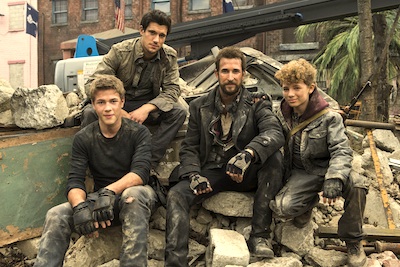
A story of a father and his sons.

Starring Noah Wyle and Moon Bloodgood, Falling Skies (Season 2 of which arrived this week on Blu-ray) has carved out its own niche, however, largely by doing basic things well – telling a classic American story of the fight for freedom, and of families struggling to stay together in wartime. And with its populist vibe and focus on civic duty, Falling Skies is also the sci-fi show for audiences who don’t usually watch sci-fi. Indeed, the series often feels inspired as much by American Westerns as by science fiction.

And, of course, there’s always the magic touch of Steven Spielberg.

“Steven Spielberg is the master of science fiction, and of drama,” Noah Wyle told us recently at Zoic Studios in Culver City, where Falling Skies‘ visual effects were being completed. Series showrunner and writer Remi Aubuchon agreed: “Steven actually is very involved in our show … he certainly reads all the scripts and watches all the dailies, and he’s intricately involved in the design of the creatures and the cool things.”

Season 3 of Falling Skies picks up where the previous two seasons left off, with former history professor Tom Mason (Wyle) and his extended family trying to pick up the pieces of civil society in the wake of a devastating alien attack. Like some grizzled, bearded patriarch out of the old West – and now serving as the acting President of the United States – Mason tries to hold it all together, as his provisional government in South Carolina forges a dubious alliance with a new alien species encountered at the end of last season.

On the home front, Mason also welcomes an unusual new daughter into the world, born to Dr. Anne Glass (Moon Bloodgood), his longtime lover and the show’s emotional center. Meanwhile, Mason’s son Hal (Drew Roy) struggles to keep himself from being used by enemy aliens as a spy, all while juggling the two edgy blondes in his life (Sarah Sanguin Carter and Jessy Schram) – one of whom just happens to be the enemy aliens’ new commander.

Such is family life in Falling Skies. Continue reading LFM’s Jason Apuzzo & Govindini Murty at The Huffington Post: A Look Behind Steven Spielberg’s Falling Skies, One of The Best Sci-Fi Shows in Years