Resnais Adapts Anouilh: LFM Reviews You Ain’t Seen Nothin’ Yet

By Joe Bendel. Can a play from the 1940’s, based on classical mythology, still speak to contemporary audiences? Alain Resnais will answer in the affirmative. As a consummate cinematic game-player, he naturally stacks the deck, casting a who’s who of French thespians in his meta-adaptation of Jean Anouilh’s Eurydice. Regardless, the star-crossed love still resonates in You Ain’t Seen Nothin’ Yet, which opens this Friday in New York.

Orpheus and Eurydice supply the back bone of YASNY, but the framing device incorporates Anouilh’s Cher Antoine ou l’amour Rate. Playing themselves, the leading lights of French stage and screen are summoned to a memorial for their dear departed friend, playwright Antoine d’Anthac. As part of the ceremony, they are to watch a video of his/Anouilh’s Eurydice, to determine whether the avant-garde revival is worth staging. It is a work they are all familiar with, having each appeared in previous productions. Watching the screen, they get caught up in the story and their own memories and begin to act out Eurydice in concert with the recorded rehearsal.
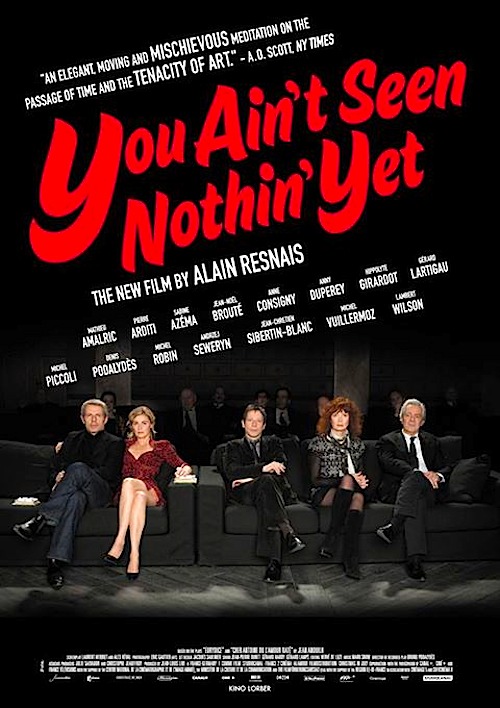
Cast members overlap and echo each other, but Resnais always maintains the integrity of Eurydice’s storyline. It all sounds very post-modern, but it is really a case of the narrative overpowering its meta-conceits rather than being defined by them.

Of course, it is hard to go wrong with YASNY’s cast. While Resnais has three sets of Orpheus and Eurydice at his disposal, he clearly favors Pierre Arditi and Sabine Azéma (two of his longtime collaborators), with good reason. Watching this couple on the late side of middle age portraying the doomed young lovers is eerily moving. Their experienced faces seem to amplify the tragedy rather than distract from it. Nonetheless, Anne Consigny’s Eurydice is exquisitely brittle and dignified, overshadowing the aloof Lambert Wilson.

Former Bond villain Mathieu Amalric exudes a deliciously Mephistophelean vibe while maintaining the moral ambiguity of Monsieur Henri, death’s avatar, a role he mostly has to himself. Michel Piccoli nicely anchors the film with his warm gravitas, ostensibly revisiting the role of Orpheus’s father, while leading the cheering section within the elite audience. In addition to playing d’Anthac with eccentric flair, Denis Podalydès (from the Comédie Française) was recruited to direct the hipster Eurydice video segments, further complicating notions of what the film is and who is its author. It is Anouilh’s Eurydice, as well as d’Anthac’s, but it is also partially Cher Antoine, mostly reconceived by Resnais, but also shaped by Podalydès.

The key point is: it’s all good. With its cast members handing off their batons like relay runners, YASNY’s affection for the theater’s passion and artifice becomes infectious. Featuring music by X-Files composer Mark Snow and Eric Gautier’s richly noir-ish cinematography, it is an unusually elegant film. Cerebral yet strangely poignant, the highly recommended You Ain’t Seen Nothin’ Yet opens this Friday (6/7) in New York at the Quad Cinema.

LFM GRADE: A-

Posted on June 3rd, 2013 at 1:04pm.
Our Voyeuristic Future: LFM Reviews Channeling @ The 2013 Dances With Films

By Joe Bendel. In the very near future, about five minutes from now, people will become even more exhibitionistic. Personal internet reality shows are the thing, made possible by special contact lens cameras. ‘Channelers’ broadcast themselves snowboarding, booty calling, and navel gazing. Some also broadcast criminal activity, such as an Army sergeant’s estranged brother. When the punk winds up dead, his avenging sibling assumes control of his channel in Drew Thomas’s Channeling (see viral teaser above), which screens tomorrow during the 2013 edition of Dances With Films.

The Maddox family was always pretty dysfunctional. The death of Wyatt, the Fast & Furious wannabe, does not help much. Returning on a bereavement leave, Jonah soon starts nosing around with the help of Tara, his brother’s on-camera co-host, sidekick, or whatever. Essentially, this leaves all the responsible stuff to his younger sister, Ashleigh. She broadcasts her life too, in hopes of finding validation from voyeuristic netizens. That is really the wrong place to be looking.

It is always pretty obvious who the bad guys are in this film, but it is never clear why they had it in for the Brothers Maddox. Wyatt’s ratings were always pretty good by channeling standards, unlike the late Howard Beale in Network. Regardless, it offers Jonah an excuse to boost some fast cars.

From "Channeling."

Channeling is a serviceable enough b-movie, but it pales in comparison to Bertrand Tavernier’s thematically similar Death Watch, which remains an eerily prescient critique of our media-driven society even over thirty years after its initial release. It is also hard to compete with Harvey Keitel, Harry Dean Stanton, and Romy Schneider.

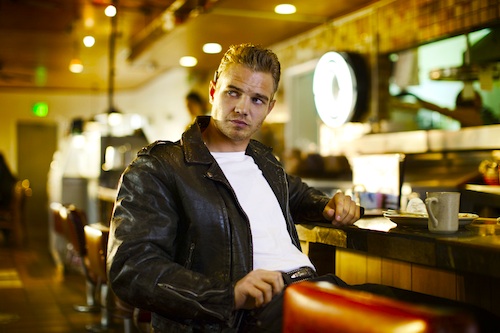
Regardless, as a leading man, Dominic De Vore seems to have graduated from the Caspar Van Dien school of acting. He is adequately square-jawed in the action scenes, but that’s about all you get. However, Kate French (probably best known from The L Word and One Tree Hill) lends the film some style and presence riding shotgun as Tara, while Taylor Handley does a presentable James Dean impression as the ill-fated Wyatt.

Thomas and cinematographer Andrew Huebscher keep things looking slick and cool throughout. Cars will be wrecked and thugs will get their beatdowns. It’s all a cut above SyFy Channel original movies, but those primarily intrigued by the premise should checkout Tavernier’s underappreciated gem instead. For Kate French’s fans, it screens tomorrow night (6/2) as part of this year’s Dances With Films in Hollywood, CA.

LFM GRADE: C+

Posted on June 1st, 2013 at 1:02pm.

Post-Dystopia Depression: LFM Reviews A Better World @ The 2013 Brooklyn Film Festival

By Joe Bendel. Think of this as what happens after the famous 1984 Apple commercial. Big Brother has fallen. Unfortunately, Henry Dremmel is no Winston Smith. Adjusting to a post-dystopian world will be difficult for him in Sacha Feiner’s short film A Better World, which screens during the 2013 Brooklyn Film Festival.

Dremmel the tool, works for the Domestic Denunciation Program. All day he monitors security cameras, reporting even the slightest deviations from the norm. One fateful night, Dremmel wakes to the sound of fireworks. The regime has fallen. Freedom has broken out, but the Denunciator cannot handle it. He prefers the structure of his drab, harshly regimented former existence.

Audiences are unlikely to see a film more explicitly associating the compulsive need for security with oppressive statism in a month of Sundays. What’s even more mind-blowing is that it hails from Belgium, the EU’s happy host nation. Regardless, writer-director Feiner really cuts to the heart of the matter. Dremmel is not an odious villain. A pathetic figure, he is the final victim of a de-humanizing collectivist system.

From "A Better World."

A Better World is also quite an impressive looking production. Olan Bowland’s bleak, washed-out cinematography and Julia Irribaria’s imposing sets create a perfectly Orwellian environment. Almost a prop himself, Vincent Kohler is appropriately cringey and clammy as Dremmel.

Despite its twenty-four minute running time, A Better World has more to say than most features. A genuinely challenging work (especially for Williamsburg hipsters), it is one of the best dystopian films of any length to hit the festival circuit. Very highly recommended, it screens this coming Monday (6/3) and Wednesday (6/5) as part of the 2013 Magnetic edition of the Brooklyn Film Festival.

Posted on May 31st, 2013 at 12:05pm.

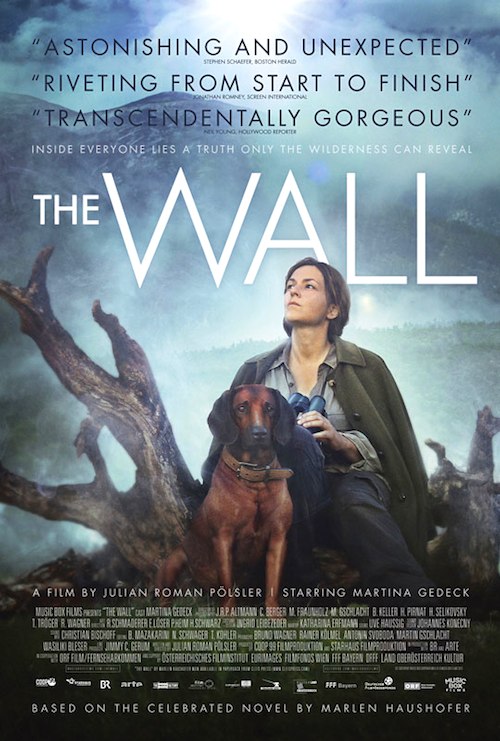
A Very Private Apocalypse: LFM Reviews The Wall

By Joe Bendel. When the television adaptation of Stephen King’s Under the Dome hits the airwaves, fans will duly wonder where he gets his ideas from. Hmm, maybe Christoffer Boe’s Allegro or Marlen Haushofer’s Die Wand. Of course, both predecessors are much more introspective in nature. Indeed, viewers witness a very private apocalypse in Julian Pölsler’s adaptation of Haushofer’s 1963 novel, The Wall, which opens this Friday in New York at the IFC Center.

A woman is holidaying with friends in an Austrian mountain lodge. Her hosts drive into town for supplies and never return. Venturing out the next morning she discovers an invisible barrier blocking the road. Scouting the mountainside, she discovers that the strange wall encircles her. She can see people on the other side, but they appear frozen in place. Time seems to only pass on her side of the wall, but it passes very slowly.

Told in flashbacks via the unnamed woman’s journal entries, The Wall consciously echoes Robinson Crusoe. With no Man Friday, the woman develops a close bond with the couple’s dog, Lynx. Indeed, it is largely her rapport with animals that keeps the woman engaged in her solitary world.

Obviously, The Wall implies much about man and our unbalanced relationship with nature. The English language voice-overs are often rather heavy-handed (and clash with the limited subtitled German dialogue) but the film’s vibe and rhythm are eerily evocative. Viewers will feel like they are getting a true taste of what it would be like to be the last sentient person on Earth.

Shot over the course of several seasons, Pölsler and his battery of cinematographers fully capitalize on the stunning scenic vistas that utterly dwarf the lone woman. Carrying the film almost single-handedly, Martina Gedeck (co-star of the modern classic The Lives of Others) gives a remarkably assured performance. Mixing depression and empowerment, it might be the purest cinematic portrayal of existential living. However, it is also worth noting Pölsler’s own dog Lynx is quite the performer in his own right.

The Wall may well be a rebuke of patriarchy and industrialization, but it still works rather well as a survivor’s story. Admittedly, it is deliberately paced (for obvious reasons), but the overall effect is hypnotic. Recommended for those who appreciate apocalyptic and allegorical cinema, The Wall opens this Friday (5/31) at the IFC Center.

LFM GRADE: B

Posted on May 30th, 2013 at 4:26pm.

LFM Reviews Sunny @ New York’s Korean Movie Night

By Joe Bendel. If Rizzo were dying of cancer, surely Frenchie would reunite the Pink Ladies. Such is the position married and well-to-do Im Na-mi finds herself in. Some members of the girl gang are happy to get back together, but others are harder to find in Kang Hyeong-chul’s monster hit Sunny, which screens tonight as part of the Korean Cultural Service’s free Korean Movie Night in New York.

While not exactly a life of quiet desperation, Im leads a sheltered existence that is not wholly fulfilling. Since her husband and daughter are too busy to visit her mother-in-law in the hospital, she upholds their obligations. During one such visit, she chances across the room of Ha Chun-hwa, the leader of the clique dubbed “Sunny.” When Im’s family moved to Seoul from the countryside, Ha took the shy teen under her wing. As we watch in flashbacks, most of Sunny quickly fell in line, but not Jung Su-ji, the moody prospective model.

When not rumbling with other girl gangs, Sunny practiced their choreography. However, they were never able to perform their big number, for reasons that will eventually be revealed. Hmm, anyone smell some unfinished business here?

In a Korean film, when a character is introduced with a fatal illness in the first act, it is a cinch there will be an emotional funeral coming down the pike. This goes way beyond Chekhov’s gun. Without a big weepy payoff, audiences would want their money back. Not to be spoilery, but Sunny delivers the goods.

Yes, this is a chick flick, but it is an admittedly well crafted film. Employing some surprisingly striking transitions for each temporal shift, Sunny is more visually stylish than it probably needed to be. In fact, Nam Na-yeoung won the best editing honors at Daejong Film Awards for good reason. As the narrative unfolds, it pulls you in – despite viewers’ macho or hipster resistances.

From "Sunny."

Yoo Ho-jeong plays grown-up Im with admirable restraint, never overplaying the gilded cage empowerment card. Likewise, Shim Eun-kyung is earnest and awkward as teenaged Im. Yet both Jin Hee-kyung and Kang Sora really outshine the ensemble as the ailing adult and fearless teenaged, Ha, respectively. Although hardly a teen herself, singer Min Hyo-rin has her moments as the high school ice queen, Jung. As for her adult counterpart, that is really the question driving Sunny’s third act.

If Cyndi Lauper floats your boat and you prefer Boney M’s version of the title song over Bobby Hebb’s original, than Sunny’s unabashedly 1980’s soundtrack will be your catnip. The ways screenwriter-director Kang interjects and darts around the May 1980 democracy protests also gives the film a bit of seasoning. He certainly conveys his point of view, without waving the bloody shirt. Sunny is shamelessly manipulative and sentimental, but it does exactly what it sets out to do. Recommended for those looking to celebrate sisterhood, it screens tonight (5/28) at the Tribeca Cinemas—free of charge, courtesy of the Korean Cultural Service in New York.

LFM GRADE: B-

Posted on May 28th, 2013 at 12:30pm.

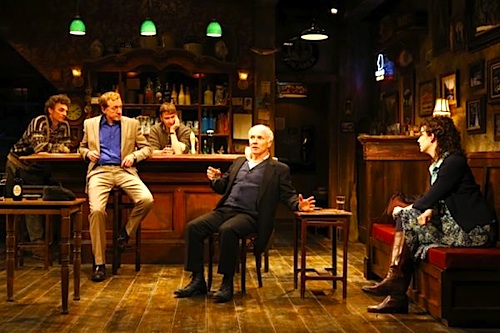
The Irish Rep Revives The Weir

By Joe Bendel. Is it the booze or is it the blarney? The two go together for the patrons of a remote Irish pub. However, their ghostly tall tales take an unexpectedly serious turn in the Irish Repertory Theatre’s revival of Conor McPherson’s The Weir, which officially opened last Thursday night in New York.

Brenden’s pub is a quiet, out-of-the-way spot, aside from the dreaded nights when busloads of German tourists descend on the barkeep like locusts. Jack, the pugnacious mechanic, and the morose mother’s boy Jim have come to spy on Finbar Mack, the local wheeler-dealer as he attempts to charm the village’s newest resident. Valerie is a woman and therefore of interest to everyone present.

The former Dubliner seems genuinely interested in the history of the area and the legendary fairy road that supposedly runs through Brenden’s public house, opening the door for a series of ghost stories. Initially they seem like campfire fare, but they have a profound effect on her. It seems she has her own deeply tragic story to tell that will echo and amplify the uncanny elements of their prior anecdotes.

McPherson is a great writer, with a flair for dialogue and a wonderfully sly approach to the telling of a tale. His mature, humanistic handling of supernatural themes comes as a welcome antidote to the adolescent angst of Twilight and the like. McPherson’s dramas, most certainly including the Olivier award winning The Weir, are also Irish to the bone, making them perfect vehicles for the Irish Rep. Indeed, The Weir boasts some wickedly droll “pub” humor. Yet, despite the heavy portents, it is shockingly endearing. While there are definitely spooky components, at its core The Weir speaks to the therapeutic benefits of getting pie-face hammered and talking malarkey.

From "The Weir."

The Weir is a true ensemble piece, but Jack the diehard Guinness man gets the big, climatic monologue and Dan Butler (probably best known as Bulldog on the Frasier show) absolutely kills with it. He masterfully expresses all of Jack’s bluster and his deepest regrets. In contrast, the hospitable Brenden might be the least showy role, because he is the only character who does not have his own personal yarn to spin (remember, it is a bartender’s job to listen). Still, he gets most of the funny bits, which Billy Carter makes the most of. He also develops some subtle-as-a-dew-drop chemistry with Tessa Klein’s Valerie.

A strong five-handed cast all around, John Keating and Sean Gormley add earthy color and character as Jim and Mack, respectively. Listening to their eerie camaraderie is a finely staged pleasure.  Director and Irish Rep co-founder Ciarán O’Reilly seamlessly guides the memorable production through McPherson’s subtle tonal shifts. Patrons should know coming in it runs straight through without an intermission, but ushers will remind you about a thousand times before it starts. Highly recommended, The Weir runs through July 7th as part of the Irish Repertory Theatre’s 25th anniversary season.

Posted on May 28th, 2013 at 12:29pm.